
When I was in elementary school, I had a German friend whose father worked for what I thought was called “The Good Institute.” Later in life, I learned that my great-grandfather had also been a “good” scholar, studying in Germany and going on to publish significant translations and criticism of whoever this good guy was. Now I’m old[er] and grey, I know the truth. My friend’s father wasn’t pursuing some obtuse notions of good and bad; he was working at an institution named for Johann Wolfgang von Goethe.
While my knowledge of Goethe is still (very) limited, for some reason he keeps being thrust into my consciousness these days. Full disclosure: I have not read The Sorrows of Young Werther or Wilhelm Meister’s Apprenticeship or any of Goethe’s other epic tomes. The Goethe texts I know intimately are ones set by Schubert, Mozart, Hugo Wolf, and so many other late 18th and 19th century composers. I love the adaptations of his works by Massenet and Gounod. And, like any good assimilated secular Jew with roots in Eastern Europe, I’ve been taught by my family to cultivate my Bildung, as Goethe demonstrates in his Bildungsromans.
I feel as though I’m speaking in a weird code at the moment. To clarify things a bit, Bildung is a type of humanistic education one acquires throughout their life. It refers not just to study, but to developing one’s own personhood. I first became familiar with the concept when reading Jeremy Eichler’s brilliant Time’s Echo, a book I truly recommend for those interested in twentieth century history/music.
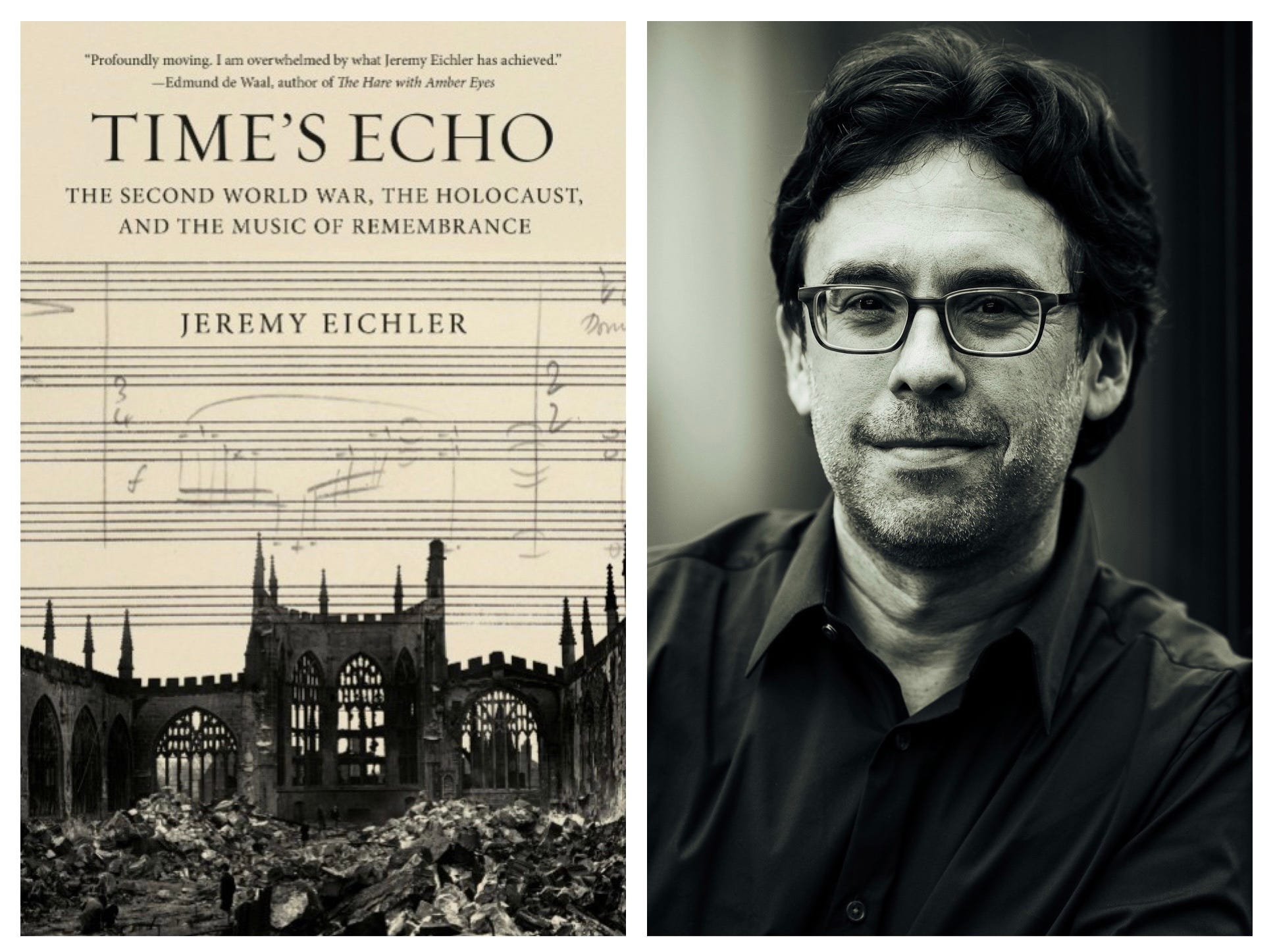
Eichler writes:
“In their journey from the ghettos to the urban middle class, many German-speaking Jews of central Europe pursued the Bildung ideal as a sort of surrogate religion, complete with a new set of prophets and sacred books. Some families changed their surnames to Schiller, in honour of the great German poet, and it was commonplace for young Jewish boys to be presented with sets of Goethe’s writing on their Bar Mitzvah, as if the knowledge contained within each volume might ever so slightly lighten the burdens of a persecuted past.”1
I’ve been exploring this notion a lot when writing about my research topic for my doctorate, Emmy Heim, as well as the many assimilated Jews in early twentieth century Europe who cultivated their Germanic education as a form of self-protection from antisemitism. The German-Jewish philosopher Hannah Arendt wrote,
“… the word assimilation received a “deep” philosophical meaning. You can hardly realize how serious we were about it. Assimilation did not mean the necessary adjustment to the country where we happened to be born and to the people whose language we happened to speak. We adjust in principle to everything and everybody.”2
Goethe and Schiller—who was ten years younger than Goethe—were the most important writers for Germans and Austrians at the turn of the twentieth century, in the same way that anglophones obsess over Shakespeare and Chaucer (or whoever else it may be). Unfortunately for us, these German poets are very difficult to adequately translate, leaving the non-Germanic world largely in the dark when it comes to Goethe and Schiller.
Those of us who’ve seen Amadeus know what a bad rap German has received for being an “ugly” language. (The horrors of the twentieth century certainly didn’t help.) Yet upon beginning my studies of German during my undergrad, I realized what a colourful, musical language German could be; its long and short vowels, plentiful consonants, and words strung together like long chains of pearls.
Adam Kirsch of The New Yorker points out in an article how Goethe’s life has been so closely examined by the German world that his lifetime is known as the Goethezeit, or the Age of Goethe. English speakers know very little about the life of Shakespeare, our Goethe (although I truly can’t wait to see Hamnet! Love love loved the book). Indeed Goethe was so influential in his time that the famously romantic suicide of Werther in his novel prompted a wave of copycats from those who believe the poet to be glorifying the practise. (Or as one of my lieder coaches put it in a masterclass on Schubert’s “Nachtstück,” “Death is a friend.”)
During a summer at the Franz-Schubert-Institut outside Vienna, my fellow singers and pianists and I spent bleary-eyed mornings listening to a lecturer elucidate the various phases of Goethe’s life, which are categorized by the women he was in love with during each phase. One morning was spent listening to a recording of the Institute’s founder discussing Goethe’s “Heidenröslein,” famously set by Schubert, and its formative use of the [a] vowel in the opening phrase—“Sah ein Knab’ ein Röslein stehn”—and its violent description of a rose’s loss of innocence.
(Not sure why the play button is in Russian but it works. The interview begins with a recording of Elly Ameling singing “Heidenröslein.”)
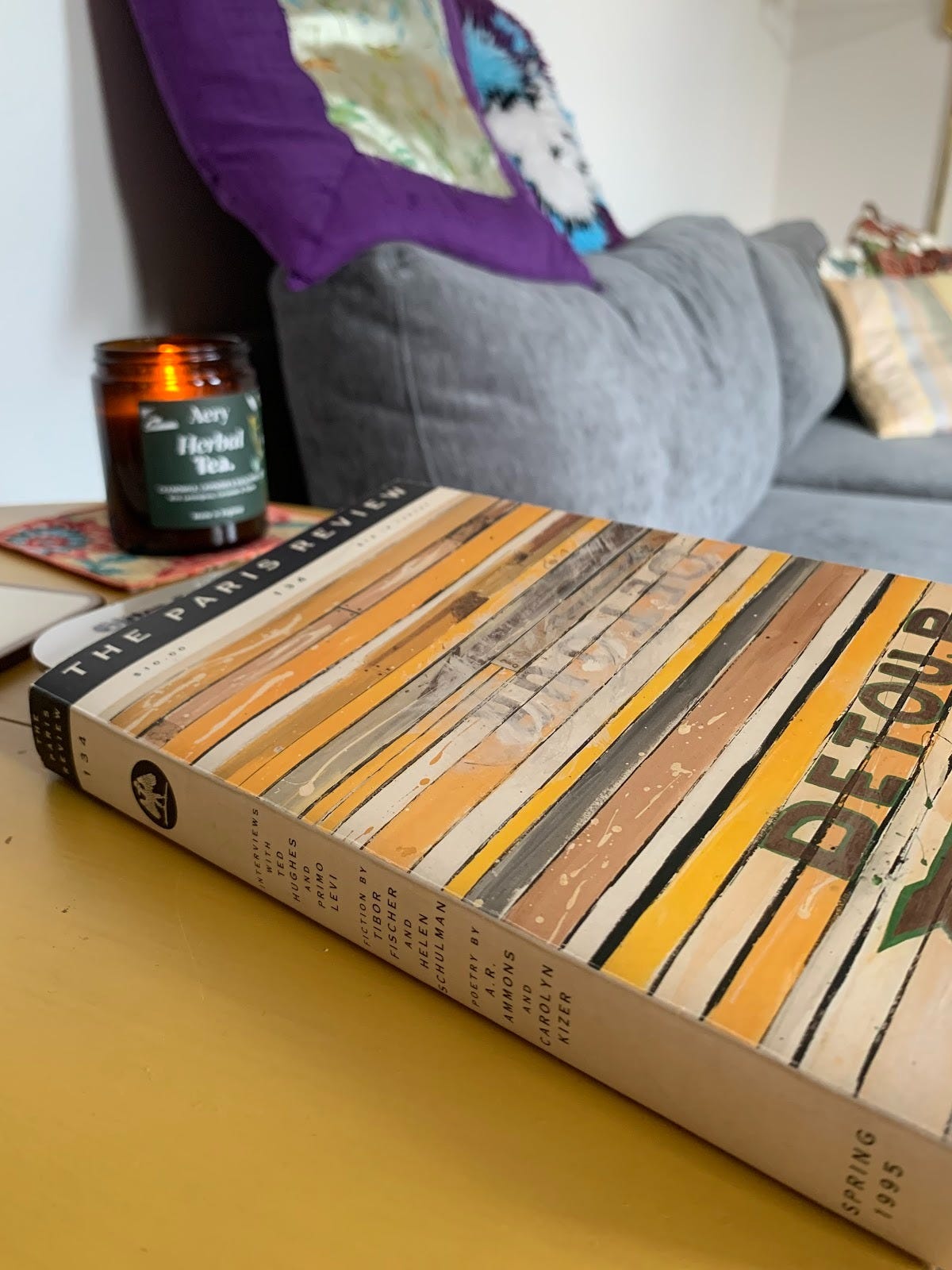
I was home in Toronto this week on a 24-hour audition trip and found a 1995 copy of The Paris Review at my parents’ house. I’m fantasizing that my late grandmother bought it in the ‘90s (she died when I was young and I love to look for connections to her). In it, Ted Hughes was interviewed about everything from his youth to his relationship with Sylvia Plath to his thoughts on writing and birds. He brings up Goethe on a number of occasions, including the funny fact that Goethe felt he couldn’t write a single word if someone else was in the house with him (this resonated with me on a particularly neurotic day when I felt I couldn’t warm-up for my audition with any of my family members within earshot). This week’s New Yorker also discussed Goethe, as a new (umpteenth) biography has just been published.
I have little to say at the end of the day, except that perhaps we non-German speakers would enjoy some time learning about and reading this titanic figure. On that note, here is a lovely art song setting of Goethe for your Saturday. I would love to know—have you read Goethe? What are your experiences with Goethe? Where should we all begin? Is it even worth reading him in translation? One of my supervisors said he first read my great-grandfather’s translation of Wilhelm Meister. Perhaps that’s where I should start…
“Nähe des Geliebten” - Nearness of the Beloved (Johann Wolfgang von Goethe, trans. Richard Wigmore)
Ich denke dein, wenn mir der Sonne Schimmer
I think of you when sunlight
Vom Meere strahlt;
glints from the sea;
Ich denke dein, wenn sich des Mondes Flimmer
I think of you when the moon’s glimmer
In Quellen malt.
is reflected in streams.
Ich sehe dich, wenn auf dem fernen Wege
I see you when, on distant roads,
Der Staub sich hebt;
dust rises;
In tiefer Nacht, wenn auf dem schmalen Stege
in the depths of night, when on the narrow bridge
Der Wandrer bebt.
the traveller trembles.
Ich höre dich, wenn dort mit dumpfem Rauschen
I hear you when, with a dull roar,
Die Welle steigt.
the waves surge up.
Im stillen Hain da geh ich oft zu lauschen,
I often go to listen in the tranquil grove
Wenn alles schweigt.
when all is silent.
Ich bin bei dir, du seist auch noch so ferne.
I am with you, however far away you are.
Du bist mir nah!
You are close to me!
Die Sonne sinkt, bald leuchten mir die Sterne.
The sun sets, soon the stars will shine for me.
O wärst du da!
Would that you were here!

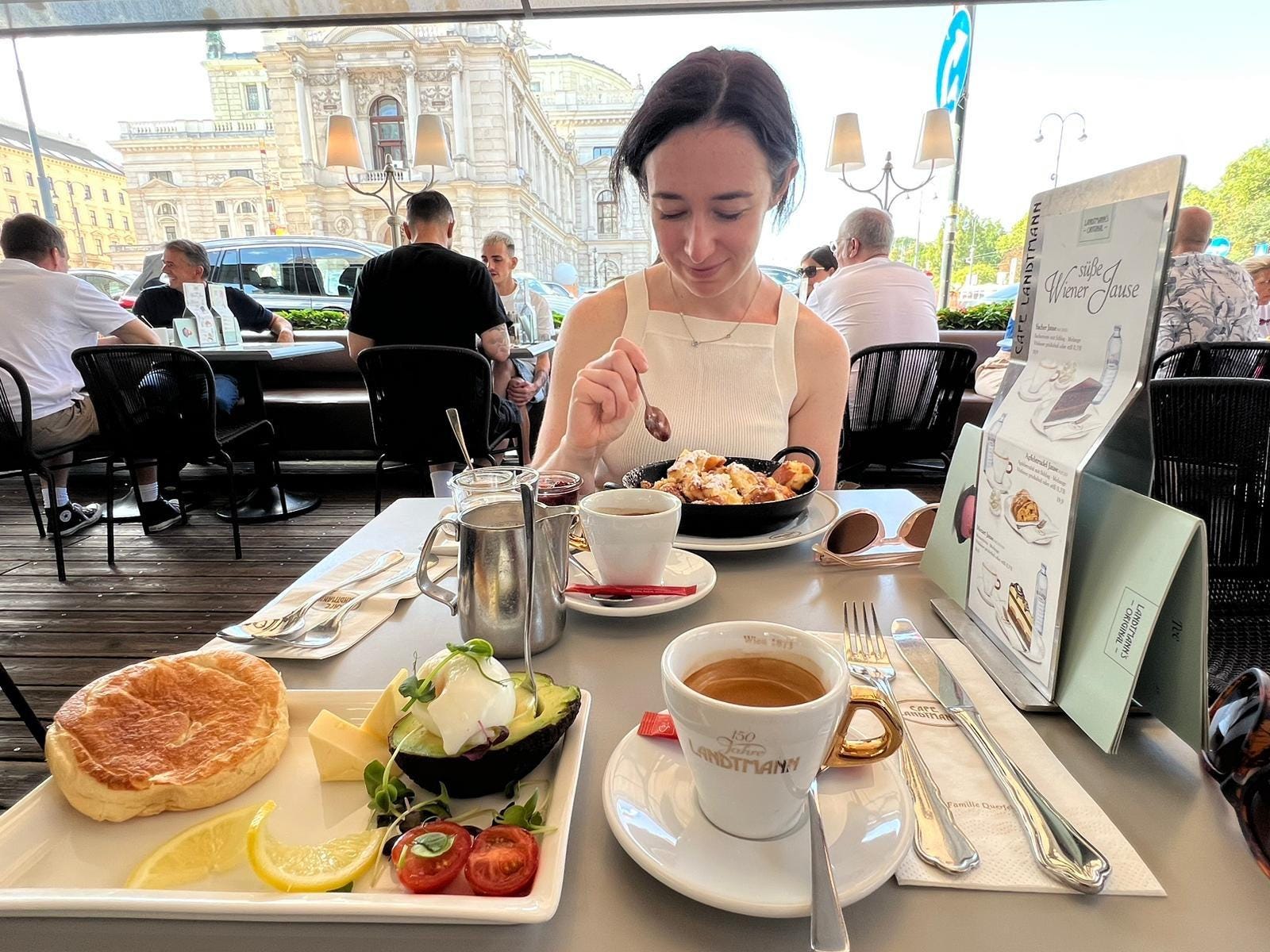
While a quick google search tells me that Goethe’s favourite foods included anchovy salad and other strange fresh German foods of the 18th century, I imagine he also might have shared a love of my favourite Austrian breakfast: Kaiserschmarrn. This recipe comes from Ottolenghi’s Comfort & is super up my alley (my bf even got me a Kaiserschmarrn cast iron skillet last year as a gift).
200g frozen cherries, defrosted
80g caster sugar
1 lemon, 4-5 wide strips of zest pared off with a peeler, then juiced, to get 4 tsp
40g raisins
45ml rum (or orange juice)
3 eggs, separated
90g plain flour
125ml whole milk
Fine sea salt
40g unsalted butter
20g flaked almonds, toasted (very easily omitted for nut free folks!)
150g soured cream
1 tbsp icing sugar
Put the cherries, half the caster sugar and the lemon zest in a small saucepan on a high heat, and cook for nine minutes, until the cherries burst and the liquid turns thick and syrupy. Take off the heat, stir in the lemon juice, transfer to a small bowl, then pick out and discard the zest and put the compote in the fridge until needed.
Put the rum or juice, and the raisins, in a small saucepan. Bring to a boil, then take off the heat and leave to cool.
Heat the oven to 200C (180C fan)/390F/gas 6. Put the egg whites and a tablespoon of caster sugar in the bowl of a stand mixer fitted with the whisk attachment and beat on high speed for two to three minutes, until they form stiff peaks. Transfer to a bowl and set aside, then clean the bowl and whisk attachment.
Put the egg yolks and a tablespoon of caster sugar in the bowl of the stand mixer and whisk on high speed for three minutes, until pale and fluffy. Turn down the speed to medium, add the flour and milk in two batches, and beat in until combined; scrape down the sides of the bowl between batches. Add a half-teaspoon of salt and a quarter of the egg whites to loosen the mixture, then gently fold in the remaining egg whites.
Put a 28cm nonstick ovenproof frying pan on a medium-high heat. Once hot, melt 30g butter in the pan and pour in the batter mix. Leave to cook for a minute, then scatter over the raisins, reserving any rum (or orange juice) for later. Transfer the pan to the oven and bake for 10 minutes, until risen and cooked through.
Remove and place on the hob on a medium-high heat. Using two wooden spoons, tear the pancake into roughly 5cm pieces, then move them to the edges of the pan. Put the remaining 10g butter and 20g caster sugar in the middle of the pan, cook for a minute, until the sugar has melted, then stir into the pieces of pancakeand take off the heat.
Transfer the pancakes to a serving plate, drizzle over the reserved rum (or orange juice), and spoon the cherry compote and soured cream into any gaps. Sprinkle the almonds on top, dust with the icing sugar and serve.
Jeremy Eichler in Time’s Echo: The Second World War, the Holocaust, and the Music of Remembrance (New York: Alfred A. Knopf., 2003), 8-9.
Hannah Arendt in “We Refugees,” Altogether Elsewhere: Writers on Exile, ed. Marc Robinson (Boston: Faber and Faber, 1995), 110-119.
No posts
Comments
Nothing yet. Say the first thing.
Sign in to join the conversation.