
How O Caledonia by Elspeth Barker landed on my reading list:
The cover grabbed my throat and refused to let go.
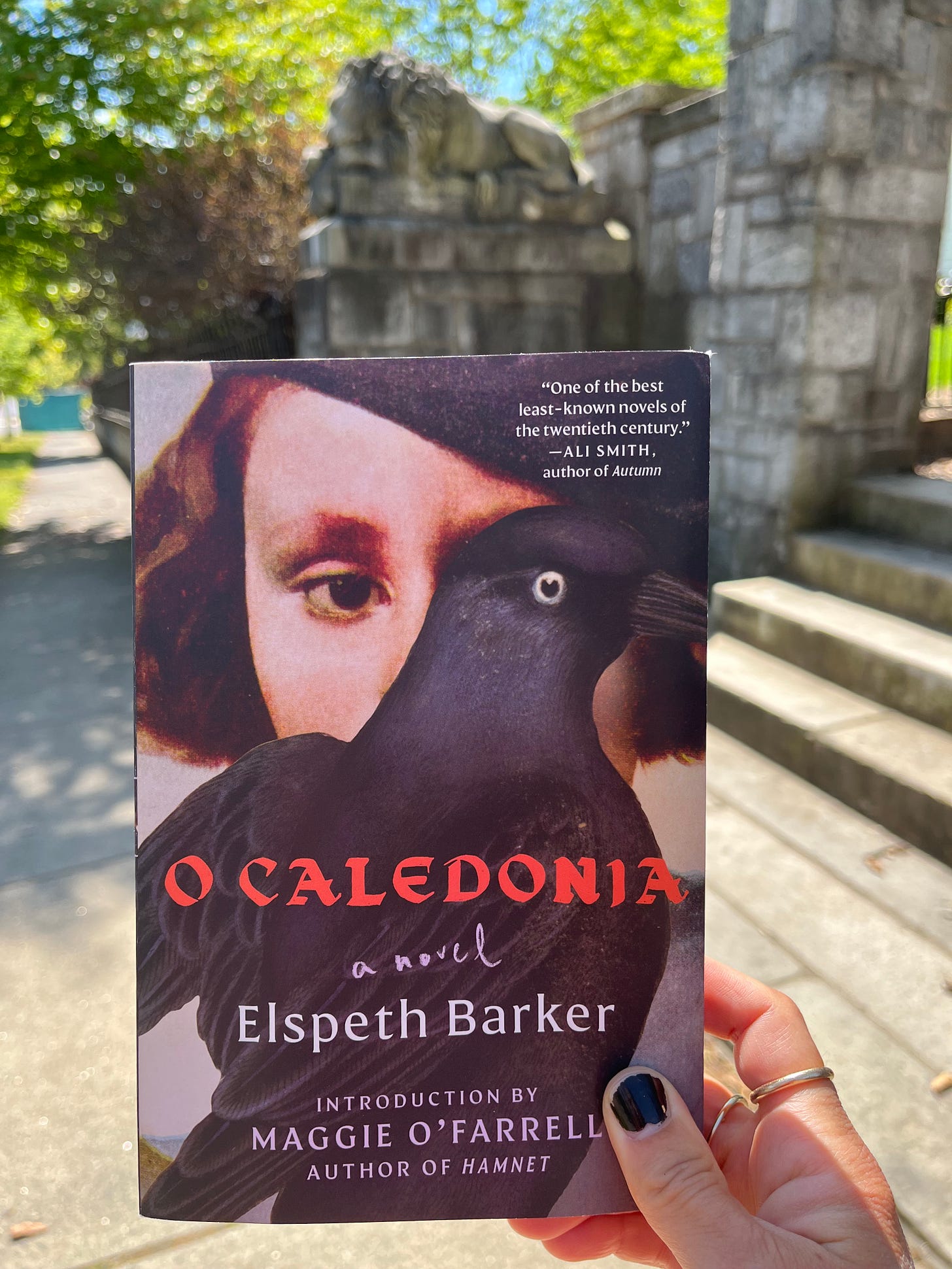
2. “One of the best least-known novels of the twentieth century” sounds like the kind of book I wish I’d known about ages ago.
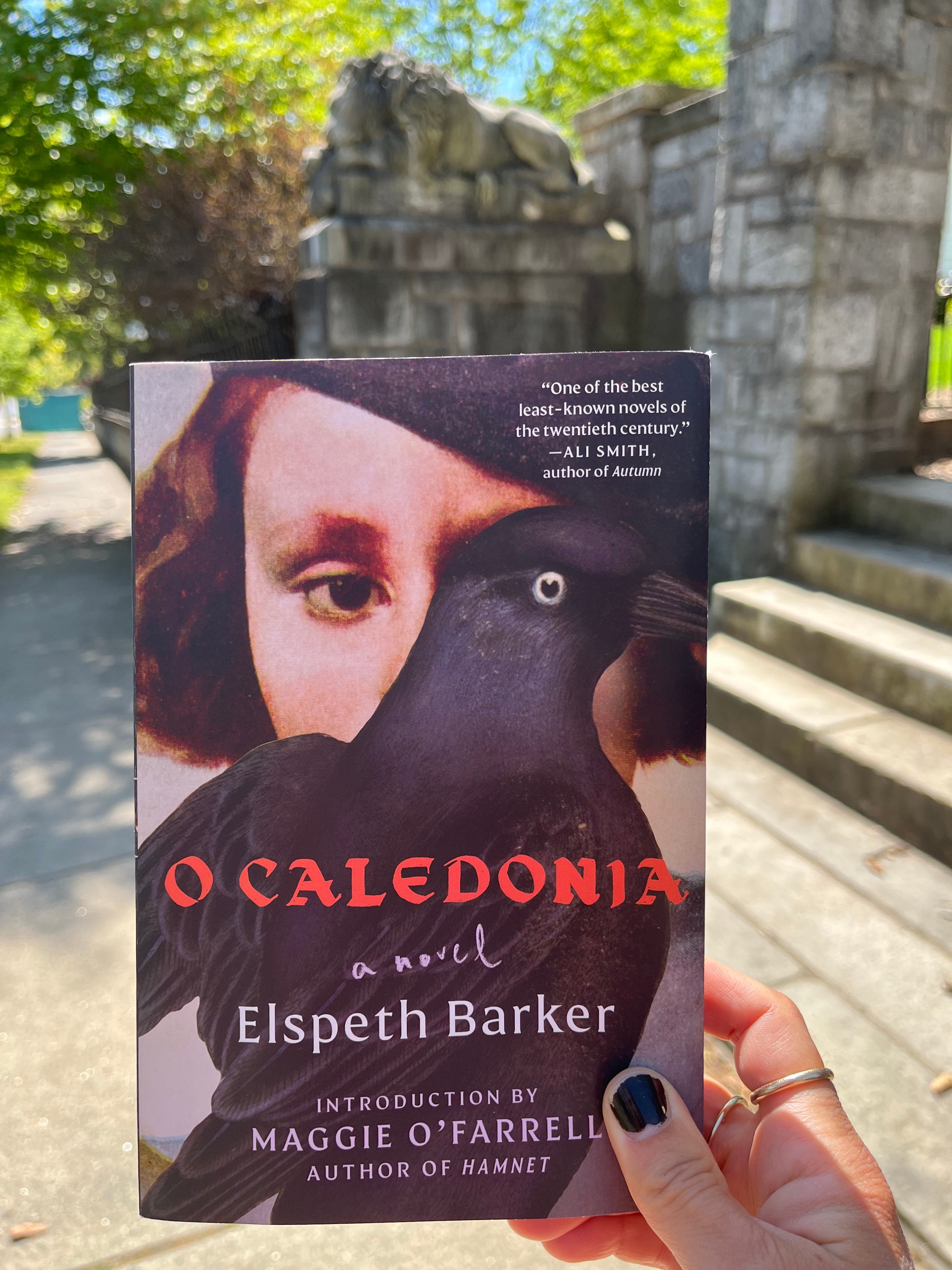
If We Have Always Lived in the Castle and The Gashlycrumb Tinies had a baby during WWII and raised it in a derelict castle in the Scottish Highlands, the result would be O Caledonia, easily my favorite novel read so far this year, and perhaps landing a spot on my top ten ever. It takes a lot for a novel to enrapture me in quite this way1, and this one sure did.
O Caledonia is one of those books that appears to be a character study but is actually a tightly plotted, if quiet, portrait of a peculiar, solitary girl named Janet growing up and dying at the ripe of age of sixteen.2 It’s a slim book, but not a quick one. The language approaches high art without getting snobbish about it. All the reviews I could find use the words “gothic,” “dark humor,” and “ironic.” I’ll add: moody.
And, oh, what a mood!
“Winter descended on the glen… Only the red earth of the hill tracks retained its color; the puddles looked like pools of blood.”
“But as the light ebbed away to a pang of sullen gold on the horizon she would turn back.”
“A splinter, a tiny shard of ice crystal, had entered her heart and lodged there.”
Janet is the eldest daughter of an eccentric, comfortable family. Grandpa’s a preacher with a fondness for exotic, talking birds; Nanny reads the children Hans Andersen and the Brothers Grimm each night in the nursery. Janet’s younger sisters are adorable and sweet or else too young to be of much interest. Janet’s one brother, Francis, is as odd as she—he is perhaps her only ally, though she does not view him as such; in a beautiful bit of projection, “Janet felt again that odd flicker of pity. How he loved his dog! How he loved his cacti and his slow-worm3! Did he love anything else? She thought not.” Like Francis, Janet loves her horse and her jackdaw more than she loves her family. She prefers books over sports, nature over parties, the mad over the sane.
Thanks for reading Sara-Rauch-haus ! This post is public so feel free to share it.
Girls like Janet are much more mainstream than they once were, but Janet’s era has no place but one of disdain4 for her bookish, day-dreamy, iconoclastic ways. She reads too much poetry and vomits every time she gets in a car. She’s prone to migraines and scattering books over every inch of her bedroom5. Janet is not one to blend in, or make herself fit—she’d rather go it alone. Surrounded as she is by family at home, and by other girls once she is shipped off to St. Uncumbra’s boarding school, she remains apart. She wants to shield herself from hurt, because hurt she is, by her parents’ indifference6 and the larger world’s judgement. When she is home at Auchnasaugh, she knows she belongs only there and yet, even there, she is reviled. Her father encourages her intelligence, but does nothing to prepare her for a world that will despise her for it; her mother, also a supporter of all that reading, deep down just wishes Janet would be a bit more girlish, a bit more confiding.7 Whatever Janet does, it is criticized, and this only increases her reclusive nature. “She believed that she moved on a higher plane, beyond spite, beyond compromise.” This belief does not spring from an inborn haughtiness; it is the result of a highly sensitive personality hardening itself off to a world that offers no safe haven.
We know from the start that Janet’s end will be a tragic one. Her short life—though not without its exquisite, thoughtful moments—follows suit, leading inexorably to its bloody end. This isn’t a murder mystery (unless you want it to be) and yet the foreknowledge of where the plot will finish never quite eases. The murder itself is vengeful, and as quick as it is inevitable. Only Janet’s jackdaw and sisters8 mourn her loss—and this we must remember from the opening pages, because it is not mentioned again.
I am old, and I am jaded, and I have read a lot of novels.
Don’t worry, I’m not giving anything away; by the end of the first page we know: “…Janet was found, oddly attired in her mother’s black lace evening dress, twisted and slumped in bloody, murderous death.”
And let’s be real—there remains plenty of judgment for the intelligent, aloof, sensitive women of today. We just wield it differently.
speckled with jackdaw poop, I might add.
As we know, they don’t her buried near them: “She had blighted their lives; let her not also blight their deaths.”
Why can’t you be smart and pretty? Every grandmother, aunt, and godmother wants to know.
"At last, in desolation, like a tiny kamikaze pilot, [the jackdaw] flew straight into the massive walls of Auchnasaugh and killed himself. Janet’s sisters found him, a bunch of waterlogged feathers in a puddle, and they buried him. They shed bitter tears for him and for Janet too, then, but they knew better than to mention it.”
Comments
Nothing yet. Say the first thing.
Sign in to join the conversation.