
How Great Expectations by Charles Dickens ended up on my reading list:
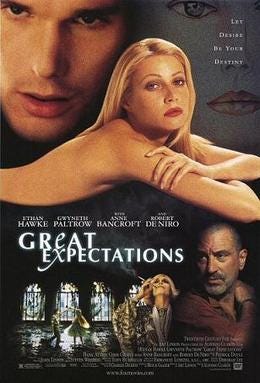
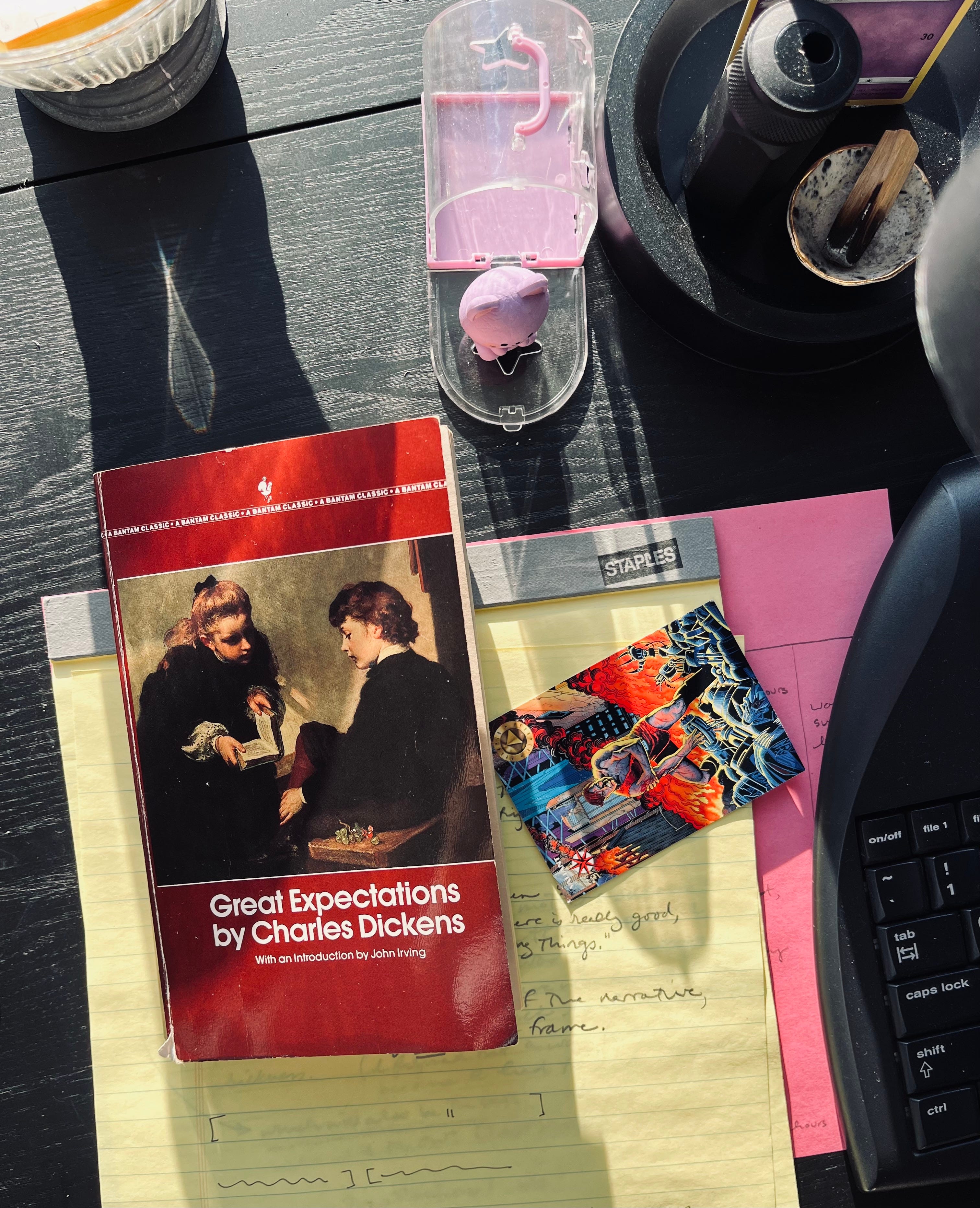
1998! 2. Found a mass market copy at my in-laws’ over this past Thanksgiving and thought, Well, I’ve been meaning to read this for a while.
At this point in my life, I consider myself pretty well-read, but I did not have a classical education1 and I was never officially a Literature major2, so there are some big gaps in my coverage of “the literary canon.”
Dickens is one such gap. It’s nearly impossible to be unfamiliar with Dickens’ work given its ongoing cultural prevalence3, and maybe this is why I’ve been remiss in actually reading Dickens’ books: I know the stories already.
Or so it seems.
But—as it turns out4—knowing the stories and reading the books themselves are two very different things. (Side note: there are a lot of “Why You Should Read the Classics” posts going around Substack right now and—while I agree, it’s worthwhile to read the classics—this is not that type of post. As my brother says, “I don’t like shoulding5 people.”) Great Expectations is fantastic—a novel to get lost (and found) in.
We begin in a churchyard, among gravestones. Pip, a young orphan, adopted by his much older sister and her blacksmith husband, is visiting his parents’ graves. Fate intervenes—as fate often does—and Pip is beset by an escaped convict, menacing and hungry. Pip is terrified of his older sister—she has “such a prevailing redness of skin that [he] sometimes used to wonder whether it was possible she washed herself with a nutmeg-grater instead of soap”; she is angry and abusive—but Pip is more terrified of the young man who “has a secret way pecooliar to himself of getting at a boy, and at his heart, and at his liver” that the convict threatens him with. Pip steals—not a little bit of food, but a whole bunch of holiday fare6—from his sister’s pantry to feed the escaped man. Pip spends much of Christmas in mortal terror of his sister discovering his thievery, but—again—fate intervenes. A sergeant and party of soldiers with muskets arrive seeking the blacksmith’s—Joe’s—help and Pip is party to the search team that eventually recaptures not one, but two escaped men. Back they go to the hulks.
“Pause you who read this, and think for a moment of the long chain of iron or gold, of thorns or flowers, that would never have bound you, but for the formation of the first link on one memorable day.”
Not long after this, Pip is invited, through the intervening of a nosy friend of his sister’s, to visit Miss Havisham’s home—Satis House—where he meets, and immediately falls for the beautiful, snobbish Estella, a young girl being raised by Miss Havisham to wreak havoc on the heart of any man who might love her.7 Pip’s encounters with Stella—his fresh understanding of the difference between his place as a soon-to apprentice blacksmith and Estella’s as pampered8 heiress of Satis House—alters his outlook on life in dramatic and complex ways.
Here’s the thing: Great Expectations is about a boy who feels like he doesn’t belong to the place he was born. I can relate. So, maybe, can you. What Pip learns over the course of the book is humility and empathy, but it takes him a while. He learns the hard way that, though it may be a miserable thing to be ashamed of home, it is a far worse thing to have no home at all.
I have a complex relationship with “home.” After spending many years attempting to run away, I landed not far from where I was born and raised. It’s not a bad place to be. Most days, I like it and am happy. I’ve been back here for twenty years now, and it’s weird: I still don’t think of it as home. The place I was raised isn’t home, and the place where I live now isn’t home. I’ve always been home, and I’ve never been home. So, where (or what) the hell is home? Home, I tend to believe, is a place of belonging that one must come to inside oneself, and it is not an easy coming to, especially if you are in the business of rejecting everything that feels like home, which I was, for a long time, and it isn’t easy for Pip, whose way of inhabiting the world struck pretty close to my heart. But, alas, one good thing about the ache and struggle of finding one’s place in the world is that it makes for a good story.
There’s a bit of the soap opera to Great Expectations: there’s a large cast of characters full of glorious quirks, lovingly described; there are strivers and warmints and grudges and intrigue galore; there is unrequited love; there are two weddings and a funeral (and a death that means more to Pip but yields no funeral); there is the learning of manners and the squandering of money; there is, ultimately, the realization that great expectations are both blessing and burden. The plot is full of glorious twists and turns, and unexpected connections; the novel is at once silly and smart and subtle and so emotionally astute9 that I found myself flustered by how close to the bone the story cut.
“We don’t see things as they are, we see them as we are.”10
“‘You made your own snares. I never made them.’”11
Pip wants so badly to believe what he believes about his fall into good fortune. His desire for Estella, his embarassment over his “common” life, his youthful pride and folly, make him blind to reality until he can be blind no more. That he does, in the end (as in the beginning), choose kindness and humility, comes with much relief.
The forces that guide our lives are so very often outside of our control, our knowing, our understanding—just there—if only we could see. But Pip can’t, and neither can we. Like Pip, we must stumble toward grace and hope we get there, eventually.
Thanks for reading Sara-Rauch-haus ! This post is public so feel free to share it.
Nor would I have wanted one! I was too rebellious as a teenager to be much interested in anything classic: my understanding of how badass the classics are came later.
In keeping with my stubborn refusal to do most anything expected of me, much of my formal education was what I might call Literature Adjacent.
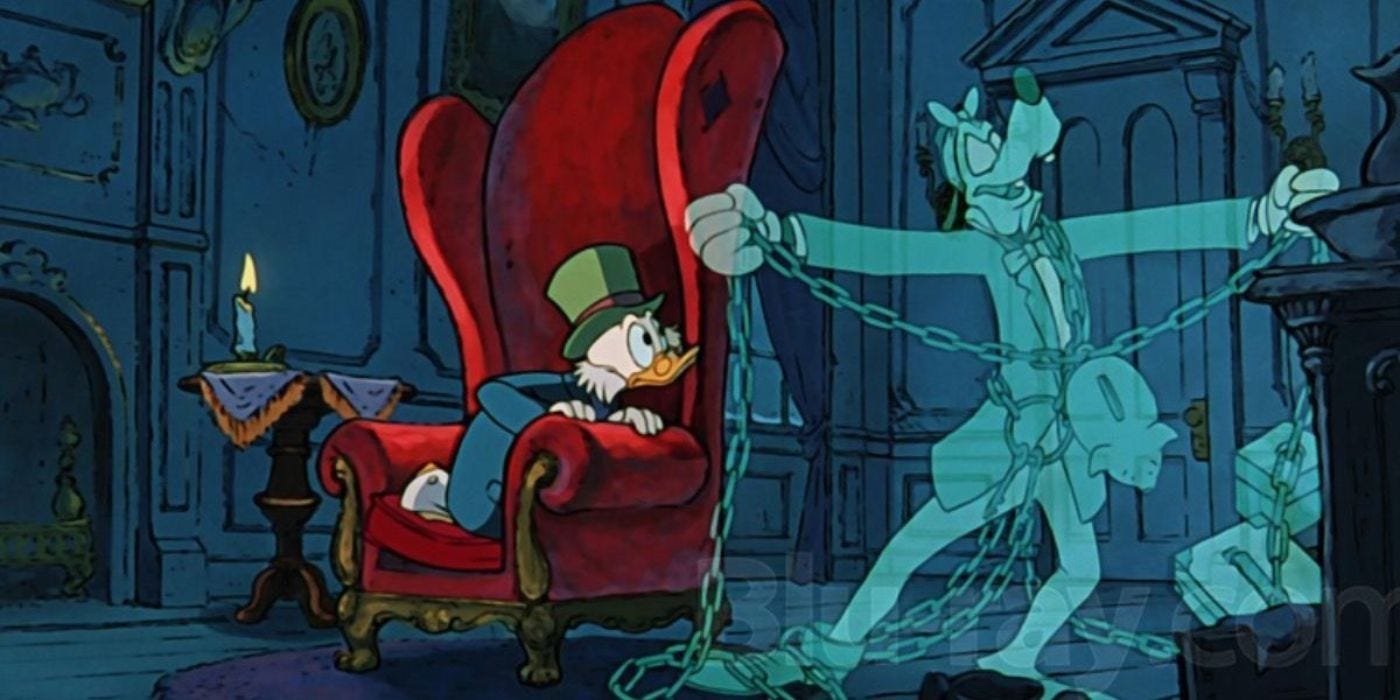
tongue in cheek, in case it’s not immediately obvious
family jury is still out over whether “shoulding” is—or should be—a word
And an iron file from Joe’s forge, the theft of which fills Pip with guilt rather than terror.
And so many do, but none as purely and enduringly as Pip.
Materially only, it seems
The beauty of Dickens is, I’m learning, his ability to make a reader laugh and cry, all the while skewering society and its endless ills.
Comments
Nothing yet. Say the first thing.
Sign in to join the conversation.