
Well, it happened — I was elected (drafted?) to city council. But I’ll tell that story another time.
At my first meeting, a member of the public voiced a concern. A neighboring town had recently called for help with a grass fire. The same day, another town called for help clearing the road for an emergency helicopter-ambulance landing. Our town’s fire department didn’t respond to either. She wanted to know if the fire department would come to her house if she needed help.
A week later, I told this story at a chic dinner in Sonoma, California. The guests mostly worked in tech or venture capital. One person nodded along as I described my first city council meeting. When I said that a constituent had asked whether the fire department would show up for her, he interjected — as people do when they’re speeding toward a known conclusion — of course they would.
And I said, just as certain — actually, they might not.
That was the same answer the mayor gave at the meeting. The mayor was saltier — he told the woman to join the fire department if she wants to guarantee that her house will be saved. But the spirit was the same.
Fire departments in rural Iowa are volunteer-led and volunteer-staffed. With every call for help, individuals weigh someone else’s emergency against their own needs. Can they afford to call out of work for a few hours, get out of bed between shifts, or abandon a cow in the middle of calving to respond to the fire? Is the fire endangering people, property, or empty pasture? Will high winds whip the fire onward, or is the grass wet enough to dampen it?
Volunteer fire departments always respond to house fires. And in this season of unusual heat and high winds, I’ve heard plenty of sirens from pickups heading toward field fires.
But there are no guarantees.
When I gestured with my glass of sauvignon blanc and proclaimed that the fire department might not respond, my venture capitalist friend said, wow, you live in the real America.

You live in the real America. I doubt he even remembers saying it.
He lives in the America of Waymos and Claude Code and sophisticated financial models. He lives in the America of on-demand delivery and concierge healthcare and retirement plans. I live in that America too, when I leave Iowa and slip into my coastal elite disguise. I wear cashmere so well that strangers seem shocked when I tell them where I really live.
Then I return to Iowa. The miles I drive from the Des Moines airport to my hometown feel like severing one life to reenter another. I get one last Starbucks, stop at one last stoplight, and then drive ever deeper into the real America as my coffee turns cold. The green fields welcome me home, but the families who used to farm them have mostly disappeared.
Here, my city council debates whether we can spend $80 on a scanner so that the city clerk can digitize some town records. After the meeting, I walk home in the fading light, check my work messages, and casually Slack about a million-dollar project. A thumbs-up emoji is enough to keep things moving. I cross the railroad tracks, walk past the abandoned gas station, scrape gravel out of my tennis shoes, and pour a glass of California red.
And I do it again the next day, the next week, splitting my personality and my body and my heart in ways that I am increasingly ill-equipped to synthesize.
I haven’t written a Substack in months. Much of it, of course, is grief over losing my dad. But grief isn’t the only reason. In previous blocked periods, I felt like my well had run dry. This time, it’s not a drought. It’s a pent-up flood of conflicting feelings and a dam about to break.
Everything feels like it’s too much, too fast, too overwhelming, as the worlds that are core to my identity pull ever further from each other.
The real America.
What is the real America? The America I visit in San Francisco, moving at light speed toward an uncertain future? Or the America I inhabit in Iowa, where the future feels equally uncertain — but forward movement is constrained by declining populations and limited opportunities?
I fear I cannot possibly capture this moment, in both my lives, and explain what it means.
I fear there’s no language for the gap between these places. The English of agentification and IPOs and prix fixe menus and sparkling or still? is not the English of volunteer firefighters and farm auctions and soup suppers and hey did you know the sewer lagoon isn’t up to code? And the English for the space between them — for this torn-apart bridge, or for a bridge that was never built — doesn’t exist.
In the real America, the fire department spends as much time setting fires as they do extinguishing them.
Do I have the language to show you this, at least?
The fire department burns overgrown fields and abandoned houses as one of their main fundraisers. Landowners pay for controlled burns on CRP land (the Conservation Reserve Program — another bit of English that doesn’t translate, since the acronym covers decades of public policy related to paying landowners not to farm). Especially if the land hasn’t been mowed for hay recently, trees spring up everywhere; prairie becomes forest when there are no buffalo left to eat the saplings. And the giant anthills on these unfarmed fields are unbelievable in their size and number. A controlled burn offers to renew the soil.
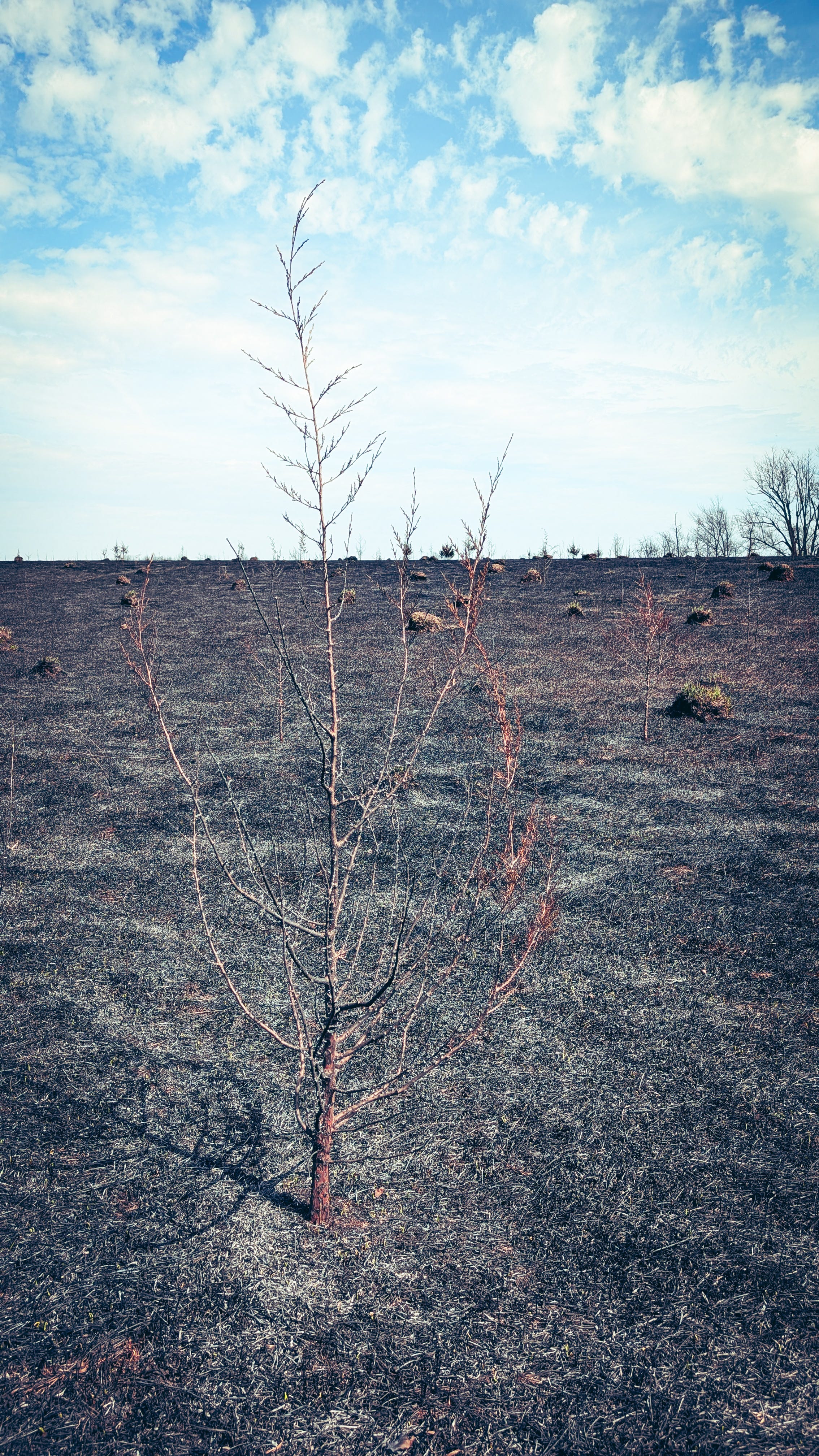
The fire department burned a field near my mom’s house a few weeks ago. Charred earth made neat edges near the fences; burned grass flattened around dead cedars. We thought the fire was out. But when the winds picked up the next day, something reignited. The renewed fire raced across a neighboring field — one that wasn’t supposed to burn — until volunteers came to put it out again.
The real America is shifting under our feet. Old sparks reignite to destroy things I never expected to see burn. Birthright citizenship was relitigated at the Supreme Court, nearly a hundred and sixty years after the 14th Amendment and a hundred and thirty years after Wong Kim Ark seemed to settle it. We’ve abandoned traditional allies and proven ourselves to be erratic and untrustworthy. We are cutting taxes and spending at record deficits and getting into crazy wars (“conflicts”, if you need language to abrogate Congress’s sole power to declare war) as nearly every indicator of economic and educational success plummets.
I remember the woman who wanted a guarantee that the fire department would come if she called.
I remember my venture capitalist friend saying you live in the real America after hearing they might not.
The American experiment has always claimed to be about progress. But it is also about escape. In a deeply individualistic society, most dreams — of striking it rich in a gold rush, of claiming a plot of land or a room of one’s own, of building a business or a college or a cult — are both a fantasy of progress, and a hope of escaping the downsides of a society that makes such dreams possible in the first place.
In my tech life, there was always this sense that technology will solve everything. More, I think there was a sense that money will solve everything. People and communities built their lives around some “guarantee” of inevitable economic growth. Implicit in all our choices was an assumption that if we worked harder, made more, saved more, kept more, these upper-middle-class enclaves would be insulated from the worst of the real America.
It’s almost as if we knew all along what the real America is: precarious, always on the verge, always battling old fires and nurturing new sparks, always burning, always remaking itself, always in flux.
To the woman who wondered if the fire department would come for her: I can’t guarantee we will save her house. I frankly can’t even guarantee that we won’t accidentally burn it ourselves.
But that’s true everywhere now. It’s true even in communities so prosperous that they think they are safe.
My community thought it was safe in the 1970s — safe in a way of life, safe in industries that seemed vital to feeding the country. We were safe until an Iran conflict + spiking oil prices + pushback against the civil rights movement + economic policies favoring big business over everyone else united to burn everything down.
If there is any guarantee, it’s this: we’ve been here before. We’ll be here again.
I’ll be here again.
Best,
Sara
p.s. Now that I’m feeling more like myself instead of a little grief goblin, I will post regularly again. Although what “feeling more like myself” means in 2026 is anyone’s guess. But I’ve missed you and I’m very much looking forward to being back.
p.p.s. If you haven’t subscribed yet, please do — it’s a free and easy way to support my work.
p.p.p.s. If you are a paid subscriber and feel like you have been ill-treated by my absence (unless you…enjoyed my absence?), please drop me a note at dearsara@sararamsey.com and I will refund your subscription, no questions asked.
p.p.p.p.s. If you missed my post about losing my dad, you can read it here.
Ozymandias in reverse
·
May 20, 2025
Closing a dead man's eyes is not as easy as the movies made me believe. I thought it would be a single swipe, one and done, like passing a squeegee over a windowpane.
No posts
Comments
Nothing yet. Say the first thing.
Sign in to join the conversation.