
As a reminder, I sometimes intersperse shorter observational posts with my longer essays about rural Iowa. The structure is based on a writing exercise from memoirist Dani Shapiro, who makes daily notes of what she did/saw/heard in order to more deeply observe the small moments.
Here’s what I did, saw, and heard in southern Iowa during America’s 250th birthday.
I bought items from two-thirds of the vendors at the first annual Fourth of July market. There were six vendors, so this is not as impressive or expensive as it sounds.
In mid-June, I saw a Facebook post asking if anyone wanted to plan some local Fourth of July festivities. Two women got together and set up an early-morning fun run, a market, and a parade in the span of a couple of weeks.
I wasn’t involved in the planning, but I wanted to support their efforts. The market consisted of a few tables in the courthouse parking lot. Two competing tables sold baked goods. One couple had fresh eggs for $2/dozen. A teenaged boy offered his 3D-printed vases and flower pots. And two little girls sold glitter hair gel.
I bought cinnamon rolls and banana bread even though I’m gluten free. I will make a frittata this week to use up the eggs I didn’t need. I skipped the 3D-printed vases because my aesthetic is too bougie, and I still feel guilty. I told the girls that the glitter hair gel looked great on them but that I was too old for it.
They told me, brightly, “Even old people can wear glitter hair gel!” That’s true. That’s also not the sales pitch I wanted to hear.
The vendor at the last table sold quirky yard art made from vintage glass and ceramic plates, cups, and bowls. They assured me that the glue will survive up to 400 degrees, at which point I will have bigger problems than monitoring the status of my yard art.
I am not someone who has ever wanted yard art, but I am leaning into the vibe here. They had a bird bath I couldn’t resist. And their profits go to a local food bank, so I happily forked over my cash.
I talked to the woman who organized the market. She is a recent transplant from Des Moines, younger than me and determined to get involved. She said sixty people had come out for the morning run — a great turnout, especially under the Midwest heat dome. She seemed to think the market was pretty good. She is already thinking of what to change for next year.
It’s easy for my cynical side to roll my eyes. I went to the Des Moines Arts Festival last weekend, which attracts 250 artists from all over the country. Many of them can sell their (gorgeous, inspiring) artworks for $1500+. I want all that art for my home, and I want all that economic growth for my hometown.
This little vendor market can’t possibly grow into anything like that.
And yet…for all our disadvantages, one key advantage is that you can do anything here.
The organizers didn’t need permits or endless planning meetings. They created what they wanted to create and invited everyone else along. Many people love early-morning runs, or buying local goods, or watching a parade, or being in one; if someone plans any of it, other people will show up. And I’m sure the sheriff’s office was happy to shut the roads for a few minutes to help them out.
Sometimes you can just stumble into doing something that makes your community a little better. Even in a heat dome. Even if you’re seen as an old person by some glitter hair gel purveyors. Even on America’s 250th birthday — a party that feels like eating the last stale bit of cake as the lights are flickering out.
Four Amish buggies full of kids rolling along the shoulder of a rural highway; an old Corvette speeding past them.
It was 91 degrees Fahrenheit, with a heat index of 110 and a surprisingly strong wind. The kids looked wilted and windblown. The boomer in the Corvette probably wasn’t faring much better.
The past and future commingle here. But what is past and what is future? Community, with its community-enforced rules? Individualism, with its individual risks and rewards? The next generation, wearing clothes from two centuries ago? The previous generation, still chasing speed as their bodies slow down?
Nothing here is as binary as it seems.
Is there a path for us — collectively and individually — to filter out the noise that separates us? What will we choose to change as we stumble forward into the next 250 years?
Have you gotten the town straightened out yet? — a constituent, at the soda fountain.
No one says constituent here, but I say it to make myself giggle. I’ve known this man my whole life. He went to high school with my dad. My dad is now buried next to the man’s parents. But since I’m on city council, I technically represent him. He likes to rib me for my efforts.
When he asked this question, he was volunteering at the soda fountain. It’s only open on Saturday nights. The staff are all volunteers. All payments are made in cash, and all cash goes toward keeping the building upright. This takes more money than can be raised by selling $4 malts. They had to pump a lot of water out of the basement this spring, and they’re constantly dealing with bricks falling out of the south wall. Since the soda fountain anchors one end of a block of similarly-decrepit old brick buildings, it may take several other buildings with it when it finally collapses.
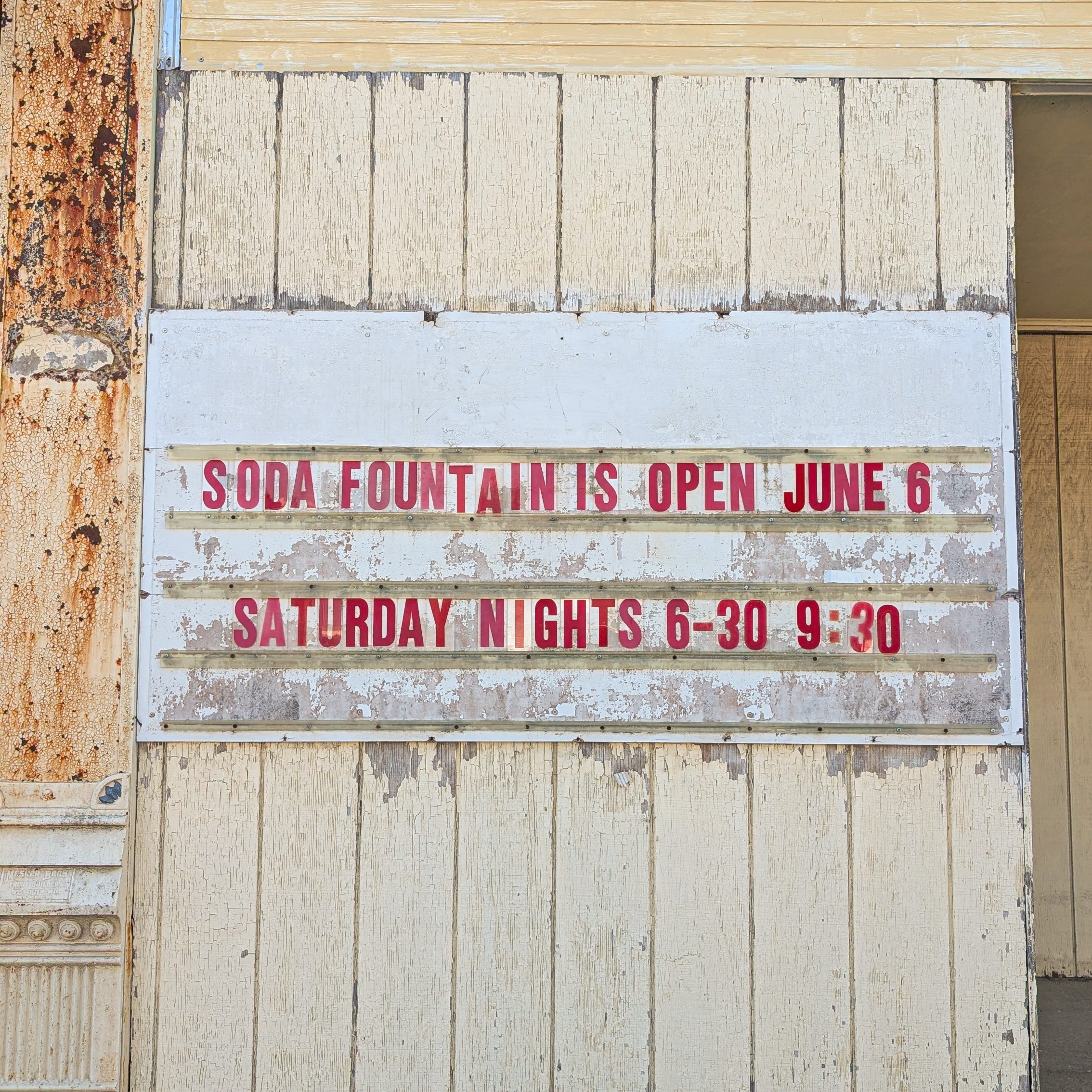
But standing in the soda fountain, it’s easy to forget all that.
Better to marvel that it’s there at all.
When I was a kid, the soda fountain was still operated as a “for-profit” (profit debatable) business by a man named Milford. He was well past retirement age, but he opened at six a.m. to sell coffee to farmers. Then he would doze in a chair in the front window all day in case another customer showed up.
My grandparents’ store was down the street. They would send my brother and me with dollar bills to sit on the red vinyl stools and ask Milford to make us shakes or malts, or Coke floats, or lemon Cokes or chocolate Cokes, or phosphates, or any number of other fountain treats that have disappeared over the last century. The #protip was to avoid the ice cream cones, since they usually went stale before Milford could sell them all.
After Milford died, the building sat empty. Eventually the contents were sold. But a group of volunteers raised enough money to buy the building. They tracked down the original soda fountain and bought it, too. And now the town can enjoy ice cream again one night a week.
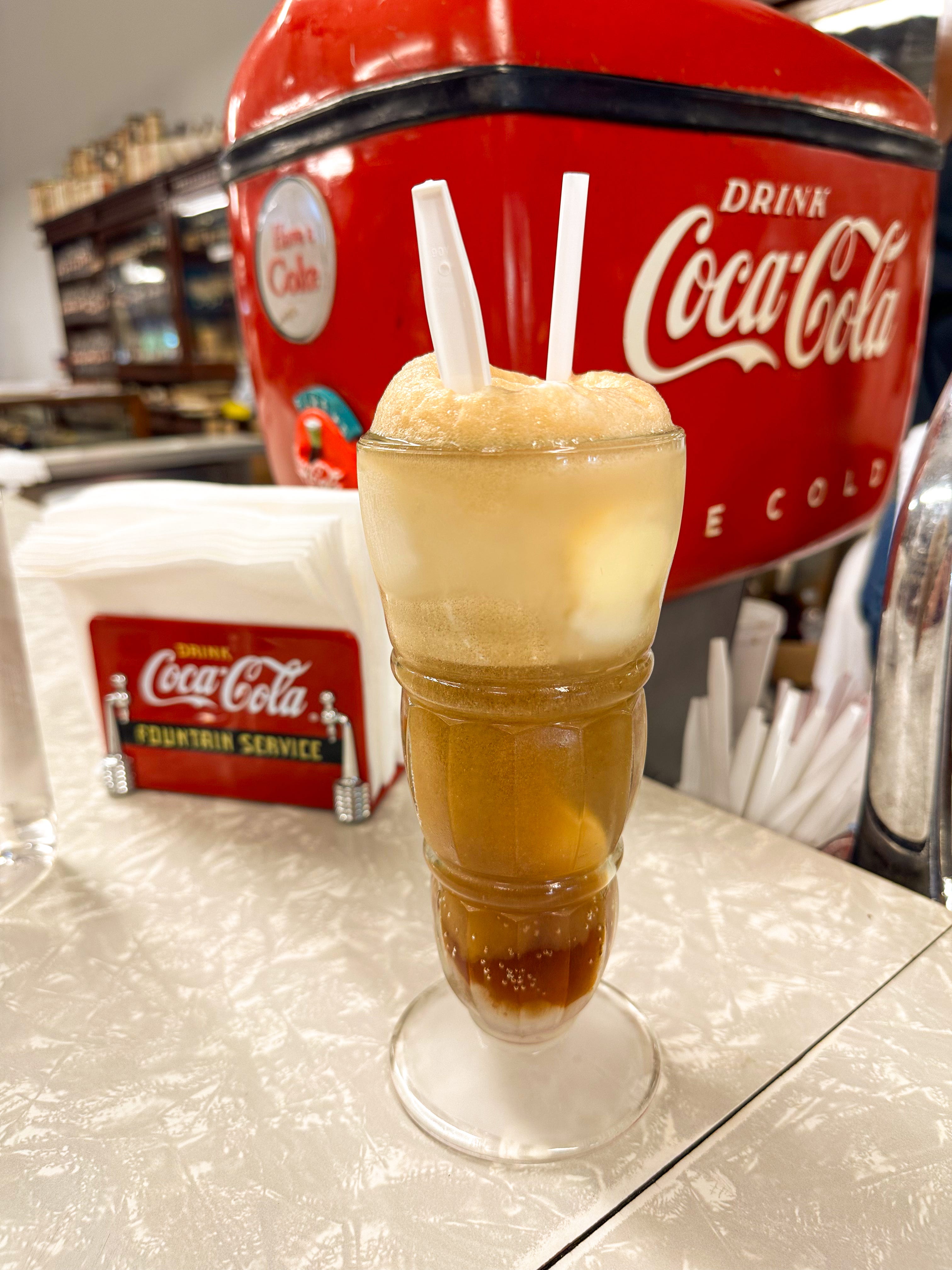
My constituent chatted with me while another volunteer (the nurse who gave me a flu shot this year, to be precise) made my vanilla shake. We started talking about the cemetery. It comes up at almost every city council meeting — whether it’s being mowed often enough, how the mowers chipped someone’s tombstone, if the city council members should all go out and string trim the cemetery in our spare time (?!).
“Seems we care more about making things look good for the dead than the living,” my constituent said.
Isn’t that the truth? It’s the last gift we can give them: keeping their graves clean, bringing flowers on Memorial Day, tending to the ancestors who came before us.
Our brains do the same after a death: tidying up all the little neural pathways we no longer need, snipping out bits of memory, allowing other memories to grow like weeds. Making some moments into monuments, letting others return to dust. Turning the dead into heroes, or devils, or complicated ghosts who haunt us.
Grass is growing over my dad’s grave now, fourteen months after his death. Some days, he’s a hero. Some days, he’s a complicated ghost. But on all days, my brain and my emotions continue to evolve around him — even though he is no longer here to contribute to the conversation.
I don’t actually care as much as my neighbors do about how the cemetery looks. I stay quiet when the idea comes up to have city council members whack weeds, knowing it will look like laziness if I explicitly opt out of tending to the cemetery. But I’m trying to avoid that particular civic duty.
In 250 years, my town will have stumbled into some other future — or none at all. Someone will mow my grave, or not.
In the meantime, there is work to do for the living. And on days when I don’t feel up to that, I have plenty of weeds in my memory to whack at.
Cheers,
Sara
p.s. Thank you so much for reading! If you haven’t subscribed yet, please do — it’s a free and easy way to support my work. I’m grateful you’re here!
If you want to support my work more deeply, please consider upgrading your subscription. Your $5 per month will likely end up at the soda fountain. I think more clearly while eating milkshakes, so your subscription will support both my essays and the rural economy. Thank you!
And finally, if you’ve already subscribed, please share with a friend. I would love to chat with more people who are interested in exploring the spaces between rural and urban life.
p.p.s. If you want to read more, I wrote about my dad’s creative acquisition of unwanted yogurt + an Amish-run discount grocery store that thrives out in the middle of nowhere. It’s one of my favorite archive posts. Read it here:
p.p.p.s. If you missed last week’s post, I wrote about the strange economics of living where it often makes sense to abandon a house instead of selling it.
No posts
Comments
Nothing yet. Say the first thing.
Sign in to join the conversation.