
TLDR:
I build with AI every day and I'm starting to worry about what daily AI use is doing to how we think.
Someone asked Claude what has changed the world for the worst but us humans haven’t realized. The answer was “the collapse of unstructured time”.
Boredom is not wasted time, it's where ideas form.
When we reach for a chatbot the moment a question appears, we skip the part of the brain that does the actual creative work.
Recent research is starting to confirm this. This article is not about quitting AI. It's about noticing when you're outsourcing your thinking, and a few small things I do to protect mine.
We just hit 4,600 subscribers! 🎉 Thank you all for the incredible support, engagement, and encouragement. I’m grateful to have such an amazing community.
For those who arrived recently: I’m Sara Nóbrega, an AI Engineer with background in physics and astrophysics.
I love cutting through the noise and the hype and write about things that, in my opinion, should be useful for everyone building with AI. Stay tuned!
🙌 Learn AI is a reader-supported publication. Paid members get my Monthly AI Engineering Brief, where I break down what you should focus on this month, what you can ignore and what I’d learn/build next.
I am an AI Engineer. I build with these tools every day.
I am also the person writing this article, which is a critical take on how we are using them. That contradiction is the point.
I’m not here to tell you AI is melting your brain.
I don’t think it is per se, but frankly, no one knows yet.
The studies that will tell us what daily LLM use does to human cognition over ten years simply do not exist.
We’re the test group.
What I want to do is name something I keep noticing in myself, in people I mentor, and in the way builders talk about their work.
We are losing something in the rush to get an instant answer, and I think it’s worth a pause.
The screenshot that pushed me to write this argues that the real change in the modern world is the collapse of unstructured time:
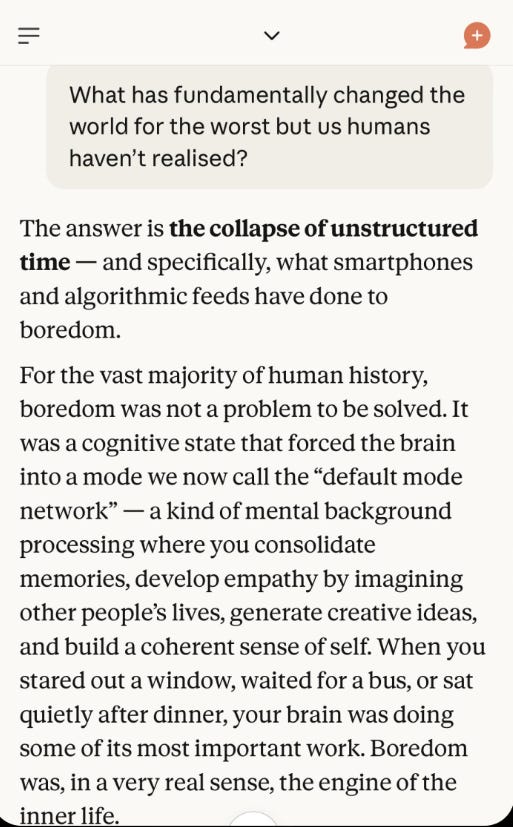
This one hit me hard. I had been thinking about this for quite a while.
The fact that we never sit with a blank moment anymore. And how AI is boosting this problem.
Let’s talk about this important theme here in this article and explore what can you do about it!
Save this and spend 10 minutes today noticing how often you reach for a chatbot before you’ve finished forming the question.
Send it to any builder, founder, or friend who feels like their thinking has gotten a little flatter since AI became their default.
Here is what I keep catching myself doing.
A question pops into my head. Before I’ve even finished thinking it through, my fingers are typing it into Claude.
The answer arrives in three seconds. I read it. I move on. The question is “answered.”
But what actually happened in those three seconds? Almost nothing in my own head.
I didn’t sit with the question.
I didn’t notice what I already knew about it. I didn’t connect it to anything else I’ve been thinking about. I just got served the result.
When I look at this with Google as a comparison, the difference is sharp.
Google was slower.
You typed a query, you got ten blue links, you opened a few, you read different perspectives, you noticed when two sources contradicted each other.
The friction was the feature. It made you do work. With AI, the friction is gone, and so is the work.
The thing that worries me is that we are starting to not trust our own thinking, because we’ve stopped doing it.
There’s a part of the brain neuroscientists call the Default Mode Network (DMN).
It’s the system that switches on when you’re not focused on a task.
👉Showering. Walking. Staring out a window on a bus. Sitting quietly after dinner.
The research on this is reasonably clear.
The DMN is heavily involved in creative thinking, memory consolidation, future planning, and the kind of loose mental association where new ideas form.
In one study at the University of Utah, researchers used direct brain stimulation to disrupt the default mode network during creative tasks, and the number of creative responses dropped.
Other work has linked higher default mode network connectivity to higher performance on divergent thinking tests.
💡Translation: boredom is not wasted time. Boredom is the brain doing work you can’t see.
If you’ve ever had an idea hit you in the shower, that’s the default mode network.
If you’ve ever solved a problem the morning after sleeping on it, same network.
If your best engineering ideas tend to arrive when you’re at the gym, walking the dog, or zoning out on a train, you already know this is true.
You don’t need a neuroscientist to confirm it.
My best ideas show up exactly there. Walking. Stretching. The shower. Never when I’m staring at a chatbot.
So what happens when we fill every unstructured moment with an instant answer?
We close down the default mode network.
We replace the place where ideas form with the place where ideas get delivered.
That trade looks small in any individual moment. But it compounds.
Across a year of doing it constantly, I don’t think it’s small at all.
You might be thinking: fine, fewer creative ideas. So what.
For builders, data scientists, and engineers, here is the part that should matter.
👉A 2025 study by Michael Gerlich found a significant negative correlation between frequent generative AI use and critical thinking ability, mediated by what researchers call cognitive offloading.
👉A separate study from Carnegie Mellon and Microsoft Research came to a similar conclusion: heavy reliance on AI hinders the brain’s capacity for critical thinking.
The Gerlich study also found younger users were hit hardest, and people who considered themselves heavy AI users performed worst on reasoning assessments.
I am not going to oversell these findings. The field is young, the samples are imperfect, and we are very early. But the direction matches what I am seeing in practice.
In my own work, this shows up in a specific way. You can ship the ticket.
You can deliver the code. But can you defend it in a meeting? When your manager or a stakeholder asks a question about the design choice, the tradeoff, the reason you picked one approach over another, do you actually know the answer?
Or did the AI know it for you?
I see this in mentees too.
The people who use AI as a thinking partner build the muscle.
The people who use AI as a thinking replacement lose it. And here’s the second part.
If you’ve outsourced your thinking for two years and then you try to change jobs, the interviews are going to be brutal. You haven’t actually built the skills.
The AI built them, and the AI doesn’t come with you.
There’s a third cost I keep coming back to.
We become less resilient to failure and to things that move slowly.
When every answer is instant, sitting with a hard, slow problem starts to feel like something is wrong. It isn’t. Hard problems are supposed to feel like that. The discomfort is the work.
I want to be honest. I don’t have this figured out.
This is a historical moment and we are all making it up.
But here is what I’ve changed in my own routine over the last few months, and what I’ve noticed.
I went back to paper books. I had a Kindle and I dropped it. I noticed a few months ago that my reading had gotten worse.
I was slower, I drifted off mid-sentence, I had to re-read paragraphs because I’d zoned out.
Two or three months in, that’s mostly gone. I read faster, not because I’m trying to, but because I’m actually focused.
Reading does something for the brain that scrolling and prompting do not. I recommend reading any book that interests you. It does not matter if it is a novel, fiction, essay, self-help books. Just grab a book that you like and spend half an hour per day focused on it. You will see the changes in some weeks.
I work out. This isn’t a productivity tip. It’s the single most underrated thing for clear thinking, and most of us already know it. I’m not going to lecture you about it.
I don’t reach for the chatbot first. When I have a real question, I go to Google. I scroll past the AI overview. I open the actual websites. I read the actual sources. It sounds like I’m describing 2010. I know! But this is no longer the norm, and I think the norm is the problem.
I talk to people. I bring the things I’m chewing on to friends and family. Out loud, in conversation. Humans evolved to think in dialogue, not in chat windows.
A real conversation with someone you trust does something to your thinking that a chatbot session never will.
Sketch the ticket before you prompt. This is the most concrete one for builders.
Before I open Claude on a problem at work, I sketch the structure on paper. The requirements, the steps, the dependencies, a rough diagram. Just three or four minutes. Then I bring the AI in. The sketch keeps me in charge of the thinking. The AI accelerates the execution. That order matters a lot!
I have mixed feelings about AI.
I think most people writing about it online don’t, and that’s part of why I started this newsletter. The internet rewards confidence. Substack lets me be uncertain in public, which is closer to where I actually am.
I am in favor of using AI.I also think we need to be a lot more critical about how we use it, because the cost of not being critical is exactly the thing the screenshot I started with named.
We lose the pause. We lose the default mode network. We lose the part of ourselves where ideas come from. And we don’t notice we’ve lost it, because we feel more productive.
AI should be an assistant. Not the main brain. We don’t yet know the long-term effects of using it as the main brain, and personally I would rather not be the long-term study.
I’ve written about the brain rot angle before in a different piece.
This one is more about the pause itself.
The pause between a question forming in your head and you reaching for a tool. That pause is where you exist as a thinker. I’d like to protect mine.
Whatever I do may not work for you, and that’s the point.
Notice your own pattern.
👉How often are you reaching for AI? For what kinds of tasks? Why? How do you feel during, and how do you feel after?
If after that honest look you’re happy with the trade, great. Keep going.
If something feels off, try one thing.
👉Write your thoughts without distractions for fifteen minutes and see what comes out. Read a book. Sketch the ticket before you prompt. Have a real conversation with a friend about what you’re working on. You will probably discover, like I did, that your own mind has more in it than you’ve been letting it show.
If you enjoyed reading this stay subscribed!
🎯 Need help navigating your own AI journey? Right now I’m offering:
AI consulting calls – If you’re working on projects or exploring how to bring AI into your business, I’d love to jump on a call and help you figure things out.
Mentorship sessions – Thinking about a career move or growing your skills in AI? I can share advice and help you map out your next steps.
Premium membership perk – Get 1:1 session with me, a LinkedIn request, and my monthly premium post.
If you think my articles provide value to you, you can support my work here.
For more info DM me or reply to this email!
🍀 Learn AI is a reader-supported publication. To receive new posts and support my work, consider becoming a free or paid subscriber.
No posts
Comments
Nothing yet. Say the first thing.
Sign in to join the conversation.