
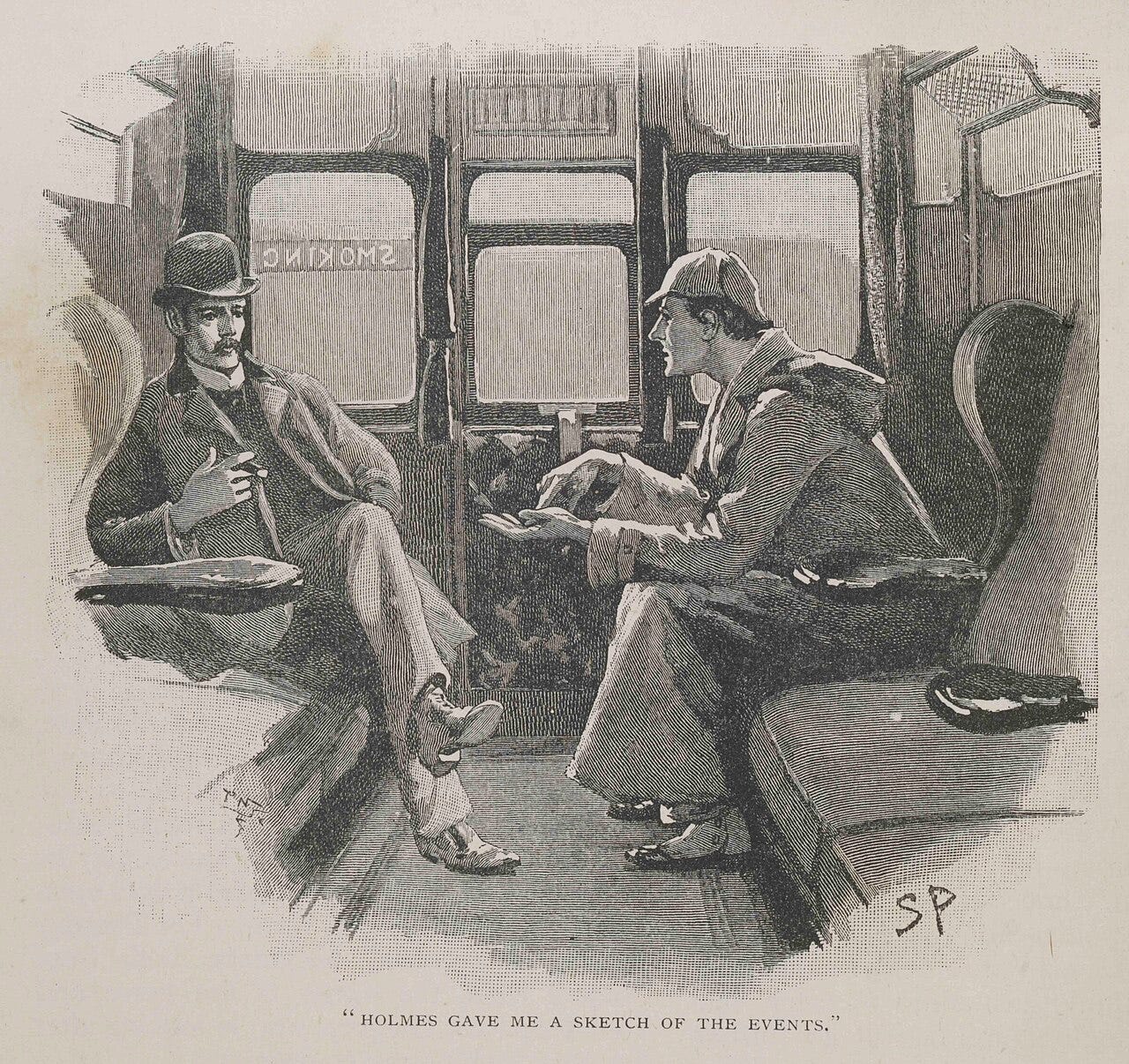
Sherlock Holmes is my soporific drug of choice. Sir Arthur Conan Doyle wrote detective tales that could be light-hearted, whimsical and funny, but were quite often violent, sad and gruesome. They are not meant to be bedtime stories, but for me, this is frequently their exact function.
I have trouble falling asleep; this has been true for much of my adult life and became truer still when I quit drinking years ago. I needed something else to soothe me to sleep, and classic English detective fiction sometimes did, and does, the trick.
For those who are curious: Melatonin makes me depressed the next day; CBD gummies are currently not on the menu of permissible bedtime treats; I use over-the-counter and prescription sleep aids sparingly, although they do help me, too; sleep has gotten a bit better since I started exercising two to three times a week a few months ago; I will, inevitably, wake up to use the bathroom at least twice.
Back to our aromantic (though not usually aromatic), emotionally avoidant, cocaine-addicted best friend from the 19th and very early 20th centuries.
I listen to a lot of Sherlock Holmes stories on audiobook – like, a lot. I prefer the ones with his worshipful best friend, military veteran Dr. John (or James, in one story) Watson, but I’ll do a Holmes solo joint too.
When people ask me what my favorite Holmes screen adaptation is, I say, “Stephen Fry’s voice in my ears as I try to fall asleep.” I have dodged their question, but also, I prefer my Sherlock Holmes tales to be read to me. Certain Holmes stories are not right for this; others are.
There are Holmes stories that involve no murder at all – like, for example, the wonderful “A Scandal in Bohemia,” featuring charming London-based American opera star Irene Adler. Adler is the one woman to ever best Holmes and to earn his begrudging respect. She was born in New Jersey, so her ability to awe any man is not surprising to me, but Holmes found it shocking.
I love this story, and yet, it is merely the second-most Holmesian entry in my curiosity cabinet of audiobook sleep aids.
The Holmes (and Watson, of course) tale that most often helps me fall asleep is “The Adventure of the Empty House,” first published in the United States in September 1903 in the popular magazine Collier’s. Its U.K. publication followed that October in The Strand Magazine.
To understand its charm requires a little bit of context.
In real life, Conan Doyle had retired his literary superstar several years prior, in the 1893 short story “The Final Problem” (published in the U.S. as “The Adventure of the Final Problem”) via an apparent murder that may also be read as self-sacrifice.
Holmes and the archvillain Dr. James Moriarty battle it out on the edge of a cliff over the Reichenbach Falls in Switzerland. Both, it seems, go over the edge and fall several stories down into the rocky rapids.
At least that is what Watson (and readers) are led to believe by a note Holmes leaves behind before following Moriarty to an almost-certain death. Watson survives, a happily married man with a decent business as a physician, but grieving the best friend he ever had.
Readers got so upset that they sent several letters of protest to Conan Doyle’s home publisher, The Strand. So many people canceled their subscriptions that the magazine suffered real financial loss.
Conan Doyle went on to write non-Holmes books, but as many successful series authors have experienced, the audience often pleads for the artist to recycle what worked so spectacularly before. On the one hand: I wish we authors could all be so lucky! On the other hand: He must’ve felt stifled, bored, and perhaps even a little resentful of all the nagging.
Conan Doyle endured eight years of this before giving the world an entirely new Holmes novel in The Hound of the Baskervilles, which was serialized in The Strand from 1901 through 1902. But that story was set before the events of “The Final Problem,” meaning that Holmes was not really “alive,” at least not if readers were to believe he still existed on a contemporary magical timeline parallel to their own.
Thus, in 1903, Conan Doyle gave loyal readers the glorious gift of “The Adventure of the Empty House.” This time, it seems the adventure of it all was baked into the title on both sides of the Pond from the very beginning.
The following obviously contains spoilers for a short story first published 123 years ago, and if you have the temerity to complain about it, please reward me with a paid subscription immediately (or a one-time tip on Venmo.)
Watson has moved on with his life, but he still greatly misses Holmes. In addition, he implies in passing that he is now a widower. Conan Doyle spills little ink over this and presumably expects the reader to spill even fewer tears.
The good doctor remains fascinated by crime, and at the moment is mildly obsessed (along with the rest of London) with the mysterious murder of a high-born, titled Australian young man who has been staying in London with his mother and sister. But without Holmes, Watson is powerless to do any real deduction of note.
He is so entranced by the sensational story that he wanders around the city in search of clues, at one point accidentally bumping into an elderly bookseller and knocking over his pile of books. The old man hisses at him and Watson apologizes, but the fellow hurries off.
Happily, in my favorite scene in any Sherlock Holmes story, the crotchety bookseller pays Watson a visit at his office and says he’s sorry for his overreaction. Watson says it’s really no big deal. The old man, apparently seeing a business opportunity, points out that Watson’s bookshelf has an unsightly empty space that really ought to be filled with affordable and attractive secondhand books. Watson turns his head to look at the bookshelf, and when he turns back around, he sees not the old man but his old friend Sherlock Holmes smiling at him from across his desk.
At point, Watson tells us, he faints for the first and last time in his life.
The joy with which Watson greets Holmes (once the detective revives the doctor with brandy) never gets old for me. Watson is practically delirious with delight. No more talk of darkness; forget these wide-eyed fears - Holmes is here. Good day, sunshine! War is over, if you want it. There are no cats in American and the streets are paved with cheese, and in London, presumably, they are paved with all 100+ forms of tobacco ash Holmes can identify by sight.
I love it because there is hope again for one whose world was drained of color by the loss of his most beloved companion (and also, as an afterthought, his loving spouse.) Watson remarks that Holmes expressed sympathy for the death of Watson’s wife not in words, but in the gentleness of his tone.
Also, Holmes explains his three-year disappearance and the various disguises he used to dodge Moriarty’s gang.
Watson immediately forgives his friend for the subterfuge, and they’re off solving crimes again immediately. I’ve heard the entire story dozens of times, and I’m usually asleep before they ID the nefarious evildoer in this particular case.
I already know the solution to this problem, the answer to the puzzle, the resolution to the conflict. For Watson and Holmes, it all works out in the end. What a comfort. What a pleasant dream.
Thank you for reading. Please feel free to share this essay with others.
Comments
Nothing yet. Say the first thing.
Sign in to join the conversation.