
I think a lot about the future of novels and publishing and whether a significant number of people will still be reading longform fiction in 20 or 50 or 100 years.
Despite reduced attention spans and the siren calls of TikTok and streaming TV, I doubt prose will disappear altogether. It has too many advantages, such as an inherent ability to convey interiority. Then again, judging by some of the reviews I’ve read1, it’s possible for readers to be uninterested in perspective-taking to the point where some feel personally insulted if a book doesn’t conform to their tastes, values, and life experience. So maybe in 20 years instead of authors we’ll have “organic input producers” who toil away in the content mines for minimum wage, fending off model collapse for the LLMs that spit out personalized slop on demand.2
Even that might be overly optimistic. I’ve only published novels for adults, but I wouldn’t be a writer if I hadn’t started reading for fun at an early age.3 So I can’t help but feel discouraged when I see less reading for pleasure among kids and multiple children’s book imprint closures in a season. Reading is one of the sneakier ways a child can gain knowledge and perspectives their parents don’t control, which is one reason we’re seeing an absolute orgy of book bans and government hostility toward libraries. The end result is fewer interesting books that fewer kids can see themselves in.
All of these things affect the future. No pipeline, no readers.
Though AI capable of generating a book-like assemblage of text is new, political opposition to the “wrong” knowledge is not. There’s a reason so many dystopian novels depict the bad guys as being against reading itself. A few years ago I went looking for a middle grade dystopia that had stuck with me from childhood, one of those books where you wonder whether it was even real. Initially I had the title slightly wrong, but ended up finding a copy on eBay, of all places.
This Time of Darkness was published in 1980 by Helen Mary (H.M.) Hoover (who also wrote a Medea retelling!!). It’s a book of its time, with themes of totalitarian planned economy and environmental destruction, which makes it an interesting time capsule of Cold War-era anxieties. It holds up fairly well though!
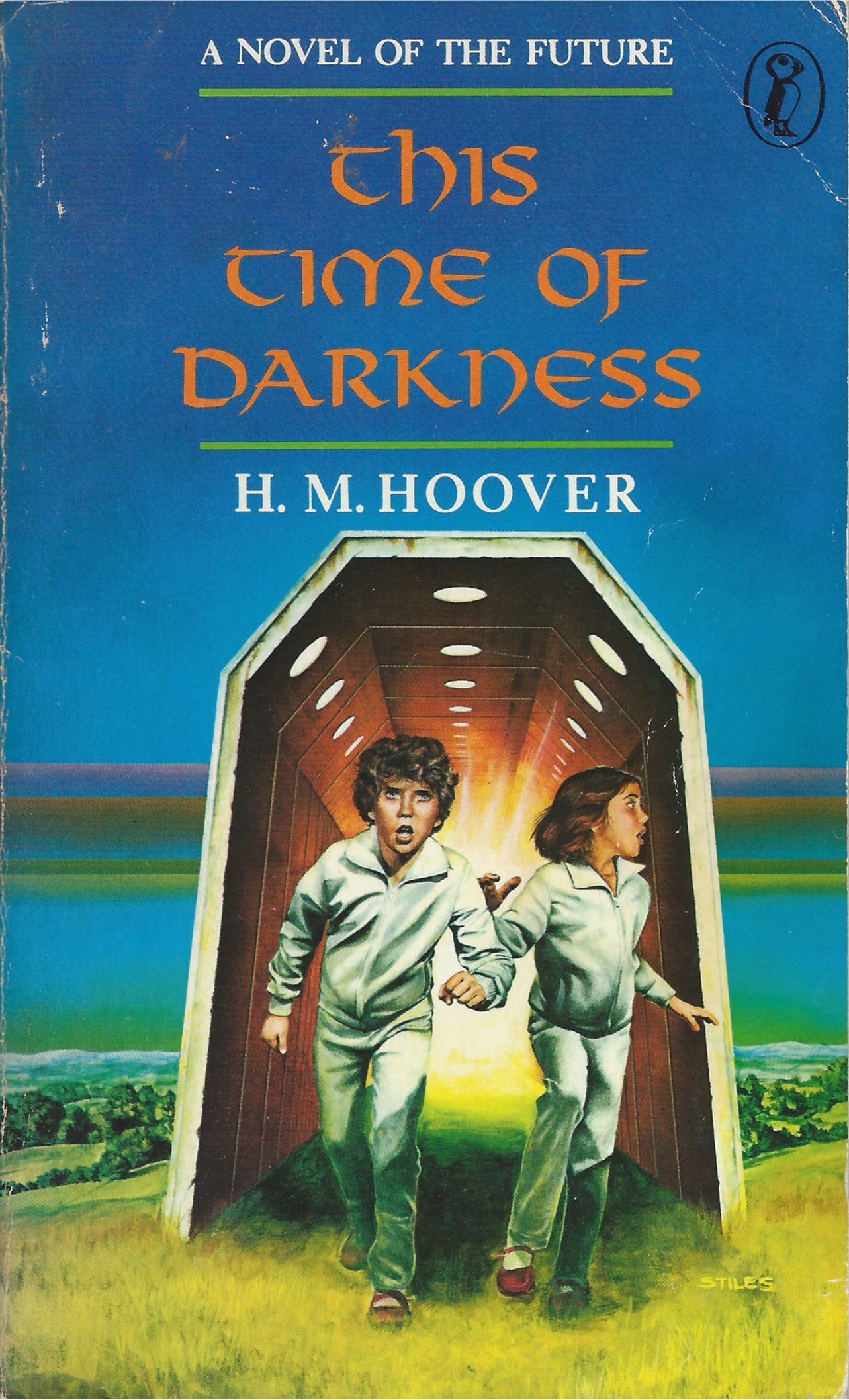
Eleven-year-old Amy is different from the other children in the crumbling underground city where she lives. For one thing, she can read, having been taught when she was younger by Janet, a former roommate in her and her mother’s overcrowded apartment. Books aren’t outlawed but heavily discouraged, and the main form of entertainment is “meditation shows” that extol the virtues of being a happy worker.
I love the way Hoover sketches Amy’s relationship with her mother (it’s bad!) in a few unsentimental but evocative sentences:
Amy wasn’t sure what was wrong with her mother, but she knew she didn’t want to be like her or, for that matter, like any adult she had ever known. Except Janet.
The sanit door rumbled open. Amy feigned sleep as Valory emerged to dress and comb her hair. Prolonged forced intimacy had created an aversion between them that increased as Amy got older.
It’s so true! This is the other side of forced proximity, where instead of enabling understanding and empathy, you get a bitch eating crackers situation. And look, a multi-clause sentence! I know there’s a whole literacy crisis but I love seeing writing for kids that isn’t fully simplified.
Hoover also doesn’t shy away from mature themes. This society, teeming with both people and vermin, pushes its despair closer to the surface than other “underground city” books like Wool. Everyone’s constantly pissed off and no one is protected. Adults grope kids in the hallways as a matter of course. Unhoused people (who are called “crazies,” because we might be in the future but we’re also in the same year Ronald Reagan got elected President!) sleep in doorways, vulnerable both to abuse from passersby and having their clothes gnawed through by rats. The city is cut off from its surroundings—more Iron Curtain vibes—and no one Amy knows has ever been Outside, where the environment is supposedly too polluted to support life.
But Janet’s early teaching piqued Amy’s curiosity. Amy forms a friendship of sorts with Axel, an obviously traumatized boy dismissed as a “psycho” (everyone’s at least mildly traumatized in this city, it’s only a matter of degree). When Axel tells Amy he’s from Outside, Amy’s like, fuck it, let’s go.
Axel insists it’s futile. Nobody believes his story4, and he’s already tried and failed to find his way out multiple times. However, Amy’s stubbornness is her key character trait, and she annoys Axel into walking up 70-odd levels with her.
This is when it becomes clear that what city dwellers have been told about every level being the same is all lies. The higher A&A climb, the quieter and cleaner it gets. They are apprehended by guards, who’ve been looking for them with the help of a “crazy” who’s actually a tracker in disguise, but escape into the eightieth, top level of the city.
How do they manage this? By reading instructions, lol. There are signs that tell them how to unlock the doors and navigate through a decontamination area, and finally one that’s basically: “Before opening this door, pull the lever to shut down the security system or lasers will kill you.” At this point I had to laugh because do you know how many people I’ve met who would have died despite being perfectly capable of reading? One of Hoover’s day jobs must have put her in contact with people who refused to RTFM.
There’s not a lot of dense lore in This Time of Darkness. Religion is barely mentioned, and much of the world building is accomplished through Amy showing Axel the ropes or brief descriptions as the pair moves through the city. Other than Amy’s mother admonishing that “waste costs,” we don’t find out what happens to all the poop. However, it’s obvious Hoover spent some time thinking about how the city would work and why things were the way they were. Some of the simplicity can be put down to this being a book for young readers, though again, it deals with dark and difficult topics without dumbing them down.
Yet it doesn’t torture the characters as much as some modern SFF and dystopia does. The plot unfolds with less overt conflict and character agency than you’d see in a book like this written now. Revelations are more quietly horrifying than explosive, like when Amy realizes the purpose of the security measures is to keep the city dwellers on the lower levels trapped, filthy, and half starved, while those on the eightieth level live in comfort.
When Amy and Axel do cross paths with upper-level people, it’s all very Morlocks vs. Eloi. The top of the city is a series of glass domes on the earth’s surface, full of natural light and green spaces. The food is real food instead of lab-created slop. Yet there are shadows of discontent; few of the people A&A meet are even aware of the lower city, believing it a horror story for children (they’ve been told their food comes from automated hydroponic farms underground5). Use of psychoactive “anti-traum” is common. You can really see the fingerprints of Brave New World here. Later we learn a little more—not much—about the history of the city and the ways in which the authorities maintain their hold over the population.
Inevitably, A&A are nabbed and interrogated by a mysterious Committee whose members argue about what to do with them. After that, a guard takes them to an abandoned, broken dome at the far edge of the settlement and…leaves them there.
At first it seems as though the children have gotten what they wanted, but after a couple days of trudging through a desertified wasteland, A&A figure out this is probably the authorities’ way of killing them without killing them. That’s okay though because it’s not too much farther to Axel’s home in the “greenbelt,” which is where the city’s food actually comes from. They’ll just have to find a gate in the twelve-foot-high electrified fence that keeps the rabbits from coming in and eating all the crops.
Amy thinks of the cute furry creatures she’s seen nibbling on grass and is like Huh, seems like overkill! But now things finally get a little bit heart-pounding, because the children are being hunted. The guard who left them at the edge of the domes is following them—to finish them off, Amy fears—as is the ragged tracker they last saw underground.
The children find the guard dead, apparently not of natural causes, and soon afterward are captured by the tracker. It turns out he isn’t planning to take them back to the city; he himself has escaped, and wants to help. He treats Amy’s sunburn, gives the children food, and tells them his sad story. His name is James and he was born in the domes. His parents died in a revolt against the authorities, and he was sent down into the lower city, to spy on “readers” who might become troublemakers. He was friends with Janet before she died.
This is all very interesting to Amy, except for the fact that she still doesn’t know who killed that guard. There’s no other humans out here except for her, Axel, and James.
But wait! There are other humans, who have regressed to an animal-like state. James says lots more people have been exiled from the domes over the years, so these could be them, broken by having to scrape out a living in the badlands after growing up in the hothouse atmosphere of the domes. Amy fears the same could happen to her if she stays out here too long.
The feral humans attack and Amy sets a grass fire to drive them off. She’s impressed with herself for her quick thinking until Axel very reasonably points out they are now surrounded by fire. The fire eventually burns itself out, but not before the trio is rendered unconscious by smoke inhalation. However, some greenbelt residents saw the fire and came out to investigate. One of them is Axel’s dad, who is overjoyed to find him alive. Axel’s real name is Michael; his family takes in Amy and James; everything is great. The end.
I swallowed this book whole as a kid. I loved how gritty it was, and how it hinted at so many stories beyond the page. I’m pretty sure I wrote fanfiction based on it, in my head if nowhere else. Reading as an adult makes it hard to turn off my inner editor though. The plot relies heavily on luck; the main characters are whisked out of trouble way too easily, even for people in a children’s book, and in many places it feels like they’re walked through the narrative rather than making real decisions. One of the points this novel seems to make is that getting out of the city is actually not all that hard for anyone who’s managed to shake themselves out of fear- or numbness-induced complacency.
Though that doesn’t extend to systemic change. In fact, the stakes are almost completely limited to the central characters: Amy, Axel, and James are the only people who escape the city and go on to live presumably happier lives. Within the city itself, any hints of revolution or resistance are mostly confined to the authorities making sure these things never happen.
This could be due to audience: unlike in YA, protagonists in books aimed at tweens are more likely to be focused on their own lives than saving the world. Though it’s tempting to ascribe This Time of Darkness’s narrow lens to the political climate in which the book was published. In 1980 the US was still nominally against communism, but they’d tried proxy-war nation building in Korea and Vietnam and obviously failed miserably, and the fall of the Soviet Union was still almost a decade away. So no point trying to change those systems, right? Just get out if you can, and look after yourself and those closest to you.
I’m conditioned to see this as a flaw, though it could be exactly what Hoover intended to do. Still, this kind of insularity, in this kind of book, might have trouble gaining traction amid today’s high-stakes, high-concept blockbusters. Although authoritarianism is rising around the world, we still like to read about injustices being righted and dictatorships being overthrown. So it’s notable to see a novel with a concept so tailor-made for a Big Book keep its focus so personal.
That authorial choice could also come down to literary trends at the time, which is another thing I can’t stop thinking about. Currently, what’s in fashion—and the need to cater to shortened attention spans—dictates at least some of the prevailing advice about what constitutes “good” writing.
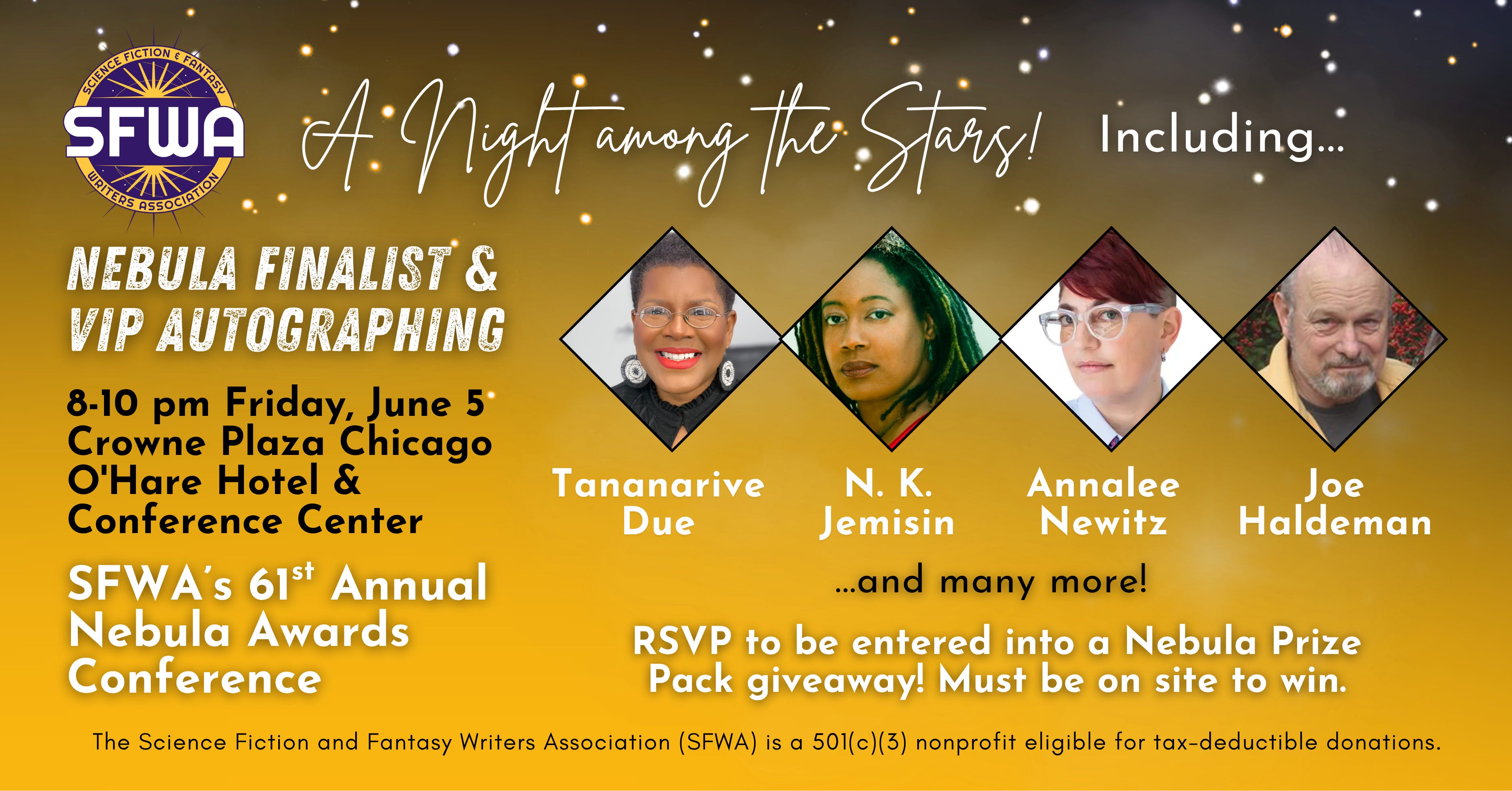
I’ll be signing books at the Nebula Awards Conference in Chicagoland on June 5 from 8-10 pm! I’ll also be at the conference from Thursday to Saturday, so if you see me wandering around looking lost, say hi!
Reading: I’m digging into The Art of Intimacy, which I bought on the recommendation of the amazing romance author Regina Black.
Watching: I just saw Obsession, in which a man deprives a woman of her agency and selfhood and actually experiences consequences. Strikes a great balance between terrifying/tragic.
Listening: I was going to post this YouTube playlist I’ve had on rotation and then I looked a bit closer at the description, did some digging, and…it’s fucking AI, y’all. I’m sure I’ve been hoodwinked into listening to clanker music before but knowing it feels as empty and “what are we even doing” as I thought it would. This is why I leave the majority of my new music discovery to the professionals.
However! I’ve also been going back through Nine Inch Nails’ catalog and I’m really enjoying this collaboration with Boys Noize.
If you enjoy my ramblings, you might like my books!
The Other Me, which PopSugar called a “Black Mirror-esque rabbit hole,” is an inventive page-turner about the choices we make and the ones made for us.
When I’m Her asks the question: How far would you go to get even with the woman who ruined your life?

Not of my own books. Some authors are able to read their own reviews and still write; mine paralyze me.
As opposed to companies just stealing or rights-grabbing writers’ work to train AI like they do now.
I say “reading for fun” like I was normal about it. Like my parents didn’t take away my books when they grounded me. Like my idea of a perfect play date wasn’t me and my friend silently poring over our respective Baby-Sitter’s Club novels.
The way he got into the city is such a random “kids being somewhere they weren’t supposed to be and doing stupid shit” story; he jumped on top of a freight bin full of vegetables just to see if he could and ended up trapped inside. Total undeveloped frontal lobe behavior. Hoover has the nature of kids down pat.
I highly doubt Hoover predicted how the LLMs-vs-workers issue would play out, but this made me think of how many “AI-powered” tasks are ghost work, either enabled or performed outright by low-paid workers from the Global South.
Comments
Nothing yet. Say the first thing.
Sign in to join the conversation.