
Confession: I’ve run out of hot takes. I’m just hot. And the past little while has “taken it out of me”.
So I’m pulsing outta here for a month to rest my nervous system and rebuild my excitement reserves.
If you’re a paid subscriber, I’ll do what I do each year and suspend subscriptions for four weeks. This just means your next monthly payment won’t come out on the next cycle (and if you’re an annual subscriber, an extra month gets tacked on). To all the new subscribers - sorry to bail just as you join the community.
You’re obviously free to catch up on past reads and join the comments thread (where the community will, no doubt, respond with their usual discerning gusto).

For now, I’ll leave you with an insight into my sleeping arrangement here in London (I’ve been in town for work) and a reflection on absurdity, given All The Absurd Things about the place.
I shared here the special way I have to repose around the world. Artificial noises and smells assault me and impede my life, so I carry my own camp mattress and linen everywhere so that I can tuck myself into the most neutral nook possible (often a bathroom floor) and get something approximating sleep.
I’m sharing another image of my set-up, this time in a small studio in Notting Hill, simply to create a rupture - one that might help some of you out there feel OK about whatever discordant measures you must take to “get you through the night”. I mean, we are all just walking each other home….
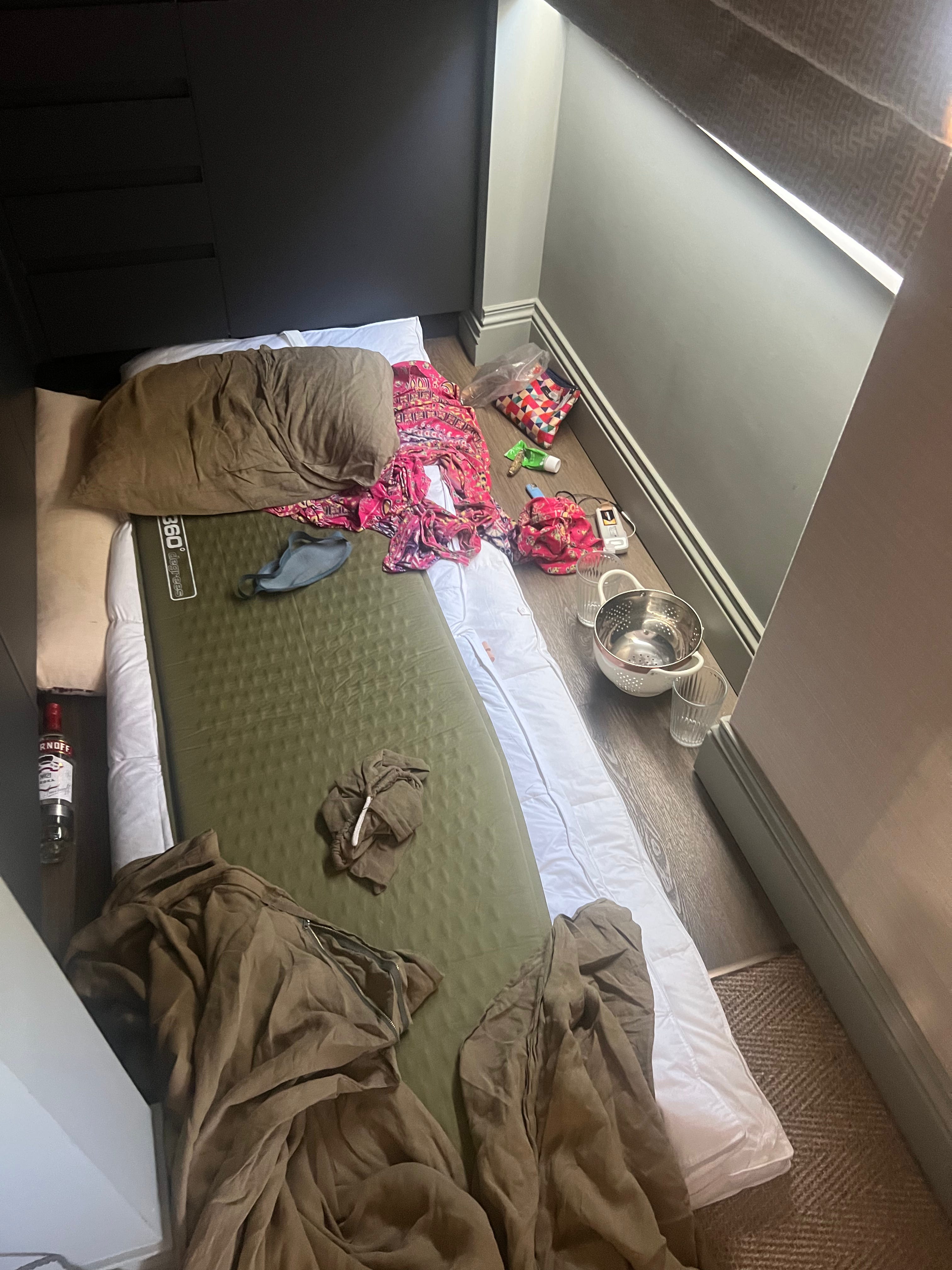
I set up my urban encampment in the kitchenette on this occasion because it was away from the communal corridor and the “crinkling” power box. And under the window, the heat is stifling in London buildings in a heatwave. Alas, I can’t use fans (some primordial reflex in my brain that detects artificial noises puts me in a sustained flight or fight state).
I’m on the floor because….floors are steady. The vodka bottle? It was in the freezer and I hugged it against my body to stay cool. The colander? It was propping the window open. The patterned wrap skirt under the pillow? A familiar smelling personal item to block the residual smell of washing powder on the duvet under my camp mat. Even so, I slept no more than three hours for four nights.
As I write in I Eat the Stars, we are in absurd times. I write:
“Absurdity, at a psychological level, is a cognitive clash that happens when a larger perspective (like the whole of our civilization unraveling) undermines the reality of a smaller perspective (our BAU lives), and we are left, mid- clash, wholly aware of essences.”
Last night in London, the Poetry Pharmacy hosted a lovely event featuring my book. Earlier that day I’d done three podcasts, had a lunch with a work colleague, run chores, before hurtling across London on a Lime bike in a hot head wind to attend an invite for tea (that arrived by email at 10am) at the House of Lords with some strategist for Baron Such And Such to chat AI and the spirit. I’d tucked a wrap skirt in my bag. I wrapped it around the shorts I was wearing. I literally spat on my hands and flattened back my fringe as I jumped off the bike and bolted to the security entrance.
That’s not the absurd bit. Nor that Baron Such And Such’s team then accompanied me to the book event. The absurdity was that - unbeknownst to me - the event was being held inside a certain cosmetics store whose politics I align with but whose toxic fragrances I must cross the street to avoid. Like, wherever I am in the world, I will get a pffft of a whiff of this particular store’s fragrance from under the shutters, when the store is closed for the day and I have to adjust route.
Anyway, there was nothing I could do. I had to show up and battle through my primal need to fight or flee. I had to bear.
The absurdity of it all, said someone in the crowd who was aware of my very intense sensitivity to even the slightest hint of fragrance.
But the perfection, too. After all, I was there to talk about our collective need to accept that what we’re in is simply hard (get used to it now!). And that getting radically cool with discomfort is the new superpower. And that we must now, simply, bear.
Life is a self-referring phenomenon. What is happening at the macro is playing out at the micro, and in the in-between. It’s all speeding up. And the absurdities are getting more stark.
Here’s a few more to bear:
The Vice President has just released a new polarising memoir called Communion about, yep, civilizational death:
“A death, not of an individual, but of the civilization that gave an individual’s life meaning.”
He goes on:
“The decline of Christianity has left us without a shared moral language. In its place, the right has worshiped the marketplace, while the left has embarked on an endless quest of self-indulgent self-discovery.”
The guy is sounding a lot like Nietzsche in Thus Spoke Zarathustra. And a lot like us. When you pan right back, so much of what is happening around us amounts to instances of humans wrangling (often ineffective, destructive, immature) with the same overwhelming discordance. This is worth remembering when we find ourselves hating on the humans.
From my (self-indulgent, self-discovering) leftist position, I argue that the schism kicks in around people’s differing relationship to change. Some of us reach to collective human possibility, others cherry-pick aspects of the past to resist the change. And what we resist persists. And festers. And inverts. And requires violence and dominance to maintain.
A Ross Douthat interview with Rod Dreher picks up on similar themes (I persevere with these Christian Right voices because I really want to understand their fear, the impetus behind their chosen beliefs, etc.). The latter believes the collapse of Christianity has ushered civilizational decline in Europe, that we’ve traded our humanity for comfort, and he worries that totalitarianism is around the corner for the United States. There’s a WH Auden quote he cites, that I adore, as an - absurd - aside:
“Stagger on, rejoicing.”
So, another instance of the dodgy guys sounding like the rest of us. Palantir CEO Alex Karp just let slip something I say repeatedly - the biggest risk we face is not being burnt to a crisp by heatwave or death by singularity (etc. etc.), but mass civil unrest as we all lose our shit amid the uncertainty and flux. But read what he said to this effect and spot the difference (I’ll assist by italicising and bolding the truly crook bit):
“The biggest challenge to A.I. in this country is political unrest. If I were sitting here in private with my peers, I’d be telling them the country could blow up politically and none of us are going to make any money when the country blows up.”
Daniel Pinchbeck is writing a book serialisation on the future of the Left. His latest chapter looks at the machinery of war, and at preparing men to become “killing machines”. He poses a very chilling question:
Is the United States getting prepared, step by step, to accept the unthinkable? Is the “Manosphere” a crucial part part of this process?
I get asked this all the time - what should young people study at university now? My answer is: philosophy. Being able to think critically and discerningly will be a superpower in a world where technology is rendering discernment a farce. Absurdly, the co-head of Anthropic says the same. Ditto the tediously neoliberal techno-accelerationist Economist:
As AI gets better than knowledge workers at answering small questions, people are likely to focus on big ones. Philosophy looks more relevant than ever.
A few finds from the socials…
A woman uses OnlyFans to raise money to hike the biggest mountain in the lower 48 states. Count the madnesses. It gets better. I followed up on the story just now. She had to be airlifted out after the water she drank in an IG reel she posted to fans turned out to be contaminated.
South Korea has built a Buddhist robot monk. Won’t spell out the obvious here.
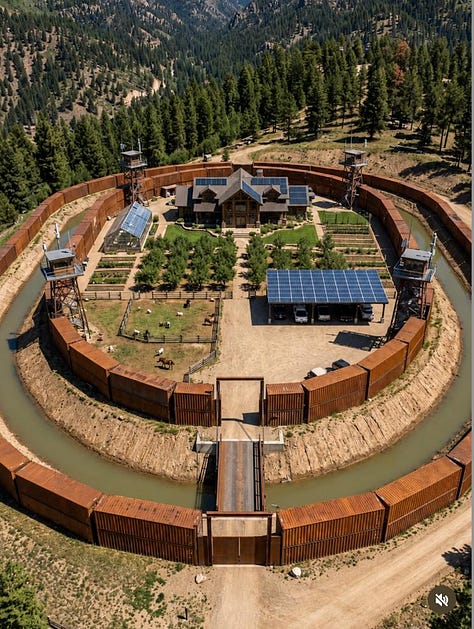
Peaceful homesteading with FO security lookouts. Again. Speaks for itself.

This New York Times op-ed makes this excellent observation. As AI takes over, it’s creating “busywork” for the mere mortals. We used to outsource our personal accounting, for instance. But now that we can create agents to do the same task, well, we can both put a poor accountant out of a job and wind up doing the work (of supervising the AI) ourselves.
“The A.I. revolution involves a massive transfer of labor — not from worker to machine, but from worker to consumer….Tasks that we used to delegate will still be done. They will simply move out of the work force and into the household as new forms of invisible, unpaid labor.”
Irony-slash-paradox, more than absurdity, perhaps.
Employers are now using AI (in Slack, Zoom and other platforms) to monitor employees’ emotional states. Of course, the data is being used to boost productivity and growth. Burger King, for instance, is piloting an AI headset that evaluates fast-food workers’ interactions for friendliness. Gross. And Orwellian. Mercifully, the European Union has already banned the idea.
A new study - titled “The Obscenity of Hope: educating young people in the Anthropocene ” - has backed something that, again, we’ve been exploring in this forum, wonderfully drawing everything together with an acknowledgment that kids need to be taught to embrace the “absurdity of it all”:
“While the received wisdom is that young people need to have ‘hope,’ we borrow from a range of critical perspectives to argue that hope is an obscene, labyrinthine concept that does more to trap students than it does to prepare them for ‘the Anthropocene.’ Indeed, in the context of profound and interconnected psychological, political, social and environmental crises we argue that the development of ecological worldviews in young people can be enhanced by putting aside hope and embracing the absurd reality playing out for people and planet. Somewhat provocatively, we see such an approach as the basis for a ‘hope-less’ revolution in education. Rather than becoming lost in the dualism of hope or despair, our approach emphasizes the need for ‘revolutionary’ change.”
Perfectly post-tragic.
So, how the hell are we to handle so much absurdity? Albert Camus’ answer was that the absurdity itself forces us into a truly authentic happiness, a “happiness without hope,” funnily enough. This happiness is not predicated on conditions but on the experience of simply existing in the “implacable grandeur of this life.”My answer: It will be hard. But I invite all of us here to not succumb to it, to continue to try and resolve it. I urge you to bear witness, to seek to understand the original and shared pain points, to feel compassion for humanity’s flawed attempts to do the actual right thing, and to refuse to allow such absurdity to shift Overton windows. We can not stop this shit, but equally we must not normalise it.
Oh, and just by way of a small update. I Eat the Stars will soon be translated into Dutch (publisher Nigh Vitalite has just bought the rights) and Portuguese (via a large Brazilian publisher). I’ll share exact release dates when I have them, but do feel free to reach out if you are Dutch or Brazilian or Portuguese and would like to collaborate on any kind of release ideas!
Courage to you all, take care of each other. I’m currently on
a ferry in Greece. My connecting flight was delayed. The passport control queue was delayed (new biometric controls, none of us agreed to). But I spoke to a Greek man in a uniform who spoke to a Greek woman in a uniform and I got to the front of the queue and hitched a ride to the port…and, bless the goddamn Greeks…the ferry was also delayed.
Sarah xx
Comments
Nothing yet. Say the first thing.
Sign in to join the conversation.