
I’m holding the mic but I’m quiet because I’m listening to an audience member. She’s upset because she thinks the kids will vote Reform. This seems unlikely to me given a wealth of data on the matter, but I’m trying to keep an open mind as she tells me her worries, which relate to phones and social media and Nigel Farage. Another woman a few seats away pipes up to relay relevant statistics. It’s an intelligent but high-strung audience, anxious about the future. I’m grateful to be in this independent bookstore, run by a father and daughter duo who wrote to me after reading my book. I’ve listened as they explained they both take no salary and work other jobs to keep the place open. The walls are lined with the books of authors I know personally. The seats are full. I’ve spent more money on transit than I could make in book sales to be in this town in rural England.
I’m still trying to make sense of the question. But it’s difficult to focus, because outside, there are noises that are making everyone ill at ease. Earlier that day, the local trans pride group drew chalk drawings (cheesy, loving ones) on the pavement outside the bookstore and now members of the local far right Facebook group have come and shouted at everyone involved and tried to wash the drawings away. At this hour, the trans community members are back, drawing on the sidewalk yet again while our event happens. Somehow their presence makes me feel slightly useless up on the stage, all my rambling about sociology and methodological triangulation, even though chalk drawings admittedly have somewhat limited utility too. I feel preposterous. And on edge. We all shift in our seats a bit when we hear voices outside. At one point, the voices get louder and the audience member with the data points set gets up to check on things. (It’s okay, she says, returning, Things are fine.)
The event carries on. Next is the book signing. I’ve done dozens, but they don’t really get old. There’s someone who doesn’t like nonfiction but plugged through and ultimately liked the book. There’s someone who disagreed with me about what to do about tech companies. The whole process feels like Christian communion. The reader tells me their thoughts, I ask them a question too usually, I sign the book, we smile, next. But it’s not just pretence or performance; somehow, something is transferred besides the book. It doesn’t feel honestly that different from the work I used to do facilitating therapeutic groups for the School of Life. Maybe it should feel different? Towards the end of the signing, a woman asks me, “why are you here?”
“This is my job,” I tell her.
“But why are you here? We’re in the middle of nowhere!”
And then, from outside, the far right guys are back, this time screaming and whooping, and the trans activists pour into the store shaking and even crying, and the bookstore owners’ daughter goes out to intervene and the upstairs neighbours of the bookstore throw a bucketful of water on her head. It’s a sort of slow motion pandemonium, after that. Someone is shouting “that’s assault!” Someone is shivering and wet. Someone is calling the police, which I personally don’t see much value in but it’s happening. Eventually, the bookstore owner takes me out the back door and drives me to the train station. I get an immigrant-made kebab and take the train back to London. Train, train, tube, tube. I have done enough mental health and activist interventions in my life to know whatever feelings I might have will come later. Home. Partners and friend Max are in the living room. They tell me they’re sorry to hear about it. I tell them it’s just what it is, part of the job description for the job I have now without ever having been assigned it.
Thanks for reading My Subschtick ! This post is public so feel free to share it.
I tell them also that it’s only going to get worse, these disruptions and the world that creates them, and that I can’t help but think that none of us really, neither myself nor my audience, have the skills for what comes next.
When I was in graduate school, an ongoing debate in critical and social theory was whether there should be norms that underlie the work of a theorist. Should we, for example, posit a certain set of values and work backwards from there to discern what society should be like? There are obvious upsides to doing so. Having norms allows you to point in a direction you’d like society to go, which is rather more inspiring and possibly more “productive” than simply criticizing everything. Norms also make it easier to articulate why (for example) you don’t want a world run by AI, where humans mostly consume its slop. How to justify this without some conception of the good? How can I argue in my next book that humans being interdependent is good, or justify my automatic sense that the creepy holographic customs agent at the border at Gatwick airport is bad?
On the other hand, once you take on a set of norms as part of your theory, you might steer society too much, or assume too much. You might take on bad norms and use them uncritically without realising it. The history of social theory is littered with examples of theorists who did just this, and who look stupid or evil now. There’s Aristotle’s love of slavery. (There’s a lot of people’s love of slavery, actually.) There are many social theorists who uncritically posit that women are naturally weak or unreasonable. How could you ever properly critique society from within it, as part of it, given how flawed it is? On the other hand, how could you ever do it from anywhere else?
I understand why our professors (and their predecessors in the critical theory tradition) were agonised by the “normative question”. One wants to check oneself for dangerous biases, and simultaneously one wants to be able to confirm that one’s moral system is better than that of a Nazi. But I confess that the “normative” debate feels mildly irrelevant when one is day to day trekking around dodging far right trolls and working directly in the service of social movements. Because in those moments (or more commonly, in the post-neoliberal remaining constellation of fragmented efforts to better the world) the endeavour of theorising about societal change doesn’t appear norms-first, it appears relationship-first. Several days a week, I have a live audience of human beings, and that brings with it a whole other set of interesting problems and questions that shape how I think, questions that involve norms in some way but where the most obvious and perhaps significant challenges lie elsewhere. I am, by necessity, preoccupied with what the audience feel, think, assume, what they are afraid of, what they can imagine, whether I answer their questions… And, of course, will they call the cops, and will they be ok. On the train home, I might also worry about whether they can answer my questions, the questions that are posed, implicitly at times, in the book. It is relational this way of thinking, which is probably why the book signing carries a strange kind of weight.
These questions about my audience keep me up at night much more than any questions about the moral basis for my work. It’s not that the normative question is entirely irrelevant, of course, but it does now seem to me that it takes up an inordinate amount of space in academic conversation while the audience is hardly ever discussed. Or perhaps what I feel is that the normative questions are often best explored after one has thought deeply about one’s audience; that they cannot be disentangled from that.
See Theodor Adorno, who is known for being perhaps the most anti-normative critical theorist. There’s no right life in the wrong one, he opined, and thus, no knowing as a social theorist what the right life might look like. Don’t stand at the front of the protest shouting too many positive demands, then, he might be interpreted as saying. As a social theorist, such a philosophy suggests, one should simply identify what is wrong with society by noting its internal contradictions, through a negative-dialectical approach. His students felt this was all unforgivably passive. (My ‘students’ sometimes do too, especially in the face of climate catastrophe, Gaza, and so much more). And so they attacked him with flower petals while bare-breasted to protest his inaction.
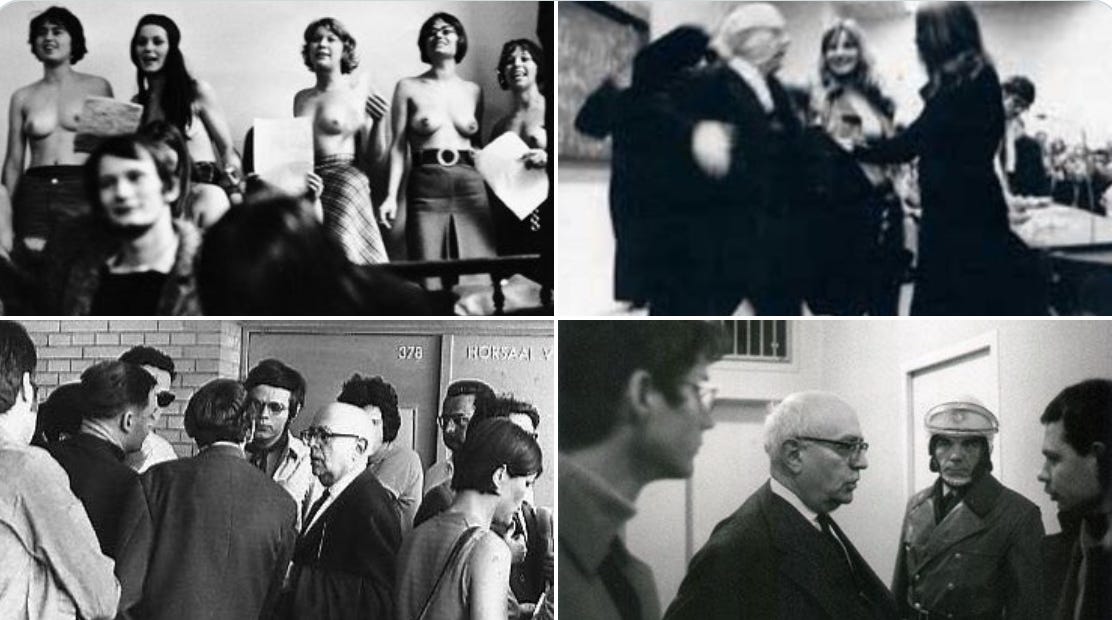
The students saw Adorno as a failure for his avoidance and even opposition to more radical forms of political action. He probably saw them as “left-wing fascists”. When I think of this incident, I see a disagreement about normativity, yes, and also a disagreement about the role of a political/social theorist and their role in ‘right life’. But most of all I see a failure of a theorist to respond to his actual audience, even if that audience is… annoying. Today, Adorno calling the cops is seen as a failure even by my very professionalised professors, a lapse in self-reflection and judgment. One’s audience might be wrong, but maybe there’s no right life without them, and no right life in opposition to them.
If I would not call the cops on the far right guys outside the bookstore, I think it’s also likely that I could not call the cops on my audience as Adorno did, even if they naked flowerbombed me. Frankly, I cannot imagine feeling that far away from my audience, that other to them, because I see them as the other party in the work I’m engaged in, even when they’re mad at me (and sometimes they are).
This ethos towards my audience is partially my professional training. I carry within me the instructional designer’s mantra that the audience is never all wrong, even in their mistakes. If I’m honest, though, it all runs even deeper than this. What I truly feel is this: to write for and speak to your audience well, you have to… love them. I mean this “I have to” in a descriptive, not normative, way: I can’t get through it without that motivation-wise (and many others I know privately tell me they feel the same way). Nothing else would get me to Kent in the rain through four different trains! Nothing else would keep me going as my editor tells me, using polite British euphemisms, that my book sales are only “promising” right now. No, I have to look out into the audience and want their agency and flourishing more than I want to be paid or known or cool or even respected, and I have to want these things for them even if they ask annoying questions, even if their protests seem mild or a little performative, even if they live in a small town in the middle of nowhere, and perhaps especially then.
Of course my audience-love also troubles me. After all, isn’t that current of love likely to generate its own unspoken norms for my work? Who is to say those norms are good? What’s so good about the audience in such a broken world? Left wing audiences are not exactly always fountains of wisdom. They are arguably all too fond of chalk drawings and bare breasts as primary forms of action in the face of very grave structural problems, and usually not great at disciplined organisation at the ground level to meet people’s most pressing material needs. I often get why Adorno preferred his books to the crowd.
Still, the view I have these days as I write is neither from “above” or “below” as it was defined and debated in grad school. No; it’s the view from the mic. And, at minimum, this position has probably saved me from a variety of pitfalls. In writing, I can sometimes too easily assume my audience understands or even agrees. As a speaker, my audience will let me know immediately where I’m wrong. The live audience reminds me of the scale and nature of human confusion, frustration, and dissent, including dissent from my own views. And it places that dissent within context and at scale better than any algorithm. In other ways, too, the mic is a nicer place to theorise from than “online”. While one can in theory love an online audience, perhaps one shouldn’t; they’re too vast, and too estranged from you and each other for certain kinds of conversations. If you must love an online audience, I suspect you should probably love them modelled off the way you love an in-person audience. Otherwise, you might lose not just perspective but also a grasp on the task at hand in social theory. One’s online audience is often more charmed by coolness and edgy hot takes. Those may constitute a fun game for a while, but it will realistically feel hollow when the nearby city in Kent has run out of water and there are marches to deport all immigrants happening nearby. Part of what I gain by going to rural England is the audience, and the reality of their problems.
A few days later Max and I are headed back to my house after teaching a five-hour workshop for radical Jews in North London. We head out into the streets and realise immediately that we are not getting home the way we came. In fact, public transit is not really a possibility: it’s the Arsenal parade, and three quarters of a million people have flooded London to celebrate the team’s recent wins. The streets are covered in trash.
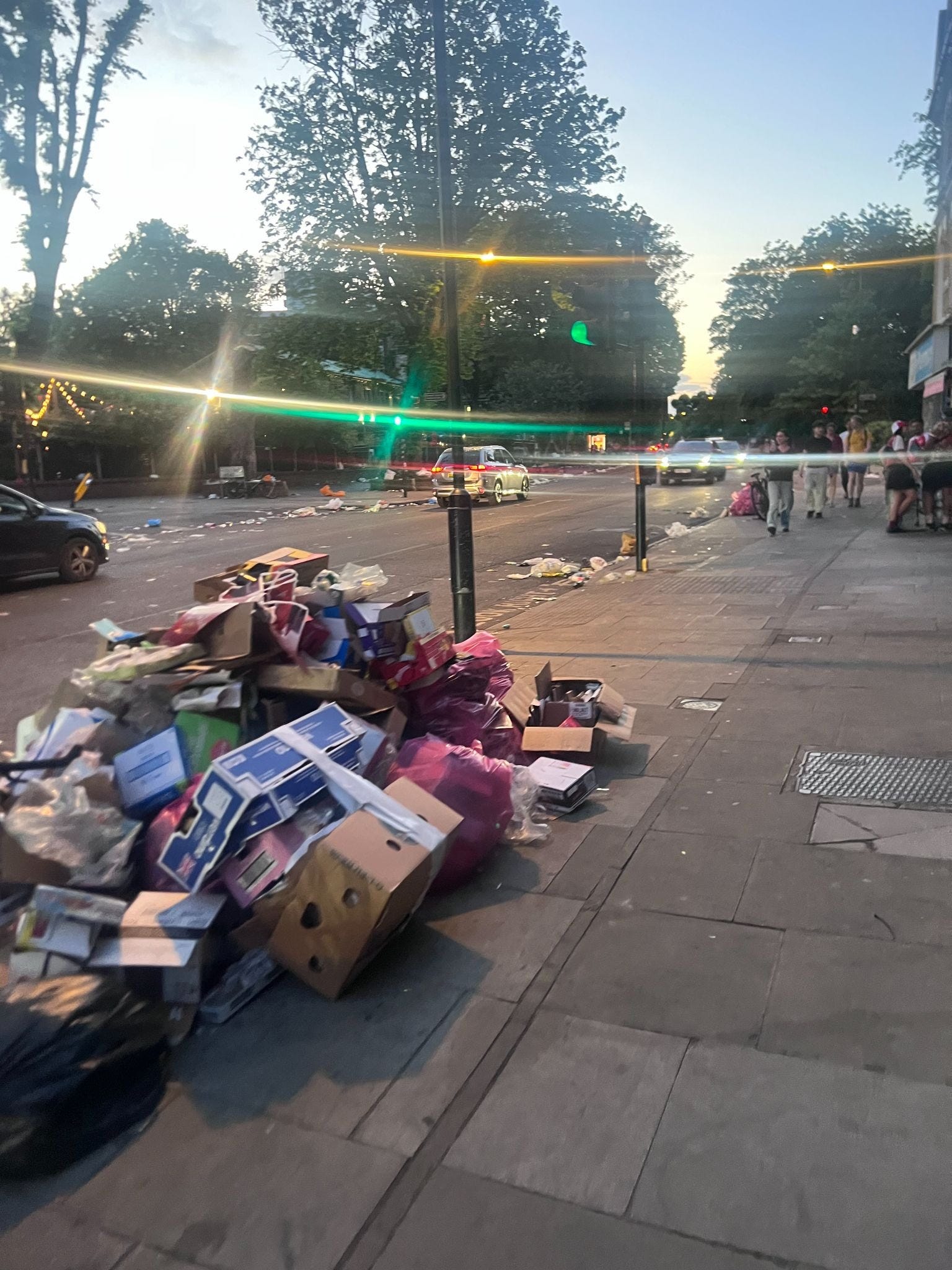

People are jubilant, unleashed, deeply relaxed in a strange way one rarely sees in public. There are (I don’t know a less blunt way to put this) many more people of colour out and about than usual, even for London. They, and everyone else, are cheering, whooping, chanting, dressed in red, bringing their kids with them, cycling one another around on city bikes in unsafe, joyful configurations.
“Imagine if this many people came into the city to do something political,” Max said to me. “They’ve shut this whole town down.”
They really had. We felt a strange mixture of alienation from, and curiosity towards, the joyful masses. Could we love them? I found I could, but certainly it took greater imagination. The exercise felt good. After a little while, we both felt something else. “Maybe we’re talking to the wrong people…” The audiences I speak to are still largely bourgeois, overeducated, downwardly-mobile, anxious. What would it mean to speak to an entirely different crowd? Might they do entirely different things in response to radical ideas? One thing I recognise right away: I might not be the speaker for that audience. The view from the mic is limited, and my particular view from the mic is especially limited in some regards. Which is not to say it isn’t also useful that I sometimes have one.
Despite these very unsolved concerns about myself and about my audience, I continue on. There’s work to do. Normative debates go on endlessly because nothing happens that might truly solve them; relational dilemmas go on endlessly because so much changes even while one is thinking. I’m off to the next event in Kent tomorrow. It’s being organised by a Joloff rice cafe, which is about the scale at which these tiny pockets of resistance start right now. I’ll seek perspective there.
No posts
Comments
Nothing yet. Say the first thing.
Sign in to join the conversation.