
Another repost alert (I hope long-time readers appreciate (& forgive) my recycling of articles of late… with a masters thesis, a college and a practice to prioritize, I simply often run out of time to compile new works. For now.)
Chelsea Smock offers an actual homeopathic perspective of miasm theory - not the instapath kind currently doing the rounds… in her article

I encourage you to follow Chelsea’s work as it is sound - always!
Thanks Chelsea!
Also, for homeopaths, I am sure that this 2023 paper will be as enlightening for you as it was (& still is) for me
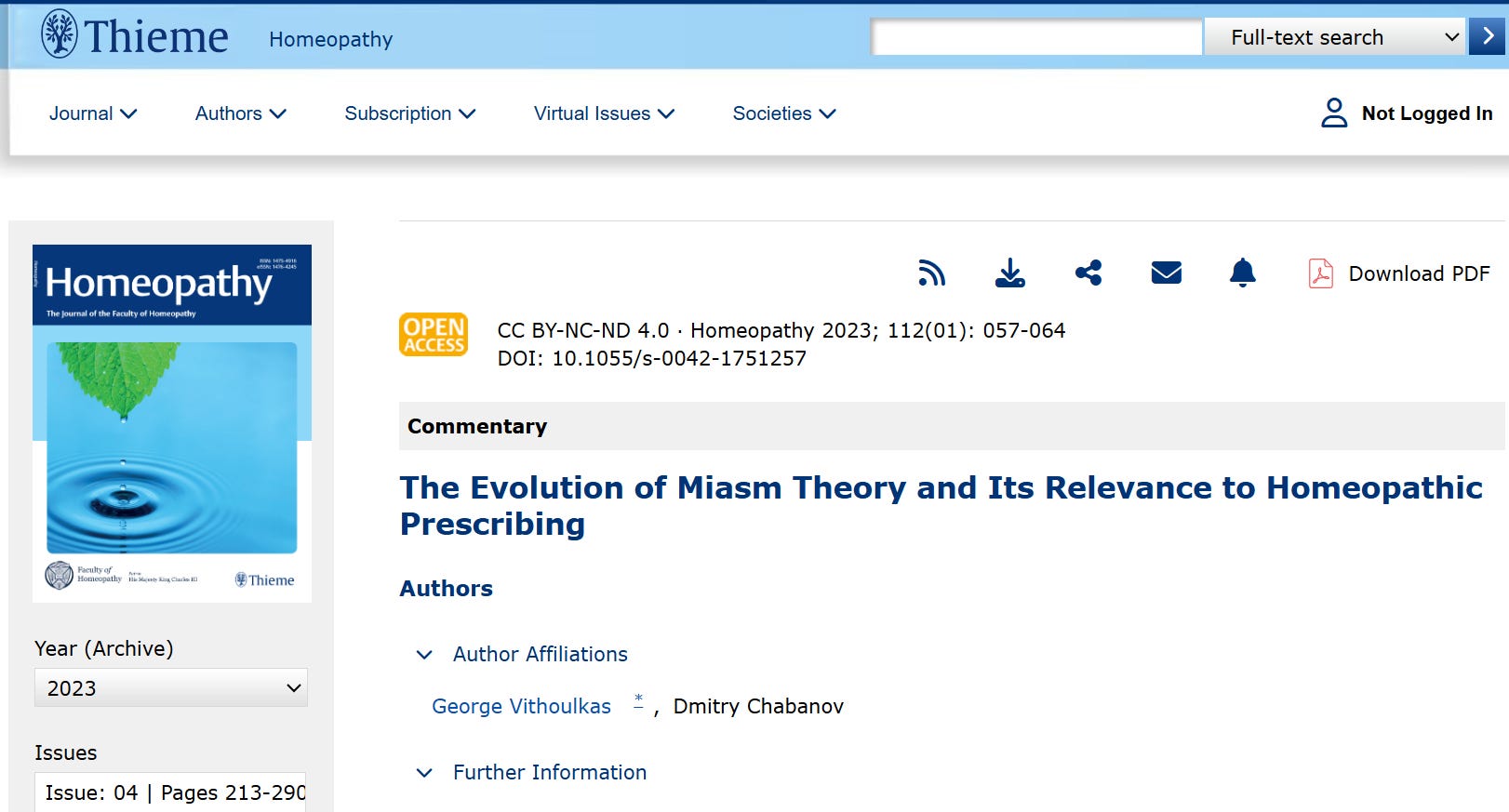
‘ For most health professionals who have chosen the challenging path of comprehending classical homeopathy, the theory of miasms is the most intriguing part of our science and is an area where much misunderstanding, criticism and controversy prevails. There are now a large number of opposing ideas and opinions on the subject of miasms, with various classifications, many of which we believe to be erroneous and which confuse many homeopaths and result in incorrect prescriptions.
Here we clarify the main postulates of Hahnemann's miasm theory and analyse how his followers transformed his ideas over the next century in the light of medical discoveries. This allows us to understand the limited relevance of miasm theory to modern day prescribing and offer a new and precise definition of the term miasm in relation to modern diseases such as cancer and autoimmune diseases. How we apply this theory to the health challenges of the 21 st century, such as increasing environmental pollution and other toxins, may play an important role in the future wellbeing of the human population. ’1
-
And, of course, here is an article from my own archives for you too;
Homeopathy & Parental Overwhelm
·
January 20, 2023

Miasmatic theory provides us with the valuable explanation as to how the health of humanity has deteriorated into its current awful state of morbidity with so many varied chronic health conditions.
-
‘In contrast to frequent claims, the available Meta Analyses of homoeopathy in placebo-controlled randomised trials for any indication show significant positive effects beyond placebo. Compared to other medical interventions, the quality of evidence for efficacy of homoeopathy was similar or higher than for 90% of interventions across medicine. Accordingly, the efficacy evidence from placebo-controlled randomised trials provides no justification for regulatory or political actions against homoeopathy in health-care systems.’2

Sarah Penrose has studied and practiced homeopathy since 2005. Alongside three qualifications in homeopathy, Sarah is currently completing a Master of Applied Health Science research thesis which aims to advance understanding of homeopathic medicine. As of 2026, Sarah is principal of the Australasian College of Homeopathy collegehom.com
Vithoulkas G, Chabanov D. (2023). The Evolution of Miasm Theory and Its Relevance to Homeopathic Prescribing. Homeopathy. Feb;112(1):57-64. doi: 10.1055/s-0042-1751257
Hamre, HJ., Glockmann, A., von Ammon, K et al. (2023). Efficacy of homoeopathic treatment: Systematic review of meta-analyses of randomised placebo-controlled homoeopathy trials for any indication. Systematic Rev. Oct 7;12(1):191. doi.org/10.1186/s13643-023-02313-2
Comments
Nothing yet. Say the first thing.
Sign in to join the conversation.