If the state’s justification cannot rest on fraud, it has to rest on danger. The work itself has to be dangerous enough, in the hands of an unlicensed person, to justify stopping it. And that requires the licensed system being protected to be meaningfully safer and more effective than the unlicensed help being suppressed.
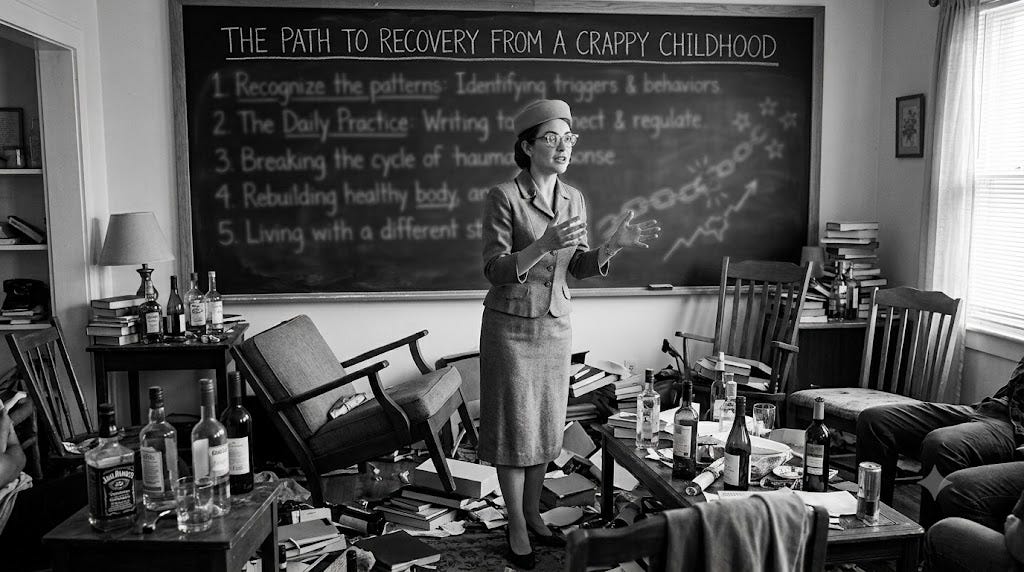
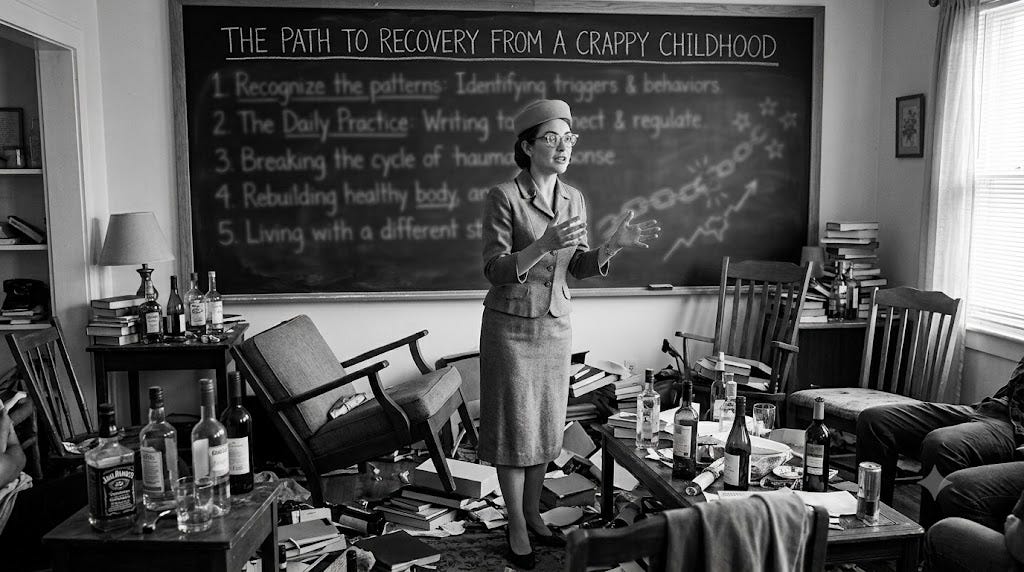
Anna Runkle, who writes and produces videos as The Crappy Childhood Fairy, grew up, by her own account, in a household marked by neglect, trauma, violence, and addiction. She then spent seventeen years in therapy with eleven different therapists before finding a writing practice that helped her begin to recover. From there, she developed her own methods for living in the aftermath of a difficult childhood and built a large online audience around teaching them.
Many people report feeling helped by her work. Runkle does not claim to be a therapist, doctor, or licensed clinician. But California’s Board of Psychology cited her for practicing psychology without a license.¹
If the state is going to stop an unlicensed person from offering clearly disclosed help to willing adults, what exactly is it protecting the public from? Licensure and clinical training are important. But we cannot treat licensure as evidence of effectiveness when the field’s own outcome literature does not support that confidence.
I. California’s claim
The justification is stated plainly in the law itself. The Psychology Licensing Law exists, in the Legislature’s words, to protect the public from the “unauthorized and unqualified practice of psychology.”² Protecting the public is written into the statute as the Board’s highest priority.³ That is a serious mission. The state is not just trying to make people jump through hoops to become psychologists. Of course not. It’s protecting the public from harm. But harm of what exactly?
II. A boundary with no clinical shape
The statute states plainly that the following requires a license: applying “psychological principles, methods, and procedures of understanding, predicting, and influencing behavior,” principles the law itself names as learning, perception, motivation, emotion, and interpersonal relationships.⁴
Does this sound like a description of a specialized clinical act? Not really. It sounds like a description of what any attentive person does constantly. It could be a parent reading a child’s mood. A manager thinking through a colleague’s motivation. It could be a friend trying to understand why someone reacted the way she did.
Psychology is the name of a field of study the same way sociology or biology is. Medicine and law, on the other hand, name slightly more specific professional acts in their statutes, such as cutting into a body or representing someone in court. California licensed an entire area of human knowledge instead, and drew its line at a concrete, specific bar: a doctorate, 3,000 hours of supervised experience, two exams, a background check.⁵ The state itself has decided that clearing that bar does not mean anything about someone’s effectiveness or skill but rather, that the person has demonstrated “minimal competency.”⁶
The psychology license is not the only credential that lets someone do this work (i.e., practice psychology). Marriage and family therapists, clinical social workers, and professional clinical counselors each clear a different bar, a different degree, different hours, different exams, administered by an entirely different board, the Board of Behavioral Sciences, not the Board of Psychology, and each is authorized to do work that looks indistinguishable from what the psychology statute claims to control: psychotherapy, counseling, applied psychotherapy of a non-medical nature.⁷
What we have is not a single clinical boundary. We have several credentialing systems authorizing overlapping versions of the same work. Psychologists, marriage and family therapists, clinical social workers, and professional counselors may all talk with people about emotion, motivation, relationships, family history, behavior, and change. They do so under different statutes, different boards, different degrees, and different professional titles. From the client’s perspective, the conversations may be identical. The legal difference is whether the person speaking has entered through one of the state-approved professional categories.
Runkle had not. She also did not pretend otherwise. She said plainly, and often, that she was not a therapist, not a doctor, and not a licensed clinician. The Board’s position was that this did not matter. They didn’t accuse her of pretending to be something she wasn’t. They accused her of engaging in conversations the Board deems the exclusive domain of the approved credentialing system.
III. No fraud problem
Runkle’s case is fundamentally not a case about deception. Her videos commonly begin the same way: she is not a doctor, she is not a therapist. She has said this consistently, for years, in her public materials, and, according to her own account, to paying clients directly. It did not matter. The Board’s determination was not that she misrepresented herself. It was that what she was doing, regardless of what she called it, met the statutory definition.⁸ The Board’s theory did not turn on consumer confusion. It turned on the state’s claim that the work itself fell within the licensed practice of psychology.
If the state’s justification cannot rest on fraud, it has to rest on danger. The work itself has to be dangerous enough, in the hands of an unlicensed person, to justify stopping it. And that requires a further claim: that the licensed system being protected is meaningfully safer and more effective than the unlicensed help being suppressed. That is the claim the rest of this essay examines.
IV. Licensure Is Not an Outcome Measure
Why did the state decide to license psychologists at all, and why exclude everyone else from a category defined this broadly? The statute does not tell us but part of the historical answer is that psychology adopted the licensing architecture of medicine: boards, exams, and scope-of-practice statutes in the twentieth century. This was largely to gain professional legitimacy and eligibility for insurance reimbursement. Medicine’s licensing scheme was built on real, documented harm: unlicensed surgery or medication produces measurable, undeniable damage. Psychology borrowed that same architecture without anyone first showing that unlicensed conversation about behavior and emotion produces any kind of comparable harm. Once the licensing structure existed, excluding everyone outside no longer required justification. The category itself became the justification.
The credential isn’t defending the public from a demonstrated harm. It is defending its own existence.
So what is the licensing credential doing that is beneficial now? Does holding a license predict who’s actually good at the work of psychologically helping someone? Well, researchers have indeed tried to answer this question but psychology can’t quite seem to figure it out.
In 2005, Wampold and Brown tracked 6,146 patients across roughly 581 therapists in a managed-care setting. They accounted for how severe each patient’s problems were before treatment began, then asked whether knowing which therapist a patient saw helped predict how well that patient did. About 5 percent of the variation in outcomes traced back to the therapist.⁹ Saxon and Barkham found a similar pattern in a separate dataset.¹⁰
Both studies then asked the obvious next question: what separates the therapists whose patients do better from the therapists whose patients do worse? They checked the obvious candidates: age, years practicing, professional degree. None of these factors accounted for the difference.
So the honest state of the research is that the field can show that some clinicians are reliably better than others. But it doesn’t know why. And it cannot show that anything a license certifies explains which ones are which.
The same pattern shows up on the harm side. One study found some licensed therapists’ patients were far more likely to drop out or get worse than others’, with no clear explanation for the difference.¹¹ Separately, researchers have identified specific ways licensed treatment can cause real harm, not just fail to help.¹² A field that requires a boundary meant to protect the public from incompetence should be able to say where competence and incompetence actually lie. The evidence suggests that the field doesn’t quite know.
V. Runkle Did Not Prove the Field Wrong. She Exposed Its Presumption.
Runkle’s history shows something specific: a licensed system can fail the same person repeatedly, across eleven separate attempts, while still claiming exclusive legal authority over the thing it failed to provide. For the state’s case, that is just as damaging as any claim about Runkle’s own effectiveness would be. She did not leave treatment early. She kept showing up, in good faith, to what the state considers the only legitimate source of this kind of help, and it did not work.
If Anna Runkle’s methods are effective—or more effective for the people who seek her out than the licensed field trying to stop her—the implications are serious. Testimonials, audience size, and Runkle’s own account of her recovery establish that people feel helped by her. We don’t know much more than that. On the other hand, the licensed field has decades of outcome data behind it, and that data establishes the same limited thing: some people are helped, some are not, and the field cannot say in advance which is which.
Both sides have evidence of being helpful. Neither side has proof of being more effective than the other. The profession is acting as though licensure settles that question when its own outcome literature says it remains open.
That is what makes the case clinically serious. If the public interest is helping people recover, regulate, function, and rebuild their lives, then the question is not whether Runkle entered through the approved door. The question is whether people are being helped. And if they are, the field’s first response should not be punishment. It should be curiosity. What did Anna Runkle understand, name, and deliver that so many licensed clinicians did not?
VI. What should count as help
The licensed field wants to treat Runkle’s lack of credential as the problem. But from the standpoint of clinical effectiveness, it is not a problem at all. The decisive question is whether the person seeking help is better able to live, better able to choose good things, relate well to others, regulate, and act in the world after receiving the help being offered.
Even the field’s own measure of success doesn’t measure against that standard. What gets measured, almost universally and exclusively, is symptom reduction: a lower score on a depression scale, fewer checked boxes on an anxiety inventory. That is what is easy to measure. But what if it’s the wrong metric?
Consider a woman in an abusive relationship who comes in reporting depression and anxiety. If her symptom scores improve, she learns to cope, to manage the anxiety day to day, and she stays in the abusive relationship, has she gotten better? If instead her scores don’t move for months, she still reports depression and anxiety right up until the day she leaves, and once she’s out, she rebuilds a life that looks nothing like the one that produced those symptoms, has she gotten worse? The scale would say the first woman improved and the second did not. Most people’s instinct says the opposite is true.
There is a long tradition, predating the current era’s pressure to make everything billable, of distinguishing symptomatic change from something deeper, what Freud called structural change, a shift in how a person’s internal life is organized rather than in how many symptoms she reports.¹³ A more recent line of research, modeling psychological change through the language of dynamic systems, arrives independently at something close to the same idea, describing healing as a process of destabilizing a rigid pattern and letting a new one reorganize through trial and error.¹⁴
A field that has not settled what meaningful psychological change actually is should be careful about using the power of the state to monopolize who is allowed to produce it.
VII. Professional self-interest
There are professionals in the field who agree with the state board. Becoming licensed costs real money and real years: a graduate degree, thousands of hours of supervised practice, exams. When a clinician pays that price, it’s understandable that he or she would want the credential to continue to mean something. This is regardless of whether the credential ever actually signified skill or effectiveness. Occupational licensing in general tends to involve pressure from inside the profession to create the credential and defend it, rather than the public asking for state intervention to protect itself from charlatans.¹⁵
Professional investment is being mistaken for public interest. A therapist who defends the license she worked hard for believes in it. She paid a real price for that credential: years, money, supervised hours. It’s natural to treat that cost as proof the credential must matter. But wanting something to be true because you paid for it isn’t the same as it being true. As the research discussed here shows, there is no reason to believe that licensure tracks who actually helps people and who doesn’t.
Even the boundary between therapy and adjacent services is less stable in practice than the profession often suggests. Licensed clinicians themselves increasingly market coaching, consulting, and psychoeducational services near the edge of psychotherapy.¹⁶ That does not make those services illegitimate. It suggests the boundary may not function as a neutral account of public danger, flexing for insiders in ways it does not for outsiders offering clearly disclosed help.
Conclusion
If we were to strip away the whole legal argument, what’s left? A woman spent seventeen years failing to get help from a licensed system, then built something on her own that worked for her.
It’s a method many people report finding useful. Runkle was forced to sue the state to protect her livelihood. No one has demonstrated she caused any harm. Rather, she seems to have helped many people. But she never paid the price of admission into a system that cannot say what it’s protecting or how it would know.
So, has the licensed field of psychology proved the superiority it is asking the state to enforce? No. In the absence of fraud, coercion, or demonstrated harm, that matters.
A profession that cannot identify its own competence, cannot define its own success, and cannot show that this enforcement action protects the public has no grounds to describe itself as the protector of the public against a woman who told the truth about who she was and helped many of the people who came to her.
If the public interest is effectiveness, this is not public protection. It is a field defending its exclusivity against people who may be helping others in ways the licensed system cannot prove it does better.
Sarah Ozol Shore, MS is a clinical trainer, founder of the Clinical Effectiveness Institute, and developer of the Clinical Discernment Framework, a real-time assessment model for strengthening clinical effectiveness. She trains clinicians to become more effective, including how to discern what kind of therapeutic work is possible in the therapy room at any given time.
Monthly Online Seminar Series: Why Good Interventions Fail — The next monthly online seminar takes place August 7, 12:00–1:00 PM Eastern.
The series runs monthly, is free of charge, and is designed for clinicians who want to develop the capacity and discernment required for truly effective psychotherapeutic work regardless of modality, technique or orientation.
Runkle v. Tate, complaint filed June 3, 2026, U.S. District Court, Northern District of California (Oakland); Reply in Support of Motion for Preliminary Injunction filed July 1, 2026. Runkle represented by the Pacific Legal Foundation, Caleb R. Trotter and Chris Barnewolt. Biographical details are drawn from PLF’s own case description and Runkle’s public statements.

Comments
Nothing yet. Say the first thing.
Sign in to join the conversation.