
Happy Monday, and if you missed it, last week Energy Bad Boys and I had a new op-ed in the Wall Street Journal about the solar lobby’s hiring of former Minnesota Gov. Tim Pawlenty — and why his enthusiasm for renewable energy in Minnesota didn’t work out for families paying more for less electricity.
Read the whole thing here. And if you’re coming here from Energy Bad Boys, welcome. I hope you subscribe and stick around.
Now, to the state of the grid as we head into the summer months proper.
The North American Electric Reliability Corporation’s 2026 Summer Reliability Assessment, released May 19th, finds that every assessment area should be able to meet normal peak summer demand. Only three regions carry elevated risk this summer: New England, Saskatchewan, and the Pacific Northwest. That’s half as many as last year, when parts of the Midwest, Texas, and the central U.S. were all on the list.
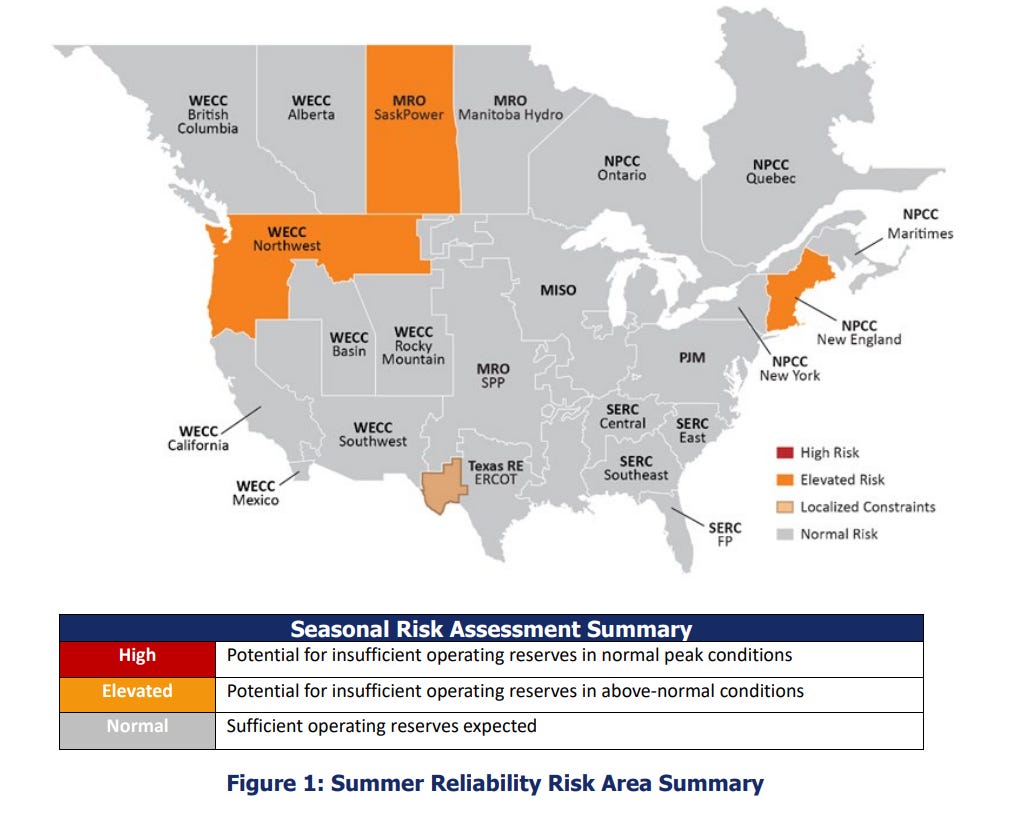
That’s definitely better than last summer’s assessment. But NERC’s director of reliability assessment and system analysis cautioned against reading too much into this summer’s improvement: “The improved conditions we’re seeing shouldn’t be interpreted as saying that overall reliability risk is declining.”
He’s right. Despite new capacity coming online, the improved outlook owes as much to slower-than-anticipated data center interconnections as it does to greater preparedness.
NPCC-New England, which includes Connecticut, Maine, Massachusetts, New Hampshire, Rhode Island, and Vermont, anticipates a 14% reserve margin, which shrinks to 4% with “typical outages” and could drop to a -0.9% margin with “higher demand, outages, [and] derates in extreme conditions.” NERC notes that “New England may rely on non-firm imports to cover shortfalls” despite the region slashing its projected net firm imports by half from the 2025 assessment.
The Pacific Northwest’s anticipated reserve margin dropped from 32% last year to 27% this year, elevating its risk. The region is contending with “challenging hydrological conditions” including persistent drought and low snowpack, which means the region’s generation mix of 55% hydropower may not deliver in a dry year. WECC’s probabilistic study shows the hour of greatest risk falls around 6 p.m. in early summer, when hydro output may not cover the duck-curve solar drop-off.
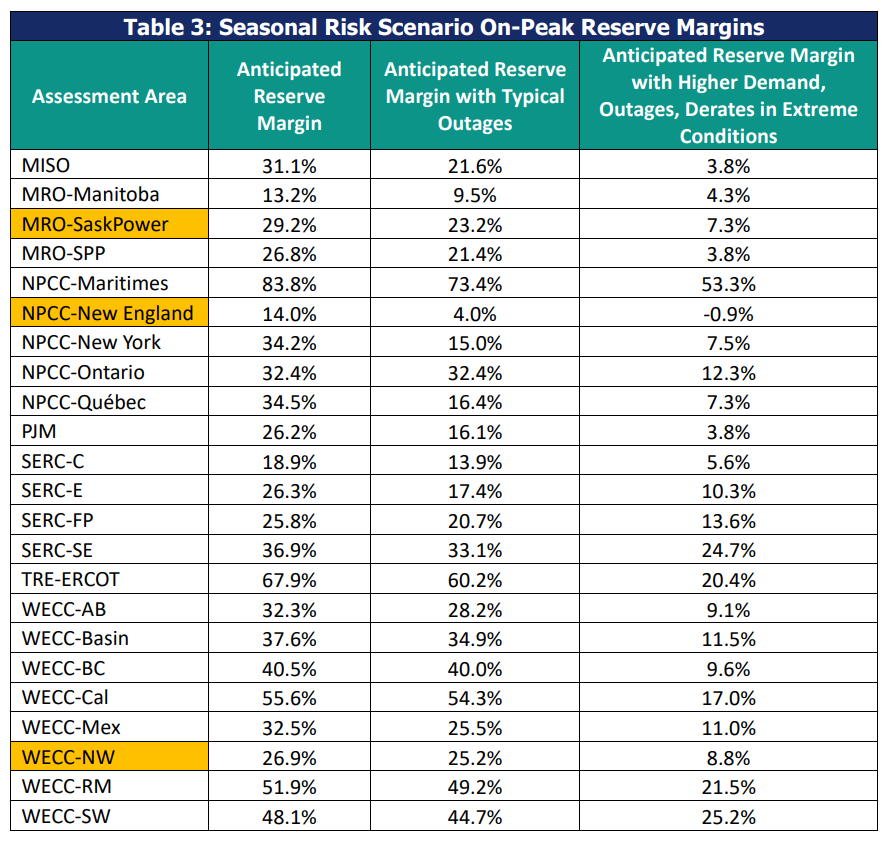
ERCOT, which was at elevated risk last summer, is now off the list. NERC attributes this to battery storage additions of 8,780 MW in 2025 and another 2,677 MW by March 2026, which helped drive the probability of an Energy Emergency Alert on the highest-risk August hour from 3.1% last year down to 0.43%. NERC still flags that Western ERCOT may face operational challenges when high demand coincides with low wind and solar output and transmission congestion.
More than 58 GW of new capacity at peak has been added across NERC’s turf since last summer, driven by “substantial amounts of solar PV and battery resources and some new natural-gas-fired generators.”
NERC rightly discounts weather-dependent resources to what they can produce at peak demand. Despite building 30.5 GW of nameplate solar, the resource only contributes 16.4 GW at peak. Battery storage additions are expected to contribute 14.7 GW, natural gas 6.7 GW, and wind 1.6 GW. The “other capacity change” of 19 GW is a result of “resource additions of other types as well as changes to generator availability (e.g., completion of extended nuclear generator outages, changes to maintenance plans).”
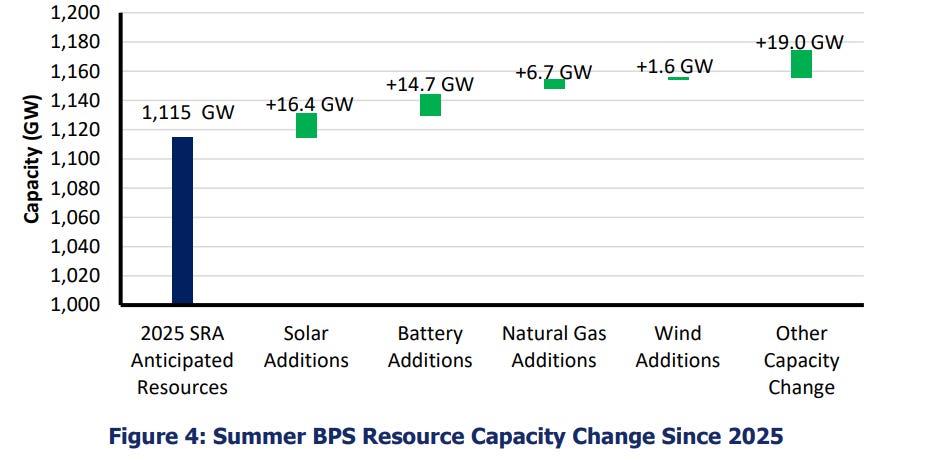
Solar sees a 46% derate in the summer because the grid’s riskiest hours now fall in the evening after sunset, when solar output is declining or gone. In winter, that solar is much less useful: NERC’s November assessment showed 11 GW of new solar contributed just 1.2 GW at winter peak, an 89% derate.
NERC also warns about the “impacts of wind drought (i.e. low wind periods),” which “pose a risk to reliability.” That’s because “the impact of wind ramp events—particularly down ramp—must be anticipated and planned for such that appropriate resources are ready to replace the energy lost during these conditions.” (Those “appropriate resources?” I’d imagine natural gas, since, you know, it can be dispatched to ramp up when it’s needed).
NERC says: “Load growth from data centers and large loads continues to propel North American electricity demand forecasts higher, with an increase in peak demand since Summer 2025 exceeding the change observed from the prior summer.”
Aggregated peak demand across all assessment areas climbed more than 11 GW, exceeding the 10 GW year-on-year jump that preceded last summer. Nineteen out of 23 areas saw demand increases from the 2025 projections. However, several areas revised forecasts downward because data centers are connecting to the grid more slowly than expected. That demand may still materialize later if those projects are merely delayed rather than cancelled outright.
NERC also points out that "large computational and other large loads pose operational challenges.” This is all about the Level 3 essential actions alert that NERC issued, which warns that “unexpected disconnections” of data centers from the grid have “caused frequency overshoot and high voltages.”
NERC is not counting as “anticipated resources” the plants currently operating under Section 202(c) of the Federal Power Act, which allows the Department of Energy to order power plants to keep running when grid reliability is at risk. Since May 2025, DOE has issued more than 43 emergency orders, delaying the retirement of at least 4.4 GW of coal capacity.
The 202(c) orders are an emergency tool doing a planning job, which will by necessity be a blunt instrument. But the DOE wouldn’t need to step in if states weren’t forcing the issue.
Three of the five states with plants subject to retirement-deferral orders — Colorado, Washington, and Michigan — have aggressive clean energy mandates that pushed retirements faster than replacement capacity could be built. Michigan’s Consumers Energy planned to close the J.H. Campbell coal-fired plant fifteen years before the end of its design life. Craig Unit 1 was set to close at the end of 2025 under a 2016 settlement agreement.
Colorado’s attorney general argued there was no emergency and the plant wasn’t needed. One week after Colorado utilities joined the Southwest Power Pool on April 1, SPP issued its first Resource Advisory for the West, and Craig had to run to help out.
NERC’s director of reliability assessment and system analysis said that “increasing risks for early fall and winter seasons reinforce the need for additional firm and dispatchable resources to maintain reliability and meet rising electricity demand.”
Under the One Big Beautiful Bill Act, wind and solar projects that begin construction after July 4, 2026 must be placed in service by the end of 2027 to claim wind and solar tax credits. The subsidy-driven buildout that produced most of this year’s additions is approaching a cliff. What comes after will determine whether the grid gets the firm, dispatchable resources NERC is unambiguously asking for, or more of what it already has too much of.
This summer outlook is better, and we can expect, on reasonable grounds, that the grid will avoid shortfalls in most areas. But the capacity built since last summer performs well below nameplate at peak, and it helps that data center demand has materialized more slowly than expected. An improving assessment built on underperforming resources and delayed demand could easily change by the summer of 2027.
This piece was expanded upon from a piece published at Independent Women on May 26, 2026.
Subscribe to get the next Montalbano Mondays in your inbox June 15, 2026.
Comments
Nothing yet. Say the first thing.
Sign in to join the conversation.