
One of the most common critiques I got on “What We Keep Getting Wrong About Regenerative Agriculture” was that my argument didn’t acknowledge that regen farms and ranches can be highly lucrative. There’s so many examples, people wrote to tell me, from Gabe Brown to White Oak Pastures to Joel Salatin’s Polyface Farm, that prove there can be real financial returns to farming regeneratively.
Though I may seem curmudgeony in my writing, in real life, I’m actually pretty open to being proven wrong. I often think of my writing as a chance to present a hypothesis, and then test whether it’s true or false. I’m a person who has, for better and worse, been checking and rechecking my hypotheses for decades. It’s one of the reasons I jumped at a chance, just two weeks after I published the above essay, to spend three days at a soil health training in Northern New Mexico, testing all the theories I’d just presented with practitioners and educators who are out advancing soil health and regenerative ag practices every day.
I learned (and relearned) a lot in those three days– from refreshing my knowledge of eighth grade ecology to seeing first hand the results of adaptive grazing, and how effective it can be as a tool to suppress aridifying species on rangeland. I also came away with a theory, about a key barrier to regen ag adoption, and why regen ag economics are such a hard (put not impossible!) nut to crack.
I’m calling it my IKEA Theory of Regenerative Agriculture.
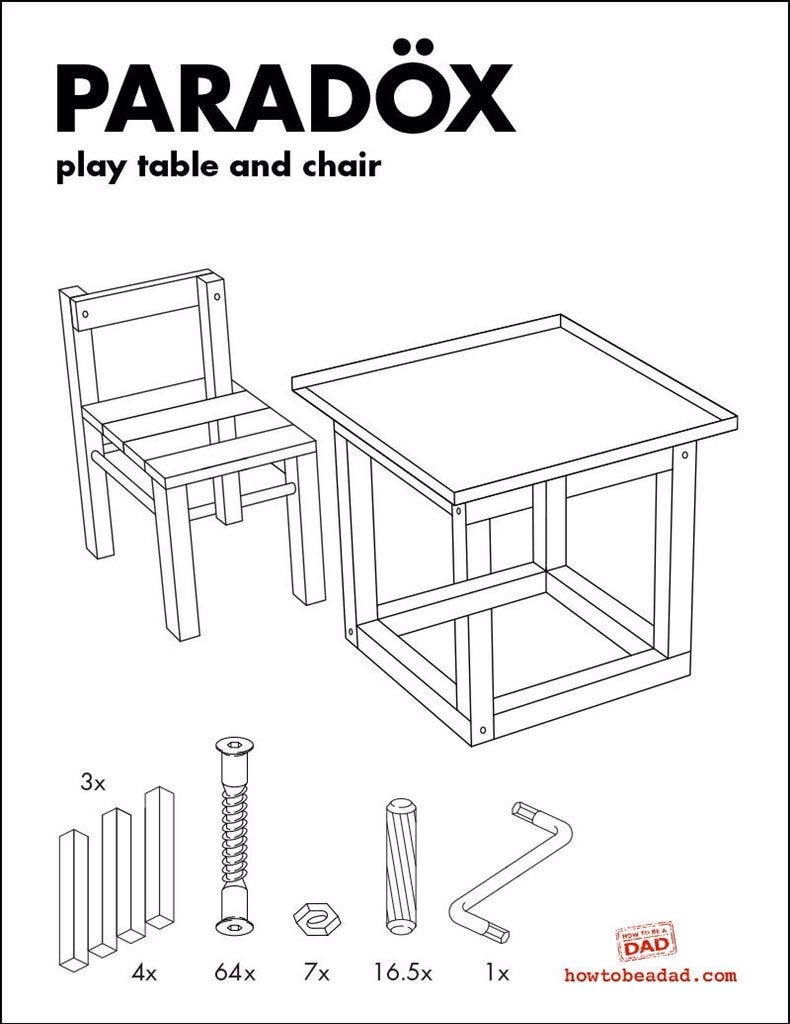
So there’s this idea that’s been floating around in sustainable/regen ag spaces since at least 2008, when The Omnivore’s Dilemma first brought Joel Salatin into the spotlight. Today, it’s still so common that the instructors at my soil health workshop said it offhandedly multiple times.
“Farmers and ranchers make more money doing regen ag because you’re replacing expensive off-farm inputs (like fertilizer, pesticides, etc.) with intensive management, making money from what they know, instead of what they buy.” The unspoken implication here is that regen ag allows farmers and ranchers to substitute expensive products and services with their knowledge and skill, something that’s, more or less, free.
This hand-wavey statement chaffed me the first time I encountered it almost two decades ago, and it still chafes me today. And listen, you know me, I’m no stan for conventional farmers (or frankly, for any farmers at all). But I’ve always thought the idea that any farmer, if they really wanted to, could just “buy less and do more” was so oversimplified it was literally getting it wrong.
In “What We’re Getting Wrong,” I spoke to the first half of the above statement, offering evidence that though regen practices can save farmers some money on inputs, it doesn’t affect many of the most expensive inputs on many farms and ranches (rent, insurance, labor, fuel, etc.). Today, I want to talk about the second half of this statement, the idea that “intensive management” is a simple and cost-efficient substitute for off-farm inputs.
So first of all, what is “intensive management?”
In the regen ag world, it means something like having deep and intimate knowledge about the land, plants, and animals you work with, and an extensive understanding of how they interact, such that you can work with nature instead of against it, adapting to changing conditions in order to produce food and fiber in a way that’s environmental and economically sustainable.
Yeah, yeah, but what does this mean? What does it actually take for a farmer or rancher to be able to achieve “intensive management?” And how big is the gap, exactly, between this type of farming and what we might call “regular management” that conventional growers are doing with the help of all their expensive off-farm inputs?

Consider two furniture-makers.
The first is a master craftsman. He calls himself a “furniture-maker,” but really he is a carpenter, an upholsterer, a designer, and maybe more than anything, a wood ethusiast.
I know exactly one furniture-maker like this— our good friend Tom. We hired him to make us a dining room table that would last us the rest of our lives.
He came to our house to learn what we were looking for. He looked at the room where it would sit, at the windows and how the light would shine through. He talked to us about the kinds of meals we liked to have, how we celebrate holidays, what our plates and our chairs looked like. He designed our table, sketching as we talked, and when he was finished, he started in on a two hour discourse about the pros and cons of different types of wood.
After our initial conversation, Tom would text us every few days as he visited wholesalers, sending two or three images at a time of unfinished slabs of wood, splashed with water so we could see the beautiful patterns and dimensions of the rough-hewn pieces. He spent six weeks finding the exact right top for our table. He called us again a few weeks after, when our table was half-done. He wanted us to come to his studio to check his work, and to show us the two sides of the slab, so we could decide which would face up for the rest of our lives. In the weeks following, he hand-beveled the edges, just because he thought it would look beautiful. When he finally delivered our table, he placed it just so in our dining room, aligning it perfectly so that the afternoon sun made the wood grain glisten. He announced, before he left, that as long as we didn’t put it outside, he was confident it would last 1,000 years.
Tom is a furniture-maker.
Next door to Tom is another furniture-maker. He sells much more furniture than Tom, he sells it much more affordably, and he makes it much more quickly. In fact, if you pick out something off his showroom floor, you can take it home that day. How? Well, Harry (we’re calling this one Harry) gets the furniture he sells from IKEA, then assembles it himself.
Now, anyone who’s ever assembled IKEA furniture will know, putting together a dresser, a shelving unit, even a dining room table from our Swedish friends is not what you might call “easy.” It takes attention, intelligence, and if you want all the parts to actually fit together the way they’re supposed to, some skill with a wrench. Harry is still very much making furniture, and between selecting the right pieces to order, putting dozens of items together a day, and then managing a sales force to get them marketed, sold, and delivered, he’s doing plenty of hard work.
And yet, it’s hard to say that Tom and Harry have the same job. Their products serve similar functions, but that is where the similarities end. Tom and Harry’s furniture businesses operate at different price points, volumes, qualities, levels of service, timelines, and margins. It’s not too hard to argue that Tom and Harry are actually running two different kinds of businesses, each built on a different set of essential skills that they, as the owner/operator, bring to the table.
And most notably, Harry can not just make a few easy changes to his business or his skillset and magically become a master craftsman like Tom.
To be a truly regenerative farmer or rancher is to be a Tom-like master agrarian craftsman.
Real “intensive management” is not about memorizing the soil health principles, planting a cover crop, and calling it a day. It is about being an expert agronomist, ecologist, entomologist, animal husbandry specialist, and probably a passable hydrologist and geologist to boot. It’s about having not only a passion for farming well, but long experience in doing it in your specific geographic, social, and economic circumstances, too. To be the kind of regenerative farmer or rancher that we really idolize (and should!) involves sometimes doing things the hard way simply because you prefer to do them elegantly or beautifully, regardless of extra cost.
This is what it takes to do “management intensive” regen farming: Mastery.
But the vast majority of farmers and ranchers in America today are IKEA farmers. Which again, is not to say that these farmers lack skill or that they are not working hard. They are! Absolutely! It’s hard to run a business. It’s hard to farm and ranch. It takes skill and determination to buy inputs, assemble them into a productive crop, sell the outcome, and keep your bills paid. These are the tenants of “regular management.” But the important thing is that these management skills are not really comparable, nor are they easily convertible, to the kind of mastery an “intensive manager” has. After all, the knowledge, skill, and passion gap between master agrarians and IKEA farmers is as wide as the gap between Tom and Harry.
This is the problem with the idea that “regen ag is economically viable because farmers can replace expensive off-farm inputs with ‘free’ intensive management.” It’s not that the statement is not true! It is true– just as it is with our furniture-makers. After all, Tom can sell his furniture for much more than Harry (and trust me, he does), and Tom doesn’t have to pay IKEA for designs, materials, or anything else. Tom is paying much less for “inputs” to the high-dollar table he’s selling. Tom is earning an economic reward for his mastery. But Harry cannot easily do the same. He lacks the same mastery as Tom. To achieve a similar economic outcome would take years and years, and he’d first have to, essentially, abandon his career of running a furniture shop, and start again at the bottom, as a beginner hand-made furniture-maker.
This is what the oversimplified idea of “just swap inputs for intensive management” leaves out. Namely, that “intensive management” skills are often an incredibly difficult (and therefore, costly) thing to acquire!
If my days in Northern New Mexico taught me anything, they reminded me how hard (and expensive) it is to become a master rancher.
I’ll be the first to say it, the ranch we were on was beautiful. On my way to it, I passed hundreds of miles of over-grazed, aridifying, cholla-infested pasture, and then I passed a single fence-line, and it was like a switch flipped. The grass on the ranch is greener, despite our current drought. There is little cholla to be found. And there’s wildlife galore– songbirds, coyotes, mule deer, even massive herds of elk.
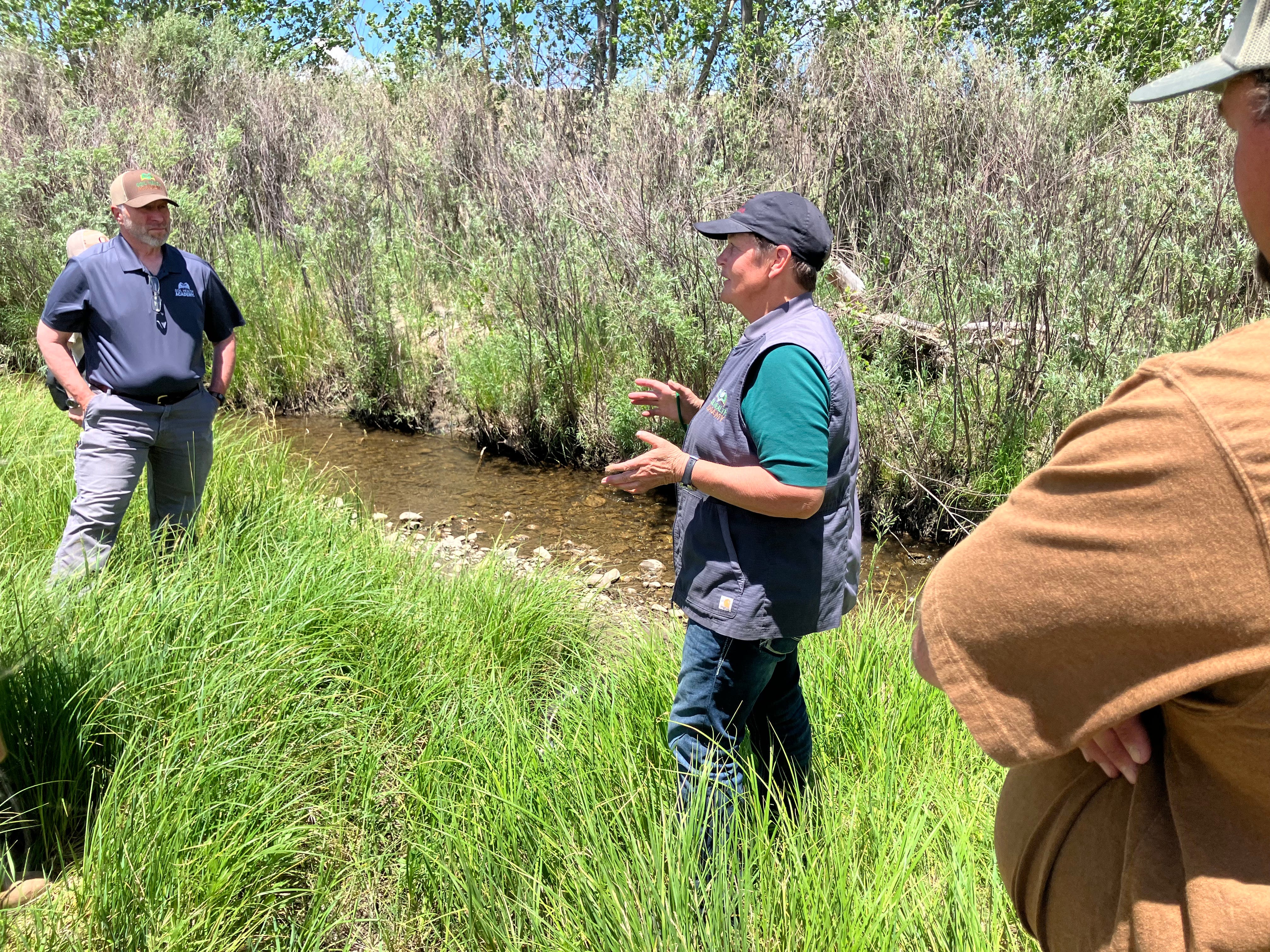
This oasis on the high plains did not materialize by accident. One simple example, driving down to the ranch headquarters, I crossed a postcard pretty river, with baby cottonwood trees flanking cattails, tall, silky grasses swaying in a breeze, with a muskrat dam holding back a glassy pool straight out of a fairy tale. I learned from the rancher, that just a few years ago, that same area was bare stream bank, denuded of any life and filling up with eroding sediment. It’s recovery was wrought with very careful management, using a small group of cows doing incredibly brief (1-4 days once every two years for eight years), limited area, high-intensity grazing. And it took her more than a decade of refining her adaptive grazing skills to have the confidence to even try to graze it in the first place.
What the rancherhas done on her ranch is genuinely some of the most impressive regenerative ranching I’ve ever witnessed. And the operation, which she runs with other members of her family, has had to evolve as a result of her adaptive work. They do hunting and outfitting on the ranch now (harvesting some of the magnificent elk and deer that are flourishing on the ranch’s healthier pastures), which provides significant income, helping make up for what was lost when Kim cut back the cattle herd to the appropriate density years ago. That was an easy sentence to type, but let me make it harder to swallow. Today, the rancher raises about 650 cow-calf pairs on the operation. In years past, the ranch’s herd peaked above 1600. That bigger herd was over-grazing the pastures and damaging the land and water, yes, but it was also bringing in hundreds of thousands of dollars more income every year. That tradeoff was not an easy one to make.
So why did they do it? In no small part, it’s because she is a master rancher. Her beef is exquisite. Her cattle are healthy and robust despite using essentially no inputs (wormers, feed supplements, etc.). The ranch is gorgeous, and it is already showing signs of resiliency to the pressures of a hotter, drier climate. And most importantly, she loves (and I mean LOVES) the ranch, and ranching itself. She is like Tom, a true artisan, and a top-tier intensive manager.
And today, the diversified ranch business (the hunting/outfitting enterprise is just one of many that go beyond selling beef) is economically successful enough to support six families. The rancher’s management is a part of that picture, but it’s worth underlining that the ranch isn’t financially viable because the management-intensive grazing resulted in increase beef productivity (the herd size went down, not up), nor because it allowed her to demand sky-high prices in the market for her regen beef. The ranch is viable because she and her partners are expert managers, including of the ranch’s finances, and they’ve creatively built the right mix of income streams to keep the operation in the black even while selling 2/3rds fewer cows from the same land-base.
For all of these reasons, this rancher’s example is not easy to follow. If a rancher considering her path has been operating conventional ranching businesses for decades, they’ve spent their career refining the exact opposite skillset— the ability to grow a lot of cattle cheaply on too little land, and managing the downsides with off-farm inputs. To them, the advice to “just stop doing that and start managing differently” is absurd, like telling an IKEA assembler, “just become a master furniture-maker.”
What would it actually take for a “regular management” rancher to follow in this rancher’s footsteps? Well, first, they would have to confront the fact that maybe the way they’ve always done things, the way dad did things, and grandad too, is not the only way, or even the best way. I think it’s hard to overstate how hard this step can be. It requires contending with the idea that this thing you’ve been doing your whole life, well, maybe you weren’t as good at it as you thought. Then, after that devastating blow, they’d actually have to learn what this rancher knows. That work has taken her 20+ years of reading, going to conferences, meeting with experts, taking classes, and experimenting herself (and often getting it wrong). So that’s just a quick two decades. Then, once they have some confidence in what they’re doing, they’d have to start making changes to their business. They’d have to start by abandoning much of the knowledge and skill they’ve spent your career refining (if you think knowing how to buy farm inputs while turning a profit is easy, I’ve got news for you), and instead take big, potentially expensive risks on experiments, new tools, and strategies. Like Kim, for example, a rancher might need to dramatically de-populate their herd. A farmer might need to completely rethink their crop rotation. If these bets don’t pay off, it could be the end of the farm or ranch, and of a generational legacy. A lot of producers who end up making them anyway are the ones already at the end of their rope– those whose situation is already do or die. And sometimes it works (Gabe Brown!) and sometimes it doesn’t (countless farmers you’ve never heard of, because we don’t take notice when farms fail).
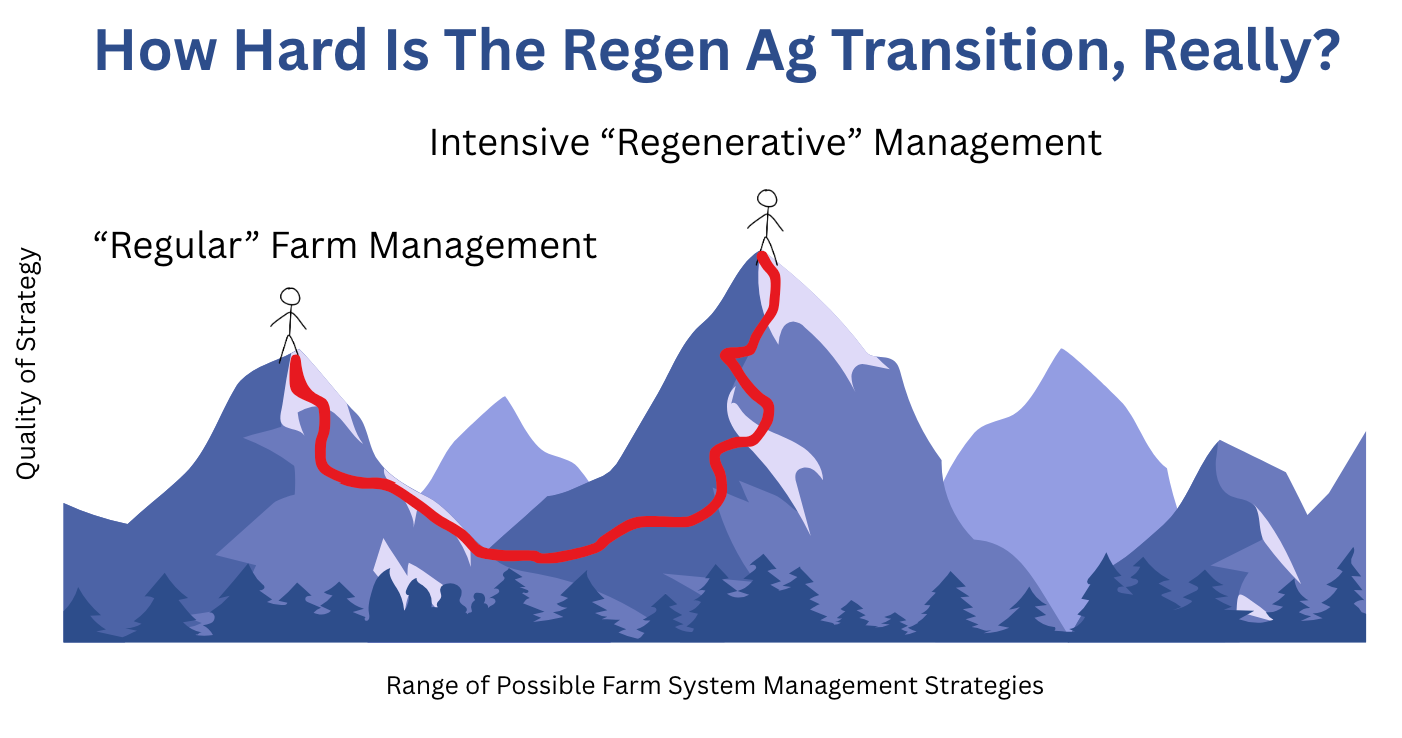
Now, am I arguing that a “regular management” farmer can never become the kind of master craftsman that “intensive management” requires? No! Of course they can. But I hope this allegory illustrates just how difficult and costly that transition is. The IKEA furniture-maker can’t simply watch a couple of webinars or go to a conference about “wood selection” or “furniture design” and then immediately suspend their IKEA order forever, throw out all their existing stock, and determine to be a master craftsman from that day forward. Neither can a conventional farmer.
So where does this leave us?
For one, I think it’s absolutely right that we should want (and demand!) more ranchers like this rancher— true agrarian craftspeople.
But at the same time, the idea that we will convince many, or all, of America’s farmers and ranchers to follow in her, or Gabe Brown, Joel Salatin, or Will Harris’s footsteps feels, frankly, unhinged. I would expect nothing less than widespread resistance to this effort.
But farmers and ranchers aren’t resisting the transition because they need $5 or $10 extra an acre, or a $100,000 grant, or a .25% discount on their operating loan to make the whole “investment” pencil out. Farmers and ranchers resist the transition to regen ag and “intensive management” because to undergo the transition would change their businesses in such a dramatic way that they are no longer a good fit to own and operate it. In fact, I think you could argue that the average American farmer or rancher does not currently have the right skillset, and maybe not even the right foundation, to successfully make the transition to regenerative ag.
Strikingly, the instructors of my soil health workshop essentially agreed with me on this. One of them said directly, “I think on many farms, what it will take to transition to adaptive management is for someone to die.” This “someone” is the generation of American farmers who control decision-making on most farms, and thus control a significant portion of our farm and ranchland, and who are, on average, nearly 60 years old.
This realization, of the real cost of the transition to intensive managment, offers some valuable clarity. First, for those who have made it their job to convince farmers to adopt regenerative ag practices, especially through the use of payments, this begs the question; is that working for you? Are these payments truly leading to IKEA farmers/ranchers undergoing the long and costly journey to become master agrarians? Or are you paying for them to make marginal changes to their IKEA assembly work, and in that way mainly helping to extend their ability to continue operating as they always have? And for those trying to support farmers who have raised their hand to do the IKEA-to-craftsman transition; how are you actually supporting them? Are you pushing them into cookie-cutter training programs that, rather than allowing them to be the captains of their own mastery journey, aim primarily to impose arbitrary outside standards? Are you lowering the price or smoothing the road to obtain “intensive management” skills, or are you just helping them buy fancier wrenches to assemble their IKEA furniture more efficiently?
Finally, all of this begs a tough question for all of us, farmers and non-farmers alike, to reckon with. If we want food, feed, fuel, and fiber that is cheap, that we can buy whenever and wherever we want and toss thoughtlessly as trends change, then we should not be pressuring all farmers and ranchers to make this transition. There is a place in our world for IKEA furniture (I own plenty of it myself!).
I say this because the kind of food, feed, fuel, and fiber that will come out of truly regenerative, intensively managed farms and ranches will be like our dining room table. It will be beautiful, delicious, and it’ll last for generations if we take care of it. But it will also be expensive, and most of us will be forced to buy much less of it than we do today. This doesn’t just mean more expensive produce and meat. It means less of it too. And less new clothes. And less driving. It’s easy to say “great, we want those things!” But when push comes to shove, will you be willing to take the bus for 50 minutes when the drive in your suburban takes just 15? Be honest, would you?
I know for a fact that even many of the most ardent regen ag advocates are not ready to make the kind of holistic sacrifices that a true regen transition would require. That’s something to at least think about before we spend billions more trying to make it happen.
Thanks for reading!
If you haven’t listened to the latest episode of Agribusiness Blueprint, we cover how our current Iran-related energy crisis compares to the 1970s, and how we can use the tools built back then to weather today’s storm.
No posts
Comments
Nothing yet. Say the first thing.
Sign in to join the conversation.