
In my last article I spoke about purchasing my own labs every 6 months to get a check in on my health and track trends. (click here if you haven’t read that one)
One of the trends I find interesting to track seasonally is Vitamin D - especially since I haven’t regularly taken any vitamin D supplements in many years now.
In this article I will talk about what’s actually realistic if you don’t plan on using supplements - my actual labs & why shooting for high levels might not be the flex you think it is.
I also talk about why just testing D3 can give an incomplete picture & the 4 patterns to look for!
Before we dive in and I share what my actual non-supplemented labs are:
Only 3 spots left for Blueprint Coaching & we start Monday June 22nd. Click here to watch the free info session & click here if you are ready to sign up!
Father’s Day picks:
If you’re shopping for the dads in your life this weekend (or honestly, for yourself) - I made a short list of amazon favorites - click here to check it out.
New Here? my Free Product guide + my Favorite Hair Care products FAQ Guide (updated) & my Updated Chlorine Protocol
If you’ve decided to get your vitamin D the way humans always did, from the sun and your food instead of a capsule, you’ve probably run into a confusing problem. You get your blood drawn, your number comes back, and somewhere online there’s a voice telling you it should be higher. 70. 80. “Optimal.” So you start to wonder if going supplement-free means settling for second best.
I want to walk through what the science actually shows about the numbers real people reach from sun exposure alone, because once you see the data, the picture gets a lot clearer, and a lot more reassuring.
I’ll also share some of my labs over the last few years since I’ve made the personal decision not to take vitamin D supplements.
And a quick note that this is not medical advice & Vitamin D needs and interpretation vary by individual; work with a qualified provider on testing and any changes to your routine, especially if your levels are low or you have a health condition that affects vitamin D metabolism.
Let’s start with the people who get the most sun on Earth, because they tell us what the human body naturally produces when nothing is limiting it.
Researchers studied traditionally-living populations in Tanzania, the Maasai and the Hadzabe, people who spend most of the day outdoors, year-round, at the equator. Lifelong, abundant sun. If any humans on the planet should have sky-high vitamin D, it’s them. Their mean 25-OH D came in around 46 ng/mL!
(More on the fact that they have darker skin in a moment, because it cuts in a direction you might not expect.)
Now look at sun-drenched modern people. A study of healthy young adults in Hawaii, latitude 21 degrees, with high habitual sun exposure, found that the maximum 25-OH level natural UV exposure seems to produce is around 60 ng/mL. The authors actually suggested using 60 as a sensible upper limit, because that’s roughly where the body tops out from sunlight no matter how much you get. And an analysis of San Diego beach lifeguards at the end of summer, none taking supplements, put their average around 45 ng/mL.
See the pattern? Equatorial hunter-gatherers, tropical-living adults, professional sun-exposed lifeguards, they all cluster in the mid-40s to around 60 ng/mL.
For context, the average American sits closer to 24 ng/mL, largely from an indoor life, so there’s real room to move up. But the natural ceiling, the number your body arrives at from genuine sun exposure, lands in a moderate range, not the stratosphere.
Here’s the mechanism that makes this make sense, and it’s the most important thing to understand if you’re going supplement-free: your skin will not overproduce vitamin D.
When UVB hits your skin, it converts a precursor into vitamin D3. But that same UVB also breaks down vitamin D3 and its precursor once you’ve made enough. It’s a built-in shutoff. This is why you physically cannot sunburn your way to vitamin D toxicity, your skin regulates the supply and stops when it’s had enough. There is no overdose switch on sunlight.
Click here to watch my free webinar on safe sun exposure if you are interested in learning how to get started with natural vitamin D safely.
A capsule has no such brake. That’s the real difference between natural and supplemented vitamin D, and it’s why supplemented blood levels can climb into ranges that natural exposure essentially never reaches.
So when your sun-derived number settles in the 40s, that’s not your body falling short of some higher target. That’s your body doing exactly what it evolved to do, making what it needs and then stopping.
A moderate, stable number from the sun is normal & not a reason to panic
If you’re not supplementing, your realistic number depends on a few things you mostly don’t control:
Your latitude sets the ceiling for half the year. Above roughly 37 to 40 degrees, the sun never climbs high enough in winter for UVB to reach your skin at all. Skin synthesis essentially shuts off from about October to March. So if you live in the northern US, Canada, the UK, northern Europe, expect a real winter dip, every single year, no matter how diligent you are.
MyCircadianApp (click here to download) - tells you exactly when UVB is available every single day & all year long (code SARAHK for a free trial)
Expect a seasonal curve, not a flat line. Studies in northern populations show 25-OH peaking in late summer and bottoming out in late winter, with swings of 30 to 40 percent between the two. A number in the 40s in August that drifts to the low 30s or high 20s in February is a normal, healthy rhythm, not a problem to panic-fix.
Your skin tone changes how fast you make it. This is the one people get backwards, so it’s worth slowing down on. Melanin is essentially built-in sun protection, it absorbs UVB, which is exactly the wavelength your skin uses to make vitamin D. So darker skin makes vitamin D more slowly and needs more sun exposure to produce the same amount. Lighter skin is the opposite: less melanin means UVB reaches the synthesis machinery more easily, so light-skinned people make vitamin D faster, with less sun.
That’s why in the settings of MyCircadianApp - we make you put in your skin type before estimating your vitamin D production.
Here’s the part that matters if you’re light-skinned and going supplement-free: that efficiency is helpful in low-light seasons and at higher latitudes, where every bit of weak winter or shoulder-season sun counts. You can reach a decent level with less time outside than someone with darker skin would need. That’s an advantage worth using.
HOWEVER - being light-skinned does not raise your natural ceiling or exempt you from the winter shutoff. Remember the Maasai and Hadzabe, who have very dark skin, still landing around 46 ng/mL.
Their darker skin slows the rate of production, but with lifelong equatorial sun they get there anyway, and they don’t overshoot, because the same self-limiting brake caps everyone. A light-skinned person isn’t going to blow past that natural range just by having less melanin; they’ll just arrive at their level faster.
And once winter removes the UVB at northern latitudes, skin tone is moot, nobody is making meaningful vitamin D from a sun that never gets high enough. So if you’re light-skinned, the takeaway is: you’re efficient, which helps you bank more during the months you can, but you should still expect the same moderate ceiling and the same seasonal dip as everyone else. Efficiency is not immunity from the calendar.
One more nuance for light skin specifically: that same efficiency means you burn faster, too. The amount of sun that gives you plenty of vitamin D may be well short of the amount that turns you pink. You do not need to burn to make vitamin D, in fact burning is a sign you’ve gone well past the point of any benefit. Click here to watch my free safe sun exposure webinar.
Your genetics set part of it too. A twin study found about half the summer variation in 25-OH was genetic. Two people with identical sun habits and identical skin tone can land at different numbers, and both can be perfectly healthy.
So a realistic, honest expectation for a supplement-free person: a summer peak somewhere in the 30s to 50s ng/mL if you’re getting consistent sun, drifting down in winter, with the whole curve shifted by where you live, your skin, and your genes. Landing in the 40s to 50s and holding fairly steady is a genuinely strong natural result.
I will share my labs by season below.
Here’s a freeing truth: the one number you’re handed is a smaller part of the story than people think.
The 25-OH D on your lab is your storage form, how much vitamin D you have banked. It’s the right number to track and the standard status marker. But your body also makes an active form (called 1,25-OH D) that does the actual work at the cellular level, and that one is a tightly regulated hormone.
Your body holds it in range on purpose, adjusting it based on your calcium, your parathyroid hormone, your phosphate. It doesn’t only rise and fall with how much sun you got.
Here’s something most people, and most doctors, miss: the standard vitamin D test only measures one of two numbers that matter.
The 25-OH D on your lab is your storage form, how much vitamin D you have banked. It’s the right number for tracking your status and your seasonal trend, and it’s what most of this article is about. But your body also makes an active form, 1,25-OH D, the hormone that does the actual work at the cellular level. And here’s the key: that active form is tightly regulated, your body adjusts it based on your calcium, your parathyroid hormone, your magnesium, and your phosphate. It does not simply rise and fall with how much sun you got.
This is exactly why I test both, and why I’d encourage you to ask your doctor for both (I purchase my own with Ulta Labs, because I have a hard time getting my doctor to order it). The two numbers read together tell you something neither one can alone. When they’re out of sync, that gap is the actual signal.
Here are the four patterns I walk through in my Safe Sun webinar:
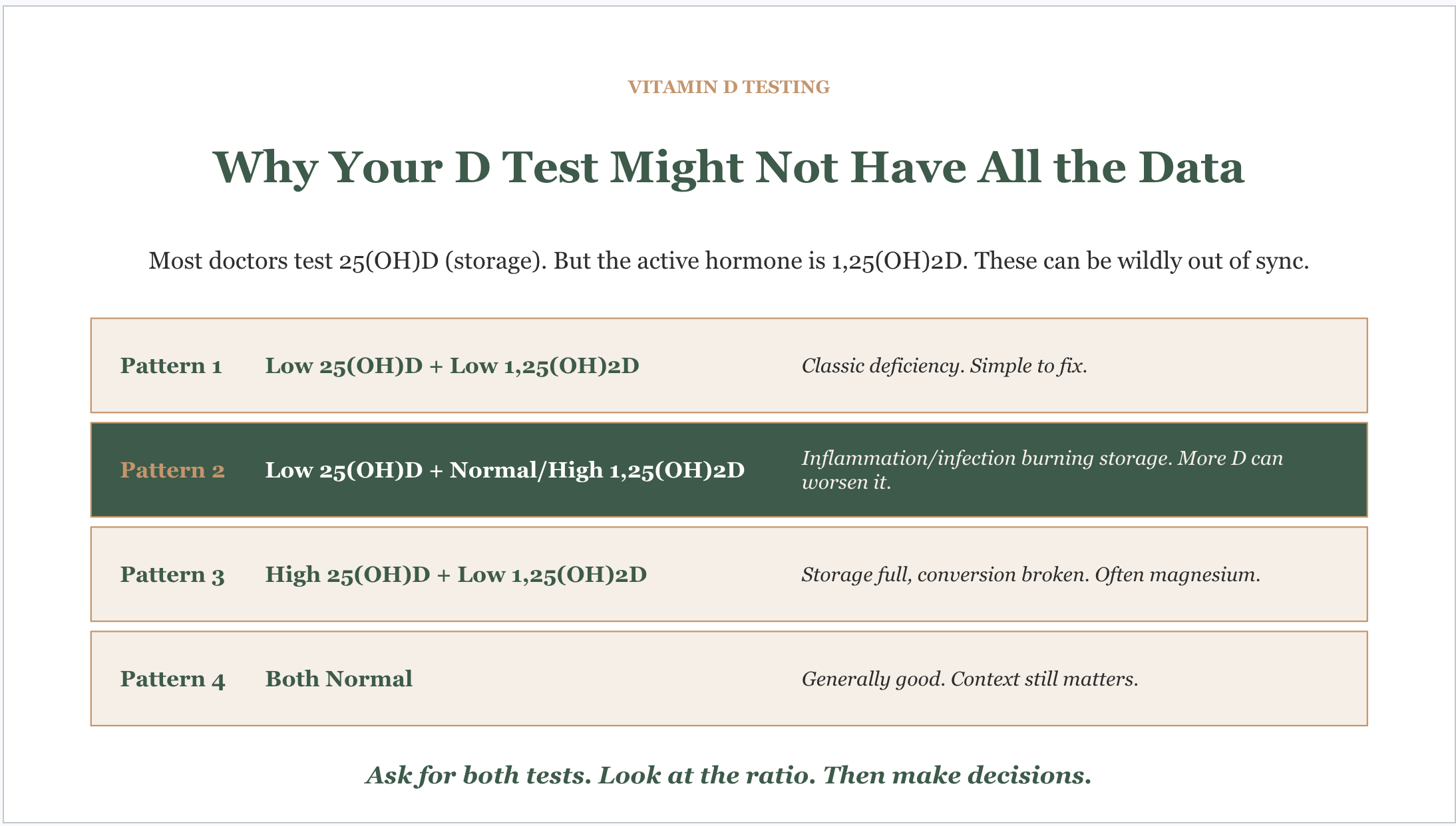
Pattern 1, low storage and low active. This is classic deficiency, and it’s the simplest to address. Both tanks are genuinely low.
Pattern 2, low storage but normal or high active. This is the one almost no one catches. When inflammation or infection is burning through your storage, or when low storage pushes your parathyroid hormone up to convert more of your limited supply into the active form, your active number can look totally normal, even high, while your storage runs down underneath it. If you only saw the storage number you might reach for a high-dose supplement, but here more vitamin D can actually make things worse, because the real driver is inflammation, not a simple shortage. This is the pattern that makes “just take more D” a mistake.
Pattern 3, high storage but low active. Here the tank is full but the conversion is stuck. The body isn’t turning storage into the active hormone efficiently, and that’s frequently a magnesium story, since magnesium is a required cofactor for that conversion. More vitamin D isn’t the answer here either, the bottleneck is downstream.
Pattern 4, both normal. Generally a good sign. Context still matters, but this is the picture you want.
See why a single number can mislead you? Someone in Pattern 2 or Pattern 3 can have a storage number that looks fine or even high, while the active hormone tells a completely different story.
Now, one honest caution, because I always want to be straight with you. The point of looking at both is to see the pattern, not to compute a precise “ratio” at home and act on it. You can’t 100% calculate a reliable ratio from two numbers drawn on different days or run by different labs, the values have to come from the same sample, measured the same way, or the math is meaningless. I learned this firsthand: my 25-OH came back 55 on one panel and 60 at a different lab in the same month, a five-point spread on the same body, same month, just different assays.
So look at both numbers, understand which pattern you’re likely in, and bring that to a provider who can read it alongside your calcium, magnesium, and parathyroid hormone. That’s how this information becomes useful, not by chasing a decimal.
That’s also why testing both is worth it. Not to collect more numbers to obsess over, but because the relationship between the two is where the real story can live, and it’s a story a single test can hide.
Most people don’t understand that an 25-OH reading can come back low even when your sun exposure and intake are perfectly reasonable, because other things in your body pull the number down. If your level surprises you, these are worth understanding before you conclude you’re not getting enough vitamin D (and supplements won’t usually fix these - talked about more in my safe sun webinar).
Body composition. Vitamin D is fat-soluble, and there’s a well-established inverse relationship between body fat and circulating 25-OH D. The leading explanation isn’t that fat “steals” your vitamin D, it’s volumetric dilution: the same amount of vitamin D distributed through a larger body volume produces a lower concentration in the blood. So the reading can run lower as a matter of distribution, not necessarily a true shortage of total vitamin D in the body.
Inflammation and autoimmune conditions. This is a big one and most people have never heard it. 25-OH D behaves as what’s called a negative acute-phase reactant, meaning that when inflammation goes up, the measured level tends to go down. Studies consistently show that as inflammatory markers like CRP rise, circulating 25-OH D falls. So someone with an autoimmune condition, or anyone in an inflammatory state, can see a lower number that partly reflects the inflammation itself, not just their vitamin D supply. It’s also why the low-vitamin-D-and-autoimmunity link is complicated: low readings are associated with several autoimmune conditions, but the arrow doesn’t point cleanly in one direction, inflammation can be lowering the number as much as the other way around.
Infections and acute illness. Same mechanism, shorter timeline. During an active infection or acute illness, 25-OH D can drop transiently as part of the inflammatory response, then rebound once you recover. The practical upshot: testing your vitamin D in the middle of being sick, or right after, can hand you an artificially low number that isn’t your real baseline. If you want an accurate read, test when you’re well, not when you’re fighting something.
None of this means a low number should be ignored. It means a low number is a question, not a verdict. Before you decide your sun-and-food approach is failing, it’s worth asking whether something else, your body composition, an inflammatory or autoimmune process, or a recent illness, is shaping what shows up on the lab. And those are exactly the kinds of questions to work through with a provider who can see your whole picture, not something to self-diagnose from one result.
We can also help you more in Blueprint Coaching!
You’ve probably seen it: a functional medicine doctor or someone with a big following insisting your level should be 70, 80, even higher, and that anything less means you’re failing your health. So if sunlight naturally maxes most people out around 60, should you take a supplement to push past that?
Here’s what the actual randomized trial evidence says, and it’s worth knowing before you spend money or worry.
The big supplement trials don’t support chasing 70 to 80. VITAL, the largest trial of its kind with more than 25,000 people taking 2,000 IU a day, raised participants to roughly the low-to-mid 40s ng/mL on average. The benefits that showed up were modest, a small reduction in cancer mortality that only emerged after about four years, and a possible late signal for fractures, and one widely cited analysis concluded that because the levels reached in the major trials were already in the high-normal range, it’s unlikely higher doses would have done more. In other words, the benefit plateaued right around where sunlight already puts you.
The threshold that actually matters is getting above 30, not reaching 80. Across the research, the meaningful risk reductions come from moving deficient people, those under 20, up past 30. Below 20 is where real trouble clusters. Once you’re comfortably above 30, and especially in the 40s to 50s, the curve flattens. Reviews looking at people who already have decent vitamin D status (above the mid-20s) generally don’t find that more supplementation moves the needle much on bone or non-bone health.
So where does the 70 to 80 number come from? Mostly from observational studies, the kind where people with higher vitamin D look healthier. The catch is that those studies are heavily confounded: people with higher vitamin D also tend to be the people who are outside more, move more, and are simply healthier to begin with, so their high D is often a marker of a sunny, active life rather than the cause of their good health. When researchers actually randomize people to higher levels in controlled trials, the dramatic benefits the observational data hinted at largely don’t show up. The 70-to-80 advice leans on the observational story while the trial evidence sits well below it.
In fairness, this is still debated. A minority of researchers argue the trials are flawed, that they enrolled people who were already replete, used modest doses, and ran too short, and they lean on observational and evolutionary data to argue for higher targets. That view exists and it’s held by serious people. But the weight of the randomized evidence, the gold standard, does not support medicating a healthy, naturally-derived level up into the 70s and 80s.
So to answer the question directly: if your body maxes out around 60 from the sun, there is no strong trial-backed reason to supplement your way higher. A natural level in the 40s to 60s isn’t necessarily a deficit to fix. It’s very likely at or near the top of where the evidence shows any benefit at all.
Here’s my own data, supplement-free:
Want the full year-round picture, including exactly why last spring’s numbers looked so different from this spring’s, plus all the scientific references for this article? Upgrade to paid.
Want my help directly? Grab one of the 3 remaining spots in Blueprint!
And if you have a question about if Blueprint is right for you - email me at info@sarahkleinerwellness.com
Comments
Nothing yet. Say the first thing.
Sign in to join the conversation.