
Hello, readers! I'm writing this in advance as I'm away on family business. According to my publisher, there is a $2.99 sale this week on my April 2020 book, Hiding in Plain Sight. I’m sharing excerpts because this book, unfortunately, never goes out of style. It covers Trump, Epstein, Kushner, and transnational organized crime in US institutions from the 1970s onward.
If you’d like to support my continuing research, the best way is to subscribe here:
The following excerpt is from a chapter called “The 1980s: Roy Cohn’s Orwellian America.” I wrote it in 2019.
* * *
Much like I do not remember the era of the American Dream, I do not remember a time before Donald Trump. In this respect, I am like most Americans: he has inhabited our collective consciousness for my entire life, which means he has been committing crimes, unpunished, for my entire life. He has been profiting off of American pain for my entire life, and American elites — the elites he pretends to condemn — have been enabling him for my entire life. That is the template of expectations for my generation and all that followed: crime committed brazenly is over time redefined as something other than crime. It is entertainment, and then it is autocracy, and then it is too late.
My mother, like other bored thirty-somethings of her generation, was fascinated with the Trumps, and hate-watched them as a hobby. She subscribed to Spy magazine, a publication dedicated to mocking and exposing the hypocrisies and crimes of elites. Spy ran in-depth investigatory pieces on Trump’s financial shakedowns, international circle of corruption, and marital abuses. Despite the snarkiness of Spy, these were serious articles, and they traveled to an unlikely audience due to the popularity of the magazine, which my mom saw as Mad magazine for adults.
You did not need to be a media insider or a political operative to know the dirt on Trump in the 1980s. I grew up in a house where the most fought-over magazine was TV Guide; we were ordinary people. But because of Spy, my family knew all about Trump’s filthy lucre. “Sarah, what the fuck,” my mother texted me in 2016, “why is no one reporting all the shit we knew about him when you were little? I need to find my Spys!”
Once a year, when I was a child, my mom would drive my sister and me to New York City to go sightseeing. This was a big deal, as we rarely ventured more than twenty minutes from our home, much less to places other people went for pleasure. Every time we would go to New York City, my mom would park the car near Trump Tower so we could walk in and use the public bathroom and “show Trump what we think of him!” Trump was synonymous with all that was terrible about America: greed, cruelty, stupidity, rich people. I remember giggling at the glitzy restrooms, an enthusiastic participant in my mom’s immature defiance of a world we could never enter.
There’s a bizarre tendency in New York media to, even now, position Trump as a “man of the people”: to posit that because he grew up as a mere millionaire real estate scion in Queens, he should be viewed as downtrodden because he was not raised as an even richer scion in Manhattan. No ordinary person has this view. By “ordinary people,” I mean people like my mom — a public school English teacher who enjoyed mocking a decadent asshole. By “ordinary,” I mean people like the innocent teenagers in the Central Park Five, whose reputation and lives Trump worked to destroy.
By “ordinary,” I mean pretty much anyone in the tristate area who read Spy, or the New York City tabloids, or who watched Lifestyles of the Rich and Famous and thought he was both a jackass and a joke — which meant basically all Americans by the time his bankruptcies and first divorce hit in the early 1990s. By “ordinary,” I mean everyone who did not know Trump personally and therefore could not be bribed or blackmailed by him or his inner circle. We were the useless people, the free people.
That a significant number of today’s high-profile journalists did know the Trump family personally is cause for concern. We now live in a world where products of nepotism inundate industries like journalism, a field often reporting on other products of nepotism in business and politics. These powerful sectors of society have been overtaken by connections rather than merit, and dynasties rather than unbiased workforces. These conditions do not guarantee that coverage must be terrible. While wealth does not indicate merit, it also does not inherently destroy it. Any person can choose to do a good job and tell the truth.
But the domination of nepotistic elites in national media over the past two decades has warped public perception of what “ordinary people” thought of Trump, and of what information about his corruption is thought fit to print. The transformation of the media into an industry for elites who may not recognize white-collar corruption as abnormal — or who may be reluctant to upset their family or social circles by revealing a crime — is described in depth over the next few chapters.
The late 1980s brought a flurry of accountability for Wall Street criminals and dirty Republicans — Michael Milken, Ivan Boesky, Leona Helmsley, the felons of the Iran Contra cases — but Trump was not among the indicted. However, he did not escape the bottoming out of the greed decade unscathed. By the end of the 1980s, Trump properties had gone bankrupt, and some were tarnished by their connection to tragedies and crimes — such as the 1989 freak helicopter crash that killed top executives running his dying Taj Mahal casino. (Trump callously blamed his financial ruin on their deaths.) In 1990, Wall Street bond house Salomon Brothers advised clients to bail on Trump Castle. In 1991, Trump declared bankruptcy, and by 1992, he had lost all his signature properties, with the exception of Trump Tower. He sold Khashoggi’s surveillance yacht, which he had renamed the Trump Princess.
* * *
Trump’s marital life imploded at the same time he lost his fortune, and his divorce from Ivana prompted a tide of tabloid tales. The media coverage of this era is notable because of the sense of profound relief that emerges from mainstream publications, which, unlike SPY and Wayne Barrett’s reporting at The Village Voice, had been functioning as flacks for reasons yet to be entirely discerned. A 1990 New York magazine profile confesses that media coverage stemmed from both laziness and the ceaseless drive of both Donald and Ivana to make themselves available, even if the reporting was unflattering and the ratings were low:
“The deep secret of all Trump coverage is that it is cost-effective news — Nielsen ratings and newsstand sales aside. Everything is easily available: the lawyers’ statements by fax, the PR quote for the day, the file footage of all the principals, the photo opportunities at convenient midtown locations — near news offices and TV studios. Trump vs Trump is accessible. That’s why it may run forever,” wrote Edwin Diamond in a March 1990 column titled “Bonfire of the Inanities.”
That was 1990. Now transpose this internal logic into a world where national media is conglomerated in elite coastal cities like New York, digital and cable stories must be produced in a frenzied 24/7 cycle, fact-checking is on the wane, and the lines between news and entertainment — and truth and reality — have blurred, creating an infotainment nexus driven as much by the need to fill space and kill time as it is by the desire to make money. That is the media world that Trump inhabited in later decades, one whose vulnerabilities he understood intimately, for he had helped create them.
In later chapters, I describe how this loss of leverage in the media occurred, and how Trump capitalized on it, but it is critical to observe how early the seeds of destruction were planted—and that the media reaped the harvest of its own demise. One of the most striking examples is the coverage of the divorce itself. In 1990, Trump was brought low after decades of flagrant highs, and journalists pounced. Roy Cohn was dead and no longer a threat, and so Trump exposés abounded as Ivana opened up her own world to the press.
These included scathing early 1990s Vanity Fair profiles in which twelve-year-old Donald Trump Jr. told a reporter that Trump did not love him, did not love himself, but only loved his money; to the 1993 book Lost Tycoon by Harry Hurt III, which declared that Trump did not know how to have sex with women and describes Ivana purchasing a book on female orgasms and announcing “I have to give this to The Donald; he can never find the spots.” From the start of the marriage, their terrible sex life, wrote Hurt, had sent Trump running back to Roy Cohn, who was forced to write a new prenup to placate the sexually unsatisfied Ivana. Hurt’s book paints a disturbing picture of Trump’s conception of love and consensual sexual relations.
The worst revelation of Hurt’s book is one that was made in Ivana’s 1990 divorce deposition and reemerged during the 2016 campaign: : Ivana had said at the time of her divorce that Trump, angered by a painful scalp reduction surgery to remove a bald spot conducted by a doctor Ivana recommended, grabbed her, pulled out hair from her own scalp, bellowed, “Your fucking doctor has ruined me!,” and raped her. The deposition papers describe a terrified Ivana hiding in a closet in the hours after the rape, emerging in the morning to find Trump sneering at her, asking: “Does it hurt?” (Before Hurt’s book was published, Ivana had retracted her testimony, saying she was not raped “in a literal or criminal sense”.)
When Trump’s 2016 campaign began to pick up steam, making Hurt worry he may become the candidate, Hurt asked his publisher, Norton, to reissue Lost Tycoon. But they told him the thirty-three-year-old book was now “too dangerous to publish.” Hurt ended up republishing it himself on Kindle to try to get the word out. In 2015, a Daily Beast reporter wrote a piece detailing the alleged rape of Ivana and was threatened by Trump’s aspiring Roy Cohn replacement, lawyer and future felon Michael Cohen.
“What I’m going to do to you is going to be fucking disgusting. You understand me?” Cohen told the Daily Beast reporter. “You write a story that has Mr. Trump’s name in it, with the word ‘rape,’ and I’m going to mess your life up . . . for as long as you’re on this frickin’ planet . . . you’re going to have judgments against you, so much money. You’ll never know how to get out from underneath it.”
These threats were reported in The Daily Beast along with details of the rape. But they did not make it into most mainstream coverage of Trump. Hurt tried to get the story of Trump’s history of sexual assault on cable news, only to have CNN cancel on him multiple times—until the Access Hollywood “grab ’em by the pussy” tape forced the topic into the public eye. In winter 2019, in his federal testimony, Michael Cohen admitted to making at least five hundred threats under Trump’s orders for over a decade, describing him as akin to a mafia boss—without using the word “mafia” itself.
Other reporters who had covered Trump’s early criminal history were silenced. Acclaimed journalist David Cay Johnston, author of multiple bestsellers about Trump, noted that in addition to refusing to cover the rape of Ivana, the 2016 press would not report on Trump’s documented ties to organized crime:
“If people knew more of the truth about Trump and what he’s doing to our government, we’d be seeing more protests,” he told The Nation. “For example, they have no idea about his years of dealings with a confessed drug trafficker. [The trafficker is Joseph Weichselbaum, indicted in 1985 for running a cocaine ring, who lived in Trump Plaza and was defended to the judge by Trump as a character witness in court; after serving a minor sentence, Weichselbaum moved into Trump Tower, purchasing a $2.4 million apartment in cash.] And my fellow journalists didn’t report that; I offered them all the documents and they wouldn’t print it.”
Trump covers up crime with scandal. That is his main propaganda tactic, the one few seem to be able to discern. He would rather be seen as a married man who had an affair than a man who raped his wife and assaulted countless women and girls. He would rather be seen as an overconfident tycoon racking up bankruptcies than a skilled and powerful man associated with the mafia running a series of shakedowns for foreign backers. He would rather be a president mocked as an idiot in a “Make America Great Again” cap than be known as a vindictive traitor who seeks to strip America down and sell it for parts. The crimes are much worse than the scandals, but the media will always take the scandal bait.
The public, having been assured that it’s just scandal, it’s just Trump being Trump, will then surrender its own demands for accountability. This is called “normalcy bias”: the idea that if a situation is truly dangerous, if massive crimes are being committed in plain sight, someone will intervene and stop them. “Normalcy bias” is the psychological counterpart to “American exceptionalism”. You can see these dual myths at play in every massive American oversight turned tragedy, from 9/11 to the war in Iraq to the 2008 financial crisis. (Notably, you see many of the same elite scammers, men who profit off the good faith that informs normalcy bias, in each of these atrocities as well.)
But no one held Trump accountable — not in the 1980s, not now. That is to say, no one held Trump accountable in a meaningful way, the only way he and his criminal kind recognize: indictment and imprisonment. He remained a distant folk villain, a TV and tabloid monster, a threat outside my orbit. I could walk in and out of Trump Tower as a little girl and not feel afraid. It never crossed my mind that, thirty years later, this man would endanger my life.
* * *
Order Hiding in Plain Sight here. The $2.99 sale should be wherever ebooks are sold.
Readers — I’m offline this week to spend time with my family in light of my father’s recent death. I’ll be back later with new articles. Thank you for understanding.
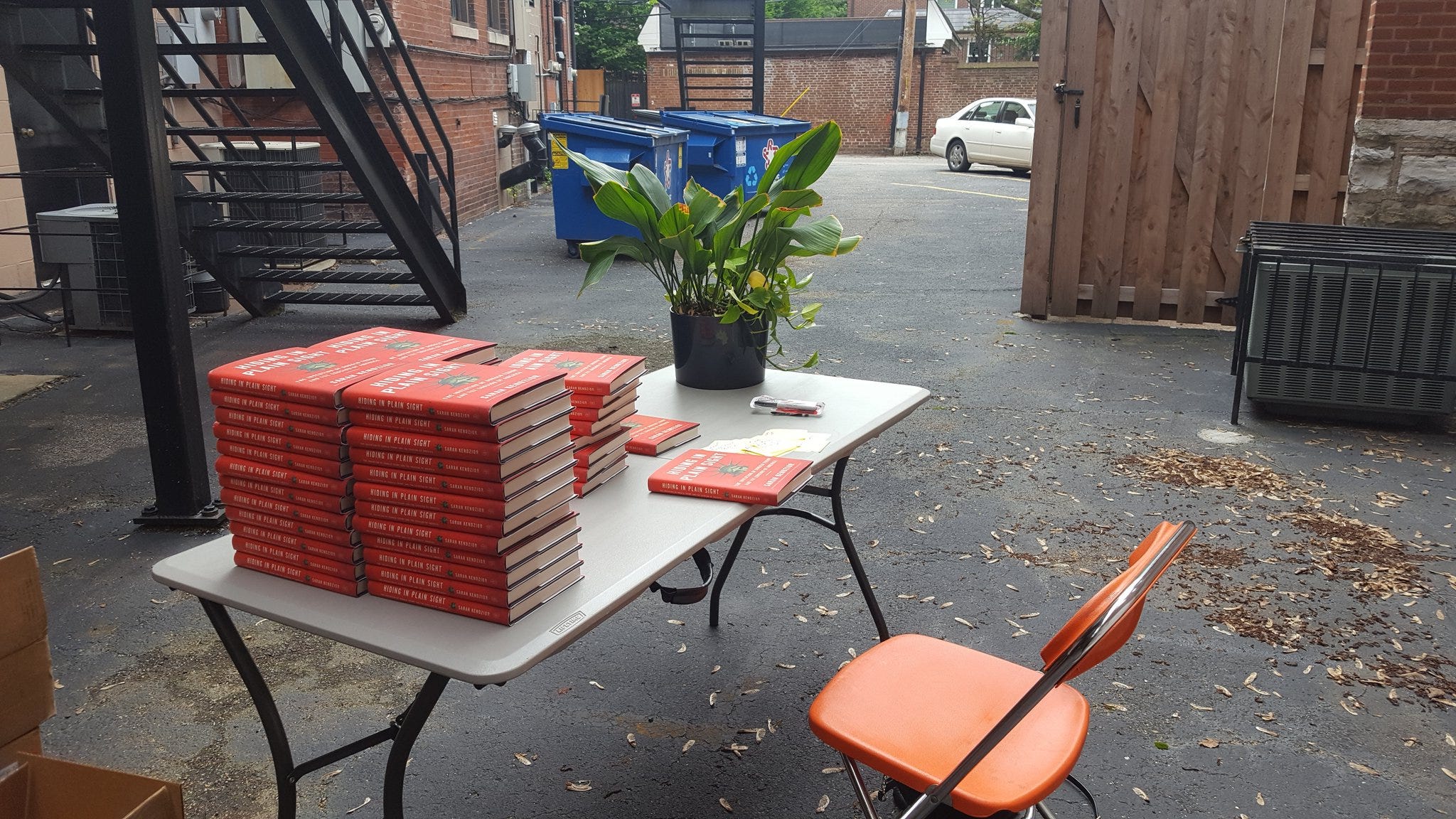
Signing Hiding in Plain Sight behind Left Bank Books at the start of the pandemic. It is so 2020 to sign a bestseller about Trump in a back alley near a dumpster.
Comments
Nothing yet. Say the first thing.
Sign in to join the conversation.