
Despite being an avid reader since pretty much birth, thoughts about reading fiction as frivolous, “just entertainment,” or not productive, have long haunted the back of my mind.
As an English teacher, I’m sure it comes as no surprise that I highly value reading. Stories can be incredibly powerful. They help readers build empathy, shift perspectives, and teach emotional intelligence and creative thinking. They also remind us we’re not alone—arguably one of the most valuable reasons for reading.
Yet I put off my writing dreams for decades because writing fiction didn’t feel “important enough.” At least not in the same way as that time I went to law school to try to save the whales.
This even came up in conversation with a friend recently. I’m having so much fun writing the current series of novels I’m working on that I told her this felt like the thing I was born for. But then I immediately followed that up with: “But is it kind of weird that I think my purpose in life is essentially to live inside an imaginary world with imaginary characters?”
In fact, I’m so inside this “imaginary world” that it was really difficult recently to write something that I knew would emotionally devastate my characters—even though it’s pretty much an author’s job to throw a bunch of obstacles in their path or else there’s no story. But because my characters feel so real to me, it hurt anyway.
But I also learned something. Because going through that emotional journey alongside my characters is actually the very thing that expanded my perspective on the value of fiction.
Before I get there, just a disclaimer: I would never argue there’s anything wrong with reading (or writing) for escapism. I now understand that believing writing fiction wasn’t an important enough thing to do with my life was really a form of self-sabotage—to avoid doing the very thing that makes my heart sing—and joy is reason enough to do anything.
Escapism can also be highly valuable. Sometimes we need comfort, adventure, hope, or simply a break from the world. I fell in love with cozy fiction when I became the primary caretaker to my dad, whose health is slowly declining due to vascular dementia. Reading cozy books helped me cope with the depression I experienced.
But even just escaping the day-to-day stressors of normal reality is reason enough to pick up a book. Honestly, doing anything just because we love it can absolutely be the whole point. I’ve been reading for the sheer pleasure of it my entire life.
But now that I’ve knocked out drafts of the first three novels in a 12-book cozy mystery series, I’ve also experienced something even deeper about the value of reading and writing—and that’s that stories can also be a vehicle for personal growth.
The creative process is endlessly fascinating to me because we never quite know what will surface. One thing I’m noticing surfacing now: There is some actual truth to writers writing what they know.
What seems to be surfacing naturally—all on its own—are my characters’ internal struggles. Apparently, they’re also mine.
Here’s what that’s teaching me about the value of fiction: I’m noticing that as I write certain scenes where they have to confront some kind of internal obstacle, it often mirrors (completely unintentionally) something I’m going through or have been through.
For example, I was raised by a father who dealt with his anxiety by trying to control everything, including his kids. It meant that once I grew up, autonomy became extremely important to me, to the point where it’s triggering whenever I feel like anything external is controlling my choices (people or circumstances). Guess what my protagonist is struggling with in the draft of the book I just finished?
But it’s not just the situation. It’s also the journey. Writing my protagonist’s experience helped me see it in a new way. So much that it helped heal something in me in the way I saw my dad.
I used to see him as the person who taught me to be afraid of living my own life—because I didn’t trust myself, other people, or the world around me. Now I see him more clearly as someone who suffers extreme anxiety due to the multiple traumas he experienced in his own life.
In other words, he’s a man so terrified of loss, he did the only thing he knew how to try and prevent it—control everything around him. And the more clearly I see my dad, the less I make it mean anything about me.
Granted, I’ve had years of therapy. But writing this character helped me finally overcome the last hurdle in forgiving my dad. And now, I don’t feel as reactive or triggered to perceived control, because I know I get to make my own choices, even when external circumstances may feel otherwise—because I always get to choose how I respond to them. I’m also trusting myself more because it’s become easier to separate his voice in my head from my own.
This means that my character’s growth arc helped heal my own. And it all took place inside my imagination.
So who says stories are “just” escapism?
Stories help us find meaning, connection, and belonging. They also show us who we are and who we can be. That’s because the best stories transform characters from who they were into who they become—exactly because of all those obstacles we authors throw in their path to make a story a story.
In fact, one way to see stories is through characters’ wants and needs. Their wants are their external goals, but their needs are the internal thing they have to grow into understanding. Often, for characters to get what they want, they have to grow (discover what they need), which means their primary obstacle isn’t necessarily external. Often, their biggest obstacle is themselves.
That makes character growth one of the basic ingredients of a compelling story. It’s also the part that makes reading most valuable, as I see it. Because character is the part that we connect with—that helps us feel seen and understood and that we’re not, in the end, alone.
And character growth shows us not only who we are, but also who we can become.
Fiction can absolutely be escapism, and sometimes that is exactly what we need. But fiction can also do something deeper. It can help us understand ourselves, other people, and the world we live in. And often, the best stories are the ones that change how we see something and bring us back to our own lives with a new understanding.
Have you ever read a book that changed you?

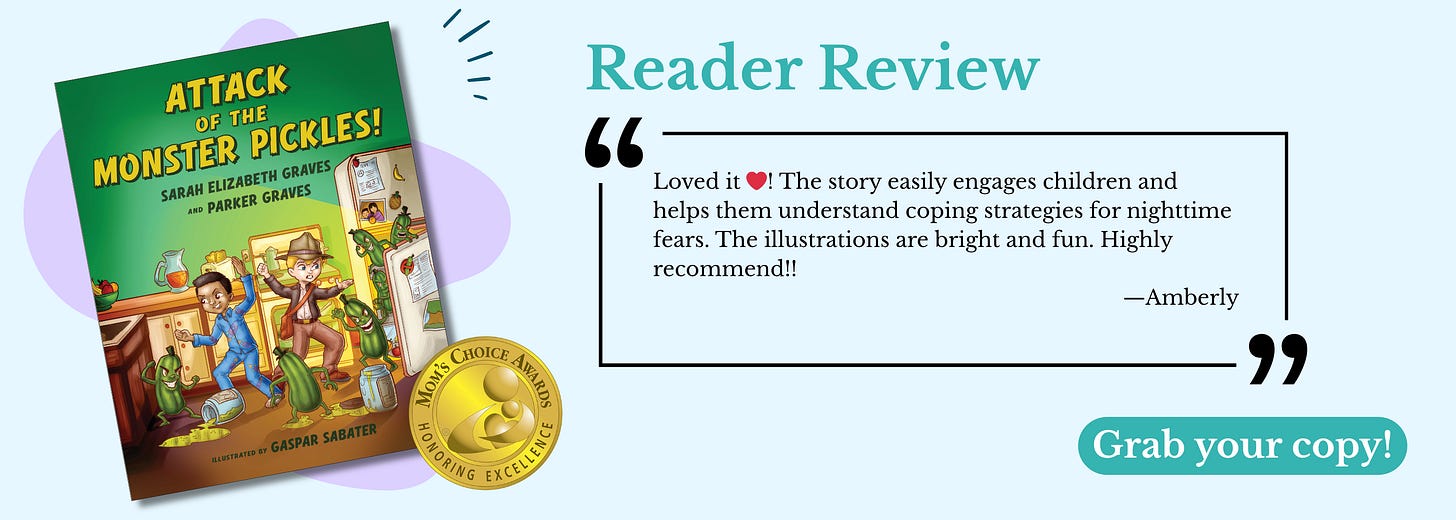
Looking for a picture book for readers ages 6–8 that’s full of the kind of silly fun kids love and a powerful message parents and teachers can get behind? Use your imagination to turn bedtime fears into monster-sized courage with Parker’s and my award-winning picture book, Attack of the Monster Pickles!
No posts
Comments
Nothing yet. Say the first thing.
Sign in to join the conversation.