
As a career educator, I’ve noticed something interesting about the way we teach school subjects. We often put science and reading into separate boxes: this is literacy time; this is science time.
But both begin with the same thing: Curiosity.
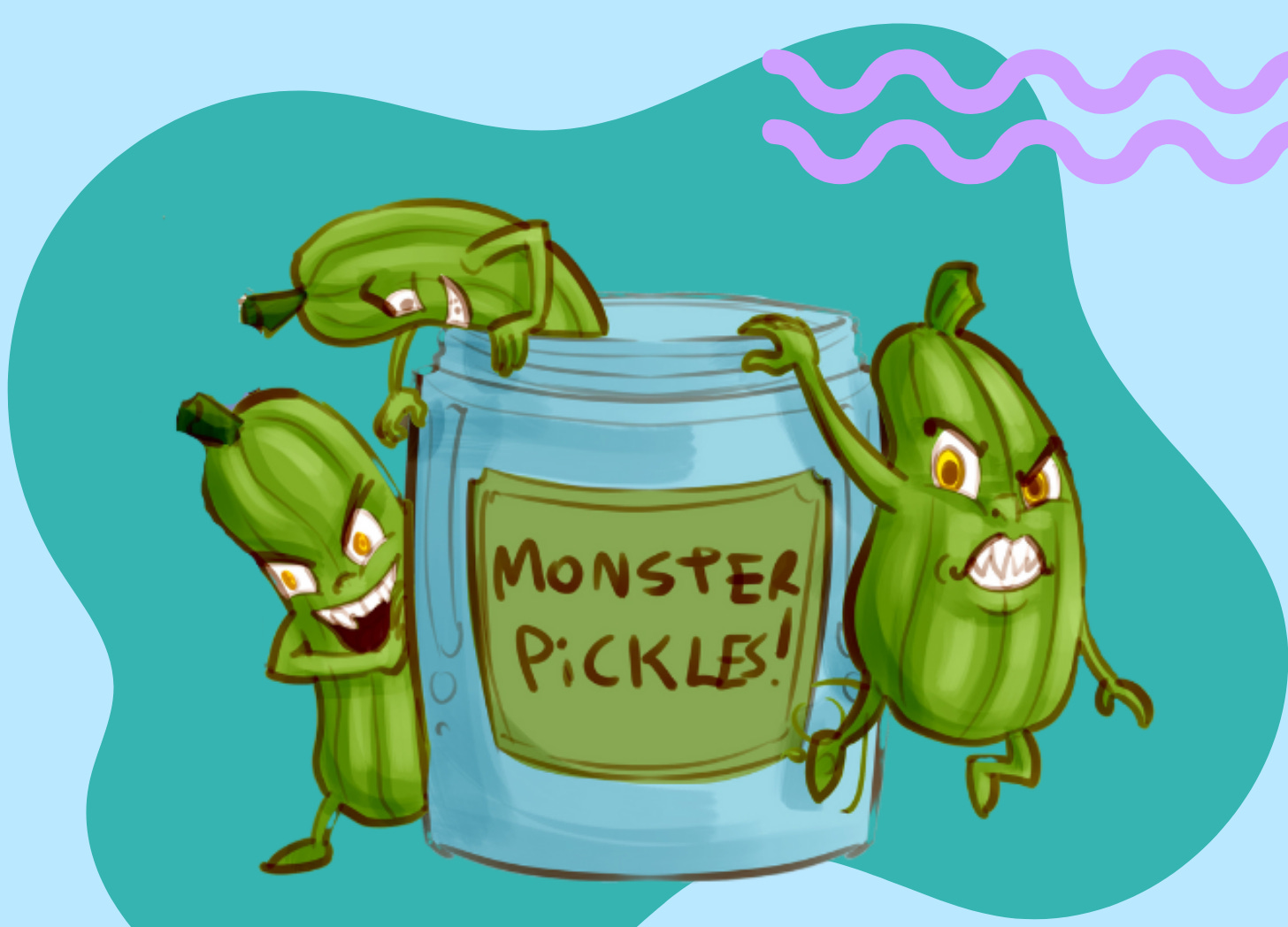
Writers often start with a “what if?” question. Attack of the Monster Pickles!, the book I wrote with my son, began with Parker asking: “What if the house noises I keep hearing at night are actually pickles that came to life in the kitchen?!?”
And from that one wonderfully weird question, an entire story grew.
Reading works much the same way. A title, cover, premise, or back-cover blurb makes us wonder what’s going to happen—and we keep turning the pages because we want to find out.
Science starts with wondering too. Before we form a hypothesis or run an experiment, we ask a question: What will happen if...? Why does...? What if we try...?
Which means stories and science may belong together more naturally than we sometimes realize.
A story set in space might make a child wonder how rockets work. A book about sharks might lead to questions about ocean animals. And a story about giant monster pickles? Well, there are definitely some weird science possibilities there.
Parker has always loved both stories and science, and I don’t think that’s a coincidence.
I’ve watched him read about something and then want to explore it for himself—from exploding baking-soda-and-vinegar volcanoes to blocks of sand filled with “dinosaur fossils.”
Books have inspired trips to the zoo to learn more about animals, trips to the beach to collect seashells, and all kinds of experiments at home.
One of his favorite book series, Goosebumps, even gave us a perfect excuse for science. After reading about the strange, blob-like Monster Blood, making slime became an opportunity to learn about polymers.
The story sparked the curiosity, and then the curiosity sparked the learning.
There’s something else I’ve learned from Parker: if I announce that something is a learning activity, his enthusiasm tends to disappear pretty quickly.
As a kid with ADHD, he’d much rather follow his own curiosity than sit through a lesson simply because someone has decided he needs to learn something.
But when he’s following that curiosity? He’s learning all the time.
He might not be particularly interested if I say, “Today we’re going to learn about the science behind pickling.” But: “Hey, want to see what happens if we leave a cucumber in vinegar?” That’s a completely different proposition.
Suddenly, we’re exploring osmosis—but it doesn’t feel like a lesson. It feels like finding out what happens. And that distinction can make a huge difference.
Of course, the giant monster pickles in our book aren’t exactly scientifically plausible. 😂
But stories don’t have to be realistic to make kids wonder about the real world. Once a child starts asking questions, you’ve got an opening for investigation, experimentation, and discovery.
Because stories and science both start in exactly the same place: What if?
There’s a reason imagination and learning work so well together. Curiosity asks the question. Imagination helps us picture the possibilities. And then we get to investigate what might actually be true.
Using stories as a springboard for STEM can make learning feel less like something adults are assigning and more like an extension of a child’s own imagination.
And you can do it with almost any book. A story about winter animals can lead to experimenting with fake snow. A story about cities can inspire kids to build structures with blocks or toothpicks and marshmallows. A book about flight can turn into an experiment comparing different paper-airplane designs.
The important part isn’t choosing the “right” activity. It’s noticing what makes your child wonder—and following that question a little farther.
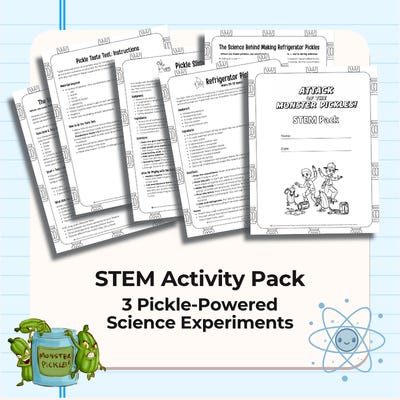
I created three free hands-on pickle science experiments inspired by Attack of the Monster Pickles! for kids from preschool through upper elementary—and, honestly, anyone else who thinks experimenting with pickles sounds fun.
Kids can:
make their own “monster pickles” while exploring osmosis
create “pickle life support” while learning about polymers
investigate different kinds of pickles using their senses of taste and smell
It’s silly science, hands-on learning, and story-inspired curiosity all rolled into one.
You can grab the free Monster Pickles STEM Pack here. 👇
Thanks for reading! Liked this post? Show it some love and smash that like button! 💜 (It helps other readers find it too.) Know someone who would also enjoy this content? Hit the “share” button below! 👇
Like FREE Stuff? (Who doesn’t? 😜) Visit my website for tons of free printable kids’ activities—many with done-for-you lesson plans! Perfect for parents looking for summer activities for their kids or teachers planning for fall lessons.
AI Disclosure: I use AI tools like Grammarly to help me with copyediting and ChatGPT for editorial feedback and occasional brainstorming. I never use generative AI to write for me. You can read more about how I do and don’t use AI at the bottom of my About page.
No posts
Comments
Nothing yet. Say the first thing.
Sign in to join the conversation.