
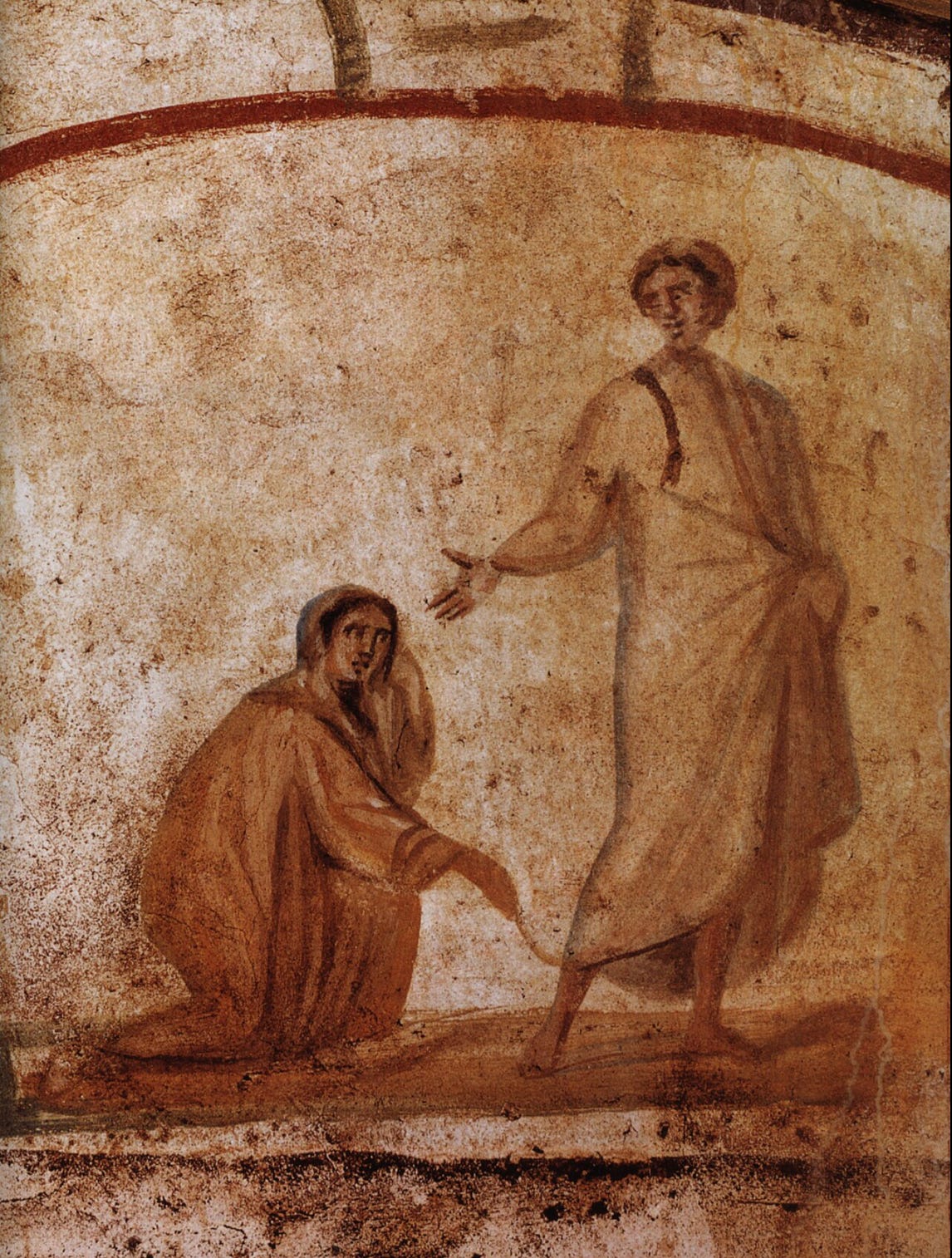
One of my favourite stories in the Gospels is the one about the healing of the woman who touched just the hem of Jesus’ robe. Afflicted for twelve years by a ‘discharge of blood’, her resources spent on doctors who could not help her, this woman allowed her bleeding, sore body to be jostled by the crowd, shoved this way and that, until the current of curiosity and need shoved her right up against the Person she sought.
It’s easy to imagine why she didn’t call for his attention, didn’t risk the gaze of the throng. An illness such as hers would be deeply tinged with dirtiness and shame. In a great irony, anyone who happened to touch her in her quest for cleansing might consider themselves unclean. So she, with a real, but timid faith, touched the hem and thought herself unseen.
But she was healed. She was healed. And then she was summoned.
The way the story is told in Scripture makes it clear she wasn’t just reluctant to come forward, she was hiding. She was probably standing in any shadow she could find, blending in, crouching down. And she almost succeeded. The disciples scoffed at Jesus’ demand to behold the person who ‘touched’ him in a crowd of dozens if not hundreds, all pressed up against each other in their own particular need to touch him. But he broached no refusal, and as one translation has it, ‘when she saw that she was not hidden’ she came forward, and the stark words of it should move the even the cold heart to tears, for she went ‘with trembling to kneel down before him’.
She had hidden because she expected to be condemned.
The miracle of what happened next was perhaps as great as the health now radiating through her body. Jesus looked upon her and knew her and praised her. He uncovered her not for judgement, but to help her understand she was not, and never had been hidden from him. She was known to her healer and he was proud of her. Her Maker and her Savior was not content for her to glimpse his back, and assume herself lucky with the table scraps of mere health. Her wound was shame as much as any malady of blood and the only healing for that was to be seen. Seen without rejection, seen with love, embraced by praise.
It’s the particularity of it that makes me ache.
Have you ever noticed that Jesus never performs a general healing? How easy it would have been for him to lift his hands over a crowd and command everyone in a general way to be healed of whatever disease they bore. How efficient. But Jesus never healed people, he healed persons.
Mostly, because He was a person, limited as we all are to a single body, to two reaching hands, two eyes capable of facing only one direction at once. Jesus, as God became a single, embodied human, insistent upon the preciousness of personhood, of each particular, irreplaceable, unrepeatable person. He did not generally heal because the love he came to proclaim was not general.
The love of God is radically particular, distinct in shape and expression, a love that cherishes the odd, embodied particularity that is you, me, in a comprehensive knowing we have experienced perhaps never, or perhaps only in the fragmented sacrament of parental affection or romantic love or a deeply generous friendship.
The gaze Christ had for that woman in that moment, one that revealed her not for rejection, but for comprehensive renewal, is the gaze I believe we are called to bear to and for each other. His healing doesn’t continue in a general way, it continues through the eyes and hands of those who love him, who have been loved and seen by him. Christ plays and looks upon the broken in ten thousand places, as Hopkins would say, lovely in eyes not his own but… ours.
We are meant to look in love as he looked, to ‘see’ with the eyes of His Spirit, to act with the radical generosity of his love.
I don’t take in much news anymore but as a postpartum mother interested in the landscape and cultural understanding of mental illness in the modern world, I cannot escape a little knowledge of the current trial of Linsday Clancy, a woman who killed her three children in a moment of (contested) postpartum psychosis.
The grief and mystery and evil and need of the case are more than I can parse out. I am grateful not to bear the burden of discernment that jury must carry. But when I read the long list of medications thrown at that woman in her overwhelming anxiety, when I see the number of times she asked for help, described a sense of dread beyond her capacity to bear, I think of the woman clutching at Jesus’ hem, too shamed to even speak out loud the nature of her ailment.
He saw her. He insisted upon looking at her. Jesus saw this woman we can barely look at, Lindsay. Beholding her in a knowing love that encompassed not just the fact of her illness, but the shame she bore, and the grief she carried, and the things she was too terrified to speak.
I wish that broken, violent mother could have known that gaze. I wish that she could have been seen and treated not just as an illness, with medications tossed at her symptoms like food to a hungry pet, but as a person. I wish her shame and fear could have been treated as an illness equal to the intrusive thoughts or violent ideas she suffered. I wish her husband could have looked at her comprehensively enough to grasp the depth of her desperation.
That gaze, that cherishing gaze that encompasses not just the broken state of our bodies, but of our hearts, it’s the only hope for the healing of the world. But the particularity of Jesus’ gaze in the Gospels is not just something we receive, it is something He asks us to learn how to give.
‘Love one another as I have loved you,’ he said on the eve of his loving death. How can we, actually? What an impossible task!
We live in a world that makes it difficult to offer the gaze of love to any one person or thing. Our eyes are ceaselessly beckoned from this image to that person. A hundred faces, a thousand needs may cross our sight in a day. I think this can be disabling. I also think it can leave us complacent and strangely incapable of seeing the quietly desperate person in front of us. We can’t, of course, see all these scrolled faces, these headlined people, these wild needs.
But we aren’t called to see a thousand people with an incarnational gaze. We aren’t asked to behold a hundred souls in the way that Jesus beheld that woman.
We’re just asked to see the person right in front of us in that world healing way.
Sometimes it’s a spouse or a child. Sometimes a friend. Sometimes it really is the stranger or the homeless woman or the refugee. Sometimes it is the mentally ill parishioner who says annoying and difficult things most weeks but never misses a service. Sometimes it’s the neighbour who asks too much for comfort, or perhaps not enough for friendship. Sometimes it really is the mentally ill, depressive mother who is closer to desperation than anyone suspects… until you look. Sometimes… it’s ourself.
But that gaze, that potent, gathered attention is one of the great works of faith in our world, the great proclamations of God’s particular, transformative love.
Who then, will you look at today?
I’m off to do some close attending myself…
Thanks for reading From the Vicarage! This post is public so feel free to share it.
Comments
Nothing yet. Say the first thing.
Sign in to join the conversation.