
When we feel called to learn a new language, we are being wooed.
Learning to listen requires a patient grace we rarely afford ourselves. Instead, we stay caught in the noise, addicted to the constant production that leaves us bone-tired. We confuse momentum with growth, and doing with becoming.
In this essay, I am exploring the language that is seducing me, and what it costs to actually stop and follow it. Clumsily, yes. Slowly, yes. But it feels like the whole world is shifting beneath my feet.
What beautiful thing may be trying to speak to you?
The full reflection continues below for paid subscribers.




I’m remembering how my children learned to speak. Before any words formed, there was so much listening and attending to. They were absorbing the world, soaking in the rhythm and letting the sounds settle inside them before they even attempted a response. Then came the babbling, sifting, and probing, enduring the exhausting threshold of trying to understand and be understood. It took years of attentive silence, slowly and patiently linking together the tones and echoes that would eventually form a bond. From there, the connection grew fluid, strong, and alive, but it began in absolute attunement.
Lately, I sense I am being asked to learn in much the same way. I can hear the stirring of another language, not a human one, inviting me into conversation. I realize how much faith it requires to move toward something you can’t grasp. Long before meaning, there is only attraction; something calls and we turn toward it, not knowing where it will lead, only that some instinct keeps drawing us closer. I don’t know how to speak it yet, or what exactly I am listening for, but something inside is twisting alive, and I want to follow it deep into the forest where it speaks its strange tongue.
I wish I could extend that same mercy to my own body, the mercy of simply listening and being unformed, when I meet something so wild and unfamiliar. Yet I find myself impatient with the silence and waiting. I struggle to recognize that I am a student to something that does not hurry, something that never dishonors the long abiding.
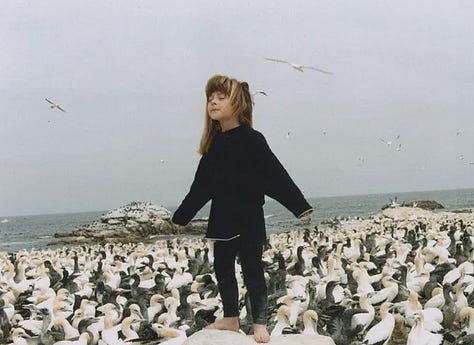
My ears perk to a song sparrow call from the thicket as a warm midafternoon wind presses against my skin. The lake’s great body speaks wildly supportive words, and the trees look as if they are bowing toward me, waiting for me to say something back. For what reason, I am not sure, but something hidden a few layers deep remembers what I did when I was very new to this world, swimming in the water of sound and messages, attuning my whole life toward a single voice, some frequency engaging me. We not only learn different human languages, but older, unlettered tongues that don’t use words at all.
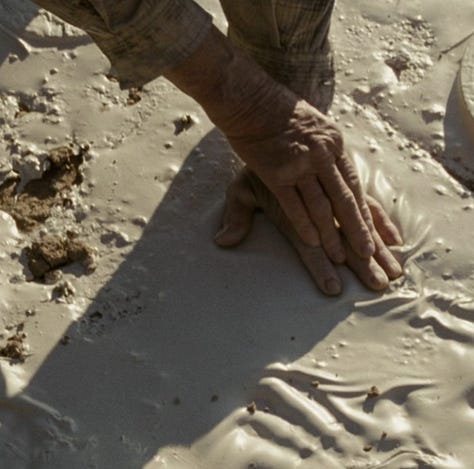
Among the Kogi of northern Colombia, some children are chosen to become Mamos, the wisdom keepers of their community. Before they are taught to lead, they are taught to perceive Aluna—the unseen living intelligence beneath the visible world. Soon after a child is born, they are carried into the darkness of a cave, where elders raise them for up to nine years, to perceive the unseen speaking to them. Halfway across the world, San trackers of the Kalahari spend years reading a bent blade of grass and the disturbed insects, the weight of a hoof pressed into sand, until the land begins to guide them. A San elder once described this as making cords with creation: every act of patient attention twists another strand, until a single thread becomes a rope. Naturalists who study bird language know this same rope. They watch so closely that when they walk through the forest, the calls are whole sentences of safety and warning, and union being sung through branch and sky.
Sometimes when I look at a wall of trees bound together, shimmering and still, a thin breath moving through their leaves, I see them looking at me and me at them. There is a presence watching me here that I only occasionally dare to look back at, for fear of getting lost there in a slow, green turning. All of it moves slightly, as if to part a path for me through its thick-branched arms. The cord between us strengthens.
Sharing a pause before such patient witnesses, I realize how much of my life is spent in the narrow, crowded rooms of mind. Our human worries and endless pursuits are not wrong, but to walk through a world that is actively speaking and pay it no mind feels like a profound forgetting.
Are you done yet? a voice asks. Done with the bone-deep exhaustion of always pursuing? Are you quite finished giving all of yourself to the one mind that never rests?
I have spent much of my life treating myself like a project needing fixing, constantly searching for something to add or replace. A broken plate. But our truest gifts of quiet attention and our capacity to listen and perceive aren’t meant to be served up for approval. The best thing we can do is have the courage to inhabit our skin. There is no performing in this. The gift is in the receiving. Here in the woods, as the striving slows down, I am learning to let that inheritance be placed around my neck. The language of the land has no word for proving. It instructs how to stand, empty-handed, in awe. It is a practice of paying attention and being astonished—just as Mary Oliver said—and then finding the words to tell about it.
“Today is a day like any other: twenty-four hours, a little sunshine, a little rain. Listen, says ambition, nervously shifting her weight from one boot to another —why don’t you get going? For there I am, in the mossy shadows, under the trees. And to tell the truth, I don’t want to let go of the wrists of idleness, I don’t want to sell my life for money, I don’t even want to come out of the rain.” —Mary Oliver, from “Black Oaks”
I find so much comfort in seeing Mary argue with her ambition, hearing her aspiration urging her to hurry along, while a more elemental part of her chose to linger in mossy shadows. I sense the wild was adorning her with her gifts, and she understood this much. She stayed out in the rain to learn and receive a slow, wild language, and then spent the rest of her life sharing it with a starving world.
We are allowed to hold onto the wrists of idleness, for it is not idle at all; it carries us to the boundary where we can begin to hear this other language and fill ourselves with gifts.
Comments
Nothing yet. Say the first thing.
Sign in to join the conversation.