






*Thank you for your patience—this is the January post, arriving a little late. February will bring two essays.
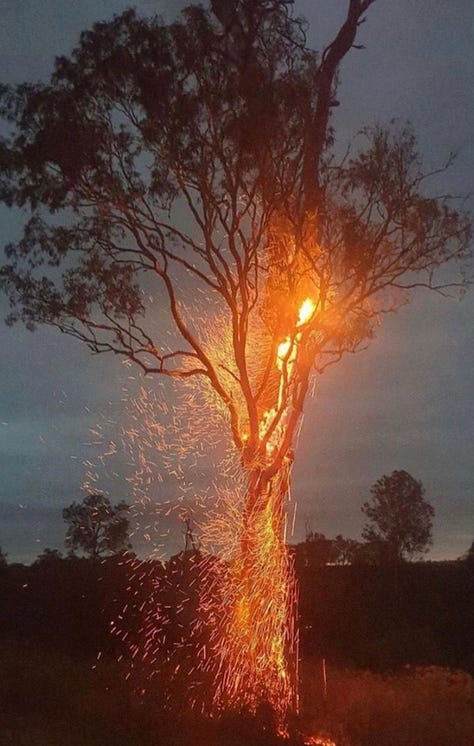
What life and its mystery have been urging me to remember lately is this: just because I am looking in one direction—say, toward a giant, hissing fire—does not mean that nothing else exists in the room. When I am afraid, when I feel small and helpless, that fear eclipses another presence, but it does not erase it.
I am standing in only one corner of a very large room. The windows are open somewhere out of view. The air behind me carries the faintest trace of lavender. The heart has not stopped its singing, and the body continues to move with its great, gentle waters.
The strength of the fire does not mean it can take everything. There is a place it cannot reach. When I can remember this, it feels like turning toward the sound of the sea or like following a low, reverberating call back to what feeds me. Honeyed water finding parched lips.
In Sufi teaching, there are two movements of the soul: fana, annihilation, and baqa, subsistence. Fana is what burns away in the fire, like the false self, the illusion of control, the structures we thought we needed to survive. Baqa is what remains when the burning is done. The essential and the untouchable. The water in the grain. The path is not to avoid fana, but to move through it, allowing the fire to take what was never truly ours. What survives the flame was always here, even when we are looking in the opposite direction.
This essay is about remembering that we, the living, carry something fire cannot touch. It is about what pressure comes to reveal, and how music can be made of us if we listen wisely. It is about a dream of a self, and perhaps a world, collapsing into a body of soft water, into the lap of a humming earth. It is about trembling with eyes open, not turning away, of not knowing how, but looking, until looking brings no fear.

One log sputters as fire tries to take it. Its body lies heavy over the ember’s flicker, dampening the hot tongue of flame. The weight of its watery blood pools in the thick filaments of grain; it is still dense with sap. “I am still living,” the stubborn birch cries, defying its death. The flames do their best to lick back, layer by layer, the skin of this body, only to find one fed by sky-rivers. Still breathing, still living inside the heat, aware of the soft beat of blood and the life that loved it.
Lately, I’ve been noticing what refuses to burn. I see it in the land, in people, in bodies, in the human spirit, the way pressure does not always kill what is alive, but splits it open to show where its sap still pulses. There is a life in us that fire cannot take, a hidden inlet to our deep home, flooding itself with water the way the sea throws itself back into being.
When I speak of fire in this way, I am not speaking only in metaphor. Fire has many faces, and it moves through the world at different temperatures. There are the immediate and devastating kinds of fire where a life is threatened, a home is lost, a body is harmed. And there are quieter fires, that move as pressure and fear, as a slow erosion of ground and trust. The same heat that is burning whole landscapes also touches our smaller, private lives, pressing on the nervous system, testing what can hold.
Recently, while guiding the first retreat I have ever led, I felt the fire at the door. A strange storm rose inside me, a tempest that held every memory of being shamed for my sensitivity, for admitting openly the things most keep hidden. It was the fire of annihilating thought. The tightening kind that slowly tries to seal the voice and body shut. I was afraid of being deficient, of reaching for something true only to have it rejected and unheard. To be met with pity instead of understanding. This fear feels so old, as if I have suffered punishment for my truth before. Rejection and alienation, it is the primal fear of not belonging. And yet, as I moved with the fire at my back, I discovered something intact. A single thread. So strong it did not waver or burn back, but brightened and held. And through that pressure, not despite it, it came forward and offered what it had come to give.
That thread was faith and creativity and connection to the sacred all at once. It was my inner authority. But more than these names, it was a quiet, certain place, a narrow slit of sunlight it could live inside, even with the fire still present. This thread was a deepening of wonder.
Comments
Nothing yet. Say the first thing.
Sign in to join the conversation.