
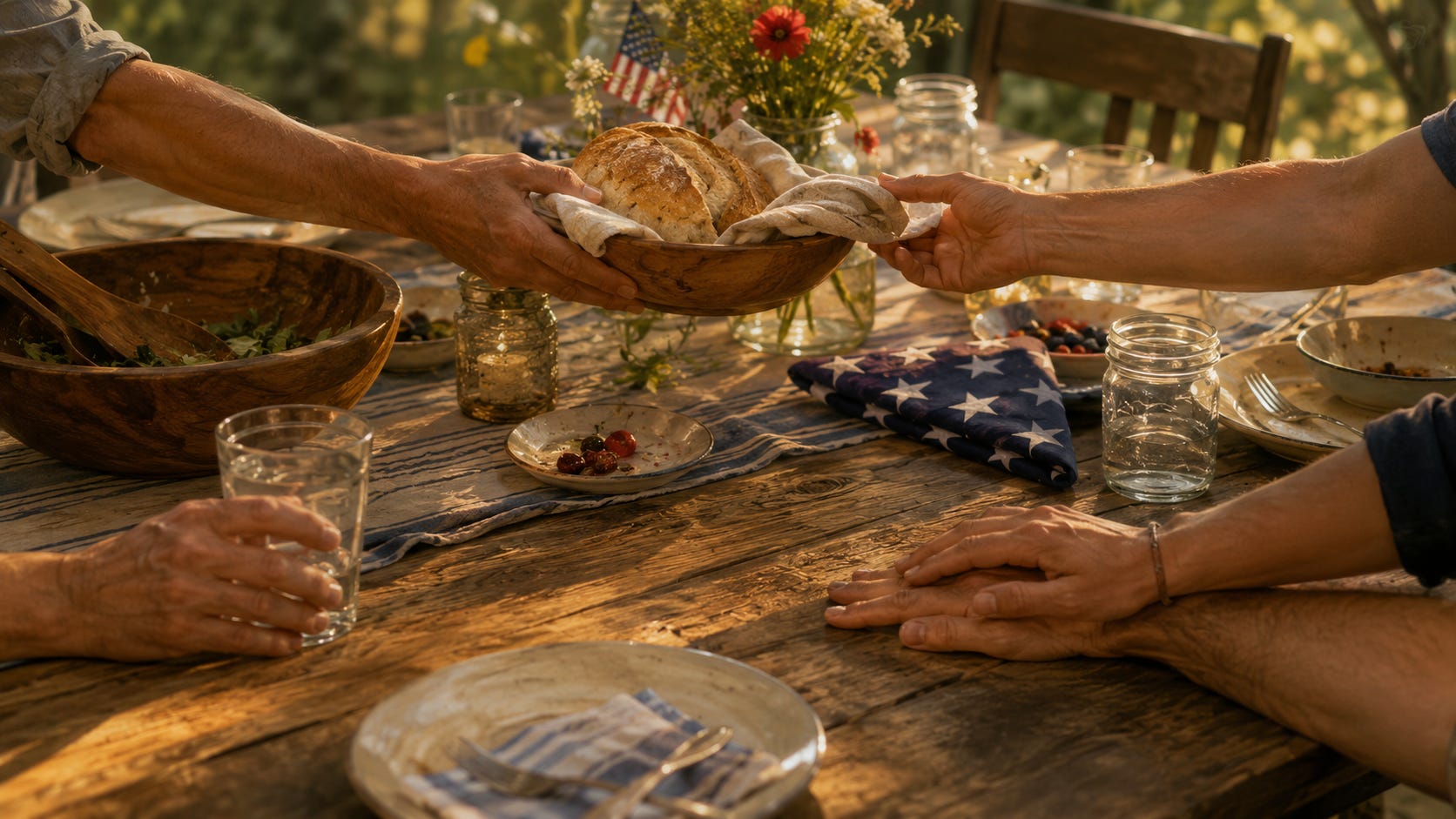
Last weekend, the U.S.A. turned 250. Despite the heat, we did what we always do: fireworks, flags, and cookouts. We also repeated a word we hear so often it sometimes floats free of its meaning.
Independence.
Independence is a beautiful word. It has carried this country a long way. But as I was rereading the document we were celebrating, I found another idea I needed to celebrate, hiding in plain sight at the very end.
The Declaration of Independence closes like this: “we mutually pledge to each other our Lives, our Fortunes and our sacred Honor.”
Read that again. The most famous declaration of independence in human history ends with a promise of dependence — 56 men binding themselves to one another because what they had just signed could get every one of them hanged.
They didn’t declare independence as individuals. They declared it together, staking their lives on the trustworthiness of the men beside them.
Our independence, it turns out, was an act of interdependence from the very first day.
We tend to forget that half of the story. The America of our imagination is full of lone pioneers, self-made men, cabins built by one pair of hands. But the America of actual history is barn raisings, quilting circles, volunteer fire brigades, potluck dinners, and buckets passed hand to hand.
Nobody survived a winter in 1776 — or a rowhouse block in 1926 — on rugged individualism alone. Neighbors were each other’s safety net. Mutual reliance wasn’t the opposite of the American experiment. It was the condition that made the experiment possible.
And yet somewhere along the way, we let independence swallow the whole story. We turned needing help into a kind of failure.
But that’s not how we live, day in and day out. My husband and I have built a thoroughly interdependent life. He’s a genius with household maintenance. I can get a decent dinner ready on time. Neither of us thinks of this arrangement as weakness. We think of it as a good partnership. Leaning on each other is the pleasure of the thing, not the flaw in it.
But notice what happens when the leaning becomes less mutual. We have a different word ready for that: burden. I don’t know anyone who says, “I hope I never have to lean on my children.”
We all say the other thing: “I don’t want to be a burden.” As if there were a bright line somewhere – invisible, but absolute – where the ordinary, healthy dependence we practice every day of our lives suddenly turns shameful.
Who drew that line? And why do we all pretend we know where it is?
My old professor, Henri Nouwen, spent his life tugging at this thread. I knew him in his Wounded Healer years, before he left the university world to live in a community with intellectually disabled adults.
Real community, he taught us, isn’t built on shared strength. It rests on “the shared confession of our basic brokenness.” He came to believe that a life’s worth wasn’t measured by the success that comes from strength and achievements, but by fruitfulness – which, he insisted, we find only in understanding our own vulnerability and weakness.
That is about as un-American as a sentence can sound. It is also, I suspect, closer to the truth of how this country has actually worked for 250 years. We have flourished not because 13 colonies went it alone, but because they didn’t. It’s right there in the name we gave ourselves. Not the Independent States. The United States.
So here is my unfashionable thought for our 251st year: maybe the declaration we need now is a declaration of interdependence. Not instead of liberty – because of it. Free people, freely pledging to each other lives, fortunes, sacred honor. Let’s honor the founders’ last sentence, not just their first.
I’ll be returning to this territory in the months ahead, because I’ve come to believe our terror of depending on one another underlies some of the hardest questions we face about aging, illness, decline, disability, and the death we all face.
For now, here’s one question to carry through the summer:
Who are the people you could pledge yourself to – and who has pledged themselves to you?
Comments
Nothing yet. Say the first thing.
Sign in to join the conversation.