
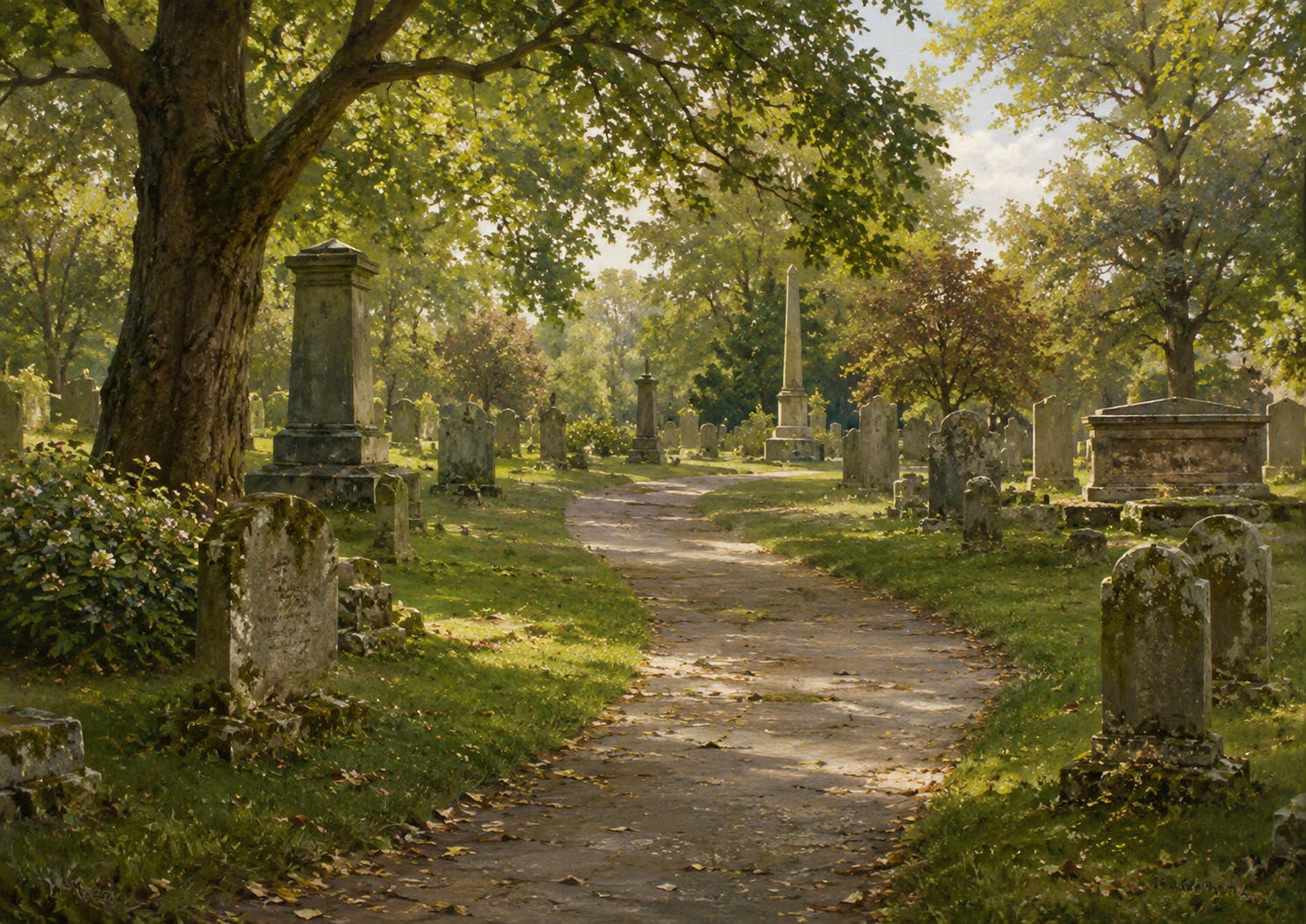
“Perpetual care” is one of those cemetery phrases that sounds comforting before we even stop to define it.
But it has always made me squint a little.
Perpetual? Really?
Can anyone promise that?
Walk through a well-kept cemetery and you can feel why the phrase works. The grass is trimmed and the path is clear. Someone is tending this ground.
The promise of perpetual care is easy to love. It speaks to something deep in us, especially after death has taken someone we care about. We do not want the graves of our loved ones to look neglected.
Of course, the phrase has a practical meaning. In the United States, where a century ago there seemed to be abundant land for nearby cemeteries, perpetual care grew out of a real problem: How do you maintain burial grounds over time, especially after plots have already been sold?
For many cemeteries, the answer was a maintenance fund. A portion of burial sales would be set aside and invested, with the income used to care for the cemetery over time.
That care usually includes ordinary upkeep: mowing, pruning, road repair, drainage, tree care, and general maintenance of the grounds.
That matters. But it is not the same as promising that every grave, marker, monument, or memory will be preserved in loving detail forever.
That is a smaller promise than the word perpetual suggests. And yet the word still works on us.
Why? I think it works because we hear “perpetual care” as emotional reassurance, not just financial.
We want the dead to be treated with dignity, and that is a deeply human impulse.
Impermanence hurts. So, even though we know better, we still reach for words like perpetual the same way we reach for smooth stones at gravesides, framed photographs on mantels, recipes in our mother’s handwriting, a shirt that still carries a trace of someone we miss.
We are trying to hold on. That doesn’t make us foolish. It makes us mortal.
Still, mortality has a way of pressing on our language until we have to admit what words can and cannot do.
Even if cemetery grounds stay tidy for generations, something else is harder to maintain: memory.
Most of us are not remembered in rich detail for very long. How many of us know the full names of each of our grandparents? How many of us know even the first names of all eight of our great-grandparents?
Family memory fades after a few generations. A stone outlasts the living memory attached to it.
It makes me sad to write that. But it is true for me, and for most people I know.
Perhaps that is why the phrase “perpetual care” carries so much weight. It reassures us not only about grass and gravel, but about the underlying fear that memory is fragile. That being gone will slowly turn into being unknown.
A comforting phrase can’t solve that. But it doesn’t have to.
Maybe it comforts us because it stands in for a more modest and more human hope: that for a good while, at least, there will be signs of care. That the dead will not be treated as disposable. That even after those who knew them are gone, the ground itself will show some evidence of respect.
That is not “perpetual,” but it is something.
Our attachment to this promise is not universal, of course. Over the centuries, reverence for the dead has taken many forms, and in much of the world, burial space has never been treated as a forever claim to one piece of land.
But we Americans have loved the idea of perpetual care. And maybe what we love in it is not the illusion that anything here can literally last forever.
Maybe it is simply the hope that care itself can outlast us long enough for grief to soften and long enough for those who come after us to feel less alone.
The older I get, the more I wonder whether the deepest care we can offer is not the fantasy of forever, but the practice of stewardship while we are here.
That is a different kind of promise. Smaller, yes. But truer.
Comments
Nothing yet. Say the first thing.
Sign in to join the conversation.