
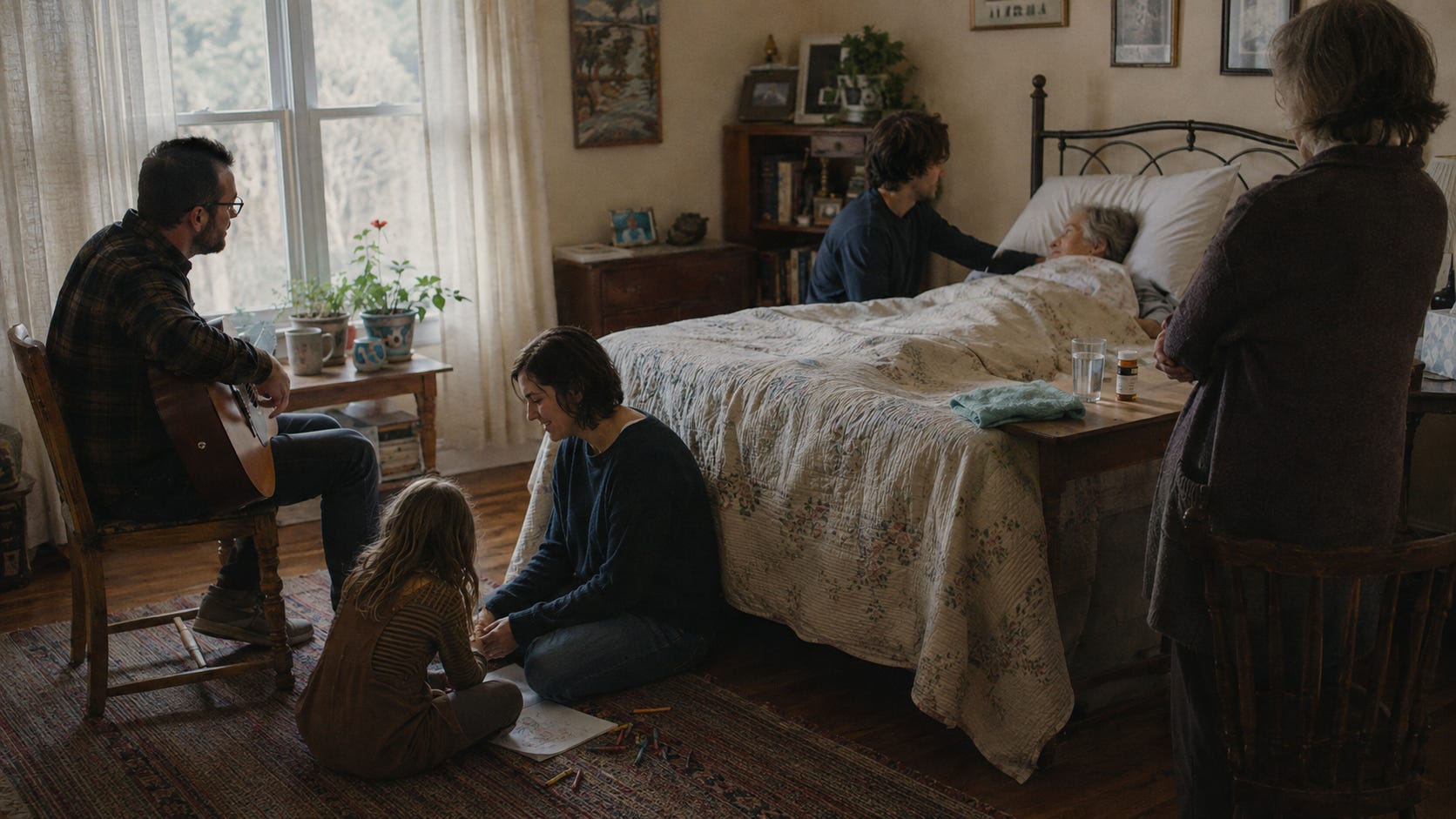
Until the 20th century, death was a familiar presence and a recognizable process. Caregivers were usually women. They took care of dying family members, just as they helped usher babies into the world.
As in labor and childbirth, there are stages in the dying process, and these caregivers knew them. They were alert to signs that death was near.
They noticed that the dying person gradually slept more and ate less, breathing patterns changed, and sometimes the dying person seemed agitated or talked to people nobody else could see.
Deathbed gatherings were family affairs. Children were welcome. And the deathbed was right there at home. All of them were aware when their loved one’s life was coming close to the end.
Then, in the 20th century, a new trend began to emerge. Families took sick and dying people to hospitals. It made sense, as medical advances offered more opportunities to extend life.
But as hospitals became the place to die, death changed from a family affair to a medical event supervised by professionals. And gradually, death came to be seen more as a medical defeat than as something natural and inevitable.
Essential pieces of practical wisdom slipped away. Our culture found itself in an era the French cultural historian Philippe Ariès described as a time of “hidden,” even “forbidden,” death.
Death was no longer familiar. Instead, death was a failure, something to be hidden away and not talked about. Family members no longer prepared their loved ones for burial. Instead, their bodies were whisked away to funeral homes.
The convenience came at a cost:
We forgot the signs and patterns that precede a human’s last breath.
We forgot how to be present through that process.
And we forgot how to talk about death, which makes it harder to think about and prepare for our own.
In a sense, we forgot how to die.
What does that mean?
People continued to die. But the attitudes and customs that had shaped those experiences for dying people and their loved ones gave way to clinical assessments and measurements.
Death became a flatline on a machine rather than a profound moment of mystery and reverence.
But it is hard for a culture to ignore the reality of death for long. Toward the end of the 20th century, people like Dr. Elisabeth Kübler-Ross began to break the silence, shredding the veil we had created around death.
Increasingly, caregivers at all levels now recognize what is lost when death becomes mainly a medical event: the presence of family, the chance to say goodbye, the reverence of a bedside gathering.
In her 2022 TED talk, “What happens as we die,” Dr. Kathryn Mannix, a British hospice physician, makes a strong case for talking about death more freely. She recalls an elegant French woman in the last stages of a terminal disease, torn by fear that she would die in agony.
Dr. Mannix, then a young physician more focused on preventing pain and prolonging life than comforting the dying, listened as her supervisor explained to the woman what typically happens as a person dies.
Then she watched, wide-eyed, as the dying woman kissed the older doctor’s hands and sank back onto her pillow, hugely relieved.
“How have I never noticed that?” Dr. Mannix asked herself, referring to the pattern of physical changes in the last stages of a typical death.
Even more fascinating to her was the power of describing ordinary dying to a dying person, watching as it “shines the light of understanding and information into that dark place where all their fears and imagination were at play.”
In the years since, she has had that same conversation with terminally ill patients countless times, and no one has ever asked her to stop. Instead, they say, “Can you tell my family that?”
Losing the practical wisdom about how death usually unfolds leaves us expecting the worst. But as Dr. Mannix shows us, a typical death is not a Hollywood spectacle. It is more likely to be a quiet, gradual process.
That is comforting to know, both for dying people and the loved ones keeping watch.
And it is another good reason to bring death out from that secretive 20th-century veil.
Kathryn Mannix’s TED talk runs about 15 minutes. It’s worth the time.
Comments
Nothing yet. Say the first thing.
Sign in to join the conversation.