
I was listening to this podcast conversation, and Katie asked Grace Blakely about her new book. Blakely said that she came up with the idea for her new book after the book tour for her first book, Vulture Capitalism. She said that, on that book tour, everybody kept asking her “what can I do?” She goes on:
It was basically like I kept getting the same question, which is people standing up in my book talks and being like, what can I do? And I was like, why is everyone asking this same question? Because I feel like 50 years ago, you know, when my grandfather was like a trade unionist on the left in the labor movement, people weren’t running around being like, oh my God, what do I do? They were organizing. So I was like, what’s the big shift that’s happened over the last kind of 50 years that’s brought us to the situation where everyone realizes there’s a problem, but we all feel so stuck and unable to respond? And I realized it came down to this issue of individualism.
One morning a few weeks ago, Grant sent me an article about some shady likely Russian-backed oil tanker the US was pursuing in the Atlantic Ocean between Iceland and Britain and asked me some questions about it. We were both busy working that day, so I didn’t get a chance to read it. We met up at a kid’s basketball game late that afternoon, and he asked me if I had a chance to read it. I said (kindly I think), “sweetie, ICE murdered a woman in Minneapolis and the Secretary of State told the US Senate that we’re going to buy Greenland today; I think we have bigger fish to fry than some rogue oil tanker.”1 This led to our maybe 400th discussion of what are we going to do about all of this [flails her arms around helplessly] - the question that anyone paying attention has been asking themselves since at least last January (if not much longer).
A rerun of the same discussion Grant and I have had countless times since Election Day led me to think back to Blakely’s remarks. Maybe asking “what can I do?!” is part of the problem. Maybe instead we need to ask better questions like “what do I care about enough that it will energize me to participate in it for the long haul?” and “where can I find community with people who care about that thing too?” or “who in my community is already doing this thing I care about?”
Blakely said people 50 years ago like her grandfather weren’t asking “what can I do?” because they had unions, movements, churches, and other types of like-minded communities where like-minded people helped them fight for the things they believed in, gave them an easy structure to their activism, and helped them hold the powerful accountable. Changing a workplace isn’t as daunting when you’re already in conversation and community with most of the people who work there. We need to get back to this kind of mentality that Blakely’s grandfather took for granted.
There are many lessons to come out of how the Twin Cities have stood up to the ICE takeover of their communities, but I think this is the one we need to be listening to most: community is the antidote to all that ails us.
In Adam Serwer’s excellent article in The Atlantic about the occupation, he writes:
If the Minnesota resistance has an overarching ideology, you could call it “neighborism”--a commitment to protecting the people around you, no matter who they are or where they came from. The contrast with the philosophy guiding the Trump administration couldn’t be more extreme. Vice President Vance has said that “it is totally reasonable and acceptable to look at their next-door neighbors and say, ‘I want to live next to people who I have something in common with. I don’t want to live next to four families of strangers.’” Minnesotans are insisting that their neighbors are their neighbors whether they were born in Minneapolis or Mogadishu. That is, arguably, a deeply Christian philosophy, one apparently loathed by some of the most powerful Christians in America.
In more must-read reporting in The Atlantic, Robert F. Worth reports on how radicalizing this is for your average not-very-political Minnesotan:
One of those latecomers [to the protests] was a 46-year-old documentary filmmaker named Chad Knutson. On the morning after Good was killed, he was at home with his two hound dogs, watching a live feed from the Whipple Building, where ICE is based, a five-minute drive from his house. A protester had laid a rose on a makeshift memorial to Good. As Knutson watched, an ICE agent took the rose, put it in his lapel, and then mockingly gave it to a female ICE agent. They both laughed.
Knutson told me he had never been a protester. It seemed pointless, or just a way for people to expiate their sense of guilt. But when he saw those ICE agents laughing, something broke inside him.
“I grab my keys, I grab a coat, and drive over,” Knutson told me. “I barely park my car and I’m running out screaming and crying, ‘You stole a fucking flower from a dead woman. Like, are any of you human anymore?’”
His voice was so thick with emotion that it felt almost as if he were telling a story of religious conversion. It reminded me again of the Tahrir Square protests in 2011, when so many people seemed to have reached a moral and political turning point.
Knutson now goes to the Whipple Building almost daily, bringing thermoses of hot coffee for the people who hold up signs and bellow at the ICE agents and convoys as they drive in and out. He has been tear-gassed so many times, he said, his voice has gone hoarse.
The folks we see in Minneapolis and hear about in these reporters’ stories aren’t sitting around hand-wringing asking “what can I do?” - they are finding people, leaders, and networks already doing things, and jumping in where they feel most called. I read something last week and can’t find the source now, but it said the network in Minneapolis working to support their neighbors was “leaderless - no leaderful,” and I can’t stop thinking about that. We don’t need to wait for particularly gifted leaders to show up, so much as show up ourselves and be ready to jump in to the work that is already going on.
Obviously asking what can I do isn’t a bad question - it shows you have empathy, compassion, that you’re paying attention, but it’s just another way we stay stuck in the hyper-individualism that plays a big part in what got us here. The people in Minneapolis are asking bigger, better questions - and using those questions to fuel action in service to their morals and values.
I’ve followed Garrett Bucks since George Floyd. You should too; he is a great writer. I’ve been paying attention to what he has been writing since the DHS first announced Operation Metro Surge back in December. Before Pretti’s murder, he posted some thoughts on the Religious Left after over one hundred clergy were arrested on Friday protesting at the airport:
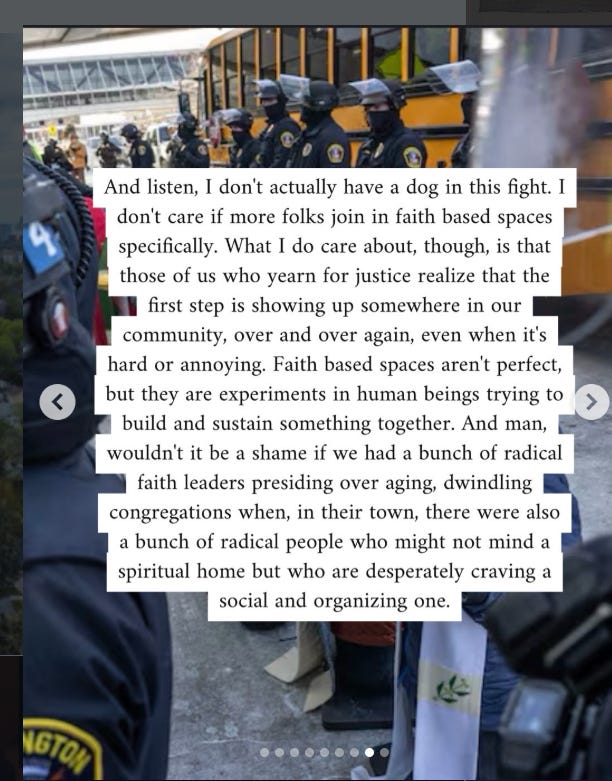
I’m with Garrett - I don’t really care if you go to church or not, but I do care that so many of us are feeling helpless and hopeless - and that THE antidote to that feeling is finding community with people who care about what is happening and taking action together. Community making is exhausting though, and we’re already worn out and worn down, which is why it’s so much easier and more life-giving to join with people who are already doing it versus starting from scratch.
Minneapolis is showing us that the time to find community is right now. It’s hard work, so jump in where people are already doing it instead of going it alone. We’re more effective together - those in power want us feeling helpless, hopeless, and alone. But even more than effectiveness and power, we are better together - healthier, happier, better rested, more hopeful, more ALIVE.
It is the better way.
In Teaching Community: A Pedagogy of Hope, bell hooks wrote, “Dominator culture has tried to keep us all afraid, to make us choose safety instead of risk, sameness instead of diversity. Moving through that fear, finding out what connects us, reveling in our differences; this is the process that brings us closer, that gives us a world of shared values, of meaningful community.”
Minneapolis is showing us what hooks was teaching, what every indigenous activist has been teaching, what the Civil Rights Movement was teaching, what Buddha and Jesus were trying to tell us - that individual solutions won’t save us, that we need to be finding communities actually caring for each other versus hand-wringing over what I as an individual can or can’t do, that caring for one another together is the only way we’re getting out of this.
I obviously started writing this before Border Patrol murdered Alex Pretti, but I think it makes the rest of this more salient, not less.
No posts
Comments
Nothing yet. Say the first thing.
Sign in to join the conversation.