
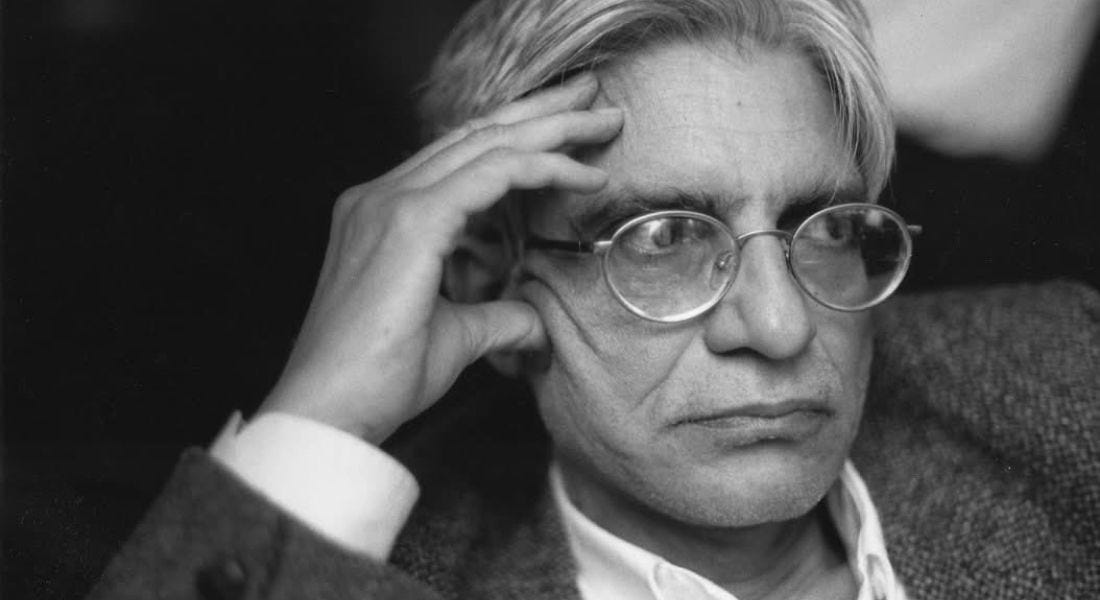
By Jaspal Singh / Global Southasia
BOSTON: A friend from Oxford sent a message on 12 August, that Amin Mughal ji had passed away that evening. I was out at the time and saw the devastating news while checking my inbox on my iPad. Shocked and trying to digest the message, I forwarded it to friends, who I thought would want to know. A flood of memories came to mind.
Messages of condolences started pouring in from across the world. Two years ago when Prof. Manzur Ejaz – who passed away last year – and I called Mazhar Tirmazi, a poet and writer in London, and he had informed us that they had a big celebration for Amin Mughal’s 90th birthday and that Mughal Sahib was in good spirits.
Mazhar told us that Amin Mughal had said that the lights across the horizon reminded him of Kotli Loharan, the place he was born near Sialkot in 1935.
I met Mughal Sahib more than 40 years ago in London. There was a conference about the Sikh genocide in Punjab, Punjabi language and culture at the London School of Economics. A friend who was at LSE introduced me to him. We had a long chat and it seemed like I had known him for a long time.
We had differences of opinion on many things, such as about the Congress government in India, the state of human rights in India, the Soviet occupation of Afghanistan, the Labour Party and liberal democracy, but he was always very warm. Over the years we met at many meetings, friends’ homes and conferences.
Anybody who was part of any people’s movements who came in touch with him, became his friend and fellow traveler. He was a prolific writer, teacher and speaker. Whether it was a people’s movement in Britain, Southasia or other parts of the world, Mughal Sahib was there and lent his voice.
He was a humanist at heart and fought all his life for the rights of the people. He was imprisoned many times in Pakistan for his views, before he left for England in 1984, seeking political asylum. However, he never accepted British nationality.
“His small Finchley flat, crowded with books, became an unofficial university for visiting writers, activists and political dissidents from both sides of the border,” as his younger friend and former colleague Dr. Ikramul Haq writes in The Friday Times.
He always argued and worked tirelessly for peace in Southasia and people to people contacts amongst all the people.
Mazhar Tirmazi told me that Amin Mughal’s nephew had taken his body to Birmingham, where the funeral was held.
Amin Mughale impacted people’s lives across several generations, which is very obvious from his social media presence in recent years.
Mughal Sahib, rest in peace. We will miss you, as will all those who are fighting for a new world and a new Southasia.
End credits
Jaspal Singh is a Punjab and Vedic scholar based in Cambridge, Massachusetts. He is a community organiser and cultural activist who has helped create dialogue and connections throughout the Southasian community, via cultural and educational initiatives. In 2022, he was one of the organizers of the Kabir Festival in Cambridge, Massachusetts.
This is a Global Southasia (formerly Sapan News) syndicated feature available for republication with due credit to sapannews.com.
This article was written and edited by humans. Click here for the Global Southasia (formerly Sapan News) AI policy.
Why ‘Southasia’ as one word?
Because our histories entangle, our struggles intersect, and our futures are bound together. It is not just a spelling choice, it’s a political and poetic one.
Ends
Thank you,
Regina Johnson
Coordinating Editor
Global Southasia
No posts
Comments
Nothing yet. Say the first thing.
Sign in to join the conversation.