
Personal essay
By Ahktar Shah / Sapan News
The early 1990s were a turbulent chapter for Pakistan, marked by deep political uncertainty and renewed military tensions with India.
Democracy was attempting to find its footing in the aftermath of the military dictator General Ziaul Haq’s death in a mysterious C-130 mid-air explosion of 1988. Although Benazir Bhutto was in office, many believed that the challenges facing the country extended far beyond the capacity of any single government.
Cut to the night of August 17, 1990, the second death anniversary of General Zia. As was customary in those days, after work, I went to a friend’s place where several of us would gather in the evenings. This was near Faisal Mosque, Islamabad, where the remains of Gen. Zia was buried.
Our gathering that evening featured the usual spirited discussions, accompanied by a generous measure of liquid refreshments. Afterwards, as everyone headed home, I made my way to the taxi stand.
Ordinarily, several drivers would be waiting for us, familiar with our routines and departure times. That evening, however, the city was unusually crowded. Thousands had gathered to commemorate General Zia’s death anniversary at the Faisal Mosque. Supporters from across the country, Pashtuns, Punjabis, Afghans, and many others, had descended upon Islamabad, filling the streets and public spaces.
To my surprise, the taxi stand was deserted. Not a single cab was available. Instead, it was occupied by groups of visitors attending commemorative events. For a moment, I considered returning to my friend’s house. Just then, a passing taxi slowed down, and I heard someone call out my surname: “Shah-jee!”
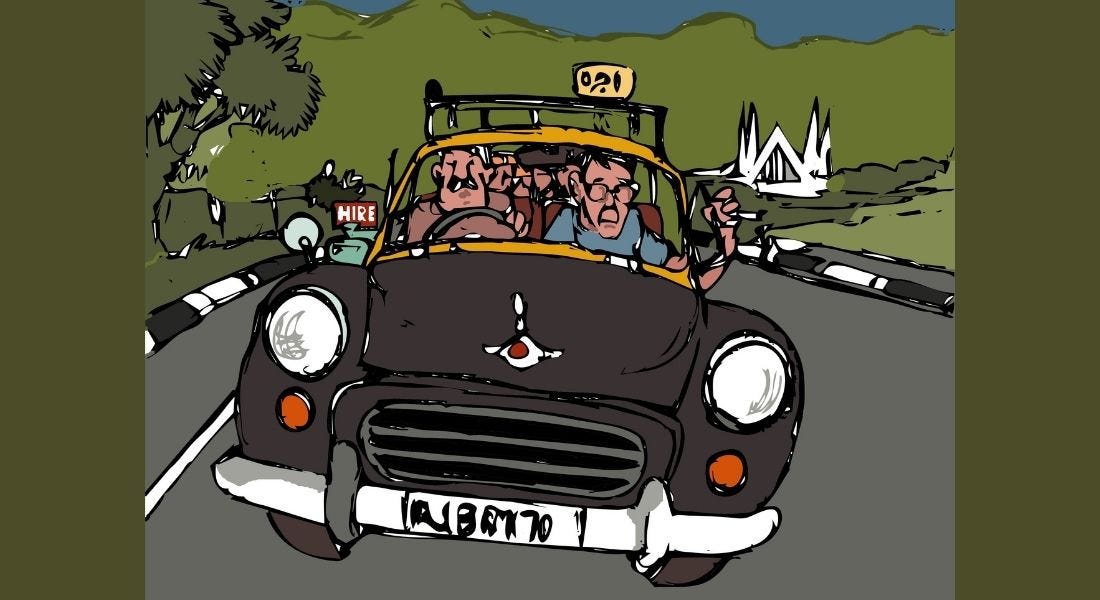
It was one of the regular drivers from the stand. Relieved, I greeted him and climbed aboard, only to discover that I had joined a shared ride. Besides the driver, three other passengers occupied the back seat. They were returning to Rawalpindi after attending the day’s commemorations for the departed dictator.
The vehicle itself was a weary old Morris Minor, whose mechanical sounds often seemed to possess a personality of their own. After exchanging greetings, we began our journey toward Rawalpindi. Before long, the conversation turned to politics, a perfectly ordinary occurrence in Pakistan, where political discussions can emerge anywhere, from drawing rooms to tea stalls and, apparently, shared taxis.
The topic of the evening was the familiar one: Tensions with India. Troops were facing each other across the border in yet another military standoff.
The atmosphere inside the cab quickly transformed into an impromptu strategic forum. One passenger after another argued passionately that the time had come to teach India a lesson. The Soviet Union had recently withdrawn from Afghanistan, and in their minds, victory over one superpower had paved the way for confronting another regional rival.
The enthusiasm was intense. Each speaker seemed determined to outdo the previous one in patriotic fervour. I chose to remain silent, partly because I was in no condition to contribute eloquently and partly because silence often provides the best seat from which to observe.
Convincing extremists to reconsider their positions is sometimes possible. When logic fails, ideology fails, and patriotism fails, it may take identifying the one concern that speaks directly to their most treasured self-interest.
Meanwhile, the driver had become so engrossed in the debate that he frequently turned around to address the passengers instead of watching the road. Every time he slowed down to make a point, the aging Morris responded with alarming mechanical protests. The engine hummed, rattled, and groaned in apparent disagreement with both the driver’s politics and his driving technique.
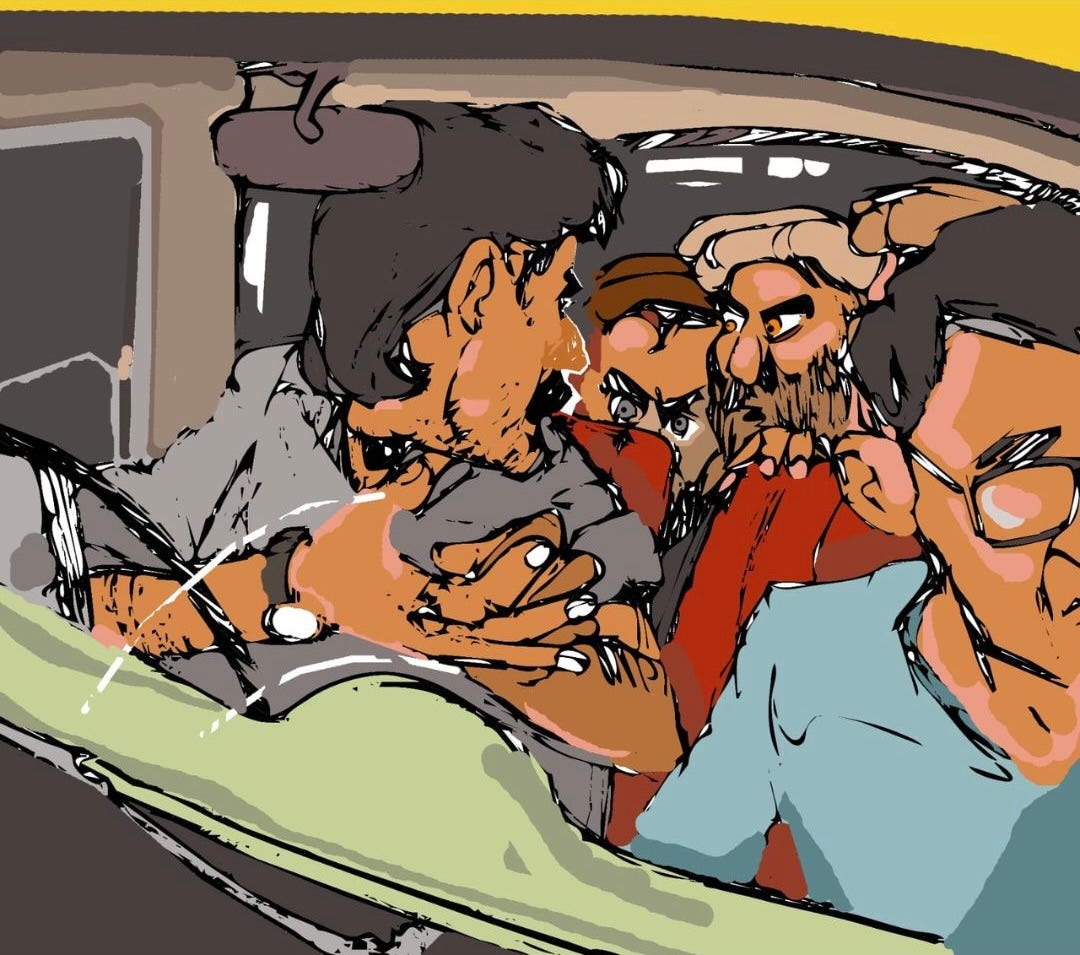
As the journey progressed, I learned that the passengers were Kashmiris and not Afghans, as I had initially assumed. Their discussion became increasingly animated as we crossed the elevated roads near Islamabad’s H-9 sector. Eventually, the driver noticed my prolonged silence.
“Shah-jee,” he asked, “You haven’t said a word. What do you think?”
Everyone fell silent and turned toward me, expecting confirmation of their views.
Instead, I offered a different perspective.
“I don’t think we can afford a war,” I said. “Both countries possess nuclear capabilities. Things are no longer as simple as they once were.”
The reaction was immediate.
To the others, my caution sounded like weakness. They dismissed my concerns and accused me of lacking courage. One particularly enthusiastic young man challenged me directly.
“What if nuclear weapons are used?” he asked. “We will die anyway. Are you afraid of death?”
It was a classic no-win situation. Any answer would simply provide fresh ammunition for further ridicule.
Then an idea occurred to me.
“You’ve misunderstood nuclear weapons,” I replied with complete seriousness. “They don’t kill you. They make you impotent for the rest of your life.”
The effect was extraordinary.
The heated hypernationalism debate vanished instantly. Silence descended upon the cab. For several moments, the only sound was the steady hum of the Morris Minor’s engine.
Finally, after a long pause, the driver broke the silence.
“War is a terrible thing,” he said thoughtfully.
And with that, the argument was over.
The remainder of the journey passed in remarkable peace. No more strategic analyses. No more declarations of glory. No more enthusiastic calls for conflict.
That evening taught me an important lesson. Convincing extremists to reconsider their positions is sometimes possible. When logic fails, ideology fails, and patriotism fails, it may take identifying the one concern that speaks directly to their most treasured self-interest.
As it turned out, the psychology of war could be surprisingly complex — but the psychology of men was often remarkably simple.
End Credits
Akhtar Shah started career as advertising agency illustrator in 1982 from Lahore, joined Muslim newspaper in 1986-87 as editorial cartoonist, moved to the News in 1994 as its editorial cartoonist and remained there till retirement in 2016, started writing memoirs and brief writeup a short period back.
This is a Sapan News syndicated feature available for republication with due credit https://www.sapannews.com.
This article was written and edited by humans. Click here for the Sapan News AI policy.
Why ‘Southasia’ as one word?
Because our histories entangle, our struggles intersect, and our futures are bound together. It is not just a spelling choice, it’s a political and poetic one.
No posts
Comments
Nothing yet. Say the first thing.
Sign in to join the conversation.