
There’s an old joke that goes like this : A farmer wins a million pounds on the lottery, and they come around to present him with the big cheque and do a short interview, and they say ‘Well, George, how do you think you’ll be spending the money?’
Old George rubs his chin and thinks for a moment and then says “I think I’ll just keep on farming until it’s all gone.”
That is about the size of it.
In a similar vein, I ask myself, how do you plan on doing ‘this smallholding thing’ on into your late sixties and beyond? And if I’m not careful, I find myself answering, “I think I’ll just keep on toiling until I drop.”
Which is an obvious answer, but not, I suspect, the right one.
So it seems obvious that before I stagger into a ditch and am never found again, it might be a good idea to review the situation a bit, and make some changes to the way we do things.
‘Give up now, and take a long holiday somewhere warm and peaceful’ is not on the list, so let’s start with fencing.
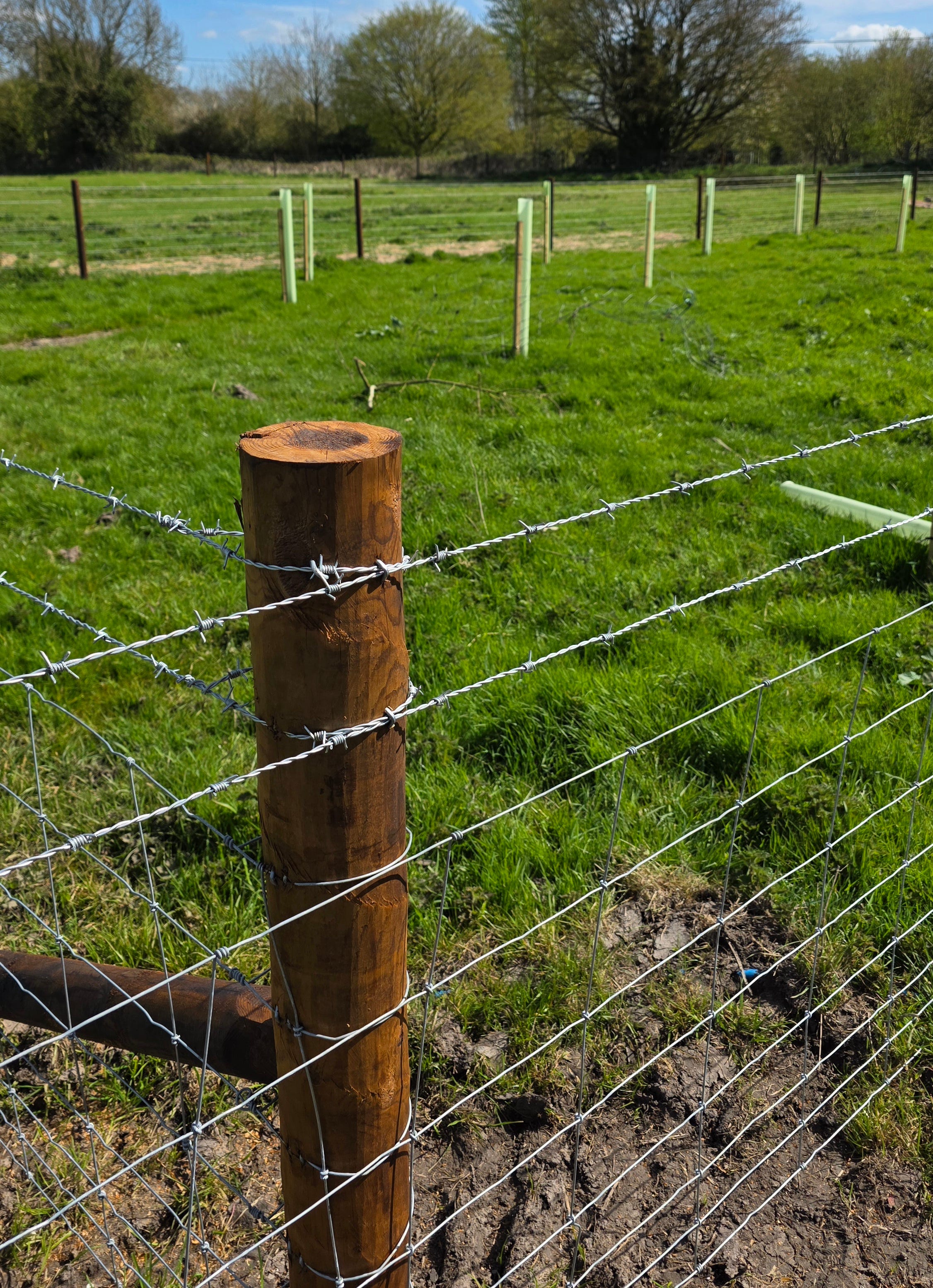
When we first explored planting some trees on the land, it was a fairly small project, which we discussed with a local organisation funding, well, tree planting. Later on our landlords became involved and wanted to do a lot of tree planting, and hedge planting, and as an aside, offered to re-fence our whole field, which was simply not to be sneezed at, so the whole project got bigger and bigger.
The plan we’d originally drawn, was passed from contractor to subcontractor, and, in theory, eventually appeared in real life on the land. Which it did. Well in part, anyway. We’re still missing a significant bit of fencing and a really, really important gate, mid way up the field.
What we didn’t think of - and arguably someone employed as a project manager and spending vast amounts of someone else’s money maybe should have done - was that the tree enclosures have no gates. In fact, no method of access at all.
So, in short, we were excited to have actual enclosed paddocks, with actual gates, so that these old bones could take some time off, at least in the winter, from hauling electric fences and batteries around, turn some sheep out in a field, close the gate, and walk away. And that has happened. Well, almost - see missing gate, above. However, we now have around an acre or so of tree enclosures, running right up the centre of the land, which, for good management probably need scything, strimming, or grazing with something tree friendly at least a couple of times a year, and the only way we have to access them is by climbing over a four foot high fence. Net gain? I’m not sure.
We had decided, as my regular reader may recall, to sell the entire flock of Oxford Down Sheep (officially the biggest native breed, absolutely humungous) and buy instead a handful of various fleece sheep, from which I could harvest fibre, without necessarily having to lamb every year. We would keep numbers low, but just enough to have something to graze the areas that do need grazing.
We then decided, that reinventing the wheel was one of our bigger failings, and that this was the year of sticking with who we are, what we are, where we are, aka The Course in Contentment, and that we should just get the numbers down a bit.
This season has held some hard lessons. You can decide to sell a flock of sheep, and you can decide not to sell the entire flock, but to sell a significant number of that flock. You can decide all you like - but if no-one steps up to buy them, you are right back where you started.
Plan A (sell the whole flock) attracted only one interested punter, a well known breeder who decided to employ bullying tactics, to try to buy them under market value. Well we weren’t in a mad rush so we pivoted to Plan B (sell a chunk of the flock) and so far have no takers.
Lambing went fabulously well, but that just means we have a lot more sheep, and currently, the weather isn’t being kind. The shearer is due tomorrow, probably a month late, and once that’s over, if we have no more interest, we may have to look at taking them to a market. Rare breeds never sell well at markets (unless specialist) and we will be looking at very disappointing money. The facts are that we cannot keep all these sheep, unless we somehow manage to find more grazing. As I spoke about here, that’s not that easy any more.
Of course, you might argue that the best change we could make, to meet our old age with peace and dignity, would indeed just be to give up. And you would have a point, but there are two hefty counterweights to that argument.
Firstly, and this one we will have to face one day, is that giving up is going to be a year long (at least) project, and will drain every ounce of our physical, mental, and possibly financial strength. All the livestock will have to be disposed of, and not one of our beasts is worth a cent, they’re all ‘no hopers and jokers and rogues’ and many of them, the kindest way for them to leave us will be final.
There is a vast array of infrastructure, of which we are very fond, and serves us well, but would be classified by our landlord as junk, and we would have to remove it all - a very time consuming and expensive exercise. We don’t have any heavy machinery, lifting or removal equipment, all of it would have to be hired, or someone with it would have to be hired.
Secondly, and more importantly, we came to have tenancy of this land by something which could only be described as a miracle, and we have never truly understood what God has required of us in this place, only that He for sure has a plan, we for sure are part of it, and it will be made plain (or not) in His timing.
And who knows but that you have come to your royal position for such a time as this?
Esther 4:14
As the world rumbles louder, and the times become more charged, the unthinkable happens and people are barely distracted from their gameshows. As wars and rumours of wars abound, and food shortages become a reality. When good is called evil, and evil good - who knows if we are here for such a time as this?
We’re going to need to wait on this a little longer.
One change we are making is to get back to the roots of our agrarian lifestyle. It’s so easy to slip, slowly, into more modern and industrial thinking, and, especially as you grow older, and hard, physical labour is less appealing, to find solutions which involve just one more machine, one more trade of your hours, for money, for stuff.
One of the books I didn’t mention in my ‘old books’ essay - possibly because I don’t think of it as old! - is ‘The Plain Reader.’ Honestly, it deserves a post of its own, but suffice it to say here, it was foundational for us, and still merits an annual re-read.
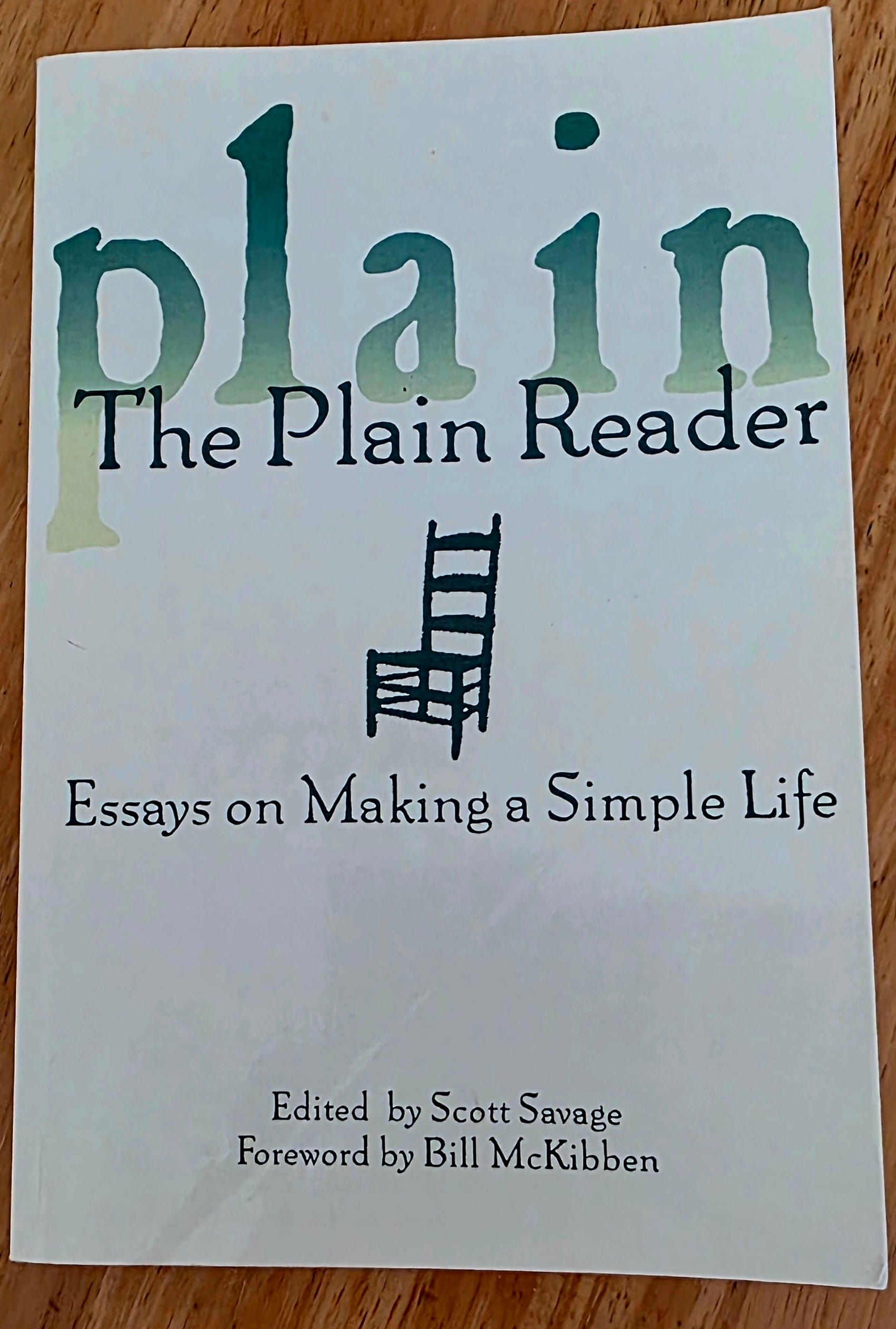
A series of essays by various writers - some well known, like Wendell Berry and Gene Lodgson, others by Amish converts and Plain Quakers - its subtitle ‘Essays on Making a Simple Life’ sums it all up for me, and bestowed those capital letters on the words Simple Life long before the wretchedness of social media commodified them.
Work is a blessing, and as old and creaky as I am, maybe I need to be reminded of these words from the essay ‘Right At Home’ by David and Elizabeth Vendley, one of my very favourites:
America’s current love affair with technology is partly based on the notion that hard work is a bad thing. If you are the smart guy, you’ll think of faster, easier ways to do things than by manual labor. The cleaner one’s hands are from the grime of hard work, the more highly esteemed and highly paid. In the average factory there are usually a few fellows whose main goal is to change the color of their shirt collars from blue to white. There is usually a storehouse of tales in each family of how Grandpa toiled in the coal mines so Dad could go to college. Now we hear how Dad toils at the office so Junior can complete his homework on his personal computer in his bedroom. It is hard to imagine how much higher we can possibly build our technological Tower of Babel before it comes tumbling down.
Our question is, what’s wrong with work? Nothing. It is healthy, productive, and satisfying. It is also time-consuming. We wonder when we ever found time to sit in front of the TV. But we feel our time now is well spent at manual labor rather than pleasure seeking. Work is our favorite pastime; we have just changed our goal from thrills to satisfaction and productivity. Our idea of fun is to sort potatoes or squish tomatoes in a grinder as a family. Counting jars of peaches, making a human assembly line to wash and label jars, milking goats—that’s fun. Our best family memories come from experiences in two places: one when we renovated an old house, the other working in our produce patch.
So, my next project, having rounded off my self imposed Course in Contentment, will be to review our Agrarian Manifesto. It will necessarily have changed - we are two old codgers now, whereas when we first undertook this shift, we had young children, and were younger ourselves. So it will need redrafting, and re-imagining.
I look forward to thinking it through, and sharing my findings. As the years pass by, we are inclined to lose our focus, and I think it can only be a good thing to re-find it. Have you done such a thing? I’d love to hear from anyone who has brought themselves back to their ‘True North’ or maybe adjusted the compass?
Until next time.
No posts
Comments
Nothing yet. Say the first thing.
Sign in to join the conversation.