
This email is part of a series sharing my “founder’s view” of building Santa Barbara Management. You can catch up on my prior emails introducing our firm here.
Wealth management is a product-driven arms race. Advisors struggle to differentiate, so they compete on a variety of dimensions, including access to unique investment products. Today’s hottest strategy for ultra-high-net-worth families is tax-aware direct indexing, and long/short extension is the version capturing the most attention and assets.
These strategies are growing at eye-popping rates. Assets have increased more than tenfold in the last two years, and AQR and Quantinno alone now manage over $100B in these products. That puts their growth on par with the AI companies dominating the headlines and makes them some of the fastest-growing financial products of all time.
The appeal is straightforward: these strategies seek to track equity indices while generating tax losses that offset capital gains and defer taxes. The combination is attractive for many ultra-high-net-worth investors, but particularly for two groups: owners of concentrated stock positions (founders and senior executives) trying to diversify exposure, and those working in asset management (hedge funds, private equity) with substantial recurring capital gain income.
The category has grown this fast because the ROI math is compelling, but also because these are phenomenally profitable and sticky products that the wealth management industry is incentivized to sell. AQR and Quantinno have built captive client bases likely to persist for decades. Exiting these strategies over a short time frame triggers substantial tax realizations, and the products have already self-selected for families averse to incurring taxes. They are likely to leave them on for the very long run.
Complexity is a feature, not a bug, from a wealth manager’s perspective. The client cannot replicate a 500-position levered extension portfolio on their own. They need the advisor to access the SMA platform, monitor it, and coordinate it with their broader portfolio. Stickiness goes up. Switching costs go up. The client is less likely to leave for a robo-advisor or go self-directed.
There is also a status signaling dynamic. Advisors who sell vanilla index funds feel commoditized. Advisors who sell “tax-aware long/short direct indexing powered by AQR’s factor research” position themselves as offering institutional-quality portfolio construction. It elevates the perceived sophistication of the practice.
As these products have exploded, the market has latched onto the benefits while at times losing sight of the risks and nuances. The result: at times these products end up in portfolios where they don’t belong. Direct indexing assets grew from $175B in 2018 to $864B in 2024, a 30% compound annual growth rate, and are expected to surpass $1T this year. Extension strategies are growing significantly faster.
Our founding at Santa Barbara Management coincided with that explosion. Per regulatory filings, Quantinno has grown from $4.6B across 591 accounts in March 2024 to $46.9B across 9,800 accounts in February 2026. AQR grew from ~$5B to $56.9B in tax-aware long/short client capital between mid-2024 and the end of 2025. Combined, those two firms alone hold more than $100B in the strategy.
Dozens of other asset managers are launching similar products. JPMorgan launched its own tax-aware long/short private fund in late 2025, joining AQR and Two Sigma. Vise launched extension strategies in December 2025, Canvas by Franklin Templeton in September 2025, Nuveen acquired Brooklyn Investment Group in June 2025 to add this capability, Frec launched in May 2025, Parametric introduced an offering in early 2025, and countless other providers have launched or are building their own.
While assets are flowing in at astounding rates, the custodians that first enabled these strategies using their own balance sheets, Fidelity and Schwab, have pulled back dramatically. Fidelity paused new account openings for long/short strategies in December and has since increased net financing costs for some clients. Last week Schwab tightened its requirements for new long/short accounts, raising minimum account size and reducing available margin. These moves point to potential cracks in the infrastructure required to support continued growth.
We see immense interest in extension strategies from prospects and clients at SBM. The growth speaks to real innovation and utility, but some in the industry now prescribe these products as blunt instruments appropriate for nearly all clients and portfolios. We are skeptical. There are no silver bullets, and these strategies are not a magical elixir. There are important risks, tradeoffs, sizing considerations, and implementation decisions to weigh.
The SBM Framework: Three Questions Before You Buy
Before we recommend a tax-aware long/short strategy to any client, we run through three questions. All three need to pass. We have turned families away from these products when they don’t, even when the prospect came to us specifically asking for them.
Question 1: Do you have meaningful, recurring capital gains, especially short-term gains?
The tax alpha is only real if you have gains to offset. Investors with minimal annual realized gains are buying a strategy whose primary benefit they cannot use. The ideal candidates have recurring short-term gains from hedge fund allocations, concentrated low-basis stock positions they want to diversify over time, or significant carried interest. Candidates with long-term gains from a single liquidity event are more marginal, although in some cases can be a good fit. That said, in many cases a simpler tool (e.g., charitable gifting, long-only direct indexing) is a better fit.
Question 2: Are you comfortable with the strategy on its own investment merits?
Strip away the tax benefit entirely. Would you hold equity index exposures at this level if it produced no tax alpha? Are you comfortable with leverage, the associated cost of the leverage, and potential that financing costs and availability may change in time? Are you comfortable with a factor-tilted portfolio? If the answer is no, the tax tail is wagging the investing dog and one should not invest.
Question 3: Do you understand how you will eventually get out and do you have charitable intentions?
Every conversation about entering these strategies should include a conversation about exiting them. After several years, you will have a very low-basis portfolio with embedded unrealized gains. Liquidating triggers substantial taxes. Stepping down from 200/100 to 130/30 can take years of consuming harvested losses. Charitably inclined clients have a natural release valve in that the most appreciated single positions can go to charity, generating a deduction while shrinking the embedded gain. Clients without charitable intentions can still benefit from these strategies, but the unwind is meaningfully harder and the lifetime ROI shrinks.
There are other ways to exit these strategies, but they are all situation dependent and require careful planning. Consider one example: an older investor with grantor trusts running tax-aware long/short. The investor would have the ability to swap securities between their estate and the trust without any tax consequences. They could swap cash into the grantor trust in exchange for highly appreciated securities. Those securities would then be eligible for a step up in basis upon death, while the cash could be redeployed in the trust, either back into tax-aware long/short or outside it.
While there are a number of approaches one can use to step out of these strategies, exiting is not without friction - and in most instances requires time, detailed planning, and yes, ultimately paying taxes.
Ultimately, the best candidates for these strategies check all three boxes. The worst candidates are the ones who check one and get sold on the product anyway.
This month I want to examine this high-growth product category in depth. When and for whom might this be an appropriate strategy for consideration? How are extension strategies best used? What are the risks and trade-offs to weigh? How and when should one “get out” of these investments?
Let’s dive in.
First, History
The origins of these tax-aware extension strategies go back years. In the late 1980s, Bill Cornelius, Mark England-Markun, and Randy Lert were using technology to analyze the risk-return attributes of stocks at a small startup called Parametric when a large family office came to them with a question: could they build a portfolio that behaved like an index but was thoughtful about taxes? That question planted the seed. Parametric built its first direct indexing solution in 1992.
This marked the beginning of “long only” direct indexing - an investment strategy that involves owning the individual stocks in an index (e.g. the S&P 500) individually rather than through a fund. Owning the stocks individually enables the sale of losing positions, and harvesting of capital losses, while replacing them with similar stocks to maintain index-like exposure. The result is a market return that closely tracks the index while generating tax savings that a pooled fund structure cannot deliver at the individual investor level.
Parametric’s innovation created an entire industry - leading to dozens of providers over time. Parametric and Aperio were the first and largest startups to build tax-aware direct indexing strategies, but this category began growing rapidly in the 2010s, with their growth enabled and fueled by the introduction of fractional share ownership and the elimination of commissions on equity trades at many larger brokerages. These innovations unlocked direct indexing for investors with smaller account balances.
In 2020 and 2021, an acquisition frenzy supercharged the space - large players bought direct indexing providers, adding distribution and marketing might. The category went from niche to strategic priority for every major asset manager. In October 2020, Morgan Stanley bought Eaton Vance primarily for its direct-indexing subsidiary, Parametric. BlackRock followed one month later by purchasing Aperio, the second-largest player, for $1.05 billion. Parametric and Aperio had each been growing at roughly 20% per year for more than a decade heading into these deals.
In 2021, JPMorgan bought OpenInvest in June, Vanguard bought JustInvest in July, and Franklin Templeton bought O’Shaughnessy Asset Management and its Canvas platform in September. These players were all traditional direct indexing providers - but the next big innovation in direct indexing was just getting started.
While direct indexing strategies were, and still are, incredibly popular, they suffered from a structural limitation: cumulative net realized losses for long-only direct indexing climb early and then flatten around 30% of initial capital. Year-one loss rates are the highest, then they fall steadily until the portfolio becomes “locked in” or “ossified.” Furthermore, the more ossified these portfolios become, the less ability the manager has to rebalance without realizing gains, and the further they deviate from the underlying index they are meant to follow - a deviation known as “tracking error.”
In those structural limitations, Hoon Kim, an investment researcher and portfolio manager, saw client frustration - but also opportunity. Kim holds a PhD in accounting and has spent his career innovating at the intersection of tax, portfolio management, and equity research. He spent more than a decade at AQR as head of equity portfolio implementation in their Global Stock Selection group - but left in 2018 to strike out on his own and launched Quantinno Capital Management.
The Launch of Tax-Aware Long/Short SMAs
In early 2021, Quantinno launched DEALS (which stands for Direct Equity Active Long Short), a separately managed account (SMA) long/short tax-loss harvesting strategy, seeing an opportunity to add leverage to direct indexing in order to amplify tax losses and avoid ossification. Soon after, AQR followed suit with a similar SMA offering called FLEX. The ideas underpinning these strategies go back to AQR’s research from 2011 (when Kim was at AQR), but the introduction of SMAs was a critical unlock for growth.
Extension strategies begin with the same foundation as long-only direct indexing but add leverage and a short book. The manager goes long individual stocks (typically weighted based on an index that the portfolio is tracking) and simultaneously shorts a similar basket, remaining index-neutral. The short positions create a second, independent source of tax losses that can deliver in rising markets, and the leverage on the longs amplifies the impact of those losses. DEALS and FLEX offer multiple variants in terms of indexes to track (S&P 500, Russell 1000, MSCI World, and more) and leverage levels including 130% long / 30% short, 145% long / 45% short, and 200% long / 100% short. Higher leverage such as 300% long / 200% short are available via Series LLC vehicles rather than via Separately Managed Accounts. Higher leverage means more harvesting surface area but also more tracking error, higher financing costs, and increased risk of a margin call or forced liquidation in a substantial market dislocation.
A clear tradeoff with these strategies relative to traditional direct indexing is substantially higher complexity. Implementing extension strategies requires nuanced decisions regarding index selection, sizing, leverage, and trust and estate implications. The strategy carries higher management fees and introduces borrowing costs. The manager needs genuine skill in selecting longs and shorts, since the active bets can detract from returns just as easily as they can add to them.
The Landmark Research Paper (September 2023)
DEALS and FLEX slowly built momentum after launch, but growth accelerated dramatically after the publication of a research paper in September 2023, “Beyond Direct Indexing: Dynamic Direct Long-Short Investing” by Liberman, Krasner, Sosner, and Freitas of AQR. It showed that long-short strategies built on factor investing principles can significantly outperform direct indexing from both a pre-tax and after-tax perspective, and that both types of strategies, if implemented with sufficiently high leverage and tracking error, can realize cumulative net capital losses of 100% of invested capital within a few years while substantially outperforming the benchmark before tax, net of implementation costs.
This paper was widely read across the wealth management industry and gave advisors and wealth planners the academic ammunition to recommend the strategy to clients. It quantified the exact problem with long-only direct indexing (losses taper after a few years, capping at roughly 30% of capital), and offered an attractive alternative, underpinned by research.
AQR followed up with “Loss Harvesting or Gain Deferral?” in the Summer 2024 Journal of Wealth Management, which revealed the surprising mechanism: the main feature of tax-aware strategies is not greater loss realization but rather slowing the unnecessary realization of capital gains.
AQR’s research shows that after 10 years, average cumulative net tax losses from a highly leveraged long/short strategy can exceed 400% of contributed capital, compared to under 50% for traditional direct indexing.
As indicated by the tremendous asset growth of these strategies, the pitch has resonated.
How the Product Works
In an extension SMA, the investor owns the several-hundred underlying securities. AQR or Quantinno (or a number of recent entrant competitors) monitor the portfolio and periodically sell securities trading below initial basis to lock in capital losses. They then redeploy that capital, seeking to minimize forecasted tracking error based on their factor models. The redeployment decision is inherently an active bet and so the manager overlays their own alpha model to try and drive pre-tax outperformance in that selection. This is the same process long employed in long-only direct indexing. Where the process differs is that the managers also dynamically balance leverage to maintain the target. If the shorts in a 145/45 portfolio go down, and the portfolio is at 145/40 leverage, they would short a fresh 5% of the portfolio to get back to 145/45. The portfolio ends up looking like a perpetual motion machine of selling, redeploying capital, and readjusting leverage.
On an ongoing basis, the key data points in evaluating a tax-aware long/short portfolio are:
Performance (net of management fees and margin and trading costs) vs. the index
Short-term capital gain / loss: recognized losses are generally short-term in nature
Long-term capital gain / loss: after the first few years, the portfolio will generally incur long-term capital gains as a cost of rebalancing the portfolio, while still producing net losses
The costs to run the strategy are:
Fees to the advisor
AQR and Quantinno do not sell directly to investors. Instead, they sell via RIAs and broker-dealers as distribution partners, with whom the investor must have a relationship and pay fees.
Fees to the SMA manager, which acts as a sub-advisor on the account (e.g., AQR, Quantinno, etc.)
Borrowing costs
Implementing the long extension requires borrowing money and paying interest. The rates vary widely by custodian and advisor (certain advisors have preferential lending rates).
Clients of advisors who implement these strategies well receive short interest rebates that partially offset the borrowing costs.
Borrowing costs are often tax-deductible, helping to offset this expense.
The Benefits
The benefits of the strategy are real, and are significant. At its best, the strategy allows investors to harvest capital losses and offset capital gains all while seeking the index return (or even better) at the portfolio level.
A 145/45 portfolio may generate capital losses of ~25% of starting capital in year 1 ($250k on a $1m portfolio), with losses declining in magnitude over the first 5 years but persisting at ~4.5% over the long run. For a California-based investor, $250k in losses may be worth up to $137.5k if offsetting short-term capital gains (based on a ~55% all-in STCG tax rate). That is effectively an extra 13.75% of “tax alpha”, an eye-popping number no matter how you slice it. To get that result while only taking on ~1.5% tracking error is astounding.
The Drawbacks
There is no such thing as a free lunch - so what’s the catch? Unfortunately, there are several drawbacks that RIAs should be highlighting to their clients with these strategies:
Unrealized gains.
Harvested losses reduce the tax basis in the account – effectively creating 1:1 unrealized gains that will need to be realized in the future. After several years, the investor will have a very low-basis portfolio that will be difficult to liquidate without incurring taxes from capital gains. In other words, these strategies defer but do not eliminate taxes. It also means that one can expect the tracking error in the portfolio to drift upward as the degrees of freedom for rebalancing are increasingly constrained.
Some investors know that they are signing up to receive a low-basis index-adjacent portfolio, but others are unfortunately surprised by the magnitude of the tax implications when they want to cash out down the line.
Tracking error.
One might expect ~1.5-2.0% tracking error for a 145/45 portfolio. Tracking error of that magnitude sounds reasonable, but the reality is that any given year may have a wider variation than the average tracking error over time. If the larger deviation year comes on the underperformance side, it can be painful. If you run this strategy long enough, you should reasonably expect to experience periods in which your portfolio materially underperforms the index on a pre-tax basis.
Higher leverage means higher expected tracking error, and it also increases the magnitude by which underperformance may be even worse than the average tracking error. The highest extension implementations should expect very substantial tracking error (a 300/200 might expect tracking error as high as 10%).
Finally, it is critical to note that expected tracking error is based on historical analysis and expected correlations between factors. A stress scenario in which historical correlations do not hold up may mean that expected tracking error understates actual deviation. Even the best models will be wrong.
Lastly - on this point, we should note that while these strategies were not running in 2008 at the start of the GFC or in 2020 at the onset of COVID, they have held up well during dislocations since launch. Quantinno’s 130/30 composite launched in March 2021, and since then has faced a few months with meaningful pullbacks in the index. Since launch, in the months in which the S&P has been down >4%, Quantinno has added positive performance, on average, over the benchmark (as they have over the entire period since launch).
Leverage.
Leverage introduces risk. Full stop. While the risk of a margin call is relatively remote due to the diversified portfolio and long-short balance, there are other risks.
There is one substantial, less-discussed risk that we believe deserves more attention: the leverage itself can disappear. This is perhaps the most concerning tail risk for these strategies. The underlying lending relationships with custodians like Schwab and Fidelity, or with prime brokers, are not long-dated fixed-term loans. Lenders can change terms at any point, raising rates or calling the loan entirely.
Recent moves at the major custodians point to potential stress in the plumbing. Fidelity and Schwab are pulling back, and Schwab specifically cited short security availability and pricing as a challenge in scaling these strategies. Fidelity has reportedly increased net financing expense, particularly the cost of short borrow.
The asymmetry for clients is ugly. If a strategy is running and the custodian raises rates unilaterally, the client faces a bad choice. Unwind and trigger a very large tax bill, or continue at a much worse net financing rate than underwritten, eating into returns for years. Both options are suboptimal.
In a severe market dislocation the problem could be far worse. If lenders are stressed, they preserve capital by any means available. In a worst case scenario, one could imagine a forced unwind at precisely the worst time to liquidate. Any forced unwind almost certainly triggers significant tax consequences for a client running these strategies.
Stepping Down.
Running a 300/200 portfolio and no longer want the risk profile? Because of the unrealized gains, stepping down to 145/45 could take several years of consuming all losses generated to unwind the portfolio - while still leaving the client with a very low-basis extension portfolio.
Stepping down to 100/0 would then take several more years, and likely require realization of some taxable gains along the way. And at the end? You will have a very low-basis ossified portfolio.
Portfolio Construction
If the benefits are real but so are the drawbacks, how should investors size these strategies?
Sizing is the central question, and it depends on three factors.
First, investors should consider how much in realized gains they expect to generate elsewhere in their portfolio. An investor with minimal annual gains has less raw material for these strategies to work with.
Second, a long/short extension should complement an equity allocation, not replace it. We have seen other advisors recommend that families substitute their entire equity index holding with a long/short direct indexing strategy. We think that is a mistake. The tracking error, complexity, and manager risk involved make it a poor substitute for a core equity position.
Third, sizing and leverage are somewhat interchangeable levers. A $10 million allocation at 130/30 generates roughly the same tax losses as a $3 million allocation at 200/100. Investors who want meaningful loss harvesting from a smaller capital commitment can achieve it through higher extensions, and vice versa - but higher extensions do introduce higher cost, greater tracking error, different implementations (portfolio margin vs. Reg T margin), and incrementally more risk of loss.
The Math
Integrating the benefits and the drawbacks into a single, unified model is impossible - for example, how do you account for the risk of a black swan event wrecking the factor model? But we can integrate many of them to interrogate whether the juice is worth the squeeze.
Our stylized integrated model assumes:
7.0% annual index returns
Tax-aware long / short mimics the index’s performance before fees and expenses, and therefore underperforms the index (or a low cost index ETF) by the management fees and financing costs
AQR and Quantinno would vehemently disagree with this assumption as their models target pre-tax alpha. For the sake of conservatism in this model, we assume that alpha does not materialize.
Investor uses losses to offset long-term capital gains at 23.8% federal and 5.0% state. Investor has enough capital gains to fully use losses each year.
Investor reinvests the tax savings in a long-only index.
Long and short sides of the portfolio increase by the index return each year (shorts lose money each year as the index rises).
Investor holds the portfolio (both the long-short and the reinvested long-only index) for 15 years before exiting and paying taxes at the end of year 15.
We compare this with just buying the long-only index, holding for 15 years, and selling and paying taxes at the end of year 15.
We find that with these assumptions, a 145/45 implementation delivers excess returns relative to the long-only of 0.5% on an annualized basis. On a $10m portfolio, that results in $1.5m in additional wealth. Viewed through that lens, you can see why we view this strategy as a nice structural advantage, but not necessarily a no-brainer in all situations.
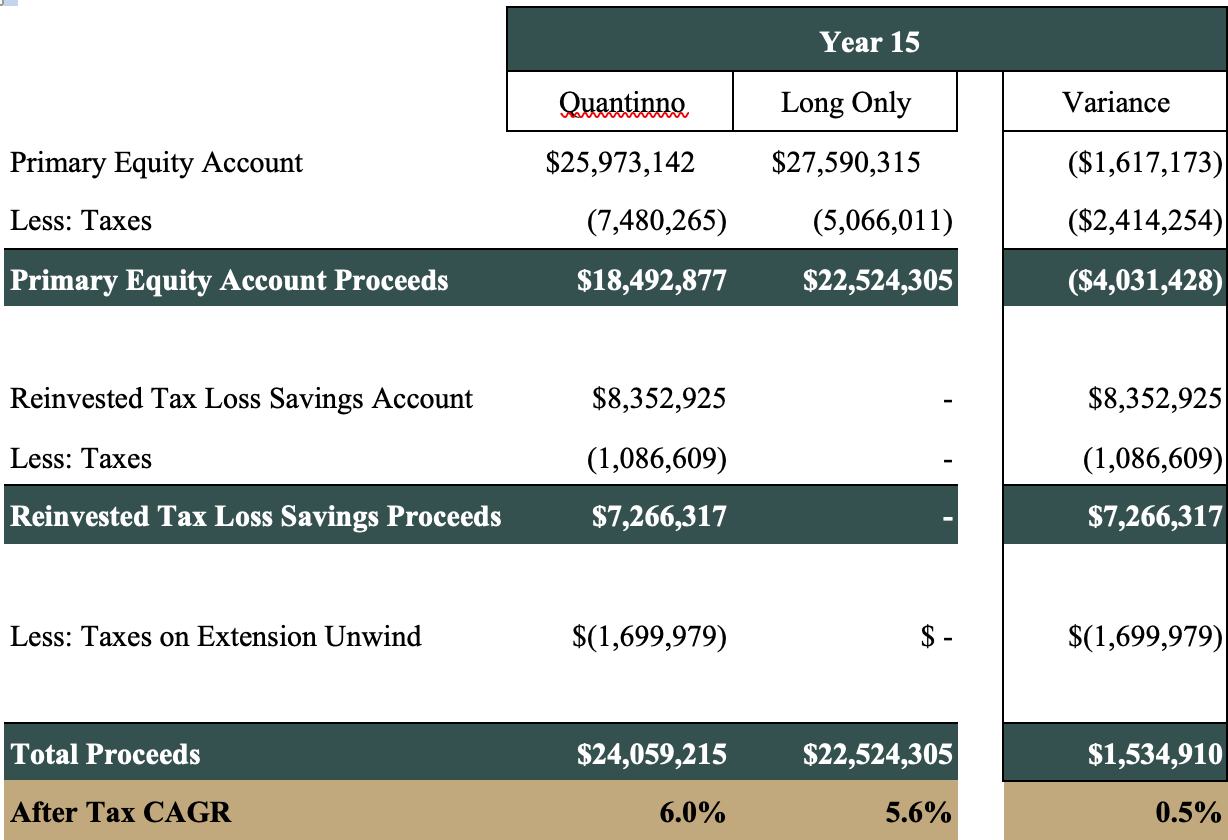
This example is intended to demonstrate general financial and tax planning concepts and should not be interpreted as guarantees of results or advice for any specific individual.
Tilting the Math in Your Favor
Our model above delivers solid results but there are a few situations in which the strategy may deliver far better outcomes:
Investor has short-term gains to offset.
Changing long-term gains (23.8%) to short-term (40.8%) in our model increases the annual benefit by 0.3%.
Investor lives in a high-tax state. Increasing the 5.0% state tax rate assumption to 13.0% for a California or New York resident adds 0.1% in annual benefit.
Pre-tax alpha. Assuming that AQR and Quantinno are able to match the index’s return after fees and expenses (implying true pre-tax alpha) adds 0.3% in annual benefit.
As we noted above, however, the best outcomes will likely come for investors who can use charitable giving or other strategies as part of their exit plan.
Our Takeaways
We certainly believe extension strategies make sense for certain clients in certain scenarios, but ultimately, implementation matters. Fees vary dramatically across portfolio managers and advisors. Cost of borrow and short rebates also differ meaningfully between advisors and custodians (and there is real risk these costs can change over time, as discussed above). Investors should research carefully and understand the incentives at play. Sizing, leverage, and tracking error decisions should be calibrated to each investor’s specific circumstances.
As with all things in wealth, caveat emptor!
In service of the long run,
Bob
The material above has been provided for informational purposes only and is not intended as legal, tax, or investment advice or a recommendation of any particular security or strategy. The investment strategy and themes discussed herein may be unsuitable for investors depending on their specific investment objectives and financial situation. Information obtained from third-party sources is believed to be reliable though its accuracy is not guaranteed, and Santa Barbara Management makes no representation or warranty as to the accuracy or completeness of the information, which should not be used as the basis of any investment decision. Information contained on third party websites that Santa Barbara Management may link to is not reviewed in their entirety for accuracy and Santa Barbara Management assumes no liability for the information contained on these websites. Opinions expressed in this commentary reflect subjective judgments of the author based on conditions at the time of writing and are subject to change without notice. Past performance is not indicative of future results.
Santa Barbara Mgmt., LLC d/b/a Santa Barbara Management is an investment advisory firm registered with the Securities and Exchange Commission (“SEC”) under the Investment Advisers Act of 1940. SEC registration does not constitute an endorsement of the firm by the SEC, nor does it indicate that the adviser or investment adviser representative has attained a particular level of skill or ability. The oral and written communications of an adviser provide you with information about which you determine to hire or retain an adviser. Form ADV Part 2A can be obtained by visiting https://adviserinfo.sec.gov
and searching for our firm name. ADV Form 2B is available upon request. Neither the information nor any opinion expressed is to be construed as solicitation to buy or sell a security or personalized investment, tax, or legal advice.
Comments
Nothing yet. Say the first thing.
Sign in to join the conversation.