
We keep asking why so many young people feel disconnected, anxious about the future, less proud of their country, and unprepared to become the next generation of workers and leaders. But maybe we should start by asking a harder question: What exactly is the bridge between adolescence and adulthood in America today?
For millions of young Americans, there really isn’t one.
A student finishes 12th grade and immediately faces enormous pressure to make life-defining decisions. They are expected to choose the “right” college, take on debt, compete for internships, build a résumé before they have had a chance to build real experience, and somehow emerge workforce-ready in an economy that is changing in real time. Increasingly, that system is not working particularly well.
Young people have lost the traditional pathways through which previous generations learned responsibility and work skills. And now, technology and AI is making it even more difficult.
Until just a couple of decades ago, many young people gained their first work experiences close to home—mowing lawns, shoveling snow, working in fast food, bagging groceries, babysitting, delivering newspapers, and more. I did the latter two, and those experiences taught me responsibility, reliability, respect for my community, and the interpersonal skills that often can’t be learned in a classroom.
Today, those jobs are all done by adults, leaving our young people with fewer opportunities to learn basic skills.
The labor market for young people has become far more difficult, especially for recent graduates trying to land their first meaningful opportunity. Recent data from the Federal Reserve Bank of New York shows that unemployment for recent college graduates has risen to approximately 5.6–5.7 percent, significantly above the broader unemployment rate, while underemployment remains above 40 percent for many young graduates. At the same time, employers increasingly want candidates with practical experience before they are willing to provide that experience in the first place. That contradiction is leaving an entire generation stuck between education and opportunity.
I think it’s time to think differently about how we structure the transition into adulthood.
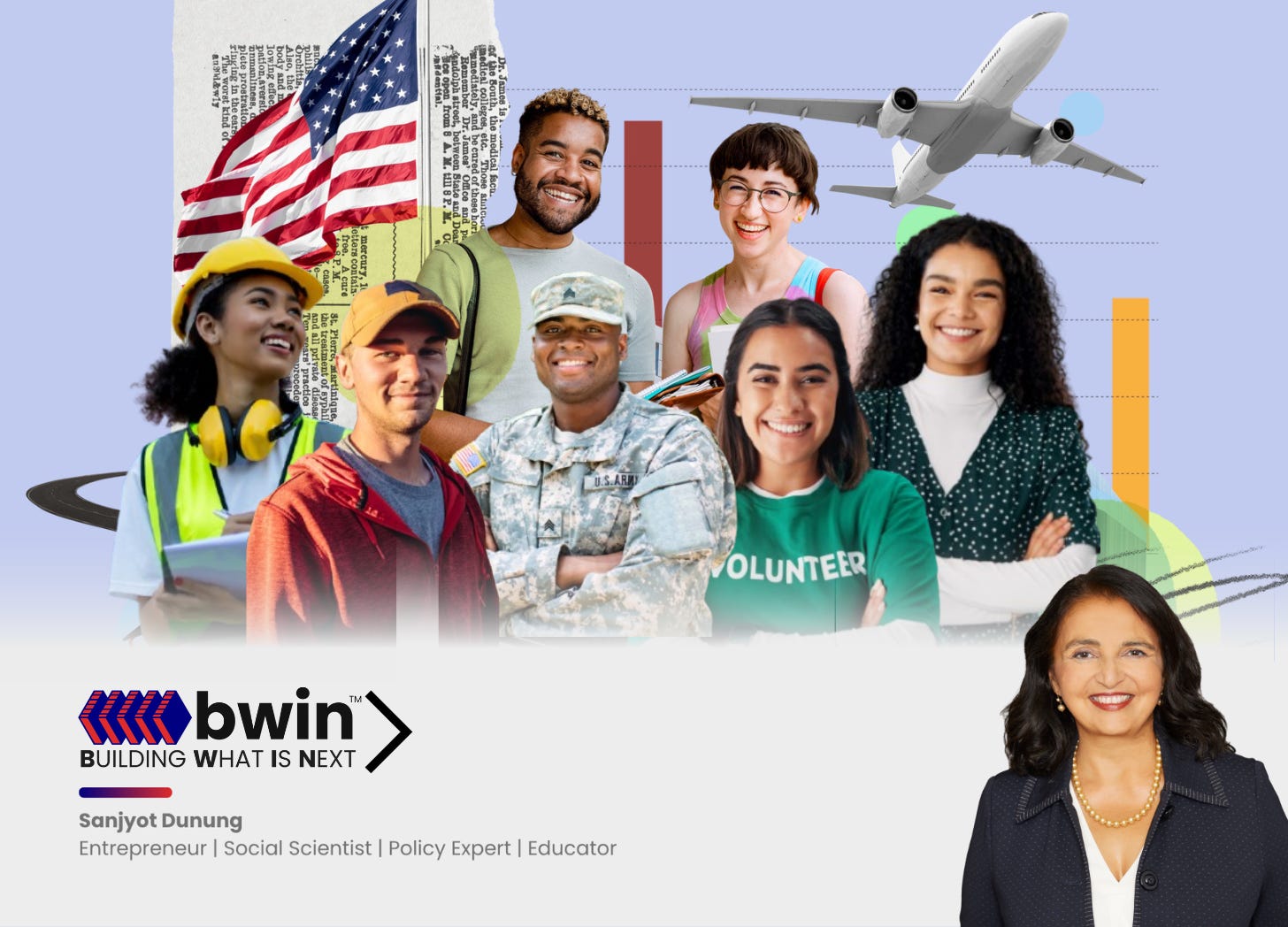
One idea worth seriously considering is a National Service Year after high school. Not simply military service—although military pathways would absolutely remain an important option—but a broader national service ecosystem that gives ALL young Americans a structured year to contribute, gain practical skills, and mature before moving into college or full-time employment.
Young people could choose from a wide range of service pathways depending on their interests and abilities. Some might serve in the military. Others could work as classroom aides in understaffed schools, support rural communities, assist in healthcare or elder-care settings, participate in infrastructure and skilled-trades programs, contribute to childcare and after-school initiatives, or work in technology and cybersecurity apprenticeships. Environmental conservation, disaster resilience, and community revitalization programs could also become part of the national framework.
Participants would receive a living stipend, healthcare coverage, workforce training, certifications, and education credits that could later be applied toward college or vocational programs. Most importantly, they would gain something increasingly difficult to obtain in today’s economy: real-world experience, real responsibility, and exposure to Americans from backgrounds very different from their own.
Bridging the Fragmentation.
One of the biggest challenges facing America today is fragmentation. Economic fragmentation, educational fragmentation, political fragmentation, and social fragmentation have created a country in which people increasingly grow up in entirely separate ecosystems. Many Americans now have limited exposure to people outside their own socioeconomic, geographic, or ideological circles.
Today, many high school students are required to complete a few hours of service during the school year—a time already packed with academics and extracurricular activities. With limited time and options, many kids find ways to fulfill the requirement with the least effort. Instead, a service year after high school would instill the spirit of service and national pride when young people have the maturity to better embrace the skills-building and interpersonal-skills development.
A National Service Year could become one of the few remaining shared civic experiences in American life.
At age eighteen, everyone is at roughly the same stage of transition. High school is over, adulthood is beginning, and identities are still forming. That creates a unique opportunity to build both skills and social cohesion.
Right now, internships and early-career opportunities are often heavily influenced by family networks, geography, financial privilege, and social capital. Students from wealthier communities are more likely to access prestigious internships, professional mentorship, and career-building opportunities early in life, while others struggle simply to gain entry-level exposure. A national service model creates something different: a structured, merit-based pathway into adulthood where ALL young Americans begin from a more equal starting point.
Students from rural Iowa, inner-city Chicago, suburban Texas, and an immigrant family in New York or California could all participate in the same national framework while developing practical skills, discipline, confidence, and a sense of contribution. That is not simply workforce policy. It is nation-building.
Fostering pride in our shared national American values and identity.
Other countries already understand the value of structured transition periods between adolescence and adulthood. In the United Kingdom, gap years are widely accepted as opportunities for maturity, service, work experience, and broader perspective, but they’re not structured enough to ensure shared values.
A better example can be found in Singapore, where national service creates a shared civic experience that cuts across socioeconomic divisions and helps foster discipline, resilience, and national cohesion. Singapore may be a small island nation, but it is home to populations that identify strongly with their ethnic and cultural heritage—Chinese, Malay, and Indian—as well as a wide range of religious traditions, including Christianity, Islam, Hinduism, Buddhism, and others, creating the potential for an explosive tinderbox.
Instead, over the decades, the mandatory national service after high school has helped to foster a shared Singaporean identity that bridges the normally divisive groups. I get that comparing Singapore and the USA may seem imbalanced by size. But Singapore offers a useful case study in how to get very diverse people to live in harmony and with strong national pride. It starts with national service.
Building on an Existing Idea—Why This Is Different from AmeriCorps.
The United States does have programs such as AmeriCorps and longstanding military service pathways, but these efforts remain fragmented, relatively small in scale, and culturally peripheral. What we need is a broader mindset shift: Service should not be viewed as punishment, a fallback option, or something reserved for a small subset of the population. It should be recognized as a respected developmental stage that strengthens both individuals and society.
One important distinction is that AmeriCorps was designed primarily as a voluntary service program, not as a broad societal transition framework. Programs like AmeriCorps have absolutely created meaningful impact for many participants and communities, particularly in education, disaster recovery, and local nonprofit support. Under the Obama administration, national service was expanded because there was recognition that civic engagement and community-based work could strengthen both opportunity and social cohesion. But AmeriCorps remained relatively small in scale, limited in visibility, and often disconnected from mainstream workforce and education pathways. Participation tended to attract students who were already civically engaged or aware of the program, rather than becoming a normalized part of the American transition into adulthood.
What makes this idea different is that it is not simply a service program—it is a rethinking of the entire post–high school transition model. A National Service Year would operate as a large-scale civic and workforce development infrastructure designed to sit between high school and either college or full-time employment. It would integrate military, workforce, technical, healthcare, education, infrastructure, and community-service tracks into a single national framework tied directly to skills development, employability, and national cohesion.
The goal is not only public service. The goal is to create a shared developmental experience that gives every young American tangible work experience, exposure to different communities, practical skills, mentorship, and a clearer sense of direction before entering adulthood full-time. In that sense, it functions not just as a public service initiative but as an economic, workforce, and nation-building strategy simultaneously.
My approach is also about economic and political realities.
The United States is simultaneously facing entry-level job shortages, growing skills gaps in critical industries, rising student debt burdens, workforce shortages in healthcare and skilled trades, and increasing technological disruption to traditional early-career jobs. At the same time, employers consistently say that young workers lack practical experience and workplace readiness.
A National Service Year directly addresses that gap by creating structured opportunities for applied learning and workforce development before young people enter the labor market full-time. Instead of simply subsidizing educational pathways disconnected from workforce realities, we could invest in practical development, civic participation, and tangible-skills acquisition. In many ways, providing stipends for structured service and training may ultimately prove more effective—and potentially less expensive—than continuing to expand systems that leave many young people disconnected from both work and purpose.
But the biggest barrier to ideas like this is not operational. It is psychological.
America has become too locked into outdated assumptions about success. We continue to operate as though every student should follow the exact same pathway from high school to college to career, even as the economy and nature of work evolve around us. We still treat credentials as more important than practical capability. We continue to think workforce development begins after graduation instead of recognizing that it should begin far earlier.
The reality is that the world has changed. Technology has changed. Global competition has changed. The economy has changed. Leadership requires the courage to rethink systems that no longer align with modern realities.
That means embracing a more innovative mindset in governance itself—one that is willing to challenge outdated assumptions, test bold ideas, and redesign transitions into adulthood for a new era. Not every idea will work perfectly, but defending systems that are clearly underperforming is not a strategy either.
A National Service Year would not solve every challenge facing young Americans. But it could accomplish something profoundly important. It could create a shared starting point, strengthen civic connection, build practical skills, foster maturity and responsibility, and help bridge some of the growing divides pulling the country apart.
Most importantly, it would recognize something we too often overlook: Young people do not just need credentials. They need experience, responsibility, mentorship, pride in community and nation, and a sense of belonging.
That is what we should be building.
Because the future isn’t something we wait for.
It’s something we build.
Thanks for reading.
Building What’s Next, Sanjyot
’
Comments
Nothing yet. Say the first thing.
Sign in to join the conversation.