
The other day I spotted this post on X by “Sama Hoole”:

Sama Hoole@SamaHoole
Every name on this list was told the science was settled. Every one of them was right. Most were punished first. James Lind, 1747: scurvy came from bad air and idleness, said the Navy. He put twelve sailors on six treatments and proved it was citrus. The Admiralty acted

3:28 AM · Aug 17, 2026 · 62.3K Views
32 Replies · 418 Reposts · 1.5K Likes
Now, I have no idea who Sama is, and have followed very little of his posts before. I tend to be suspicious of accounts which come from nowhere and appear to be promoting anti-establishment messaging whilst at the same time escaping censorship and suppression.
I am not going to comment further on that here as it’s not the focus of this post, which is that one specific element of Sama’s post on X particularly intrigued me, and that was this:
Christopher Ramsden, 2016: the largest diet trial ever run had gone unpublished since the seventies. He found the boxes in a dead researcher's basement. The men who swapped saturated fat for corn oil had lower cholesterol and more funerals.
I had never heard of Christopher Ramsden before so decided to look into the story.
The paper to which Sama is referring is this 2016 article:
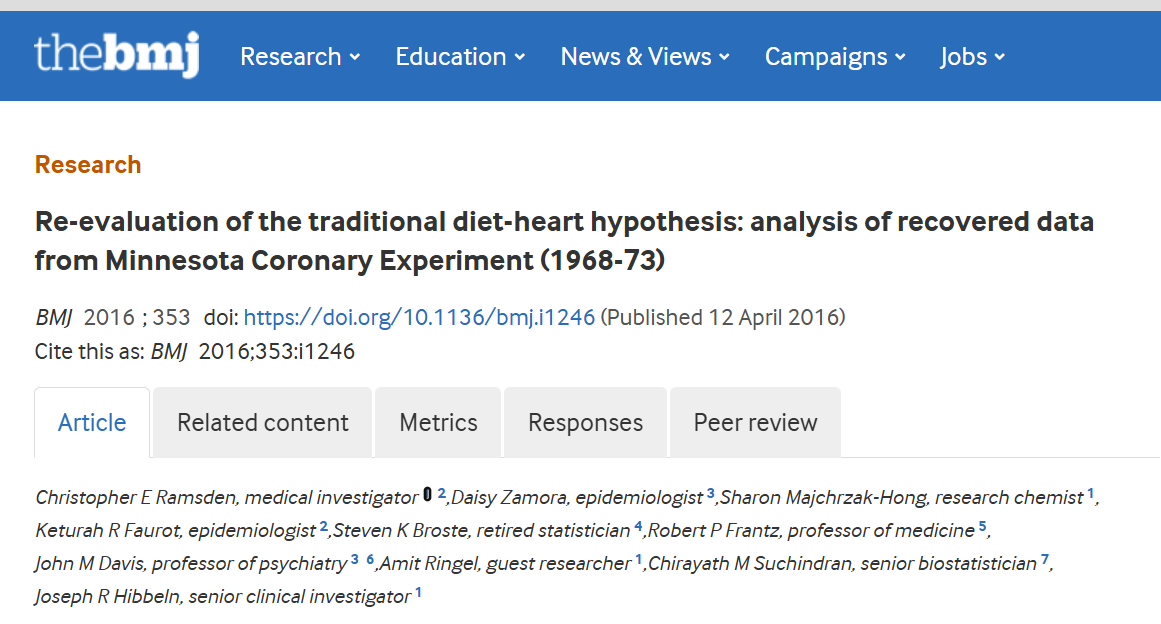
Here’s a PDF:
In Minnesota between 1968 and 1973 a huge randomised trial was undertaken to determine the effects of replacing saturated fats with vegetable oil rich in linoleic acid. Important results remained unpublished in the medical literature until Ramsden’s 2016 paper.
Key features of the Minnesota Coronary Experiment were:
A randomized, double-blind trial conducted from 1968–1973 involving 9,570 institutionalised men and women across seven Minnesota state facilities.
Half the subjects received the “intervention diet”, in which saturated fatwas replaced with liquid corn oil and polyunsaturated margarine - ie a “cholesterol-lowering diet”.
Those receiving the “control diet” continued their standard institutional diet maintaining a high saturated fat intake.
Diets were served in a single line using encoded food trays and punch cards to track missed meals and ensure adherence. Nobody - other than those preparing the diets - knew which diet each subject was receiving.
The endpoints intented to be measured included all-cause mortality, cardiovascular events, serum cholesterol levels, and postmortem evaluations of atherosclerosis and myocardial infarctions.
16,825 participants completed initial screening forms.
7,255 individuals were no longer in the hospitals when the dietary phase commenced
9,570 participants were randomized into the study (4,756 allocated to the intervention diet and 4,814 to the control diet).
9,423 participants actually began and received their assigned diets (4,685 intervention and 4,738 control); 147 patients had zero days of diet exposure and were excluded from survival curves.
9,423 participants were included in the primary full-cohort Kaplan-Meier life tables analysed by Broste in his 1981 thesis (see below).
2,403 randomized participants remained on the study diets for at least one year; longitudinal serum cholesterol measurements were recovered and analyzed for 2,355 of these individuals (1,179 intervention and 1,176 control).
Mortality and autopsy samples: Across the trial, 517 total deaths occurred, and 295 autopsies were completed; complete autopsy records for coronary/aortic atherosclerosis and myocardial infarction were recovered and analyzed for 149 patients (76 intervention and 73 control).
The trial completed in 1973, but for many years thereafter, no results were published. In a 1975 conference abstract at an American Heart Association meeting1 the methodology, population characteristics, and initial cardiovascular observations were presented.
At that time, and as Ramsden had found in his research for his 2016 paper, it was reported that no significant differences were observed between the treatment and control groups for cardiovascular events, cardiovascular deaths, or total mortality. A favorable trend in cardiovascular endpoints among certain younger participant subgroups (under age 50–55) who remained on the diet for longer periods was suggested. The fact that mortality trends looked unfavourable in the over-65s was NOT mentioned, nor any autopsy data.
No data on the relationship between individual cholesterol reduction and the risk of death was reported either, but this may be because at that time (1975) the computing power necessary to perform the complex time-based analyses was in its infancy.
In 1981 a student of the University of Minnesota called Steven Broste (a now-retired bio-statistician) completed a Master of Science thesis containing detailed Kaplan-Meier survival analyses and subgroup lifetables. This remained uncited and excluded from the scientific evidence base.
Here’s his thesis:
Broste’s analyses found the following:
There was no mortality benefit in the diet group across all 9,423 randomized participants with follow-up.
Excess mortality in the intervention group was confined primarily to participants aged 65 and older.
Crude rates and survival curves for coronary heart disease deaths revealed no beneficial effect from the experimental cholesterol-lowering diet. In fact, coronary heart disease mortality was higher in the intervention diet group.
Cox regression analysis showed cholesterol reductions were associated with a higher risk of death in those on the intervention diet for more than a year.
Interaction and Compliance Findings: Multivariable regressions indicated that diet compliance and aging had a more severe, detrimental impact on mortality in the intervention cohort.
In subjects aged 65 and older, excess mortality in the intervention diet group emerged and diverged between days 400 and 600.
Lower BMI strongly predicted higher mortality (considered due to frailty and physical debilitation.
It should be noted that not all the above findings were statistically significant, although crucially these were:
The association between the amount of cholesterol reduction and the risk of death in those on the diet for more than a year; (ie the greater the reduction from baseline, the higher the risk of death)
Divergence of excess mortality (greater in the intervention diet group) between days 400–600 in >65s
In 1989, sixteen years after the trial ended, the principal investigators published an initial report in Arteriosclerosis (PDF below) describing overall null findings for cardiovascular events and mortality; they omitted any reporting of the relationship between cholesterol and mortality, a specific older-age subgroup analsys, or any autopsy data. Instead, they focused on the small, favorable trends in younger participants and emphasised that the trial was underpowered due to high patient turnover.
This is, by the way, despite the principal investigator and author - Ivan Frantz - being well aware of Broste’s work. He is thanked in the thesis and Ramsden described it as having been completed “under mentorship of MCE researchers”.

Frantz Et Al 1989 Test Of Effect Of Lipid Lowering By Diet On Cardiovascular Risk The Minnesota Coronary Survey
433KB ∙ PDF file
Nothing more emerged regarding the study’s results until 2016 - when Ramsden et al published the BMJ piece referred to above.
In that paper, the authors repeated the analyses Broste performed and carried out additional analyses, using data obtained from the MCE archives, including that held on magnetic tape.
Their findings confirmed and expanded upon Broste’s findings:
Replacing saturated fat with linoleic acid significantly lowered serum cholesterol but showed no reduction in all-cause mortality or coronary heart disease deaths
In participants on the study diets for more than a year, each 30 mg/dl reduction in serum cholesterol was associated with a statistically significant 22% increase in the risk of death
Subgroup survival analyses revealed an excess mortality hazard confined primarily to the >65s allocated to the intervention diet, in which the increased risk of death was 74%
Data from 149 recovered autopsy reports showed no difference in coronary atherosclerosis or aortic atheroma between the groups, while myocardial infarctions were nearly twice as prevalent in the intervention diet group
Ramsden et al also performed a systematic review of all the trials of linoleic acid rich diets, which supported the hypothesis that they lowered cholesterol without reducing coronary heart disease mortality or total mortality, providing no overall clinical benefit.
That particular article did get some mainstream attention in the Washington Post (click on the picture to go to an archived version):
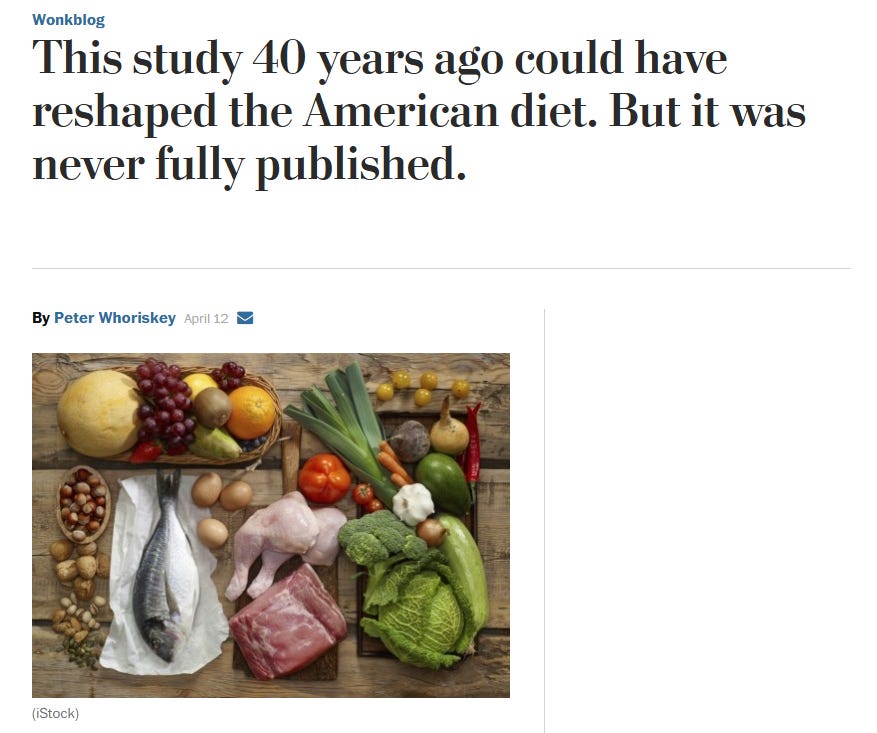
That article does address the question as to why the full results never made the light of day at the time. To quote:
Broste also suggested that at least part of the reason for the incomplete publication of the data might have been human nature. The Minnesota investigators had a theory that they believed in — that reducing blood cholesterol would make people healthier. Indeed, the idea was widespread and would soon be adopted by the federal government in the first dietary recommendations.
So when the data they collected from the mental patients conflicted with this theory, the scientists may have been reluctant to believe what their experiment had turned up.
“The results flew in the face of what people believed at the time,” said Broste. “Everyone thought cholesterol was the culprit. This theory was so widely held and so firmly believed — and then it wasn’t borne out by the data. The question then became: Was it a bad theory? Or was it bad data? ... My perception was they were hung up trying to understand the results.”
Ivan Franke’s son (Robert) gives some further clues as to what might have driven the non-publication in a forward to the supplement to the 2016 BMJ paper titled:
“Tribute to Dr. Ivan Frantz in leading the Minnesota Coronary Experiment team. Reared on Margarine and to the Tune of Spinning Ultracentrifuges: A Son’s Recollections of Ivan D. Frantz, Jr. During the Early Days of Lipid Research. Robert P. Frantz, M.D ”:
The Minnesota Coronary Survey thus was many years in the making, from its roots in epidemiology of cardiovascular disease, to development of analytical techniques capable of measuring lipid levels reproducibly, to designing the clinical trials and convincing the necessary policy stewards and funding agencies that such trials could and should be carried out. Completing the MCS was an enormous effort on the part of many individuals, including the subjects who agreed to participate. My father would praise the whole team for their efforts in making the work possible. The entire lipid research team at the U of M was passionate about what they were trying to accomplish.
Accordingly the disappointment when the overall study results were negative must have been profound. My father officially had retired from the U of M in 1984, though it was hard to see any major difference in his work ethic as an Emeritus Professor in the years after that, culminating in the publication of the MCS study results in 1989 when he was 74 years old.
If he were alive today, I know my father would have been delighted that the data he had devoted his career to making possible had been painstakingly revisited in order to shed additional light on the frustratingly paradoxical results. Science is a never ending search for the truth, including the need to revise hypotheses, to explain unexpected results, and to apply that knowledge for the betterment of the human race.
This is a text-book example of publication bias in action. Results which didn’t fit the preconceived expectations of the investigators were simply held back, in this case for decades. The scientists struggled to believe the results and assumed that there must be something wrong with the study - not that maybe the results were actually disproving their hypothesis.
In fact, these results may never have seen the light of day had Christopher Ramsden not decided to go poking around the study archives.
In this particular case, pharma pressure appears to have been absent. The trial predates the emergence of the statins; however, their existence may have played a role in later non-publication. That pressure need not have been direct. The entire machinery of scientific publication has, for many decades now, been under the direct or indirect control of Big Pharma. The careers of many scientists are sustained by the belief that cholesterol is harmful and lowering it is net beneficial.
As Upton Sinclair famously said:
It is hard to get someone to understand something when his salary depends on not understanding it.
It also seems to me that there is an inherent bias towards publishing results which demonstrate that an intervention - whatever it might be - is beneficial. It is quite difficult for scientists raised on such a premise to admit that doing nothing might be preferable to doing something.
Given that serendipity was such an important factor in the ultimate uncovering of this data, we have to ask:
How many experimental findings across science and medicine go unpublished simply because they challenge the prevailing consensus?
For several startling quotes from recent editors of the major scientific journals, see my recent article below:
Note that this is mentioned by Ramsden in the 2016 BMJ article (ref 18) but I couldn’t find any copy of the same.
No posts
Comments
Nothing yet. Say the first thing.
Sign in to join the conversation.