
Hello all!
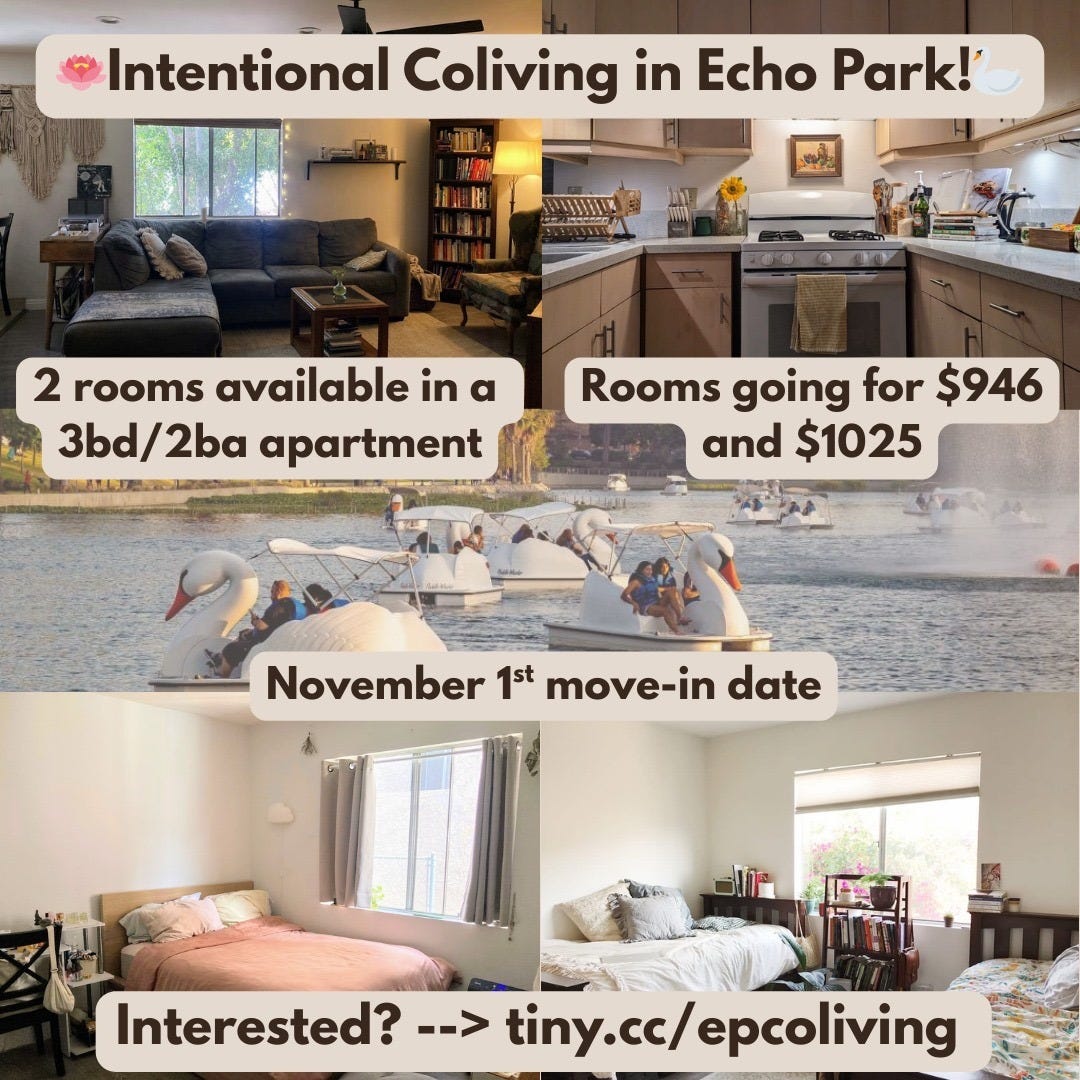
Are you in Los Angeles and looking to be in mindful intentional community? Know someone who is? Our close friend and fellow practitioner Tee Martin has a space and is looking for roommates and community members in their apartment. They live in Echo Park, a 10 minute walk from our house, and we envision a kind of sister community over there. Find more information here.
We’ll have meditation this coming Wednesday at 7 pm as usual.
On to a reflection on the future of Sangha Hous-ing from Garrett.
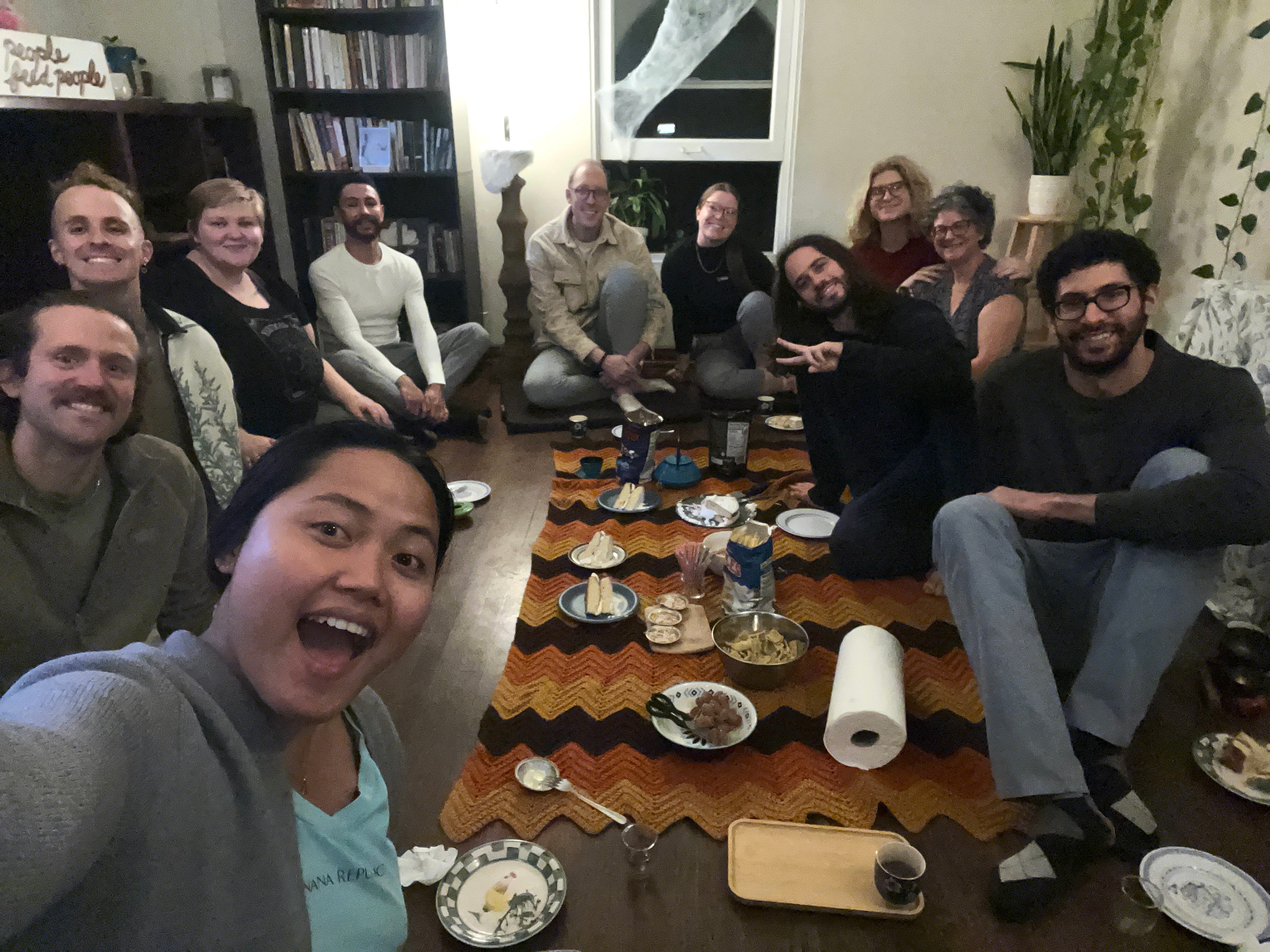
Sangha House LA is now 6 months old, no longer a newborn but still in its infancy, and in a way this infant is developing wonderfully. On a daily basis, the community brings gifts to those of us who live here, and many who don’t. The 6 of us who call it home have an environment that supports us in spiritual growth. We share meals, chores, healing, laughs and tears. Our friendship broadens and deepens. We are humbled as we surrender our ego and its clinging to a small “fairness,” and clean up a mess we didn’t create. We extend ourselves by asking for our needs to be met. On a daily basis, we practice the realization of interbeing. We also get to serve as a meditation center for a small but lively community in our weekly, open-to-the-public Wednesday evenings meditations. Diana, Ray, Tee, Sean, Julia, Anthuan, Mejin, Mona and others have been regulars and form a loose tribe that extends out in many directions. This past Wednesday, a friend attended our Wednesday sit for her first ever venture at meditation… That’s it! The house has fulfilled its mission.
But now that the car has started and the engine is running, so to speak, we are left with a different question. Where do we go? Or do we go? We have achieved the MVP of a functioning intentional community, call it Sangha House Lite, but the whole thing is but a draft, or a draft of a draft. Living in community takes work, an incredible amount of work. Relationship building, visioning, coordination, logistics. Really we have just started that work. Community as a way of life, as a calling, is a whole other thing, and we’re not there yet. Our commitment from members is measured in months, not years. We lack a decision-making structure, and processes for many elements of shared life. We don’t have a non-profit to our name, or a dime in our house fund (we don’t have a house fund!). We lack a bigger house. We don’t have relationships with other organizations, partners, or benefactors. Most importantly, we don’t have a long-term commitment to each other, or to do any of these things, or to the community way of life. That’s okay. It might reasonably not be the right way of life for someone. On the other hand, one might know that they want to do that work, but question whether this is the right time and place and group to do it with. That’s also okay. But these are the questions we are beginning to ask.
So we are in a discernment phase. To analogize, we’re dating, and we’re beginning to talk about marriage. We’re not proposing, but we’re saying that that’s our intention. Sangha House Lite is meeting our needs for the moment, we’re having fun, but we are ultimately looking for something deeper, harder, and more lasting. We want long-term commitment. We are trying to see if we are compatible for undertaking that project together. And we made some progress on that recently. We talked about it. And we agreed that we would occupy this discernment phase until April 2026. That gives us five and a half more months to occupy this preliminary stage, seeing if we have capacity and willingness and alignment to make a larger commitment together. Call it Sangha House 2.0.
So it comes time to spell out our vision, or begin spelling out a vision. There are different parts of that, but for now I’m going to break it down into an internal part and an external part. I’m going to leave aside the internal part — structure, norms, routines, and practices for relating to each other and taking care of ourselves as an alternative family. I’m setting aside how we save ourselves. I want to focus here on how we relate to the outside world, our engagement with politics and movement building. What is the blueprint for a full-bodied, engaged, thriving adult sangha house, toward which we shall strive and grow? What does a mature community look like as a part of a worldwide movement for healing, peace, and justice? After all, we are not just here to save ourselves. (Cue the superhero music.) We’re here to save the world. We place ourselves at the intersection of contemplation and action, the monastery and modern life. We are engaged Buddhists. Like Thay, Ghandi and MLK, our spiritual path is inseparable from the struggle for justice, and the transformation of society. How precisely are we doing that? In the view from 10,000 feet, how could anything our poor little house does or will do really matter?
I’ve learned to think about these things from Paul Engler, a writer, lifelong activist, community builder, and my friend and mentor. With his brother Mark Engler and partner Carlos Saveedra and the Ayni Institute, Paul developed a framework for talking about strategies for change and their interrelations and interdependence, which they call “movement ecology.” (You can read more about it here for example.) The framework is an answer to the question, “How do we create social change?” They observed groups, organizations, and cultures that agreed that we need change but disagreed over how to get it, and got derailed by infighting. Mass protest, structure based organizing, election campaigns, alternative community and spiritual healing — these headings can be useful for delineating a large swatch of activism into distinct “theories of change.” And in response to the question about which we need, Paul and company answer, “All of them! We need all of them!” While acknowledging their differences and the inherent tensions between them, they explain how these avenues mutually support and invigorate each other. We are embedded in an ecosystem, in which each part or organ plays its special part.
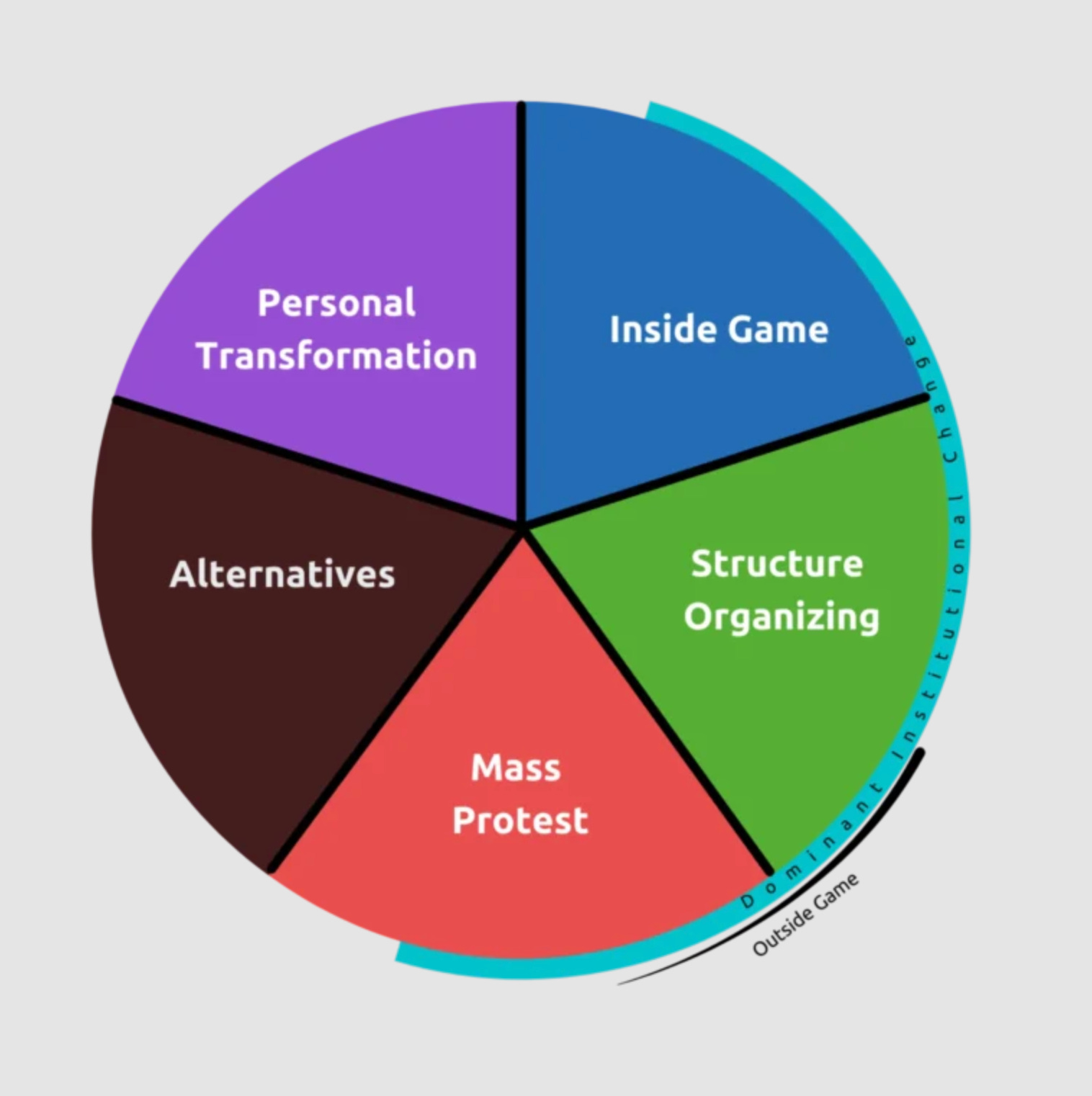
So I want to try placing the Sangha House within the broader ecosystem using this framework. Our work at the Sangha House falls into two areas, personal transformation and alternatives. I will quote some of what the Ayni institute says about these theories of change.
Personal transformation believes that change happens when we better our lives and the lives of others through providing service, improving our health and well-being, or reaching higher levels of consciousness. In this belief, personal transformation organizations and programs are focused on the individual and their transformation. Sometimes this refers to internal work, or personal work, or people changing their values or beliefs, but it can also refer to helping one another. Examples of personal transformation include leadership development programs, spiritual counseling, 12 step recovery programs, diversity and anti-oppression trainings, yoga and mindfulness practices, mental health therapy and counseling, food banks, and job-placement services. Personal transformation attends to people’s direct needs and it projects a vision of change rippling slowly outward as individual lives are improved.
Alternatives are cultures, institutions, organizations, or groups that respond to the dominant status quo or the dominant way of doing things by creating something outside of it that can serve the needs of a community. These are institutions that offer a new vision for the future by experimenting with alternative ways of doing and being. Examples of alternatives include worker and consumer cooperatives, credit unions, affinity groups, urban gardens, buy nothing groups, countercultural music genres, restorative justice programs, alternative medicine such as herbalism and psychedelics, and some alternative education curricula, such as Montessori. Alternatives reject a spectrum of dominant values in our society that oppress people, values of domination, punitivism, and capitalist extractivism. They seek to build groups, cultures, institutions, that embody the world we want to live in, and embody a different set of values based on equality, justice, and freedom. Leaders in this theory believe that in order to change the world we have to first build the kind of world we want to see. In this theory, it is impossible to create change in the world if we are not creating something new, something liberatory, something better than what is currently offered by the status quo.
As a Sangha House, we are involved in both of these areas, personal transformation and alternatives. And the first way the movement ecology framework can help us, I think, is by bringing us greater self-understanding and allowing us to see our connection and siblinghood with others within our theories of change. Let’s start with personal transformation, then, and outline the ways we are already doing this, and might be able to expand our offering with a Sangha House 2.0. We already provide services to people in our community, supporting them as they reach toward higher levels of consciousness, and mental and spiritual well-being. As I write this, Casiana is in the midst of planning her first session of laughter yoga (it took place Wednesday and was a blast!). In looking to the future, we could go further and expand our relationships with other players in this area. We can expand our relationships within the Buddhist community in Southern California, inviting monks and teachers for Dharma talks, and hosting monks from Deer Park. We could get training in NVC, practice it, and make it part of our lives. Some of my friends are developing a scalable mutual aid mental health program called the Recovery Movement, 12 Step for Everyone, and we could run a group from our house, overlapping with our community.
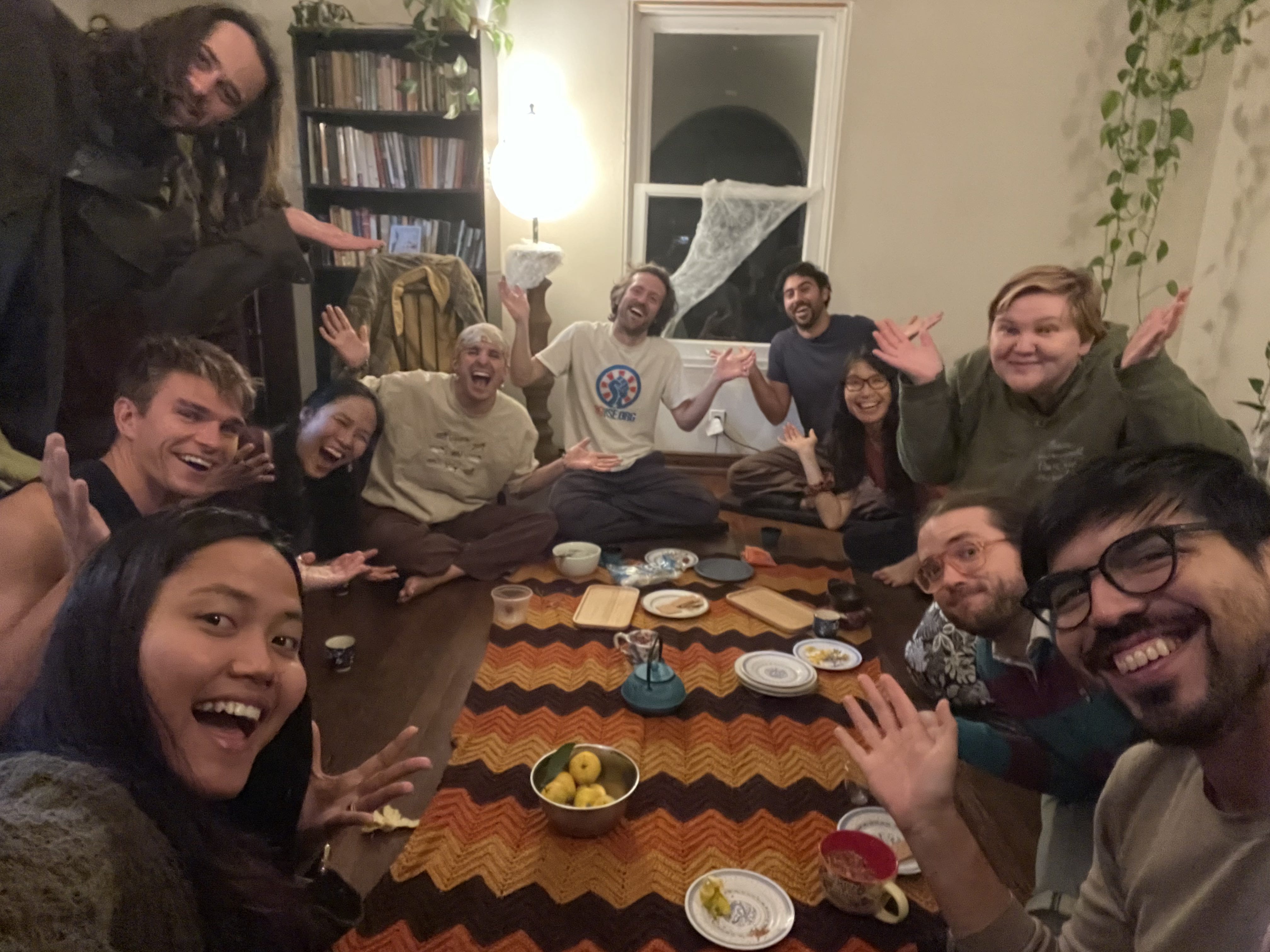
Now let’s go on to alternatives. In an individualist, capitalist, consumerist culture, living in community is inherently countercultural. We are living resistance by creating and maintaining our own polity, sharing resources, and strengthening non-market relationships. We are vegetarian, DIY, and support healing, and we are not doing it alone. We are connected with the Plum Village community at many levels. We met through the Compassionate Heart Sangha, a Plum Village sangha which meets weekly in Echo Park, and those people regularly come over to our house. Two of us are on the path to become lay monastics in the tradition. We went to Deer Park for retreat earlier this year and Casiana has been 7 or 8 times this calendar year. In the future, we want to have monastics from Deer Park stay with us. Furthermore, we want to find ways to support Plum Village sangha houses in other cities. We got a small taste of this when David Viafora, who has lived in and studied many communities in our tradition and written about them, stayed with us for 5 days in July.
The second way the movement ecology framework can help us is by allowing us to see the role our theory of change plays within the movement ecology. There’s a lot more to explore here, but I’m just going to mention some strengths and weaknesses of our theories of change within the movement ecology. In creating health in individuals and meeting people’s immediate needs, personal transformation is concrete and immediate. It brings people actual healing in the here and now. In doing so, it creates a deep feeling of impact on individuals, and can be a gateway to other forms of activism, community power, and the broader movement. Similarly, alternatives create a clearly defined container for new, radical experiments. They hold up the possibility of a different way of being. Besides offering these strengths, both personal transformation and alternatives funnel back into and support the other theories of change by mobilizing the base, developing leaders and resources. Alternatives have often been the frontlines of resistance. For example, people already living alternatively are often the first to be out on the streets for mass protests. The flip side is that personal transformation and alternatives are individualistic and hard to scale. They are labor intensive and hard to expand.
I have two main takeaways from all of this theory. The first is that we are not alone. The concepts of movement ecology give us a framework for seeing ourselves as part of something much larger than ourselves. We feel siblinghood with many of those who are doing the work of personal transformation and alternative culture along different paths. It allows us to understand and accept the role we play in the larger ecosystem. It also gives us a roadmap for strengthening our ties and connections with those around us who share our theory of change.
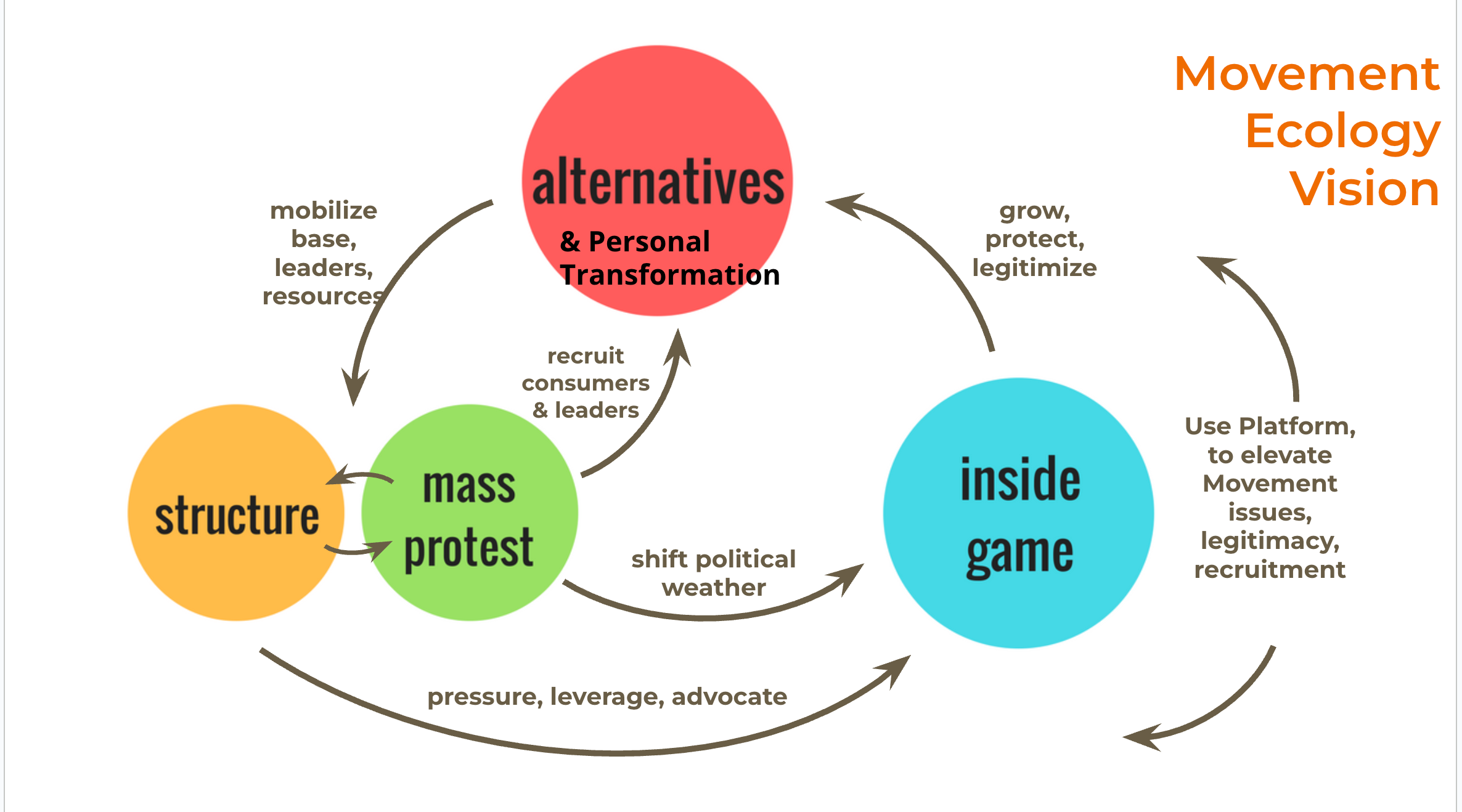
And I want to drill down on one aspect of this, one specific niche within personal transformation and alternatives where we have a lot of affinity, I think, and could find partners and support and make contributions in the broader ecosystem. This is in attempts to create structures and communities that support spiritual formation outside of but inspired by formation programs of traditional religious orders and institutions. I’m thinking of the AltDiv, The Formation Project, The Center for Spiritual Imagination, and all “new monastic” communities — this last movement especially interests me. Traditional monasticism was cloistered and set apart “from the world.” The new monasticism is lay and engaged “in the world.” The concept comes in part from Bede Griffiths, a Catholic Camaldolese Benedictine monk in India who prophesied that the future of monasticism would be lay: lay people, with families and jobs, living lives of contemplation and justice in community, with spiritual practices integrated in daily routines, belonging to an order or rule of life. With an aim of “democratizing the gifts of monastic spirituality and translating them into a form that can be lived in everyday life,” The Center for Spiritual Imagination created an innovative four year formation process that culminates in vows. The Plum Village community has its own efforts which fit into this conversation. Casiana and I are going through an experimental formation process with a group of 40 to 50 other young people to become lay monastics in the Order of Interbeing.
The second main takeaway from movement ecology for us is that it may point in the direction of something we have to offer our community. The main weakness of alternatives and personal transformation as strategies of change is that they’re labor intensive and hard to scale. An incredible level of investment in time and energy is required for therapy, spiritual direction, or an intentional community, for example. At the same time, Paul has taught me a lot about decentralized organizing, frontloading, and how to build a movement that can scale — even a decentralized mutual aid mental health movement. You aren’t going to reach everyone by one-on-one relationship work and leadership development. If you want to do that, you need another kind of vessel, a germ that can be picked up by the wind, carried afar, and spread your movement for you. You can learn a lot about this sort of thing by studying 12 step groups, which are entirely decentralized and the largest mutual aid mental health community in the world. One of the conditions that makes this possible is the articulation and systematization of 12 step practices into formats. Most famously, there’s a format for working the program (the steps). But there’s also formats for the group (the traditions), formats for the fellowship (the concepts), and formats for running a meeting (meeting script). Anyone can run a meeting by reading the script, and anyone can start a group, anywhere, because they have the formats, which are the DNA of the movement. One idea I would like to explore more is creating formats for a Sangha House, and generally finding ways to support a network of houses in the Plum Village tradition.
So we’re starting to think about whether and in what form the Sangha House will continue past this year, and my point is that as we do that it’s important to have an understanding about what larger communities we belong to, and how we can contribute to them. Because they are also the communities that will contribute to us, and provide us with models, inspiration, companionship, resources, and fellow travelers. Speaking of fellow travelers, we need to find the like-minded folks who are thinking about these things and interested in pursuing them further, because we’re just starting to work out this vision. We’re just starting. And we’re talking about whether we need a bigger house next year, and what that might look like. So if you’re interested in building intentional community around mindfulness, be in touch! Wherever you are, but especially if you’re in Los Angeles.
Bowing out.
Garrett
No posts
Comments
Nothing yet. Say the first thing.
Sign in to join the conversation.