
This piece was co-authored by Dr Matthew Kreuter and Dr Rachel Garg.
We have written here often about the challenges facing public health, and about the slow erosion of public trust in the field. Those challenges have many roots — partisanship, the inconsistencies of pandemic-era communication, the perception that public health speaks more in the language of values than in the language of evidence. We have taken up several of these elsewhere. There is, however, one further piece that deserves more attention than it tends to get, and it has to do with the story we tell about ourselves.
The dominant national narrative about health is, on most days, a narrative of foreboding. Things are bad and getting worse. Every week brings another headline of imminent risk. That story is not entirely false. Many of our health indicators are indeed troubling, and public health draws much of its public license from sounding the alarm when the alarm is warranted. But foreboding is not the whole picture. Some health problems are getting worse. Others, quietly and with very little fanfare, are getting better. When the public hears only the first half of that story, it shapes how people understand what we do and whether the work is worth supporting.
This matters because public health, more than most fields, depends on a citizenry that believes the work we are doing is effective, is worth investing in. Belief in that proposition is not automatic. It has to be cultivated, and it can be lost. A poll out of St. Louis, recently fielded, captures the problem with unusual clarity.
In an analysis of the iHeard regular survey, adult community members in St. Louis, MO were asked whether they thought the rates of six different health issues were currently rising, falling, or staying in the same in the U.S., or if they didn’t know. In other words, were these problems getting better or getting worse?
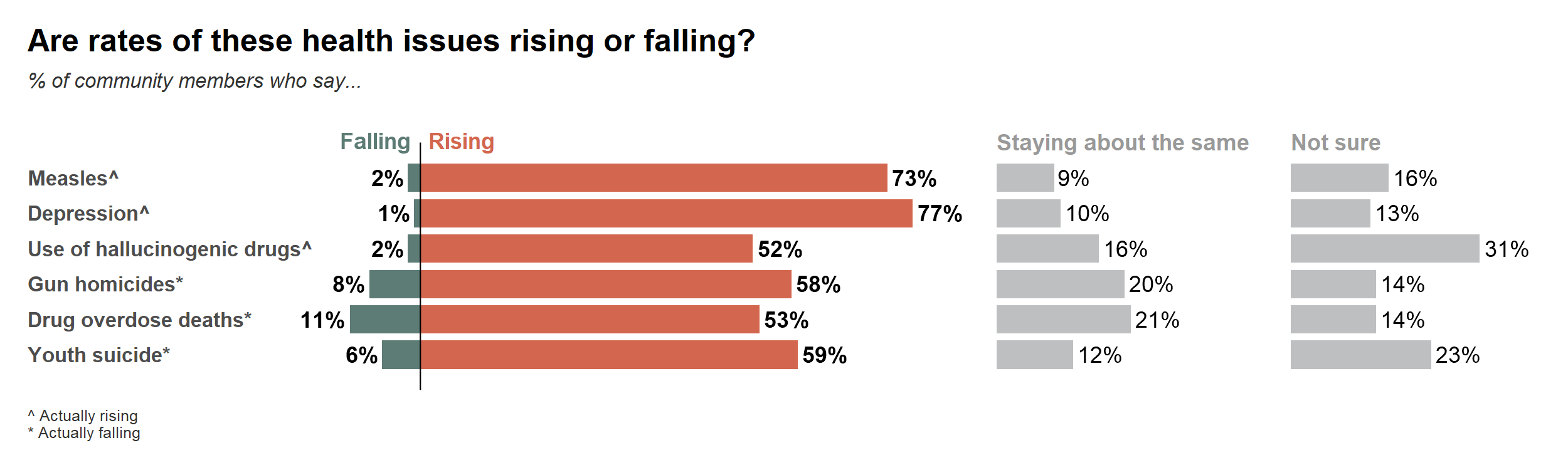
The good news: the public was widely aware that rates of measles and depression had been rising in the U.S. The bad news? People overwhelmingly had the same reaction to health issues that were actually improving. By margins as high as 10-to-1, the public thought that rates of drug overdose deaths and gun homicides were getting worse. They are not. They are improving.
There is, in other words, a gap between what is actually happening to some of our most pressing health problems and what the public believes is happening. These data suggest that people are walking around convinced we are losing ground on overdose deaths and gun homicides when the data show that we are not. Taken at a higher level, these data suggest that the public believes public health is failing on problems where it is in fact succeeding, and that this gap between reality and perception runs in only one direction. The public has correctly registered that measles is back and that depression rates are rising. What it has missed is the slow, hard-won improvements that have come from years of coordinated effort, often led by the very public health institutions whose competence is now in question.
Does it matter if people do not recognize when public health efforts are making a positive difference? We think so. Why?
First, there is a clear link between demonstrating competence and earning trust. Public agencies and public leaders build trust by committing to and delivering on promises. Over time, when organizations establish a record of delivering on promises, people trust them. Perhaps obviously, if the public does not know that we are succeeding, it is at the very least a missed opportunity to build trust.
Second, ask yourself, what do we want people’s mental model of public health to be? Do we want public health to be primarily associated with problems and threats? Crises? Pandemics? Do we want people to think “They’re the ones (not) dealing with the problem” or “They’re the people solving the problem?” Imagine if a local sports team only televised the games it lost, never the wins. Casual observers might reasonably assume the team wasn’t very good.
Claiming progress when it has been earned would be a step forward for PH. For many people and organizations in the field, humility is a badge of honor. It is on-brand for public health. But untoward humility can also work against the best interests of the field. Consider how different this is from other government entities. Think of how military successes are shared and celebrated, or the attention paid to positive reports on job creation or other economic indicators.
Taking credit for earned successes is just the first step. A bigger prize is helping the public understand how success was achieved. That requires explanation. In the case of reducing fatal opioid overdoses, making naloxone and Narcan readily available helped. Reducing the flow of fentanyl into the U.S. helped. Testing street drugs and expanding treatment helped. Perhaps most importantly, all these efforts had to be coordinated and depended on mobilizing thousands of communities and organizations across the U.S.
Successes afford public health the opportunity to explain how policies make a difference, how coordination across government agencies magnifies impact, and to recognize and thank the myriad community partners that execute plans on the ground. If we do this consistently, the public should grow to better understand the public health playbook, and trust and support its use.
The harder work, though, is structural. It means building, into the everyday practice of public health, the habit of telling our successes alongside our concerns. It means dedicating real communications resources, in agencies and in schools of public health, to explaining what is improving and why. It means leaning into optimism when it is warranted. It means training the next generation of public health professionals to feel as comfortable narrating a win as raising an alarm. None of this displaces the field’s responsibility to be honest about what is going badly. It simply widens the field’s responsibility to also be honest about what is going well. The public, and the work of public health, deserve both halves of the story.
__ __ __
Also this week
In this episode of Ideas Matter, I spoke with Lisa Gibbs, president and CEO of the Pulitzer Center, about the future of journalism.
In JAMA: Trials That Inform Health Policy: A Bridge Too Far? – with Alison Huang
No posts
Comments
Nothing yet. Say the first thing.
Sign in to join the conversation.