
Hey, friend.
Last week’s content on facebook, instagram, linkedin, bluesky, and tiktok talked about who gets erased…in real time, and also in hindsight. (If you already know about Bayard Rustin, you probably know what I’m talking about — or the LGBTQ+ activists in 1930s Germany1).
As I read the news these days, I’m struck over and over by the reality that erasure and liberation have always traveled in tandem. The same forces that make a community’s existence dangerous also make their history hard to preserve. And the communities most targeted — trans women of color, in this week’s case — have been erased not only by their oppressors but sometimes by the movements that claimed to be fighting for them.
The writer and activist Audre Lorde said: “It is not our differences that divide us. It is our inability to recognize, accept, and celebrate those differences.”
The history of queer liberation is, in part, a history of that inability — of movements that drew their borders too tight and left out the most vulnerable people at the center of the fight. Sylvia Rivera was booed off stage at a gay pride event. Bayard Rustin was kept in the shadows at the March on Washington he organized. The pattern is the same: do the work, don’t take the credit, don’t expect to be protected. And this is true of so many people who are on the margins of movements of already marginalized people. (In fact, at a conference I was at last month, a scholar-activist presented her research on the experiences of Black femmes in both the Women’s March and BLM protests and the ways they experienced inclusion and erasure and even harm.)
What I hope stays with you from this week’s newsletter is not bitterness about that — though bitterness is understandable — but a kind of fierce insistence on getting the record right. Because when we know who actually built these movements, we know who we’re protecting when we fight for them now.
This week: queer liberation, erasure, and who has always been on the front lines of this fight.
The History We Should Have Learned
Quick question: what was the first major uprising for LGBTQ+ rights in the United States? If you said Stonewall — 1969, New York City — that’s what most of us learned. But it wasn’t first.
Three years before Stonewall, in August 1966, trans women and drag queens in San Francisco’s Tenderloin district fought back against police harassment at a diner called Compton’s Cafeteria. One night, a police officer grabbed a trans woman to arrest her. She threw her cup of hot coffee in his face. The entire cafeteria erupted. And then something remarkable happened — the riot worked. San Francisco began taking the trans community seriously for the first time. The city established what became the first transgender health clinic in the nation. This story was almost entirely lost until historian Susan Stryker found evidence of it in San Francisco archives and made an Emmy-winning documentary called Screaming Queens.
Trans women — especially Black and Latina trans women — have been at the forefront of queer liberation for decades. And they have consistently been erased from the histories of the movements they built.
For more:
Susan Stryker’s documentary, all 57 minutes, is available on Youtube!
That said, I first learned about it from the HBO docuseries Equal, narrated by Billy Porter. It covers a lot of pre-Stonewall history, and it challenged and inspired me…plus it had a piece about the police raiding a Mattachine Society fundraiser and how CLERGY showed up to support them…back in 1965! It’s considered the first largescale act of religious solidarity with the LGBTQ+ community.
If you’re in SF, you can check out the historical marker, or read about it in this piece from SFist.
The Threat Right Now
In 2025 and 2026, more than twenty states passed laws restricting gender-affirming care. Executive orders directed federal agencies to recognize only two biological sexes. The Department of Education reversed Title IX protections for trans students. And on July 17, 2025, the administration eliminated the 988 Suicide Crisis Lifeline’s LGBTQ+ Youth Specialized Services entirely — the program that had provided crisis support to more than 1.5 million LGBTQ+ young people. Not reduced. Eliminated.
The Trevor Project documented a 700% spike in crisis contacts the day after the 2024 election, and a 33% spike on inauguration day when Trump signed the executive order stopping federal recognition of trans people. Young people called a crisis line in overwhelming numbers because their government told them they don’t exist. And then the administration eliminated the line.
988 still exists — it was established in 2022 — but previously there was the option to press 3 to speak with someone trained to work with LGBTQ+ people.
There are bills in the House and Senate seeking to reinstate “press 3,” and the Trevor Project has worked with the states of Illinois and California to make sure their 988 counselors are trained on LGBTQ+ needs, as well as continuing to provide their own counseling services. However, this is a palpable example of the attempted erasure of an entire community in many, many ways.
A Saint You Should Know
Bayard Rustin organized the March on Washington. The logistics, the sound system, the buses from hundreds of cities, the coordination of 250,000 people — that was Bayard Rustin. He did it in eight weeks. Then he stood backstage while Martin Luther King Jr. delivered the “I Have a Dream” speech. His name appeared almost nowhere.
Rustin was brilliant, a pacifist, a man who had studied Gandhi’s tactics in India and brought them back to the civil rights movement. He trained King in nonviolent resistance. He was also gay, and in 1953 had been arrested for “sex perversion” in California. The civil rights leadership kept him at arm’s length. When Strom Thurmond threatened to expose him, movement leaders discussed removing him from the March on Washington entirely. They didn’t — but Rustin was never given full public credit in his lifetime. He built the March on Washington. He deserved to stand on that stage.
For more: I highly recommend the 2003 documentary Brother Outsider, which is available on netflix, amazon, and (if you’re a library user) on Kanopy! It wrestles with so many issues of how to fight power and build power and maintain power with the complexity those issues deserve. There is also a 2023 biopic on netflix.
I was lucky enough to see an incredible special exhibit about him at the Civil Rights Museum in Memphis.
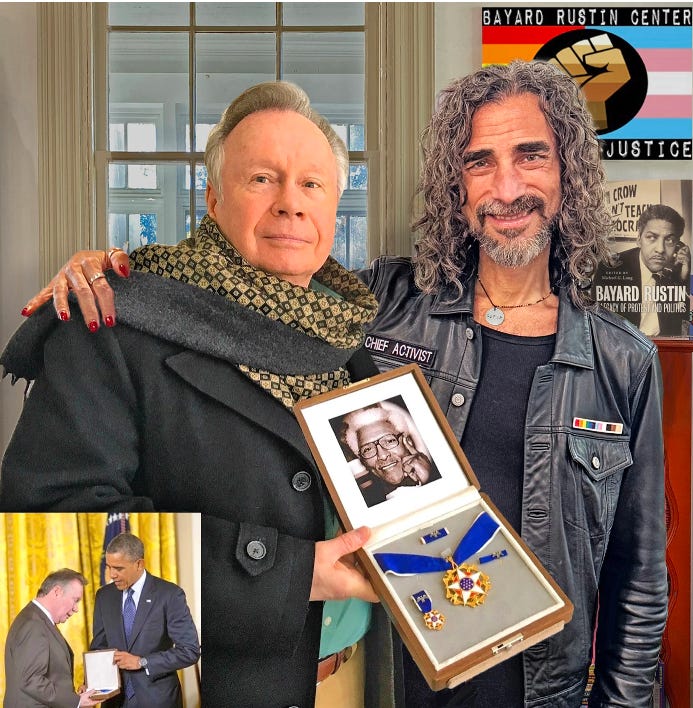
Also, check out this fabulous photo of Rustin’s partner Walter Naegle with the Medal of Freedom posthumously awarded by President Obama in 2013.
Good Trouble in Action
Twenty years ago, Bishop O.C. Allen III and his husband Rashad Burgess started Vision Cathedral in their living room in Atlanta. Today it has 3,000 members — a predominantly Black Pentecostal congregation that is one of the most visible LGBTQ-affirming faith institutions in the South. The church bought and renovated the former Confederate Avenue Baptist Church in 2010. The street is now called United Avenue. “We have people who might look like Trump supporters sitting next to queer folks,” Allen told The Advocate. “That’s the miracle.” He also said: “If another table isn’t safe for you, you have the agency to create your own.” As the women at Compton’s knew, sometimes you have to fight for that table and that safety. And as Bishop Allen shows us, there are also times to build our own table—and then make it safe for everyone who also wants us to be safe.
Largely sourced from an article in The Advocate, January 2026
Solidarity Is Already Happening
In January 2026, the Trump administration proposed three new rules that would harm transgender youth and adults — including one that would allow recipients of HHS funding to discriminate against people with gender dysphoria on the basis of disability. In other words, they were trying to use disability law as a tool to discriminate against trans people.
The Disability Rights Education and Defense Fund — DREDF — responded immediately. They published a detailed action alert explaining what the rules would do, why they were wrong, and exactly how to file public comments opposing them. They organized a letter-writing campaign. They coordinated with trans rights organizations to submit joint comments and challenge the rules in court.
This matters for reasons that go beyond the specific rules. Forty years ago, during the original fight for Section 504 of the Rehabilitation Act in the 1970s, some disability rights organizations made a strategic decision to distance themselves from LGBTQ+ rights in order to protect their own gains. DREDF’s 2026 action is a deliberate reversal of that history — a recognition that the disability rights movement cannot sacrifice trans rights and still claim to stand for human dignity. AND it was a moment to join in solidarity with disability activists and civil rights activists who had always seen their struggles and the struggle for gay liberation as intertwined.
As disability rights attorney Sarah Blahovec said at a 2025 conference: “We need to show up for other rights as well. The disability rights movement can’t sacrifice transgender rights to advance its own cause.”
This is cross-movement solidarity in practice. Not because it’s easy. Because it’s right.
Find the Disability Rights Education and Defense Fund at dredf.org and their full action alert at dredf.org/protect-trans-rights.
Bayard Rustin stood backstage at the speech he made possible. The women at Compton’s Cafeteria don’t have a national holiday. And yet — Stonewall happened because of what they started. The March on Washington happened because of what Rustin built. The work is never wasted, even when the credit disappears. You are doing work that matters, whether or not anyone is watching. I see it. I’m grateful for it. Keep going. And remember that you and I stand on the shoulders of people whose names we may not have learned, who faced even harder things than we are facing, but whose shoulders are broad and strong.
peace,
Sandhya
I don’t talk about the history of the LGBTQ+ activist community in Weimarer Berlin because this is US-focused, but when I read The Lilac People, a historical fiction novel that got me exploring more of that history, I learned so much that I had never been taught about the rights they had gained, and about how the Allies who liberated the camps then turned around and re-imprisoned queer and trans folks because apparently they thought the Nazis weren’t all wrong. Magnus Hirschfeld, the founder of the Institute for Sexual Knowledge, had files on trans people in order to help the wider public understand that transness could equate with thriving, not abnormality; they offered regular tours. They had even reached the point of legally having passports that denoted that someone was trans, in the 1930s. The Nazis were obsessed with taking Hirschfeld down, and many photos we have of Nazis burning books are from the night they raided the Institute and destroyed its library, including some records which will never be recovered. And part of why some people were rounded up is because when the Nazis invaded the Institute, they comandeered the files that included names and addresses. When people raise the alarm about surveillance culture, there are historic reasons they do so.
As a note, The Lilac People wasn’t the best written book I’ve ever read, but it was revelatory and also emapthy-evoking, such that I found myself tearing up in one of the final scenes in the book and also outraged to learn about Operation Paperclip, which I’ve since heard referenced several places — if you’re curious, look it up. But also look up Das Institut fuer Sexualwissenschaft.
No posts
Comments
Nothing yet. Say the first thing.
Sign in to join the conversation.