
Hey, friend.
So a heads up—this week’s socials (and newsletter) have featured some of my personal favorite historic stories and also one of the most heartbreaking current moments. That said, it’s a reminder to me that people who came before fought and won in pretty awful contexts.
I think you’ve heard me say this before, but here’s the thing about constitutional rights: they are not self-executing. Someone has to go to court. Someone has to refuse to close their laundry. Someone has to challenge the birth certificate, file the brief, sit through the deposition. The 14th Amendment, which protects the rights of all citizens (by birth or naturalization), was written in 1868. It took nearly 90 years of tenacious fighting before it started to be enforced with any serious rigor (when Brown v Topeka Board of Education in 1954 declared “separate but equal” to be inherently unequal, and desegregated public schools). And now, in 2026, we are watching a two-year-old U.S. citizen get deported to Honduras while a federal judge calls it “no meaningful process.” The law says one thing. The practice says another. The distance between those two things has always been the terrain of civil rights.
WEB DuBois, in his 1935 book Black Reconstruction, noted, “Rule-following, legal precedence and political consistency are not more important than right, justice and plain common-sense.” That seems as true today as when he wrote it.
In April 2025, a two-year-old girl named V.M.L. — born in Baton Rouge, Louisiana, a U.S. citizen by birth — was deported to Honduras along with her mother. Her father frantically tried to prevent it. ICE gave him less than a minute on the phone before an officer took the phone and hung up.
A federal judge — a Trump appointee — attempted to intervene. The government called back to say it was too late. V.M.L. was already in Honduras. The judge called the deportation one conducted “with no meaningful process” and said he had “strong suspicion that the Government just deported a U.S. citizen.” The legal challenge was eventually dropped — not because it lacked merit, but because the family needed to focus on surviving in Honduras.
The current administration has attempted to end birthright citizenship by executive order. The Supreme Court protected it in a 5-4 decision (which is alarmingly close for such a clearcut constitutional right). The current President has suggested Congress could easily overrule that decision legislatively (through a new amendment? It’s not clear). So far, the administration has not tried another strategy to overturn that right; the Supreme Court decision has so far eliminated citizen deportations, although initial arrests and detentions still occur.
Sources:
NPR on V.M.L. case when it happened
Info on the family pulling its lawsuit against the government due to the stress and trauma to the family here on ABC News in May 2025. No changes to the case since this suit was closed.
If you want to understand the administration’s expedited removal process in clear terms, the National Immigration Forum has a really helpful piece.
This is not new. A century and a half ago, the same thing was happening.
The 14th Amendment was written and ratified by Black Americans and their allies after slavery, at enormous cost. It was their tool, forged for their liberation. And then, in 1886, when that tool was still being actively fought over, a Chinese immigrant in San Francisco picked it up and used it, and in doing so expanded what it could protect for everyone.
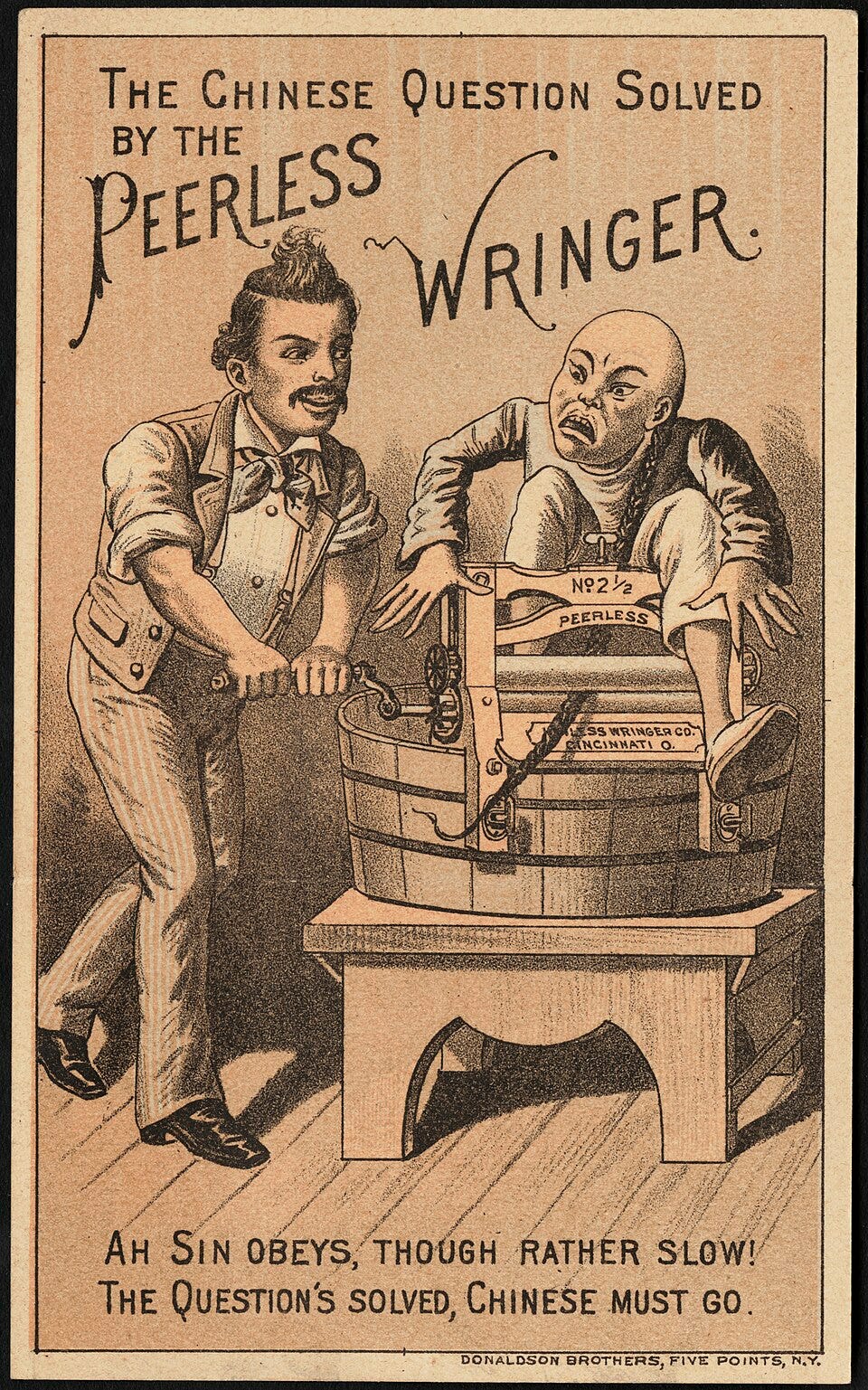
His name was Lee Yick. He ran a laundry called Yick Wo — a pun on his own name in Chinese meaning “harmony and tranquility.” When San Francisco passed a fire safety ordinance and granted permits to virtually all non-Chinese applicants while denying them to nearly all Chinese ones, Lee Yick refused to close. He was arrested, jailed, and his laundrymen’s guild funded his legal defense. The Supreme Court ruled unanimously in his favor in 1886, establishing for the first time that a law enforced with “an evil eye and an unequal hand” violates the 14th Amendment — and that the amendment protects all persons, not just citizens. The case has been cited in over 150 Supreme Court opinions. Every group standing on those protections today is standing on ground that someone else broke.
For more:
This April was the case’s 140th anniversary. The SF Standard covered the story here.
I wrote a piece on Yick Wo for an AAPI Christian magazine some years ago; I’ve learned a little more since then, but it’s still an important story to me as an American.
Thanks for reading Joy In Justice! This post is public so feel free to share it.
On February 21, 1965, Malcolm X was shot at the Audubon Ballroom in Harlem. You may have seen a famous photo, where, as he lay dying on the stage, a Japanese American woman named Yuri Kochiyama cradled his head in her lap. She had been in the audience with her children. The two had befriended each other about 18 months beforehand.
Kochiyama had been sent to an internment camp in Arkansas during World War II, after her father was arrested by the FBI and died shortly after his release. She came out of camp determined to understand the forces that had put her there. She moved to Harlem and became a community organizer, building relationships across Black, Puerto Rican, and Asian communities. She became a fierce advocate for political prisoners, reparations for Japanese American internment, and solidarity between communities of color. She lived in a time when Asian Americans were told their path to acceptance was to be quiet and assimilate. She chose solidarity instead.
I was lucky enough to hear her granddaughter speak at UPenn a year or so ago. She carries on that legacy, and she reminded me that today, when those same divisions are being exploited and constitutional protections are being stripped away, Yuri Kochiyama’s life is proof that solidarity is not naive. It is strategic. It is necessary. And it was always possible.
Sources:
Smithsonian article on Kochiyama’s activism.
Biography article on her relationship to Malcolm X and more.
A short video of Sandra Oh reading Yuri Kochiyama’s article “Then Came the War.”
I often like, in this section, to lift up local organizations and groups applying global lessons to community life.
In New Britain, Connecticut, the Muslim Justice Center launched in 2024, formed by what they call “seasoned organizers” who had been doing this work informally for years. They do legal coordination, Know Your Rights trainings, street medic training, and community celebration. Their mission statement says it plainly: “We exist because existing institutions have repeatedly failed to meet the legal, cultural, and social needs of our community.”
At a moment when Muslim students are being grabbed off sidewalks for writing op-eds, when nearly 2,000 student visas have been revoked based on political activity, Muslim communities are not waiting for someone else to protect them. They are building their own institutions.
They are also explicit about their commitment to advocating for the civil liberties of Muslims and adjacent communities. This is the work Yuri Kochiyama pioneered: refusing to accept a narrower version of safety, and building power across communities instead.
Check them out here.
In March 2025, President Trump invoked the Alien Enemies Act of 1798 to deport Venezuelan nationals without due process hearings. Over 60 organizations filed an amicus brief urging courts to heed the lessons of Japanese American incarceration. The Japanese American Citizens League said: “Stop repeating history! Japanese Americans will tell you we’ve seen this movie before — when U.S. citizens and lawful residents were demonized by bogus claims, snatched off the streets and from their homes for no offense, and locked up without charges, evidence, or hearing.”
The Asian Law Caucus — which has been fighting for Asian American and immigrant rights since 1972 — published a comprehensive Know Your Rights guide in multiple languages and has been working side by side with clients and their loved ones to protect people’s rights and keep families together. Asian Americans Advancing Justice filed briefs and organized community education. From long-standing immigrant rights nonprofits to newcomers in the space, AANHPI groups are meeting this moment, balancing their unique role and strengths with the wide spectrum of ways to show up for immigrant and refugee communities.
I will note personally that in the wake of 9/11, when South Asians and Arab Americans were being targeted with hate crimes and punitive policy proposals, the first people I remember speaking out for us were Japanese Americans, who said they would not stand by and watch the same thing happen to others that had happened to them.
This is Yuri Kochiyama’s tradition made institutional: communities who have experienced constitutional violations using that knowledge, and that authority, to stand up for communities facing the same thing now. Lee Yick’s refusal to close his laundry showed that constitutional protections can expand. These communities are proving it again, right now.
Lee Yick refused to close his laundry. Yuri Kochiyama chose solidarity when assimilation would have been safer. The Muslim Justice Center built what was needed instead of waiting. These are not superhuman acts. They are acts of people who decided that the promise of the law mattered enough to fight for, because they knew the fourteenth amendment doesn’t fight for itself.
In her 1991 article “Then Came the War,” Yuri Kochiyama wrote, “Historically, Americans have always been putting people behind walls. First there were the American Indians who were put on reservations, Africans in slavery, their lives on the plantations, Chicanos doing migratory work, and the kinds of camps they lived in, and even too, the Chinese when they worked on the railroad camps where they were almost isolated, dispossessed people — disempowered. And I feel those are the things we should fight against so they won’t happen again. It wasn’t so long ago — in 1979 — that the feeling against the Iranians was so strong because of the takeover of the U.S. embassy in Iran, where they wanted to deport Iranian students. And that is when a group called Concerned Japanese Americans organized, and that was the first issue we took up, and then we connected it with what the Japanese had gone through. This whole period of what the Japanese went through is important. If we can see the connections of how often this happens in history, we can stem the tide of these things happening again by speaking out against them.” That still feels so relevant today.
You are part of that fight, when you learn and share what you’re learning, when you make sure people like VML are not forgotten or erased, when you support those fighting for their rights, when you choose solidarity so that those rights apply to us all. I see you. I’m grateful we’re in it together.
— Sandhya
No posts
Comments
Nothing yet. Say the first thing.
Sign in to join the conversation.