
“We’ve Been Here Before”: Reconstruction was dismantled on purpose.
So is what’s happening now.
And people organized their way back before.
Hey, friend.
The hardest thing about this week’s theme — for me, anyway — is sitting with the knowledge that we’ve been here before, and that “before” didn’t end well. Reconstruction was one of the most radical democratic experiments in American history. Black men served in Congress, as governors, as sheriffs, as judges. And then it was dismantled. Violently. Deliberately. With the complicity of a federal government that chose not to intervene and sometimes aided the process.
I don’t tell you that to be discouraging. I tell you that because the historian Eric Foner, who has spent his career studying Reconstruction, says this: “Alone among the societies that abolished slavery in the nineteenth century, the United States, for a moment, offered the freedmen a measure of political control over their own destinies.” And because it happened once, people know how to build it again. Not the same way, not with the same people, but with the same understanding that democracy is not a condition you inherit — it’s a practice you maintain. The poet Adrienne Rich wrote: “My heart is moved by all I cannot save: / so much has been destroyed / I have to cast my lot with those / who age after age, perversely, / with no extraordinary power / reconstitute the world.” That’s the work. That’s always been the work.
BTW, you didn’t get an email from me last week because I was recovering from an emergency room visit the Sunday before, when my back siezed up so badly I couldn’t walk. This week I’ve finally gotten to the point I can sit up for short stints and do a little writing! I’m really lucky: when the ER sent me home even though I couldn’t sit upright, the social worker found a “gurney van” to take me. Since I could not yet climb the stairs to my partner’s apartment, my in-laws, who live in an apartment with an elevator, gladly took me in, where I’m doing my rehab now! My physical therapist said I’m making great progress and might be able to move to outpatient care by next week! Now back to our regularly scheduled content:
This week: Reconstruction, democracy, and what happens when we choose wrong — or let others choose wrong on our behalf.
The History We Should Have Learned
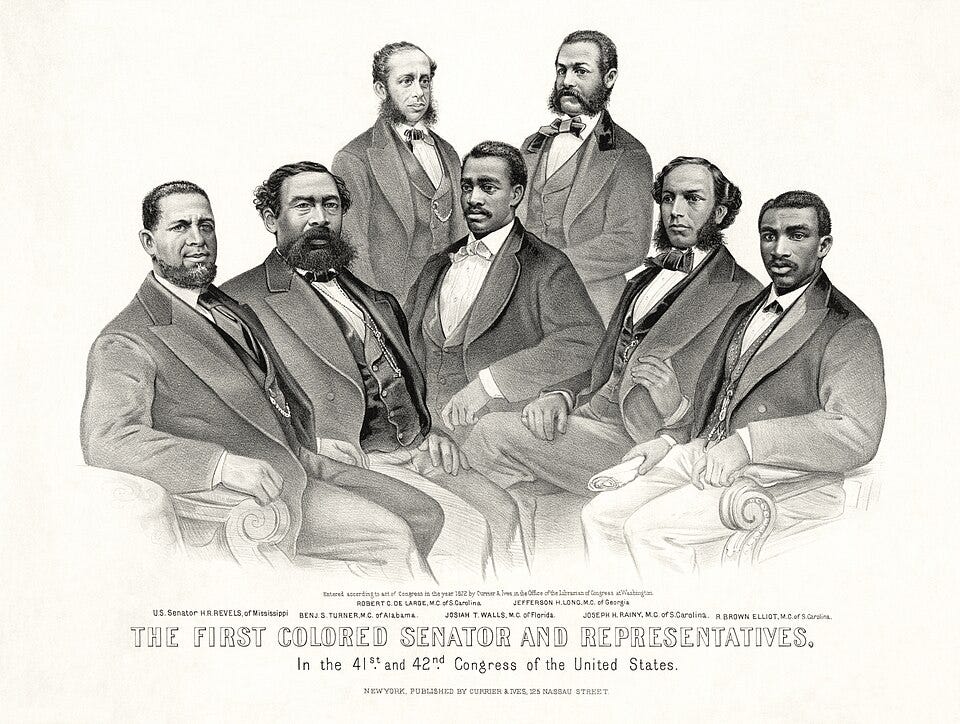
In the years right after the Civil War, the United States had Black senators, Black congressmen, Black state legislators across the South. P.B.S. Pinchback became the first Black governor in American history. There were Black sheriffs, Black judges, Black school superintendents. For a brief moment, this country tried.
That period is called Reconstruction. And what happened to it was not some natural fade. It was a deliberate, violent counter-revolution. White supremacist groups terrorized Black voters, murdered elected officials, and systematically dismantled every structure of Black political power. The federal government, which could have stopped it, chose not to. By the end of the 1870s, it was over, and in its place was what we call Jim Crow.
And you and I know, it wasn’t the end of the story. For decades, Black people and some allies fought and resisted, and built the NAACP, and built youth-led movements and learned from elders, and risked their lives and safety, even when it seemed like Jim Crow would always reign in terror.
Progress is not a straight line. It is a choice. I am grateful for our forebears who fought to show us what equality could look like; it helps me imagine what it could look like today.
For more:
Philip Dray’s Capitol Men (This is where I learned this story. It seems to be out of print now, but check out your library or used bookstore!)
Eric Foner’s Reconstruction: America’s Unfinished Revolution
Thanks for reading Joy In Justice! This post is public so feel free to share it.
What’s Happening Right Now
On April 29, 2026, the Supreme Court issued a 6-3 decision in Louisiana v. Callais that effectively gutted Section 2 of the Voting Rights Act — the primary nationwide protection against racially discriminatory voting systems. Justice Kagan wrote in dissent that the decision renders Section 2 “all but a dead letter.”
The immediate consequence: Louisiana suspended its ongoing primary election — after more than 100,000 voters had already cast early ballots — so the Republican-controlled legislature could draw a new map expected to reduce Black representation. Alabama has moved to reinstate a map a federal court had already found intentionally discriminatory. The two Black congressional representatives Louisiana elected under the VRA-compliant map — the first two Black members of Congress from Louisiana in history — may lose their seats.
For moer:
NAACP LDF — naacpldf.org/case-issue/louisiana-v-callais
ACLU — Supreme Court Strikes Down Louisiana Map and Destroys Key Voting Rights Act Provision
Center for American Progress — americanprogress.org/article/the-supreme-courts-callais-decisions
Campaign Legal Center — campaignlegal.org/update/us-supreme-court-has-eviscerated-voting-rights-act-whats-next
A Saint You Should Know
Fannie Lou Hamer was a sharecropper on a Mississippi cotton plantation when she went to her first voter registration meeting in 1962. She was 44 years old and had never heard that Black people had the right to vote. When her boss found out she’d tried to register, he told her to withdraw her application or leave the plantation. She said: “I didn’t go down there to register for you. I went down there to register for myself.”
She was evicted. She was shot at. She was beaten so severely in a Mississippi jail in 1963 that she suffered permanent kidney damage. She never fully recovered. She never stopped organizing. “I’m sick and tired of being sick and tired,” she said. She meant it as a war cry.
For more:
How Fannie Lou Hamer Challenged a Nation | National Museum of African American History and Culture
National Women’s History Museum — womenshistory.org/education-resources/biographies/fannie-lou-hamer
And if you’ve never heard the speech she gave from the floor of the 1964 Democratic National Convention, you really need to.
Good Trouble in Action
Los Angeles’ REPAIR initiative allocated approximately $8.5 million across nine neighborhoods specifically identified as having faced institutional and systemic racism. In two participatory budgeting cycles, community members voted directly on how to spend those funds — and chose job training, rental assistance, services for unhoused people, worker-led urban agriculture, and medical services. This is participatory budgeting: instead of elected officials deciding how to spend public money, residents vote directly. Since 2009, it has spread to over 50 U.S. cities, moving more than $400 million into community hands.
At a moment when federal democracy is under threat, local democracy is being built.
For more:
Solidarity Is Already Happening
Here is a story from Galveston County, Texas that almost nobody outside of voting rights circles knows. In 2021, the county’s Republican commissioners court redrew their precinct maps and eliminated the one district where Black and Latino voters — together — had been electing a representative of their choice. Not Black voters alone. Not Latino voters alone. A coalition. For years, those two communities had enough combined strength to elect a commissioner who served them both. The new map broke that coalition apart deliberately.
The voters sued. A federal judge — a Trump appointee — found the map unconstitutional, called it “mean-spirited” and “egregious.” Then, in August 2024, the full Fifth Circuit reversed him, overturning forty years of its own precedent to rule that the Voting Rights Act simply does not protect coalitions of different minority groups voting together. Six judges dissented, writing that the majority had “finally dismantled the effectiveness” of the VRA.
But here is what I want you to know: the Black and Latino voters of Galveston County are still fighting — their constitutional claims of intentional discrimination are still active in court. And their case is part of why the John Lewis Voting Rights Advancement Act matters so much. That bill — introduced in March 2025, co-sponsored by every House Democrat, supported by over 140 organizations from the NAACP to the Native American Rights Fund to the League of Women Voters to labor unions to disability rights groups — explicitly restores coalition protection as part of what the Voting Rights Act covers. Because the people who wrote it understood what Reconstruction taught us: multiracial democracy has always been the target. And protecting it requires communities showing up for each other.
The Leadership Conference on Civil and Human Rights said it plainly: “Those in power see the rise of a multiracial democracy as a threat, and they are doing everything they can to silence it. But we won’t be silenced.”
The Black and Latino voters of Galveston County refused to be divided. They built something together, and when it was taken, they kept fighting. That is the Reconstruction spirit. That is what this week is about.
Find the Campaign Legal Center’s work on this case at campaignlegal.org, and the John Lewis Voting Rights Advancement Act at civilrights.org.
For more:
campaignlegal.org/update/galveston-voters-are-still-fighting-fair-maps-and-equal-say
texastribune.org/2024/08/02/voting-rights-act-race-redistricting-5th-circuit-texas-galveston/
Civil Rights Coalition Urges Senate to Pass The John Lewis Voting Rights Advancement Act - The Leadership Conference on Civil and Human Rights
BTW, if you’re a Supreme Court nerd, your radar may have gone off when I mentioned the Fifth Circuit Court, famous as the place right-wing cases can go in order to get their case on the Supreme Court docket, to test how far right they can go. If you haven’t heard of it, here’s an article with a little bit more about the Fifth Circuit.
Fannie Lou Hamer went down to register for herself — and then spent the rest of her life making sure everyone else could too. The Black and Latino voters of Galveston County built a coalition district together, watched it get taken, and are still in court—and in the streets. The people and groups pushing the John Lewis Voting Rights Advancement Act have been at it for decades and are not stopping. This is what it looks like to refuse the Reconstruction ending — to insist that the deliberate dismantling is not the final word. You are part of that insistence every time you show up, every time you pay attention, every time you refuse to let a story like Galveston just disappear into a legal footnote. I know this week is heavy. I also know you’re carrying it anyway. Thank you. So much.
Peace,
Sandhya
Thanks for reading Joy In Justice! This post is public so feel free to share it.
No posts
Comments
Nothing yet. Say the first thing.
Sign in to join the conversation.