
“The Son is not a creature, but the true God, unoriginate, principle (archē) of all things, through whom everything exists.”1
—St Athanasius
A basic thesis of my critique of re-enchantment was that we are living in a “sensate“ society where intellect is subordinate and obedient to sense. This creates a theoretical problem--i.e. the intellect works to thematize sense experience itself and abstract from this, rather than attend to the objects themselves-- and practical problem--i.e. that the intellect cannot be practically useful in orienting us towards our transcendental teleos if its locked in on making sense of how things appear in sense experience. It comes as no surprise that if theology in this degenerate frame is instrumentalized to make sense of sense experience (credit to St Pope Pius X this is his definition of theological modernism), then thinking of theology as a science is impossible. Within a sensate mentality, theology as a science becomes a dirty word, something only cold, stale scholastic theologians do, blah blah, blah. “We want theology to be concrete, practical, living!” Here thinking rebels against thought. and the thought of theology being universal, abstract and general is perceived as its death knell, but in reality theology can only be useful within these confines. Theology is a Science. And the most advanced theological science took the form of Scholasticism.
We can understand contemporary theological developments best within this frame—e.g. so little of theological speech transcends a self-aggrandizing poetical or hyperbolic theoretical mode: e.g. “what we need today is a radical embodied sacramental ontology of concrete everyday life.” Sounds nice, but perhaps we need precision instead? Sense mocks intellect by making it try to pretend it’s not universalizing the particular itself, that it’s not abstracting and fetishizing “the concrete” as a concept. It´s true, all knowledge comes by way of the senses. And the job of the intellect is to elevate sense and abstract from it to obtain knowledge of higher truths and goods. In a sensate age, however, sense appetites dominate and constrict the intellect. This leaves christians with their bellies full but without proper defense from false teachings. People seem to forget that saints and mystics alike had no issue with theology being a science. They wholeheartedly supported this. What they couldn’t stomach was irreverence and imprecision, which the sensate mode of theology has in excess.
So what does it mean to be a science for our purposes? Quite simply--(1) that all parts be connected to the whole through a purposeful order. And serving this end, (2) both the proper object and the various aspects under which it is to be considered must be precisely determined. Then (3) all questions material to the intended knowledge must be addressed. In terms of activity, the cycle of dogma will be (a) explained, (b) demonstrated from proper sources, and (c) defended against objections. And, finally, what is the hallmark of scholasticism vis a vis the apostolic fathers, (4) that individual doctrines will be derived from one or a few fundamental principles through reasoning or at least give in a manner that expresses the internal logical coherence of christian dogma, which will then (5) seek to unite itself with the whole of our natural knowledge. This is the humble project of Scholasticism. A project now almost entirely in disrepute.
To those confined to a sensate mentality, this previous scholastic theological science comes into view only as an edifice from the outside. Scholasticism is accused of (1) serving argument or defensive purposes strictly, and not living faith or piety, (2) being “excessively rational” so as to the detriment of genuine mysticism or the service of pride alone. Yet, this is a projection of what theology in a sensate frame is anyway, i.e. its mode tends to trade clarity for theoretical over-reach and rhetorical ostentation. Long term, this threatens genuine piety, humility, and participation in the form of theological and moral reflection that sustained and developed within Christianity for centuries. Only those for whom intellect reigns over sense can profit from the scholastic edifice by dwelling within it, by discovering the internal edification of the form of thought, and of these only those who have learned the manner of explanation, demonstration, and defense (i cannot think of one single institution where these are learned, only a smattering of various figures, schools, and perspectives—e.g. most “Thomists” only know at best the most rudimentary scholastic definitions and distinctions).
It is thus no wonder that scholasticism has become a pejorative term, but it is also unjust. I think we need scholastic theological science now more than ever to discern spirits, to clarify the truth faithful must cling to, and to set forth the good to be desired. “And be not conformed to this world: but be ye transformed by the renewing of your mind, that ye may prove what is that good, and acceptable, and perfect, will of God.” (Romans 12:2). Faithful are all too easily decieved by bad theology. I think Saints rather than Scholasticism will be best suited to respond to the spiritual problems of our time. Yet, only the sort of person who can be and desires to be edified by learning this science, even if it remains quite rudimentary out of a desire for holy simplicity or poverty, can help. Why? Because the object of said science is the living God! And Saints know He deserves nothing less than the best!
Theological science is about having a standard of reverence and propriety about theological language, language which relates analogically to God Himself. Today, theological science is often more about making sense of religious experience, or worse provoking activism. When this is the case, proprieties change dramatically from decade to decade and culture to culture, while word use becomes slovenly and careless. All of which reflects a God who is kinder to the extent He grows more indifferent to Himself and what is taught about Him than He was before. Without theological science we tend towards believing in a god who is either an idol of the zeitgeist, e.g in the immanent frame this is a god who is indifferent towards the truth—a god who is there to serve and promote our experience of him. The just instead will desire that theology takes the form of a science out of respect and love for its proper object.
There are two formal hallmarks of scholastic theology. (1) presenting the body of doctrine in a unified logically ordered manner, where not merely internal coherency but also the mutual implication of doctrines is sought to be established and (2) the extensive use of philosophy towards the end of (1). Both of these points are as blithely dismissed today as they were easily defended for centuries.
Scholasticism is perhaps most harshly critiqued for, and sometimes its pejorative word use means little more than, (a) getting distracted by pointless philosophical questions, and arcane debates. The second all-too-common critique is that it is (b) too focused on defense and apology of dogma.2 And the third that (c) its use of philosophy is tantamount to reason encroaching on faith, i.e. the critique of excessive rationalism.1
All three of these points can be made to exclusively refer to (2) the consequence of the extensive use of philosophy in scholastic theology, because philosophy is going to insist upon (a) and (b) and push in the direction of (c.) And it is comforting that (2) is also far easier to defend as regards the patristic use of the scholastic method. The propriety of the use of philosophical concepts of greek provenance was established with the adoption of “substance“ and “nature“ in the nicene and calcedonian creedal formulations respectively.
Furthermore, we see the seeds of (1) a desired unity of dogma in the frequency with which St Athanasius refers to the Triune God as ἀρχή or archē, i.e. the one cause, governor, and principle of intelligibility of all things in greek philosophy, (e.g. what thales thought was water, what the pythagoreans thought was number). So already in the 4th century christian tradition chose to make use of philosophy both to deepen our understanding of particular dogmas, and to lay the groundwork for unifying the dogmas of the faith.
Even the most radical biblicist has to deal with this same work archē being used in the Septuagint to render Proverbs 9:10—i.e. “The Fear of the Lord is the beginning of Wisdom“ also as archē in “ἀρχὴ σοφίας φόβος κυρίου.” Furthermore, Our Lord identifying Himself as Logos or λόγος in the Prologue to the Gospel of John is almost more appalling. Logos is what Heraclitus identifies as the principle of reason and order permeating and organizing the cosmos. Critics, therefore, objecting to scholastic aims for theological science lack biblical, creedal, historical grounds for their conviction. If Our Lord is archē or Logos, then the project of systematizing dogma into a well ordered and mutually implying whole, ordered by one or a few principles, appears to be perfectly fitting response to the Christian claim.
We see, furthermore, in a figure like St Augustine the extensive use of philosophy. St Augustine, like the other fathers, treated various theological topics piecemeal. We dont find with him the drive to organize (1) a unified systematic theology with a philosophically informed architectonic structure. But we see in St Augustine the extensive use of philosophy. And this application to lead into (a) arcane questions—e.g. about the nature of time and how to measure it, and (b) aggressive apologetic work attacking the common errors of his day, classicism, manicheanism, etc, and (c) arriving at dogmatic conclusions that have no basis in scripture of tradition by means of philosophy alone, e.g. using the tripartite division of the soul as a reference point for explaining the doctrine of the Trinity. It’s rare that a critique of scholasticism wouldn´t also oppose the theological method of St Augustine.
Concerning (1) we see the systematic tendency also long before the age of the schoolmen— at least the impulse to order dogma into a whole—but not yet carried out with the aim of unifying or synthesizing the various dogmas into a systematic whole. St John of Damascus´ 7th century work “De Fide Orthodoxa” is perhaps the best example. It treats of God, then Creation, then Redemption of Man, then the Church and Sacraments and, in this ordering, prefigures the unity and ordering found in classic scholastic texts of the 12th and 13th century. So the impulse towards a unified presentation of the body of dogma, as well as the extensive use of philosophy in theology preceded the birth of scholasticism proper by centuries, a millenium almost if you look at St Justin Martyr.
This being said, while the origins of scholasticism can be found in the apostolic age or even in scripture, at the start of the 12th century, Peter Lombard can claim to be the first to give definite form to scholasticism: his “libri quatuor sententiarum” presented (1) the body of doctrine as a unified whole, and (2) with the extensive use of philosophy to establish the unity of the whole cycle of doctrine. What was almost more impressive, Lombard´s book and his method quickly came to dominate theological instruction in the Latin church. St Albert the Great and St Thomas would give commentary on The Sentences of Peter Lombard. The term “scholastic” comes from the men i.e. scholastici entrusted with the theological education of the youth educated in monasteries or presbyteries, i.e. schola. Thus “a scholastic” was originally a learned man and teacher—a title like dr or professor today—rather than someone who belonged to a specific school of thought.
In sum, it can be said that the 12th century was a real genesis for scholasticism in western Christianity, but its more appropriate to say this century was the moment two separate theological impulses—for unity and for the use of philosophy in theology— that had long since been apart of tradition, came to fruition and dominance in and through the person and work of Peter Lombard.
Criticisms of scholasticism usually express a disdain for philosophy or even rationality itself that would implicate patristic fathers as well. It’s very rare to see a criticism of scholasticism that hits the only possible target, i.e. the excessive use of philosophy for the purpose of unifying dogma into a whole. And for the rare bird who even aims correctly at the target, it’s hard not to feel pity for such a miser, as this task is wholesome, good and edifying for the right sort of person.
Rarer still are consistent critiques of scholasticism, i.e. those who wish in simplicity that theology stick to the fathers and scriptures. Instead, those who despise scholasticism usually have no issue with the use of philosophy in theology in general, their issue is with the specific case of good philosophy being used well to clarify and support the task of theology. Of theology abused by bad philosophy, these critics rarely object and almost always practice themselves.
As anyone who loves philosophy knows, arcane debates are surprisingly fun and helpful, and a symptom of principled, earnest, logical thinking, and they so often lead to important insights, discoveries, and conclusions. Furthermore, anyone who loves the truth loves to defend it well and systematically. The scriptures tell us: “study to shew thyself approved unto God, a workman that needeth not to be ashamed, rightly dividing the word of truth.” (2 Tim 2:15). The universe is magnificently ordered, and our minds were ordered to comprehend both its grandeur and the character of Our Creator through His works. True men of faith, men like St Augustine, see reason complimenting faith rather than stealing from it. And true men of intellectual brilliance and integrity , like St Thomas or Bl Duns Scotus, know that the proper exercise of reason is a material support and defense of mysticism and the spiritual life, rather than its enemy.3
Enjoy this post? Tip Jar—> https://buymeacoffee.com/sweller
You can also support my writing with a paid subscription for 19$\yr here. ill send you one of my hand made rosaries if you do! just give me an address.
Here are a few of my other posts on scholastic theology and terminology:
Oratio contra Arianos (Oration I), PG 25:109–115
“All Scripture is God-breathed and is useful for teaching, rebuking, correcting and training in righteousness, so that the servant of God may be thoroughly equipped for every good work.” 2 Tim 3.16 Rebuke and correction are not always evil!
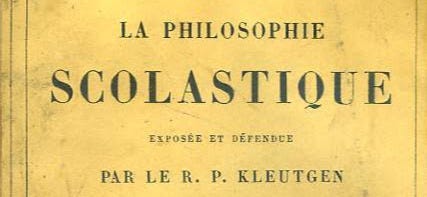
My formulations and historical references are in part reliant on Josef Kleutgen SJ in his “Theologie der Vorzeit: Letzter Band— Über die Lehrweise der Vorzeit.”
No posts
Comments
Nothing yet. Say the first thing.
Sign in to join the conversation.