
I heard her soft, mild and high pitched voice before I ever saw her. She´s not an exceptional singer—she seems unable to change pitch without breaking the tone slightly, which doesnt ruin her song by any stretch, but its not excellent singing— and that´s part of the beauty behind her song, that you see more of her heart through the imperfections and weaknesses of her singing. But then you get to know her and her real struggle and weaknesses and it´s even more astounding that she returns to the streets to praise God and wake up souls. She´s Assisi´s songbird, she´s a little flower of St Francis.
I was reading in the legends of St Francis upon my arrival in Assisi about his prayer for the city, as St Francis, unable to walk due to his final illness was being carted on a board out of Assisi and to the St Mary of the Angels in Portiuncula, where he wished to die, he asked to be turned once more ´round on exiting the city, to view it one last time:
“Lord, I pray You, that this city may always be a place where holy people live, who glorify Your name and spread Your light throughout the world.”
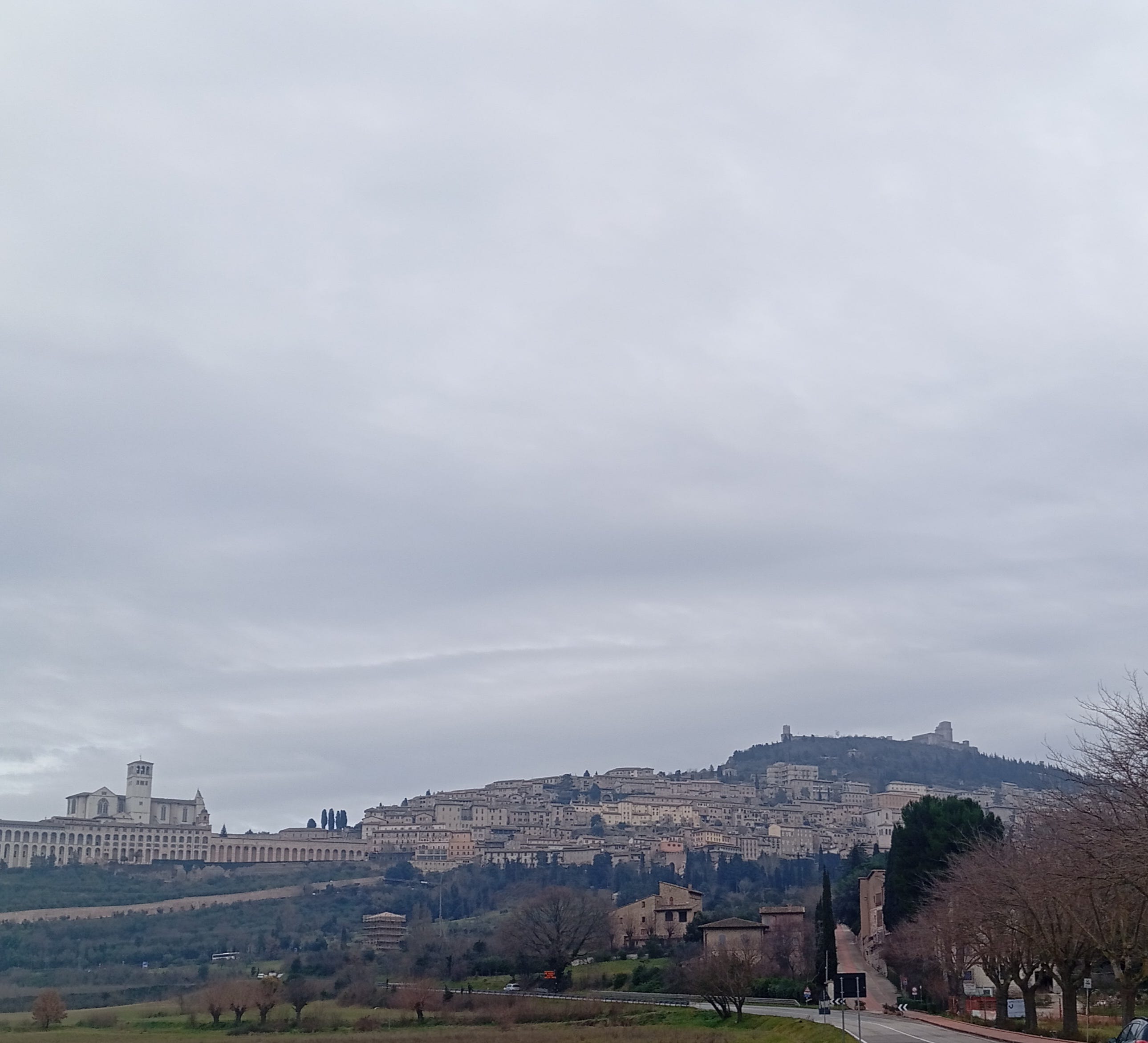
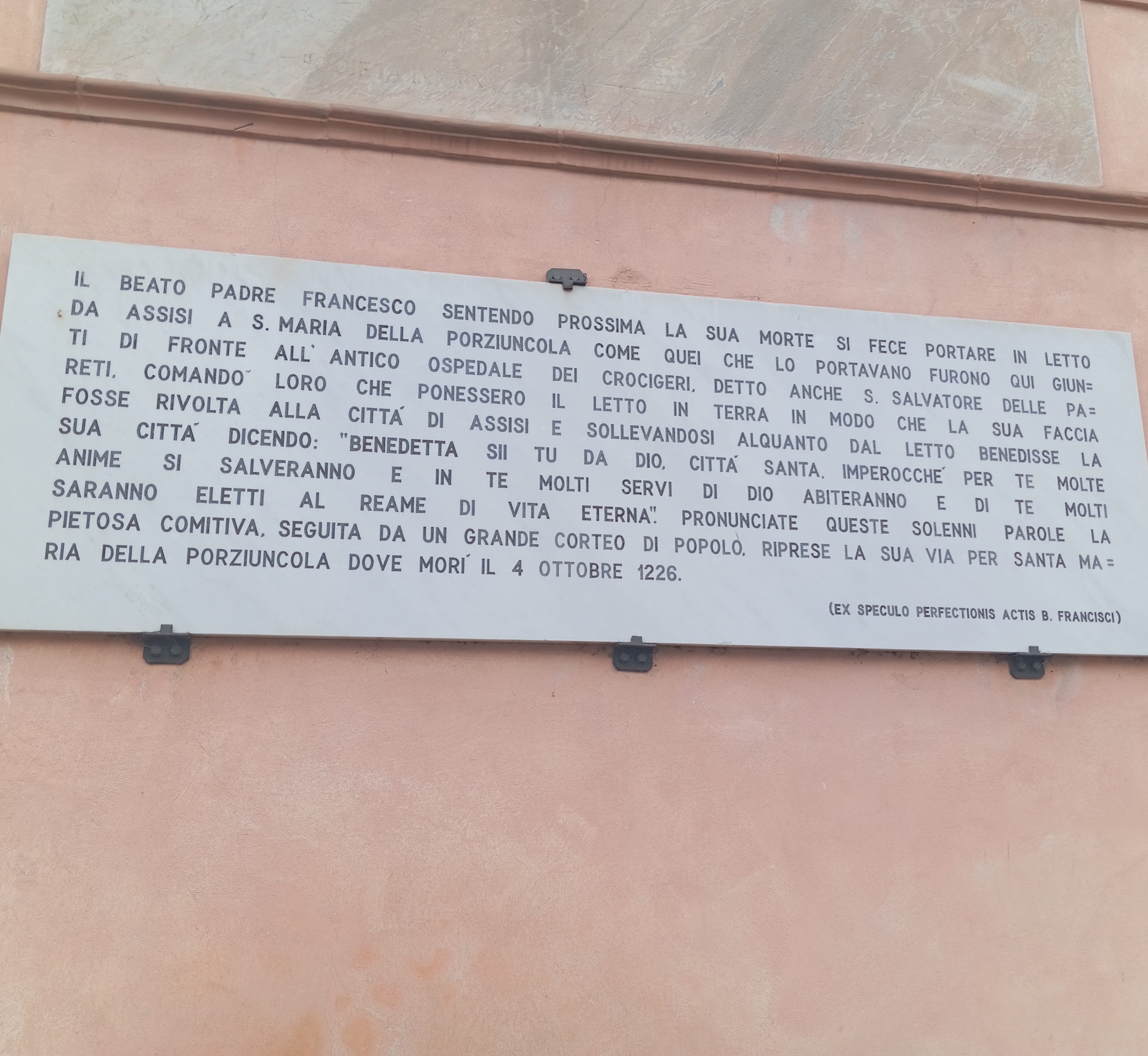
Remimiscent of Jesus´ high priestly prayer in John 17, to know who St Francis was and something about the God of Jakob is to know this prayer was answered. Thus any trip to Assisi piques my curiousity as to whether I will meet one of the fervent, light bearing souls God has brought to Assisi in answer to the prayer of its Holiest Saint. The most famous collection of legends about St Francis is called, appropriately, i fioretti, the little flowers(virtues), as it treats not merely the life of St Francis but demonstrates how quickly his flame caught on in other souls, and how holy and virtuous his confreres became within his lifetime. They were little flowers planted by St Francis, a blossoming of heavenly virtue in Assisi through the foundation of the Franciscan order and the charism of Poverty. But this visit I think I found one.
I was walking away from the Basilica of St Francis towards the center of the town and was just at the point of a bend in the road where I began to hear her meek song. I turned the corner and was charmed to find a near 60 year old lady singing in a maroon stocking cap with a ball on top and wearing a long plaid skirt. A small mat lay on the ground in front of her for people to throw spare change in her direction. She had probably about 15 euros in coins given by the slow but steady stream of Christmas pilgrims making their way to the Basilica of St Francis.
Being an occasional street singer myself, I stopped to listen as I was intrigued and pleased by her singing immediately. One could pick up from the melodies, even if the italian songs she was singing were foreign to me, that she was singing religious songs. She was uncomfortable at first with my presence there. When I suggested we sing together, she said she would only sing christian songs, making it clear she didn´t think I would know any, which given my strange appearance is certainly justified. I thus kept my distance as an observer and clapped and cheered after the first song and she blushed and told me to stop. I clapped and cheered after the second with the same result. By the third repetition of my applause and her protest, I told her if she was going to sing on the streets she couldnt expect to boss around her audience. She smiled and laughed and didn´t seem to be bothered by my applause thereafter.
We briefly spoke and I asked her if we could sing a few german songs together and she obliged but said she´d never done that with her street act. It was a day before Christmas and Simone wanted to only sing advent carols so as not to spoil advent (and christmas for that matter) with a christmas song or two. So we sang “maria durch ein dornwald ging,“ one where I can hold down a good second part, our voices blended nicely and she was smitten. “Oh I never thought I´d sing something so beautiful” she said with glee. And this began the friendship. Upon leaving she asked me to take a few euro for something to eat, as our duo act had brought in a little cash. I obliged, enough for a coffee at least.
She has the sort of cheerfulness I attribute to spiritual excellence, the sort that seems to overflow from a noble composure of ones speech and gestures, from selflessness and self-restraint. There´s another kind thats common to zealous religious sects and salesmen that betrays itself in its instrumentalization towards an end. Yet without intrigue or device, Simone´s cheerfulness was simply there, in misery, in a precarious circumstance and a very strange, and likely tragic, life.
Simone told me that first meeting she lived from singing and I was enamoured, but it was hard to fathom as she had only a little change in front of her. When she invited me over to her apartment the next week I struggled to see how her singing could cover costs of even her very humble dwelling and she told she had benefactors helping her as well.
I didn´t see her again until the feast of St John on the 27th of December when I myself was singing on the streets of Assisi she walked by. She was giddy “oh, I kept wondering if I would see you again!” And wanted to sing german christmas songs together. And we sang this time more extensively than before. She was in unusually good spirits that evening, I sang one of my favorite german christmas hymns, “Menschen die ihr wart verloren“1 with her and she drifted off to go home mid song. She pranced elegantly through the streets to my song, doing pirauets and swinging her arms elegantly curved like a ballerina, she´d pause to sing the chorus with me “Ehre sei Gott, ehre sei Gott, Ehre sei Gott in der höhe“ and then drift further down the street in her joyful christmas dance before the stopping at the next chorus to sing with me. I loved this! I think she did too.
Simone has a typical german sturdyness to her for a 60 year old woman. Her beautiful long auburn hair flows out of her stocking cap, which when removed, betrays about twice the density of gray hair at top as at bottom. I love older ladies with long hair like this as its so rare to find and the ones who keep it long are usually very dear and old fashioned like Simone, who is single-mindedly devout, her apartment has the hallmarks of the single catholic who has a religious soul but never found a convent—i.e. religious images and icons galore.
When she sings she lifts and twists and turns her arms in a dainty, feminine manner to the tune of her song, both as if to express herself more beautiful and to beckon passers by to join in. One time we were singing on the street and she told me, “now i like to improvise,” as if trying to teach me. She wanted me to sing along with her but I didnt know how to predict her next note as proceeded singing “glo-ri-a, glo-ri-a, glo-ri-a in excellsis deo!” on repeat with various lovely spontaneously created melodies, each one different, with her arms raising up with her song in a natural movement of exuberance and praise.
But she says shes physically in a lot of pain, so that a walking pilgrimage would be out of the question….had to ask! Ha. But moreso her weakness is what she calls an electromgnetic sensitivity: she literally cannot stand to be around phones. As I first approached her to sing with her, she made me immediately turn off my phone before coming in proximity to her. And when we went out for pizza once, she spontaneously exited the restaurant and refused to come back in due to a single woman using her smartphone. This wrinkle makes her life very difficult! Oh what a burden. She is unable to travel by bus, train, or plane. Even when people try to video her singing from afar she will not allow it and reminds people of her hypersensitivity. At the end of a short stint of street singing she says she is truly exhausted by being in the close proximity of so many people.
This whole issue has left her often living outside in homelessness. When she travels she can only hitchhike as its the only way of traveling that gives her freedom to tell the people surrounding her to turn off their phones. When she first moved to Assisi she was homeless here, and homeless for years. She tried to enter a few convents but her hypersensibility made them think she was mentally ill. She gives absolutely no signs of this in terms of her conversation. But in the precarious situations she often finds herself on account of her hitchhiking and homelessness, she keeps her cool and trusts in God.
Yet, unlike other bohemian women I have met, Simone doesnt strike me as rebellious at all, or counter cultural, quite the contrary, shes meticulously genteel, carries herself with a wonderful and contagious nobility. She said she would change into evening dress before going to sleep as a homeless lady, which I have never heard of before but I found endearing. Simone wields a serene tranquility and abiding joy while living what most women would define as a nightmare.
She shared her best stories of living on the margins, of being in danger and being delivered. One time a mysterious man was lurking around her where she slept at the time, under the collonade at the church of St Damiano. She prayed to Our Lady for deliverance and someone came with a car from a nearby villiage shortly thereafter. They simply wanted to sleep in their car in the peaceful presence of that holy church, and invited her to sleep in the passenger side. “Our Lady always takes care of me,” she tells me. I believe her.
She´s lived all over the tiny town of Assisi, various religious communities have given her a room for months at a time, then she´d find herself back on the streets. It doesnt seem to phase her, the songbird waited for worms from her creator, which always eventually came. When she´d tell her stories a common phrase was her recounting her conversation with God with the following “God if you really want me living like this, then I need x thing,” and x would always come.
Because of her hypersensitivity, being an anchorite or hermit somewhere far away from wifi and electricity would be ideal. But for now she´s in Assisi. And for someone so easily unsettled by the presence of phones or what have you, its not easy. Assisi is very small and bustling with tourists. She disappeard from the streets for days because she recieved a hurtful letter from a family member and needed to be alone for a few days thereafter. Despite the crowds, she loves it here. Because the various churches—San Damiano, Santa Maria degli Angeli—are irreplacable places of spiritual respite and rejuvenation for her.
The Bible speaks of the very stones crying out against our sins on the day of judgment. I believe this will occur, but I then must believe the flip side, that there are stones that are blessed by what they have witnessed, stones that cry out in praise and joy. But truly, here in Assisi, a stillness and peace pervades the city that gives a believer like me the impression the stones are still praising God for what they´ve seen. They saw the holiest group of men on planet earth since the twelve Apostles. And that´s why people come here, the reflection of these men into this unchanging place 800 years ago seemingly commenced a permanent chorus in this place. Thus for a very sensitive soul like Simone, these walls are refuge and home. She loves it here, and her mission is to join in their song. The church of San Damiano, the tiny chapel in Portiuncula are refuges for battered souls seeking refuge and peace.
I recall a conversation I had this past year with a pilgrim friend who’d lost his faith, complaining about all the hypocrisy and lack of charity he’d experienced from catholics. I told him, “but father x (a remarkable priest I wrote about elsewhere) has been taking care of you this whole time, openning his home to you and feeding you, how can you say all catholics are hypocrites? At a time when you are being housed and fed by such an exemplary person” he responded, “yeah but that´s just one.” I retorted, “one! you got one!” defiantly. “isnt that enough? its more than most people get!” and my friend fell silent.
I love the example of St Francis but haven´t met many people who really seem to live accordingly, I mean no disrespect of the franciscan religious, but, for what attracts me most to St Francis and his path—i.e. the abandonment to and romance with Providence through poverty— perhaps Simone is my one example. This Christmas at least, she was a gift given. And one is more than enough for me. What a grace to meet her!
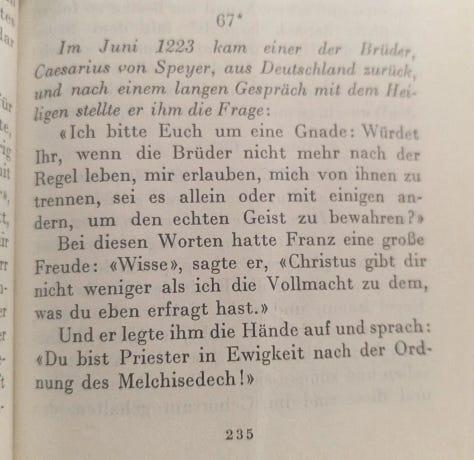
Returning to my book of Legends,2 I was pleased to find the story of a german brother who, on the occasion of the relaxing of the rule in 1223, came to St Francis and asked if he´d rather see him and others separate from the order and keep ther rule, rather than go on with groups of friars that no longer lived according to the original charism, St Francis didn´t hesitate. “Christ not less than I give you the power to do what you just asked!”

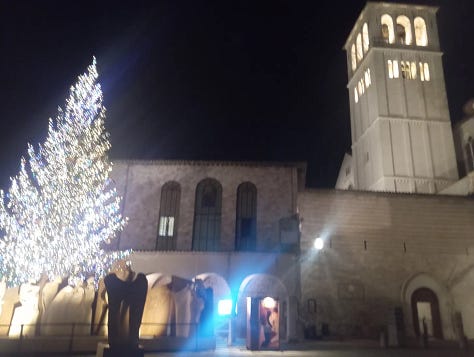
For all her sweetness and good manners, Simone has this same blunt tenancity within her spirit. I haven´t found it elsewhere. She taking the path of poverty, the path of St Francis, and expects those who take the franciscan name to do the same. She had recently asked group of franciscan brothers if helping leapers still had something to do with the franciscan charism, and told them she didnt want to hear an answer just asked that they consider it. I love her for doing things like this. I confided to her some of the trials I was going through and, after some thought, the advice she gave me was simple, severe, and consoling, just like St Francis. Another example of this: when she arrived here years ago in Christmas-time, she told me she almost fell over in shock when she first beheld the gargantuan and extravagant Christmas tree standing next to the basilica of St Francis (pictured above). She was scandalized: how does this tree fit with the charism of poverty? Her conscience moved her to write a personal letter to the friars responsible for the tree, posing this very question. Her letter still awaits response! I so admire Simone! And could not contain my joy hearing this tale. She lives by the charism of poverty and knows its difficulty and blessing. And by living it she can defend and commend it.
The grace of poverty is that the heart shows forth with a beauty, a clarity and wholeness, in poverty and weakness that is concealed by riches and strength. And, in this spirit, I think Simone has to be one of the cherished little flowers St Francis is cultivating in virtue in his holy city. Simone must be someone God brought to this city, to fulfill his final prayer, “oh no, where are the poor souls in Assisi,” say the angels, “is there one left, singing, preaching in the streets like St Francis and his brothers?” … “how ‘bout this coy songbird from germany.” “you mean the one whose afraid of smartphones… perfect!!!” “send for her, she can hold down the fort for a decade or two.” And so she does.
Simone sings to spread the good news of the Gospel, and the courage it requires for her to do it, the costs of doing so are much greater than meets the eye. The world she lives in is a dangerous and uncertain one, a numb-skull tourist trying to video her can send her running for the hills, running for peace and quiet. Shes a delicate bird, and thrives on solitude, as did St Francis, who complained about feeling dirty being around so many people when he would preach to the masses.
Lest this become a hagiography, she did close the door to me once when I came to her home in the cold wanting a warm tea. She had nothing going on and had given me the open invitation to drop by, but then wouldnt let me in her home for fear of how her cats might react to my being there. This pained her, and she acknowledged sheˋd been on the other side of this equation, but still the fear of disturbance was too great. This saddened me as it blemished her image in my mind some, but really just gave me a more realistic picture. It drove home the psychological weakness and fears that befall her delicate psyche and keep her in severe isolation.
Thus it´s through this fragile poverty of spirit that her heart greets you through her soft, pitch perfect, fluttering voice on chance days in Assisi. And her heart seems to me to be a uniquely christian miracle: joyful, abandoned to God, full of confidence and trust. Yet also imperfect—obsessing about her cats tranquility, perhaps too much?—on one occasion. Yet, observing her just before Christmas, I could only thank God that I could have the grace of meeting Simone. “What other religion could produce a woman like this?” I asked myself.
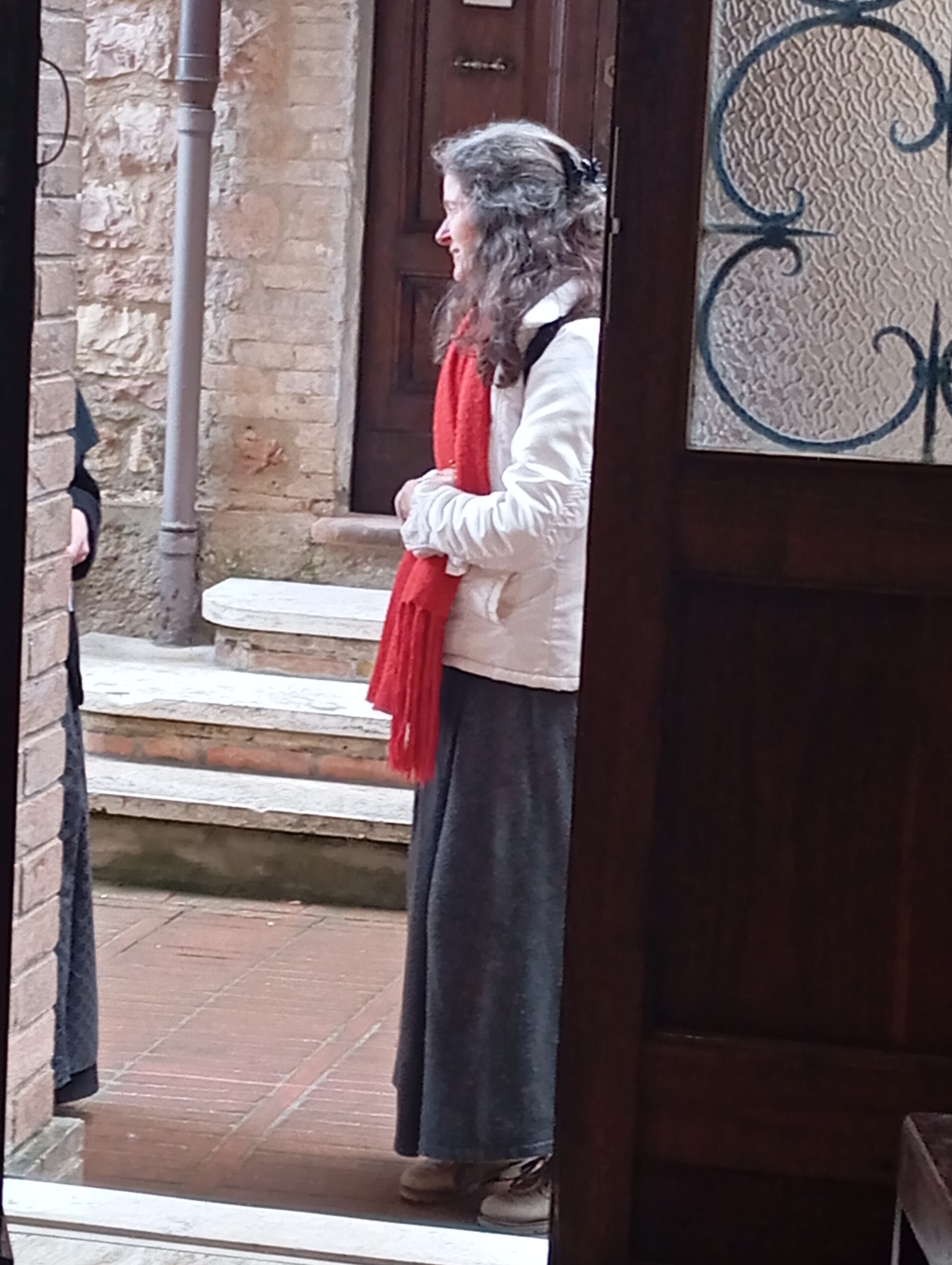
She shows the work of the cultivating power of poverty, of the poor in spirit, in the inverted world of Christianity, where every weakness can become a strength, so long as your aim is to offer your heart and your whole heart. For those who look, and behold her, or at least to me, Simone seems to betray this part of the mystery of the Incarnation, of beauty wrought in poverty, of the Divine Nobility more clearly set on display in the lowly stall in Bethelehem, where the sideshow was the shining star, and where shepherds gave their perfect song of praise and sang with all their hearts, because they had nothing else to give.
tip jar—>: https://buymeacoffee.com/sweller
“Menschen die ihr wart verloren” (from the text alone my favorite german christmas carol, I put the text below.)
Menschen, die ihr wart verloren,
lebet auf, erfreuet euch!
Heut ist Gottes Sohn geboren,
heut ward er den Menschen gleich.
"Lasst uns vor ihm niederfallen,
ihm soll unser Dank erschallen:
"Ehre sei Gott, Ehre sei Gott,
Ehre sei Gott in der Höhe!"
Welche Wunder reich an Segen
stellt uns dies Geheimnis dar!
Seht, der kann sich selbst nicht regen,
durch den alles ist und war.
Lasst uns vor ihm niederfallen …
Selbst der Urquell aller Gaben
leidet solche Dürftigkeit!
Welche Liebe muss der haben,
der sich euch so ganz geweiht!
Lasst uns vor ihm niederfallen …
Menschen! Liebt, o liebt ihn wieder
und vergesst der Liebe nie!
Singt mit Andacht Dankeslieder
und vertraut, er höret sie!
Lasst uns vor ihm niederfallen …
this book is a wonderful collection of legends and sermons and prayers of St Francis: https://www.amazon.de/Legenden-Laude-Franziskus-von-Assisi/dp/3717514946
No posts
Comments
Nothing yet. Say the first thing.
Sign in to join the conversation.