
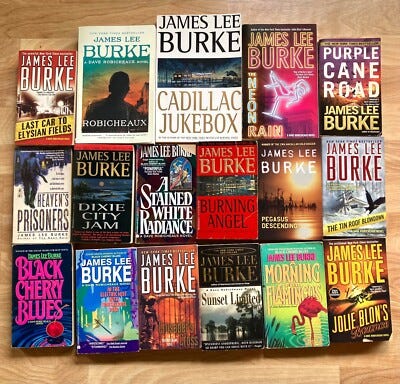
James Lee Burke might be the best living author of American detective fiction. If not, he’s in the conversation with Mosley, Paretsky, Connelly and Block.
Burke’s best-known series follows Dave Robicheaux, an alcoholic Vietnam vet turned deputy sheriff in Iberia Parish, Louisiana. It’s common for Robicheaux novels to feature a murder that is somehow intertwined with a criminal from his past, and/or Louisiana’s history of racism and violence. Crimes present and historic, demons personal as well as national.
Burke’s writing is steeped in sensory detail—loving descriptions of swampland or the red light district in New Orleans. You can feel the humidity and smell the sauce piquante.
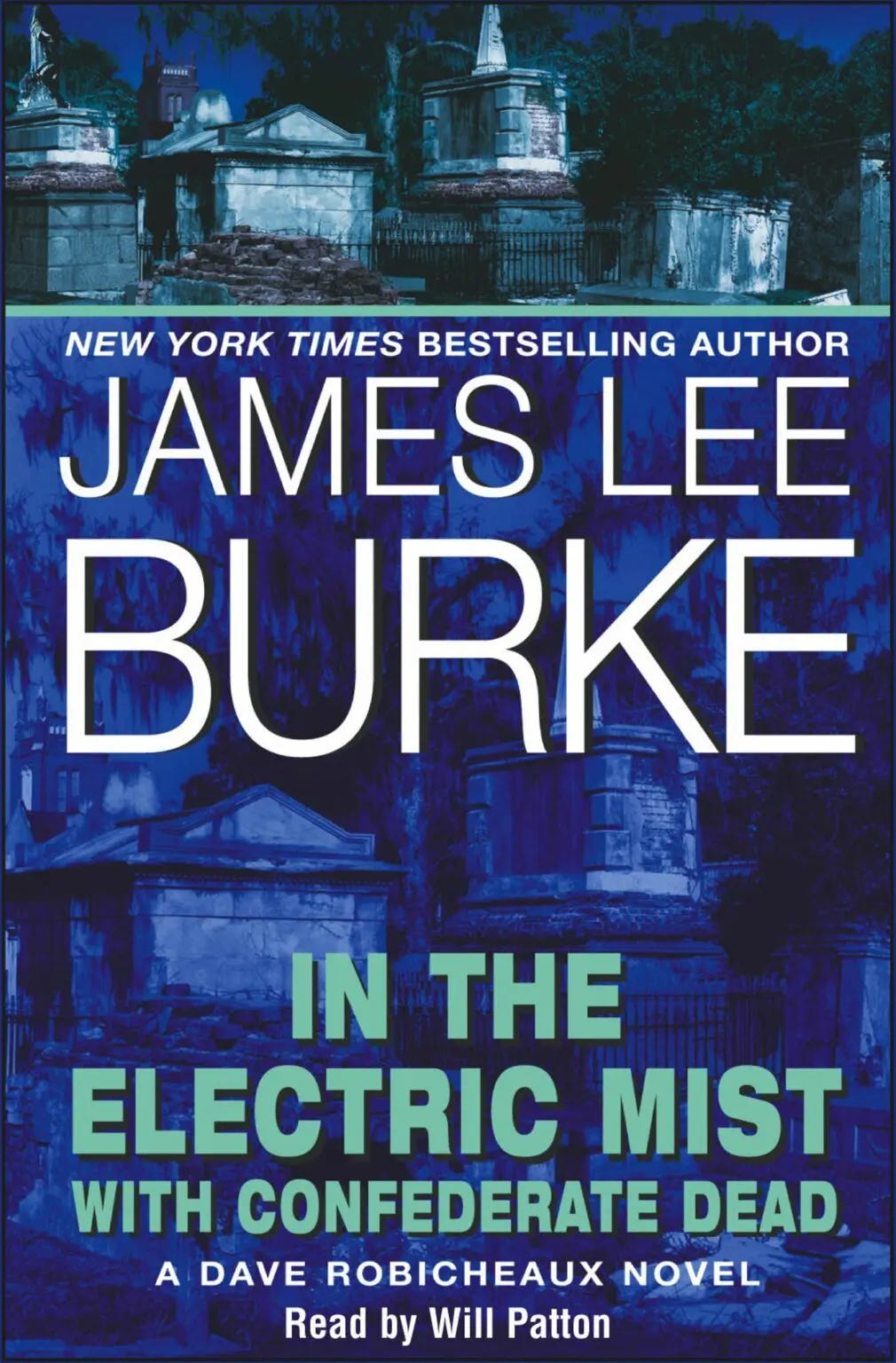
There’s also a bent towards is-it-real hallucinations that can be wonderfully surreal—in In the Electric Mist with Confederate Dead, Robicheaux is given LSD and converses with a dead Confederate general. The hallucinations don’t work in every book, but they’re always interesting.
Burke books also have only one pace. Rather than ramp up towards the end, they maintain a steady rhythm of action and description.These are thoughtful books, contemplative and atmospheric.
Themes and tropes repeat in the books—innocent (usually female) victims, criminals from Robicheaux’s past, the violence of American history writ on the present. Like Ross Macdonald and James Ellroy, or Agatha Christie for that matter, he can be criticized for writing the same book over and over—but when the book is good, isn’t that a feature rather than a bug?
What I love about Burke’s novels, which sounds quaint (and flies in the face of every crimefic trend of the last decade), is that they’re essentially about goodness. How to live a good life when it’s easier not to, and when bad things happen to you regardless?
Robicheaux struggles not to do evil, though his temper, the bottle, and a broken justice system mightily tempt him. What makes the Electric Mist hallucination so memorable is that the general is an honorable leader who cares for his troops, but is fighting for an evil cause; Robicheaux might be the mirror version of that, breaking the law dishonorably to serve a greater good…but it’s also possible that he’s exactly the same.
Walter Mosley is the only other contemporary crime writer I can think of who returns to these moral question as often as Burke. When did crime fiction stop caring about that?
My favorite “run” of Robicheaux novels is from Heaven’s Prisoners to In the Electric Mist with Confederate Dead. Of the later books, Robicheaux is a standout.
(Part Two will cover Burke’s three film adaptations—Heaven’s Prisoners, In the Electric Mist and God’s Country.)
Comments
Nothing yet. Say the first thing.
Sign in to join the conversation.