
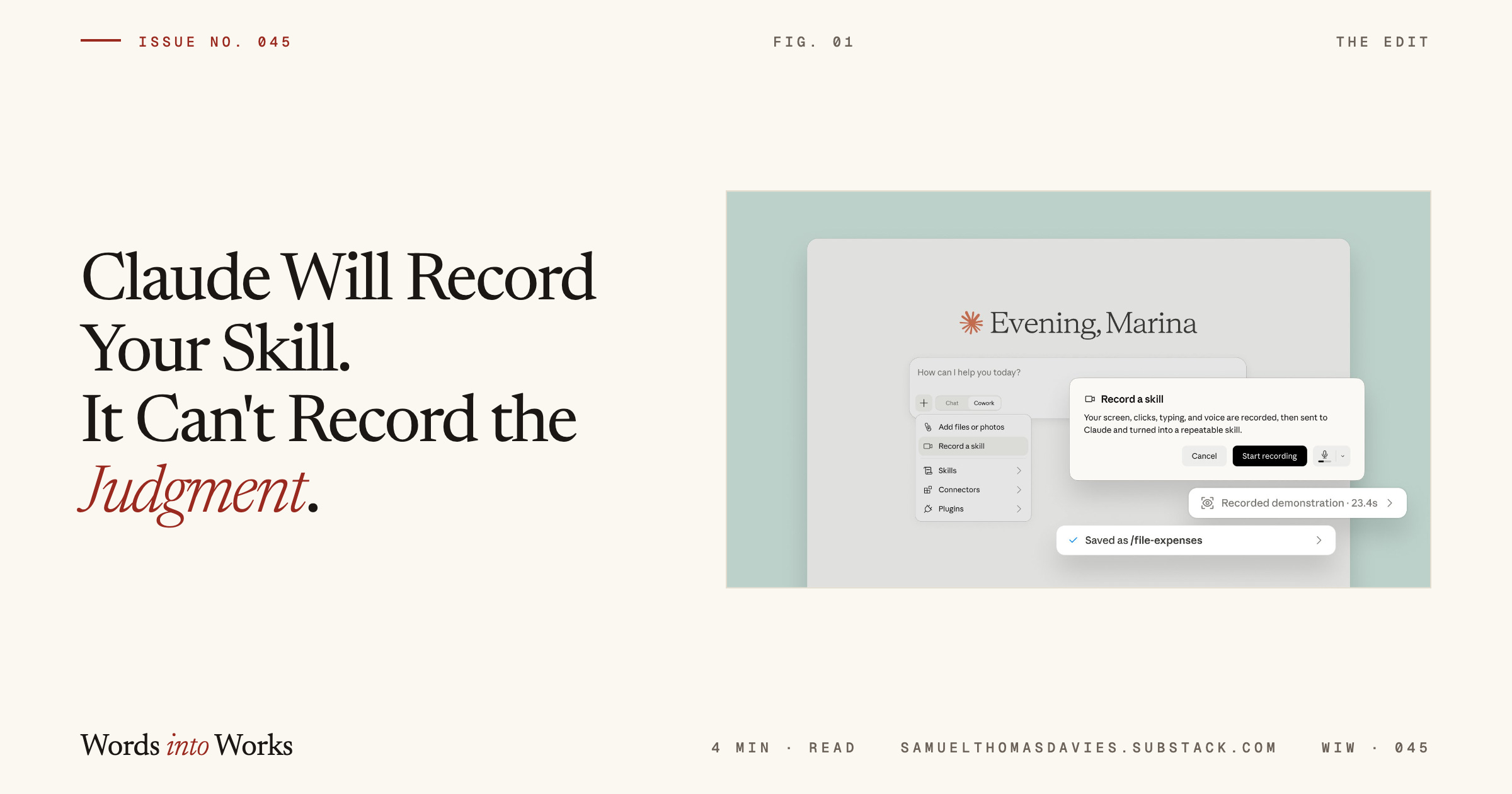
Last week, Claude shipped a new feature called Teach Claude a Skill.

Claude@claudeai
New in Claude Cowork: teach Claude a skill. Record your screen while you do a task, talk through it as you go, and Claude turns it into a skill it can run again. Find it under Record a skill in the + menu of the Claude desktop app. Available on Pro, Max, and Team plans.

3:54 PM · Jul 21, 2026 · 10.8M Views
1.29K Replies · 3.32K Reposts · 45.3K Likes
You run a task with a screen recorder going, talk through it as you work, and Claude turns the recording into a skill it can run again. No writing the skill. No editing the skill. You just do the thing, and it watches.
I’ve built more than sixty of these by hand. So, when the announcement crossed my X feed, I felt two things about four seconds apart.
The first was relief.
Building a skill from scratch is slow, and most of that time goes into plumbing nobody enjoys (the file paths, the step ordering, the “when I say this, do that”).
The second was quieter, and a little cold. If a recording can build the skill, what have I been adding by hand all this time?
To test that suspicion, I opened the skill I rely on most and read it back to myself, one line at a time.
One question for each line: would a camera pointed at my screen have caught this?
A screen recording is an honest witness to exactly one thing: what happened. The files I opened. The order I worked in. The words that ended up on the page.
For a lot of skills, that’s the whole job. In fact, the demo in the announcement built a working skill from a 23-second recording of someone sorting expense files. That’s the sweet spot, and it’s a good one.
If the task is “pull the figures from this dashboard, drop them in that sheet, bold the header row,” the clicks are the skill.
There’s no hidden reasoning to miss. Record it once and you never do it by hand again.
(I’ve written plenty of skills like that the slow way, and I felt a little stupid watching the demo.)
But the skill I opened isn’t that kind. It’s the one that drafts this newsletter in my voice, and it’s past five hundred lines.
Almost none of them are clicks.
I read mine back and the first line I saw? Never fabricate a number, anecdote, or biographical detail. Sam’s decade was spent turning nonfiction books into summaries, not prompts.
A recording of me writing would have no idea that sentence exists. I don’t do it anymore. I stopped after a draft once put words in my own past that were never there. The rule is the scar.
A few lines down: “rarely,” not “never.” Factual specificity over dramatic effect. Slight exaggeration reads as writing; precision reads as memory. A camera catches me typing “never,” but it doesn’t catch the decision, two drafts later, that “never” was a lie and “rarely” was the truth.
Then: kill “just,” “really,” “actually,” “simply.” On screen, deleting a “just” looks like fixing a typo when it’s a standing rule about how certainty sounds.
Another: put the reader in the room before the thing happens. Situate the scene, then let the event land inside it. A recording would show me writing the sentence, but it wouldn’t show me deleting the earlier version that only reported the fact.
And finally, one I earned the hard way: chaining sentences by repeating the last word creates the illusion of logic, so only chain steps that actually follow. That’s not a keystroke anywhere. That’s a caution I wrote down the week I caught myself faking momentum with a rhetorical trick.
None of it would be in a recording. The recording would keep the output and loses the judgment that made it, because that judgment runs below the level I could narrate in real time even if I tried.
A recording captures what I did. The skill is everything I did on purpose.
Remember the four-second question: if a recording can build the skill, what have I been adding by hand? This is the answer.
That skill didn’t arrive five hundred lines long. It started as a rough cut, close to what a recording would’ve handed me, then got edited every week something went wrong.
The fabrication rule went in the week a draft invented a detail about my own history. The scene-setting rule went in the week a hook reported an event instead of putting the reader in the room. The rule about flat, balanced triads reading like a machine went in after I read a book on rhetoric and finally understood why my own drafts sometimes sounded AI-made. Each rule has a date and a reason, but none of them came off a screen.
I don’t want to undersell the feature, though. Record a skill is going to be a real gift for the mechanical eighty percent: the procedures, the click-paths, the this-then-this-then-this I’ve typed out by hand like it’s 2009.
The skill that pushes this newsletter to Substack and fixes my heading capitalization on the way? A recording would nail it in one take. For those skills, the recording is the skill, and I’ve just been slow.
The distinction only bites for the skills that carry a judgment, the taste I’ve called your last real bottleneck. And you already know which of yours those are. They’re the ones you wouldn’t hand to a new hire on their first day.
So, here’s what I recommend, and it costs you ten minutes. Open a skill you lean on most, or the workflow you’d turn into one if you had the time. (Not a procedural one—one that holds your taste.) Read it top to bottom and mark every line a camera wouldn’t have caught: the thing you refuse to do, the word you always change, the tell you’ve trained yourself to hear.
That list is the part of your work that doesn’t come off a screen. When you record your next skill, that list is the second pass.
If this changed what that Record a skill button is actually handing you, send it to the person on your team who’s about to record their whole job in one take and call it done.
Comments
Nothing yet. Say the first thing.
Sign in to join the conversation.