
On the ground floor of the Supreme Court building in Washington D.C., you can find a bronze statue of one of our Founding Fathers, Chief Justice John Marshall. Often called “The Great Chief Justice”, Marshall held that position from 1801-1835 — longer than any other to this date. Marshall once wrote that slavery is “contrary to the law of nature,” and if that’s all you ever learned about him, he’d sure sound like one hell of a dude!
But, at the time of his death “The Great Chief Justice” had nearly 200 people enslaved on his various plantations across Virginia. And he spent his time on the Bench invariably siding with slave traders.
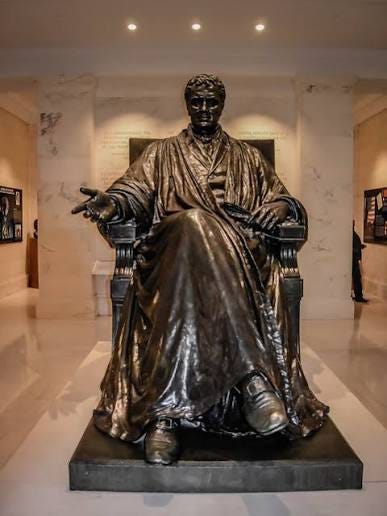
Like James Baldwin said, “I can’t believe what you say, because I see what you do.” Or, like Hoosier Poet James Whitcomb Riley once said, “When I see a bird that walks like a duck and swims like a duck and quacks like a duck, I call that bird a duck.” Or like Chico Marx once said, “Well, who’re you gonna believe, me or your own eyes?”
Pick your observation-over-rhetoric-ism. The point is, much is revealed about a country in whom it chooses to celebrate.
Roger Taney succeeded Marshall as Chief Justice and in 1857 his court ruled on the Dred Scott case. Now, at this point, slavery had existed on this land for 238 years. During that time, countless people had escaped. Some used the courts, a whole lot ran away. Enslavers battled this very stupidly by writing state and federal law after law banning escape. Even so, escapes continued along with uprisings and rebellions. White abolitionists continued fighting slavery figuratively in courts and literally in the streets. John Brown was finishing up his part in Bleeding Kansas.
Comments
Nothing yet. Say the first thing.
Sign in to join the conversation.