

Imagine the positive impact of waking up each day and reminding ourselves more often that today, “I’m going to show my love for others through my work.” Might be a good thing to do several times a day.
Gibran’s 5 words are from his short book, The Prophet (1923). It’s his best-known work. In it, Almustafa, a prophet, is asked by the people of Orphalese to share his wisdom on different topics. Those beautiful words are among others in the section, On Work (below, 3 minutes).
I hope you find them inspiring. I’ve highlighted my favorite lines. A few words are spelled using British conventions from the originally published version. The formatting is poetry formatting, as best matched to what can be done on this platform.
And he answered, saying:
You work that you may keep pace with the earth and the soul of the earth.
For to be idle is to become a stranger unto the seasons, and to step out of life’s procession, that marches in majesty and proud submission towards the infinite.
When you work you are a flute through whose heart the whispering of the hours turns to music.
Which of you would be a reed, dumb and silent, when all else sings together in unison?
Always you have been told that work is a curse and labour a misfortune.
But I say to you that when you work you fulfil a part of earth’s furthest dream, assigned to you when the dream was born,
And in keeping yourself with labour you are in truth loving life,
And to love life through labour is to be intimate with life’s inmost secret.
But if you in your pain call birth an affliction and the support of the flesh a curse written upon your brow, then I answer that naught but the sweat of your brow shall wash away that which is written.
You have been told also that life is darkness, and in your weariness you echo what was said by the weary.
And I say that life is indeed darkness save when there is urge,
And all urge is blind save when there is knowledge,
And all knowledge is vain save when there is work,
And all work is empty save when there is love;
And when you work with love you bind yourself to yourself, and to one another, and to God.
And what is it to work with love?
It is to weave the cloth with threads drawn from your heart, even as if your beloved were to wear that cloth.
It is to build a house with affection, even as if your beloved were to dwell in that house.
It is to sow seeds with tenderness and reap the harvest with joy, even as if your beloved were to eat the fruit.
It is to charge all things you fashion with a breath of your own spirit,
And to know that all the blessed dead are standing about you and watching.
Side note: Maya Angelou once said how when she did anything, “I bring everyone who has ever been kind to me, with me. Everybody. I say, ‘Come with me. I need you now.’” Source below.
Often have I heard you say, as if speaking in sleep, “He who works in marble, and finds the shape of his own soul in the stone, is nobler than he who ploughs the soil.
And he who seizes the rainbow to lay it on a cloth in the likeness of man, is more than he who makes the sandals for our feet.”
But I say, not in sleep but in the overwakefulness of noontide, that the wind speaks not more sweetly to the giant oaks than to the least of all the blades of grass;
And he alone is great who turns the voice of the wind into a song made sweeter by his own loving.
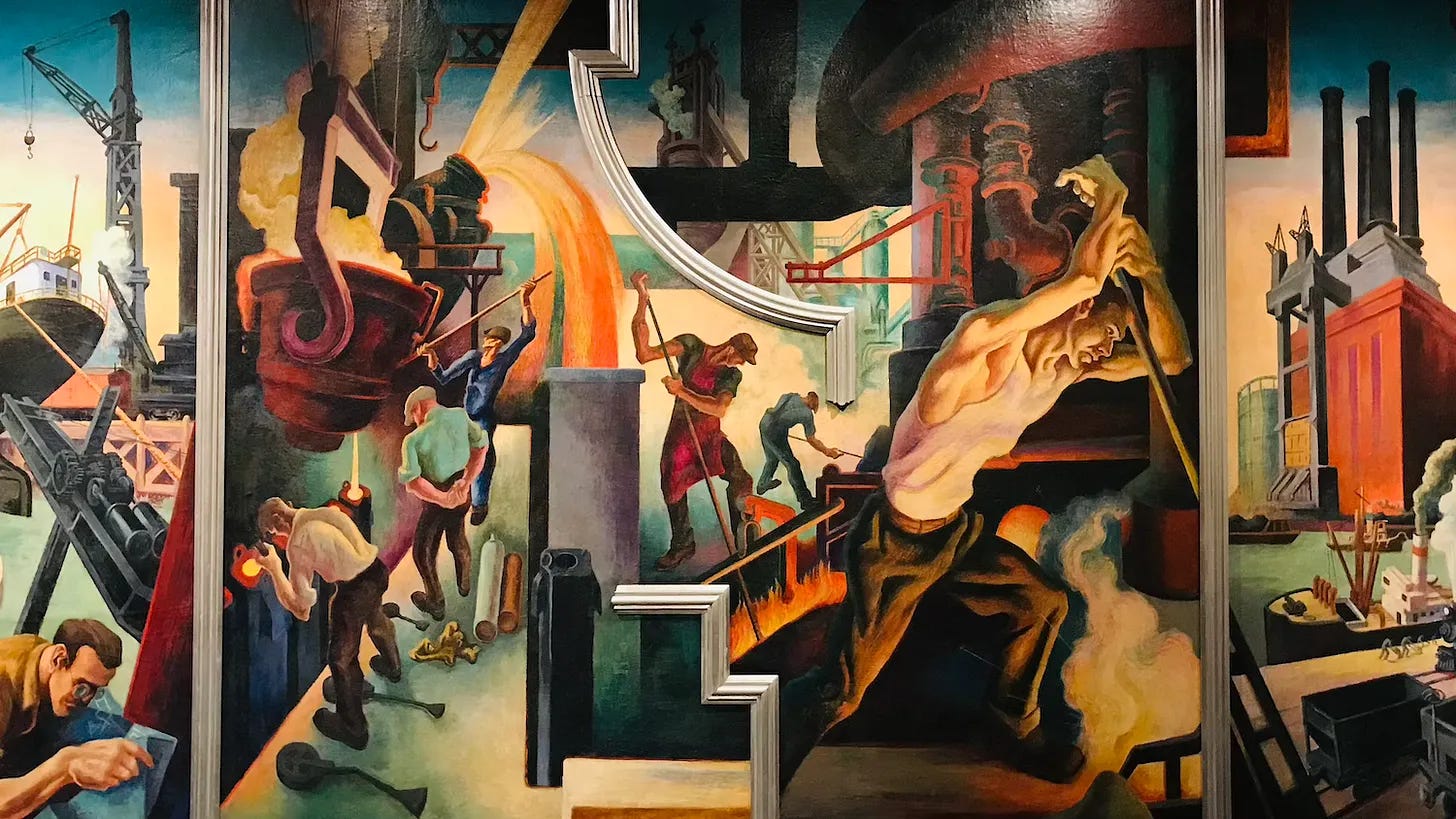
Work is love made visible.
And if you cannot work with love but only with distaste, it is better that you should leave your work and sit at the gate of the temple and take alms of those who work with joy.
For if you bake bread with indifference, you bake a bitter bread that feeds but half man’s hunger.
And if you grudge the crushing of the grapes, your grudge distils a poison in the wine.
And if you sing though as angels, and love not the singing, you muffle man’s ears to the voices of the day and the voices of the night.
Enjoy the week!
Comments
Nothing yet. Say the first thing.
Sign in to join the conversation.