
I’m still away on a campsite, cooking beans. Here’s another piece I wrote that people seemed to like, which appeared in my old friend Craig Raine’s magazine Arete, way back when. It’s a snapshot of my life nearly 25 years ago, and a period of time I still look back on with a certain amount of longing. Anyway, maybe you’ll enjoy it too.
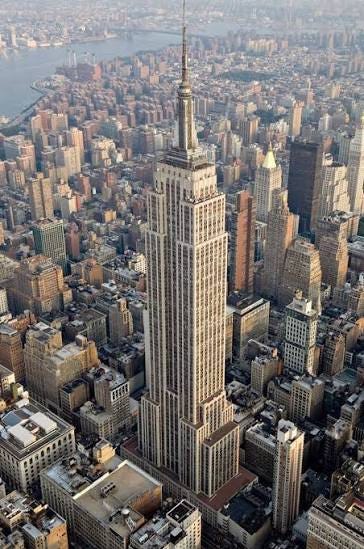
I had a one-room apartment in New York in 2002, off Broadway just a few blocks below Canal Street. It was a fourth-floor walk-up, one high ceilinged room, with ceiling-high sash windows on two sides and a bathroom to one side. In winter, hot air coughed from a duct that looked like it belonged in the Alien films. In summer, light streamed in, bleaching everything. I had no air-con. My then girlfriend stayed in London. She gave me a plastic aquarium and a packet of sea-monkeys to keep me company.
The outsider’s experience of New York is always mediated, always secondary. The idea of the city precedes and shapes the way you see it. That’s the case with all cities: but there is no other city on earth the idea of which is so fiercely promulgated. You catch yourself marvelling at steam issuing from manhole covers; at yellow cabs jouncing on their suspension; at hot-dog carts and at thickets of white-on-green street signs announcing “Delancey”, “Houston”, “Murray Street”. Each morning I turned right out of the door of my apartment and walked 15 feet and turned right again and looked up Broadway to see the Chrysler Building. I never did so without at once feeling enchanted, and remembering that it was the lair of Q: The Winged Serpent.
When I arrived, New York was secondary in another, more particular way. It was three months after the twin towers came down. I’d seen that on television from London and digested it as spectacle – your brain, watching that footage, processed it as a Bruckheimer movie rather than a piece of reportage. I had no sense of how physically enormous Ground Zero was – how much stuff wasn’t there. I had thought, at some level, it would be the size of a television screen. Part of my job, in the slightly less than a year I was there, was internalising the way in which the attacks had been real and making sense of that in print.
I was in New York as a correspondent for the Daily Telegraph. It was a promotion: I used to run the gossip column. As well as following the rolling story of the city after 9/11, my job was to cover news anywhere east of the Rockies. The first thing I did was to interview Cloaca, an artwork by Wim Delvoye – a machine which ate three square meals a day and produced shit. My story didn’t make the paper.
National politics was done from Washington. Finance was down to a colleague on the Wall Street beat. I covered local politics instead. In Colorado, there was a minor scandal when a former stripper was elected mayor. In Texas, a goat called Clay Henry III had been elected mayor without demur. Clay Henry was an alcoholic. There was a minor scandal after a man castrated the mayor for drinking his beer. I got a small scoop with my report on Wendell and Cass, the two gay penguins in Central Park Zoo. It’s possible my background in gossip, rather than hard news, shaped the way I proceeded.
I fell in with the Pack: mostly paps, and agency hacks for news agencies with names like Splash and Big Apple News on day rates for the red-tops. We drank in Irish bars. I think they regarded me as a sort of mascot. “We’re going to New Jersey to pap Dudley Moore’s funeral,” they would say. “Want to come?” I’d go.
On such jobs we’d meet the men from the National Enquirer who, like New York itself, seemed to be preceded by the idea of what it was to be a man from the National Enquirer. They wore sideways-looking eyes, very cheap suits, Velcro shoes. They were constantly changing hire car so the police wouldn’t “make” them and send them packing. They muttered. One had a thin ponytail that went the length of his back, tied every three or four inches by rubber bands. It was a look.
They were “operators”. I was not. The first big job I had, I was woken at 4am by a call from the newsdesk in London. A story had broken overnight. “Get on a plane to Baltimore,” they said. In my dressing gown, I looked up flights. There was one from Westchester Airport. I didn’t know Westchester was upstate. I didn’t yet have a bank account or a cash card. I had to wake up our office manager in her apartment in the East Village and borrow cash from her for a cab. The cab driver looked surprised when I asked him to drive me to Westchester, but he took me. It took about an hour and a half. The airport was tiny. The plane was tiny. It lifted into the air and landed and we were there. I passed through the airport and found a cab and reached the press conference around lunchtime. I learned that Baltimore is two hours from New York by train.
I was, at least at first, living in a city I didn’t know how to use. On my first days in Manhattan, living at the Washington Square Hotel (the locale made me think of the Henry James novel and of the blim of hash I’d scored in Washington Square when I was last here, aged 18, and that made me sick) I ordered a pizza. It was very expensive, but I guessed New York was expensive. I didn’t realise that “a pizza” feeds ten. I became the owner of a greasy cardboard box the size of a wagon wheel. It was impossible to fit in the tiny waste-paper bin in my room.
I couldn’t think how to smuggle it out past reception without the humiliation of my error being obvious. It finally went out on my shoulder as if I were, myself, delivering it. I pretended not to notice I had a huge pizza box on my shoulder, and the receptionist was kind enough to pretend not to notice too. I abandoned it on top of a bin – again, it wouldn’t fit – in Washington Square Park.
I tried. I started drinking martinis – gin, up, twist – as an affectation, and came to love them. The best were in a bar called Grace – gone now, I think – a few blocks over from my apartment. It had a very long, dark mahogany bar, dim light, and served potstickers in an orange sauce and martinis so big and so cold that a single one would floor you if you drank it too fast.
New York is a town of transients. Its distinctive cuisine is comfort food. I ate pizza, pulled pork, mac and cheese, burgers, clots of crisp bacon, sweet French toast, hot dogs – the watery tubes from hotdog carts and the superior sort from Gray’s Papaya or Nathan’s. I ate breakfast 24 hours a day. I went to this diner that was on the cover of a Tom Waits record; to that pub where Dylan Thomas drank. Brooklyn Bridge came pre-imagined by Hart Crane. Hell’s Kitchen came pre-imagined by Frank Miller and David Mazzucchelli; it’s now called Clinton on the taxi maps.
I hadn’t lived by myself for any length of time in years: not since I’d been a teenager at boarding school, and not really even then. If you haven’t been alone for a bit, it turns out, you simply pick up where you left off. I regressed. I did unadult things, like eating Rice-a-Roni standing up. I bought comics from Forbidden Planet on Union Square, and binge-read them, losing myself in The Invisibles and Preacher. I went to the movies by myself, often. I remember looking up to see a projectionist looking down at me. I was the only person in a matinee performance of Undercover Brother. The projectionist was laughing but I was not.
I spent weekends and some evenings walking – I liked taking the D train to Coney Island and walking on the beach off-season. Or – when I could – I’d hang out with an old friend and his wife, who lived in Murray Hill and essentially adopted me. When I had nobody to hang out with, which was reasonably often, I walked to the Tower Records on Lafayette and borrowed videos and watched them by myself, smoking. Really bad films, always: horror films, mostly. In the centre of the video store was a fenced-off area for pornography, that I looked at with shame and longing and never went into.
Watching films set in New York added to that feeling of secondariness. I watched Mimic 2: which is about a giant man-eating cockroach. At one point it scuttled past a piece of wall that I realised was the piece of wall at the end of the alley below my apartment. Inside the apartment, there were also cockroaches: whiskery, furtive and glossy as conkers on the cold white floor of the bathroom. None of them tried to eat me.
Once, when my then girlfriend was visiting and our friend Tania was staying on a futon on the floor, Tania woke us in the very small hours of the morning and hustled us to the window still disoriented and undressed and half asleep. “Look!” Curled up in the alleyway underneath the window were dozens and dozens of naked people. It was art, by Spencer Tunick. They had photographers’ lights beaming down on them from stands. I didn’t have my contact lenses in. They looked like prawns.
Even the sea-monkeys were secondary. I’d never owned sea-monkeys before, but there were advertisements for them in the old American comics I loved as a child. The adverts showed them in cartoon form, as a smiling, amphibian version of a 1960s nuclear family. Mine lived in a plastic aquarium about the size of a pint glass, on the trestle table under the window. They didn’t resemble their caricatures. They were self-propelled motes, circulating in the water. If you looked very hard, through one of the convex viewing points on the aquarium, you could see tiny legs flailing away. The summer heatwave killed them.
The last thing I reported was the first anniversary of the attacks. It was a big deal for newspapers. Supplements were planned. There were stories I was expected to get. I presented myself at fire stations. I left messages on answerphones, chasing widows. Some returned my calls. Most didn’t. Every news outlet in the world wanted a widow for the first anniversary. Every widow who wanted to tell her story had done so many times already.
I kept trying. So did everyone. We all wanted anyone whom 9/11 had hurt, and there was an unspoken system of rankings. Widows were best. Widows who had been pregnant when they lost their husbands were the best of all: reserved for classy outlets such as Vanity Fair or the New York Times. Every few days, in the run-up, the deputy foreign editor would ask me what I’d got. I’d say I’d left messages. “We need a widow,” he’d say. As time went on: “You may have to buy some flowers and knock on some doors.”
I felt sick. I didn’t know if I could do that. I didn’t know if I could refuse to.
Finally, my luck broke. Not a widow: some parents. I went to interview a couple in Pelham, a commuter town a short train ride upstate. Pelham, a town of 12,000, lost ten people in the towers. This couple’s adoptive son was one of them. I sat in their living room, sick with nerves, and asked them everything I could think of that would make them cry. I felt nothing but a sort of inward relief when they did. My eyes went to the red light on my tape recorder.
Later, transcribing the interview tape on my laptop, alone in my apartment in front of the big window, I cried so hard I had to get up and walk around the room. This was pornography. This was secondary. They wrote me a note afterwards thanking me for the article and saying I’d captured their boy exactly. I can’t now remember the name of their son.
I loved New York. I’ve never been lonelier.
No posts
Comments
Nothing yet. Say the first thing.
Sign in to join the conversation.