
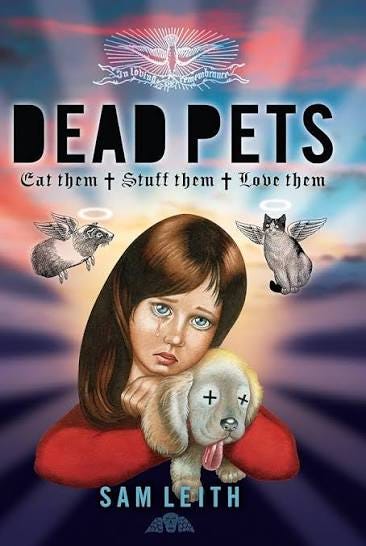
Still on holiday. But that doesn’t stop me scheduling a bit of old stuff the perplex your inbox. The rights to my spectacularly unsuccessful first book Dead Pets: Eat Them, Stuff Them, Love Them1 reverted a while back, so I don’t see why I can’t publish the odd bit here. I’m fond of it, though no question it was a mahoosive failure.
The problem was, it was conceived as a Christmas gift book, and it fell absolutely between two stools. Pet lovers were appalled and horrified by the recipes for guinea pig and dog, or the semi-jocular retellings of the fates of Rinka, Laika, Greyfriars Bobby, and Champion The Wonder Horse. At the same time, those who looked to the book for black-hearted jokes will have gone yuk at the thread of revoltingly sentimental memoir about my relationship with my cat Henry.
Ergo it sold no copies at all. Some years later, I looked ruefully back on this fiasco with my publisher, Canongate’s Jamie Byng, and said that I was very grateful for how well he had published the book, and that I felt comfort in knowing that the British Library would, in perpetuity, contain a hardback volume with my name on the spine: that I was An Author.
“I didn’t give a damn about putting your name on the spine of a book,” Jamie said glumly. “I wanted to sell some copies of it.” Sorry, dude.
Anyway, here’s the Introduction.
There is no final enough of wisdom, experience- any fucking thing. No Holy Grail, No Final Satori, no solution. Just conflict.
Only thing that can resolve conflict is love, like I felt for Fletch and Ruski, Spooner, and Calico. Pure love. What I feel for my cats past and present.
Love? What is it?
Most natural painkiller what there is.
LOVE.
Last written words of W S Burroughs
“Joyboy, these are wild words.”
Evelyn Waugh — The Loved One
I remember Silky. I remember him, or her, as if it were yesterday.
Silky was my truculent, unimaginatively-named hamster. The apple of my six-year-old eye. All day long he would sleep, buried invisibly in the middle of a nest of paper which closely resembled the shredded white radish they give you in sushi restaurants. Sometimes, if his cage was shaken violently enough, his little golden nose would quest twitching from his bed to investigate a finger poked through the bars of his cage. Into this, he would sink his needle-sharp, caramel-coloured teeth. And every night, while I slept, Silky would spend his hours of wakefulness trying to escape.
It was not seldom that, around the time I was getting on the outside of my second bowl of pre-school Shreddies, the alarm would be raised. The door of the cage would be noticed swinging open, or one of the cleats fastening it to its plastic base would have popped mysteriously loose, or the furry Houdini would have found some way, with or without the collaboration of our several cats -- who had their own reasons for being accomplices -- to squeeze his tiny form through a wide place between two bars and head out, fearless or oblivious, into the wider world.
Stalag Luft Hamster had, again, been broached, and every human in the house would be conscripted to return my brave adventurer to protective custody. The cats, with their mysterious and shifting allegiances, would silently volunteer their help.
On one such occasion, Silky looked to have made it clean away. All the usual procedures had been followed. Moments of silence – hands and knees shagged with downed cobwebs, ears cocked at the skirting boards – had been enjoined, in the hopes an unguarded, inquisitive squeak would give him away. Pipes had been knocked. Curtains had been drawn back and the indoor woodpile dismantled log by careful log onto the sitting room carpet.
The long game, as the fugitive entered his seventh or eight hour at large, had been tried. Forlorn trails of sunflower seeds had been sown, and ignored. Slippery jam jars had been baited with little corners of cheese, and poised, uptilted invitingly, on opened books on the floor. Behind the sofa in the sitting room, I lay propped on my arms, as still as a Khe San sniper for ten or fifteen minutes, attention zeroed on the length of string I had in my arms. A few feet away, in the middle of the room, the other end of the string was tethered to a stick; which in turn propped one end of an upturned Tupperware dish, precariously, over a small pile of whatever it is that hamsters eat.
Nothing doing. Evening was drawing on and, even given Silky’s exceptional resourcefulness and aggression, my reserves of optimism were on the ebb. In my memory of this, it is late summer, and the light of the setting sun falling across the west-facing sash window of my bedroom and across my bed is mellow and golden. I had climbed the stairs, my face hot with unshed tears, and flopped in despair onto the coverlet. And on that instant I heard a single rising squeak, shrill as an unattended kettle, and heard, or perhaps felt, a crackle of fragile bones.
Silky had escaped the kitchen. Silky had negotiated the stairs. Silky had evaded the cats. And Silky had settled down for a nice kip somewhere warm and dark and safe – between my mattress and my bedstead. And my careless six-year-old bottom had crushed him to death.
When I lifted the mattress, what I saw was pitiful. His small body was perpendicular to the side of the bed, just halfway up. Just where I had sat down to mourn him. And his nose, so often dabbed with my blood, was now soggy with his own. The whole front half of his body was scarlet; the back still pale and furry. The image that strikes me now, though I doubt it would have then, is of a partially used tampon. No end for a hamster.
And presently, I was making a high shrill noise of my own.
Silky was my introduction to dramatic irony. But he was also my introduction to death. And nearly everyone’s first encounter with death, if they are lucky, comes in the form of the death of a pet; everyone’s first preparation for the lifelong task of grief.
All those tiny extinctions.
I think of the sickly goldfish jouncing back from the fairground in a miraculously bulging clear polythene bag of water -- and extravagantly mourned three days later in an earthed matchbox, or in a viking funeral attended with the smell of bleach and a roar of water. And oh. All those doomed terrapins.
I think of my swimming, looping colony of tiny sea-monkeys, tenderly hatched from seeds -- my only companions in a lonely Tribeca apartment, boiled to death in their plastic aquarium when I left it, careless, in the direct sunlight of a New York summer.
I think of my own gerbils: robust, cobweb-coloured Eurydice and her companion, a smaller, trembling albino I named Persephone (I was a pretentious and, perhaps even then, morbid child). I doted on Eurydice just as I once had on Silky. I remember watching in astonishment, one night, when a moth blundered into her cage and she plucked it, one-handed, from the air, folded its wings primly down against its flanks and ate it head-first as if it were a sunflower seed.
When Eurydice succumbed to cancer, or starvation, or whatever, and returned to the underworld, my parents would not let me see the body. I finally winkled out of them why. It was because Persephone – in for a few pome granate seeds, in for the full menu degustation – had taken the opportunity to chew all the meat off her fallen companion’s hindleg. Pale fur, again stained with blood.
I think of the colonnades of lollystick gravestones, or gravestones pressed with childish thumbs from clay, which rise and fall in the quiet corners of suburban gardens.
I think of the countless cats and dogs which “went to sleep” or “were in a lot of pain” or “are with grandma in heaven” – cats the watchful child saw grow thin, stalking the margins of corridors, defecating eccentrically, dripping from ears or nose, unwashed knots of fur clotting their coats…
Pets teach us about loss, and about the nature of the world. But they also teach us about responsibility. Think of the first time a child dimly intuits, in the screech of brakes and the whomp of an impact on the other side of the hedge, the connection between letting Buster slip the lead and Buster going to visit grandma in heaven.
And these lessons are often learned, too, among other children.
Remember the one child who would return to school after having had the school gerbils to look after over the holiday? (Measles and Mumps, or Bubble and Squeak, school gerbils always seemed to be called, for some reason, and they were always dun in colour – perhaps there was a special breeder.) And remember the child’s downcast eyes; its unconvincing insouciance. Remember the looks of mistrust and suspicion from his or her classmates; unwhispered the observation that Measles had come back looking thinner, or a different colour than you remembered, or female.
I think of my friend Rebekah, one of whose two giant african land snails (Triptych and Coriander) actually did, whimsically, change sex, and start breeding with its companion. All of one long summer the ice compartment in his fridge was a mollusc Auschwitz; as tray after tray of their legions of offspring was slid in for extermination by freezing.
I never knew till then that freezing was the best way of killing baby snails. Animals seldom excite the stirrings of scientific curiousity in children more than in the manner of their deaths – though the chain of cause and effect is equally often, if we are honest, the other way round.
Witness an incident I have no personal memory of, but which my mother has often told me about over the years. I was no more than seven or eight; my brother Alex, two and a half years younger. She came upon us both lying companionably side by side on the floor one day, propped on our elbows, scrutinising something just out of her sight on the carpet in front of us.
She tiptoed up, feeling fond and maternal, to eavesdrop on our conversation. Yikes. What we were studying was the messy corpse of a squirrel, thoroughly cat-chewed from the waist down. “What do you think it died of?” my little brother was asking in a reverential whisper. I replied with an air of great sagacity: “A brain haemorrhage. Definitely.”
We owe these creatures furred and feathered, faithful fallen companions, our thanks. This book has its origins in that debt, and in a two-bottle lunch with my agent, David Miller, in the Baker Street Pizza Express. “People eat up pet stuff,” he said, as I recall. “It’s time for a cash-in.”
A note on the methodology. This not a work of academic scholarship, so I make no apologies for stretching the definition of the word “pet” from time to time. Also the word “dead”.
None of the pets you will read about here is alive. But they rest in memory, in the bosom of the Almighty or in the belly of next door’s mastiff, in legend, in visited and unvisited graves. Requiescant in pace.
I think, finally, of a story I was once told by someone older, and wiser, than me.
It’s the story of a picture-pretty little girl who walks one day into a pet shop and, her eyes wide, asks the owner: “Excuse me, sir, but can you tell me whether you sell little fwuffy wabbies?”
The owner, who is an old and kindly man, and who maybe has a grand-daughter just like that little girl, leans down to the little girl with a smile, and he says: “Of course, young lady. We have lots and lots of little rabbits. Now, what you have to decide is whether you want to have a little brown rabbit, or a little black rabbit, or beautiful little white rabbit with pretty pink eyes.”
And the little girl looks back and him, with her long-lashed blue eyes, and she says: “Fwankly, I don’t fink my pyfon gives a toss.”
This book is for that little girl, wherever she is.
And it’s also for you, Silky, wherever you are. I’m really sorry about the bed thing.
Republished in paperback, to equal unsuccess, as Daddy, Is Timmy In Heaven Now?
No posts
Comments
Nothing yet. Say the first thing.
Sign in to join the conversation.