
The following draft is a work in progress from the upcoming book, The Great Australian Scam (working title). Quotes have been condensed for readability but otherwise replicated verbatim. The meaning and intent of the speakers have been preserved.
Sandra Bevan is seated behind a wide black desk facing a pair of slender microphones. Her dark hair is gathered loosely behind her head, reading glasses are balanced on the end of her nose, and she peers over the top of the frames toward the commissioner. In her short-sleeved, floral shirt, she is the picture of a seasoned healthcare professional: practical, dependable, and dignified. Her voice wavers.
“I would be getting off the phone and I was shaking.”1
“They were just blaming, blaming, blaming. And viciously attacking me. I said, ‘Yes, I got paid $1600 for that fortnight, but the next fortnight I didn’t earn anything.’”
“I do remember driving home at night just beside myself with worry about this money and thinking I could just drive my car into a tree and make it stop.”
She falters, and takes a moment.
“But my kids needed me.”
Ms Bevan holds a bachelor degree in counselling and has worked in disability and aged care roles since the age of 16. She is one of the 340,0002 health care and social assistance workers in Australia who are employed on non-permanent contracts, and her face illuminates when she describes her work.
“I just love that job of seeing people reach their potential. It’s such a wonderful thing. Seeing people go from a point where they’re anxious and they’re really not feeling very good about themselves to really doing amazing things with their lives.”
On 11 April, 2019 the Department of Human Services issued a letter which would mark the start of more than 15 months of demands, threats, and miscalculations. Ms Bevan remembers it as torture.
“They were calling me quite a lot and at varying different times of the day. And I would be driving in between shifts and – you know, it was just a real intrusion into my work.”
“I was always trying to assert my position. But I just felt that everything I said was falling on deaf ears.”
The infamous debt recovery scheme now known as “Robodebt” implemented a fundamentally unreliable and unlawful mechanism for estimating fraudulent welfare assistance claims. After targeting more than 500,0003 people between 2015 and 2019, the scheme that was budgeted to save taxpayers $4.7 billion is instead on track to incur a net cost of $1.1 billion45. Years of tormenting the public and nothing to show for it. Unless you count the Royal Commission.
On 31 July, 2020, Centrelink decided that actually, there wasn’t any discrepancy between what Sandra Bevan had earned and what she had reported. The calls from the debt collectors stopped. But the Robodebt scheme had already taken its toll.
“I was very angry that they put me through this and put my kids through this and made my life so difficult – and then eventually, for it to be found that I was right in the very beginning – that I didn’t owe them anything.”
Sandra Bevan was not alone in being subjected to months of stress leading to suicidal thoughts. For others, such as Rhys Cauzzo6, the burden tragically proved too great.
How does one of the most prosperous nations in the world come to wage a campaign of intimidation and harassment against its most vulnerable citizens? In an age where we have widespread access to advanced computational power, how is an elementary accounting error permitted to devastate so many lives?
In the leafy suburbs of Marsfield, one of the diverse northern suburbs of Sydney, a transformation is under way.
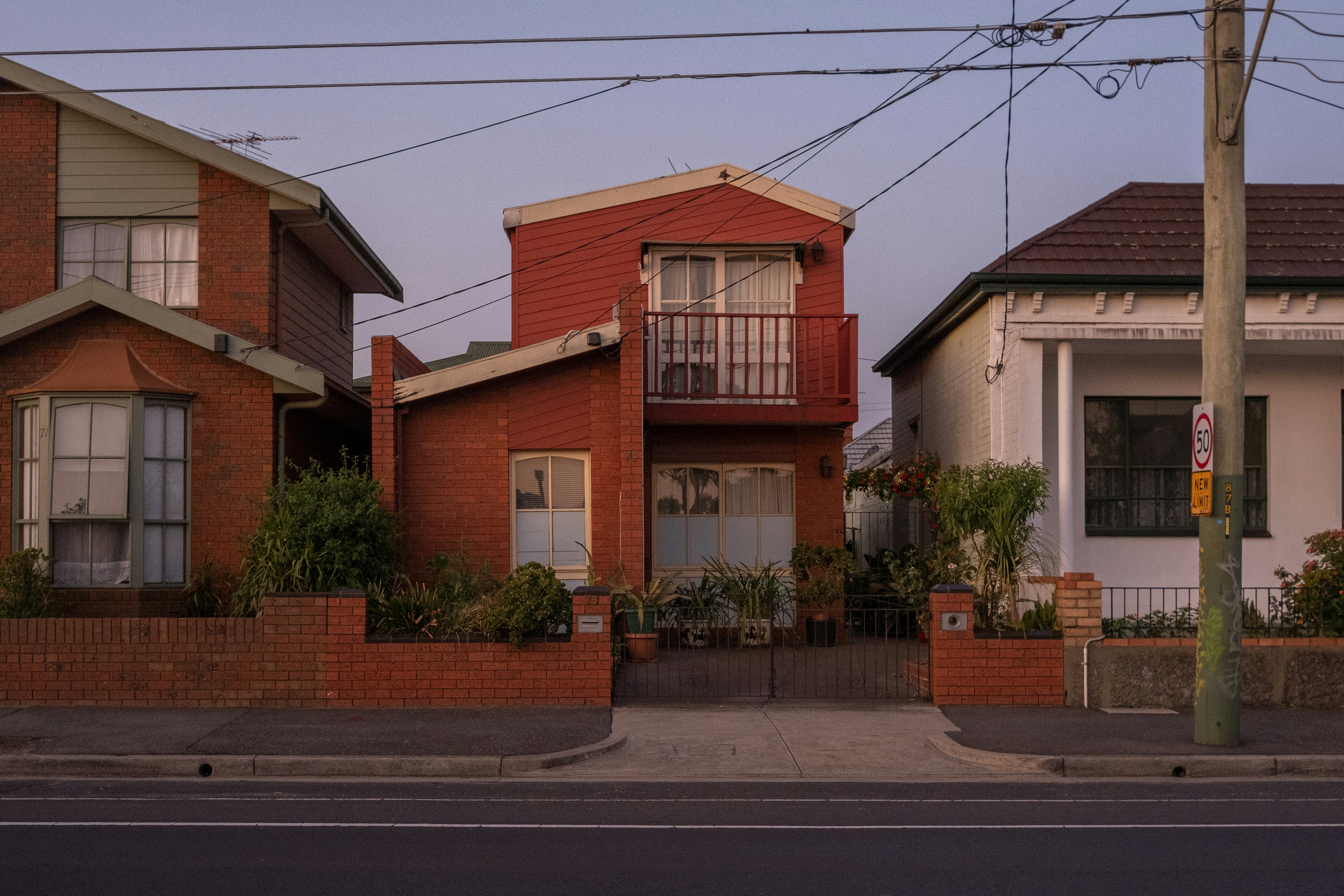
One by one, the small two-bedroom red-brick homes from the sixties are disappearing, replaced by towering town houses. The pattern is always the same. First, a for sale sign, followed swiftly by an auction. Then the construction fence appears, and an excavator levels the old home in a single day.
The speed and results of the developments are stunning. In less than four months a construction team can transform a 600sqm patch of clay and dirt into a three-storey duplex complete with basement garages, glass-framed balconies, and in some locations, a combined total of ten bedrooms. For a nation grappling with the urgent need to deliver more housing, these suburban mansions appear at first glance to be a beacon of hope.
On closer inspection, however, Marsfield is a suburb of profound contradiction. The shiny new town houses are an important piece of the puzzle.
Located almost 20km from the CBD, Marsfield is not part of Sydney’s trendy inner-west. It boasts no coastal views or harbour-side waterfront. The nearest beaches are more than an hour and a half away by public transport. Marsfield is not glamorous, but there are substantial benefits to living here. The suburb sits adjacent to Macquarie University, and the growing corporate hub of Macquarie Park. Residents enjoy easy access to the Lane Cove River which winds its way through one of Sydney’s pristine national parks. Sport facilities and playgrounds with a wide variety of equipment accommodating all age groups are dotted with surprising frequency through the streets. Decades of meticulous planning and development has made Marsfield an inviting urban community perfectly suited to young professionals and their children.
The demographic data of the broader Ryde area reflect this. There are more residents in their thirties than any other ten-year age bracket7. But other cohorts are competing to buy homes in Ryde.
Lee is a successful real-estate agent and has been working in the area for a decade.
“One trend we’ve noticed is for ex-pats returning to Australia from countries like Hong-Kong and Singapore, and they are buying property at high values for retirement and quality of life.”
“We’re seeing demand for brand new homes. We’re also seeing demand for homes that are potential knock-downs or duplex development sites.”
“It’s a good time to be selling right now, if you’re a vendor. Typically there is less stock in the market, which means there’s a greater concentration of buyers for your property.”
Of course, a good market for vendors is rarely a good market for buyers. Survey data shows stiff competition between families and investors. More than 40% of all housing stock in Ryde is owned by landlords8. To put that in the context of the local neighbourhood, this means that if you interviewed a group of ten Ryde home owners and asked why it is that they have chosen to purchase a house in Ryde, four of them would explain that they are using the building to get ahead financially, rather than to provide a home for their family and invest in the local community.
It seems that hundreds of investors with property in Ryde aren’t even renting out the homes. 9.2% of private dwellings were found to be unoccupied during the 2021 ABS census9, a number that is inflated due to factors such as travel, renovation, and sales10. But if just half of these homes are genuinely unoccupied, property speculators have locked up over 1900 unused homes and some 4000 vacant rooms.
Comparing house prices to average incomes it’s easy to see why families might struggle to buy in Ryde. A traditional free-standing home can easily fetch $3M at auction, and the brand new town houses are sold for well over $2M. Households with two adults on a combined annual income of $150,000, putting aside a healthy $45,000 per year could spend 8 years or more simply saving for a deposit, all while paying rent to a landlord they may end up competing against at the next auction.
It could be argued that Ryde shouldn’t be thought of as an option for aspiring home-owners on a median income, or that local families looking for a home with a yard rather than a 2-bed apartment simply need to update their expectations. But this isn’t the view of NSW state member for Ryde, Jordan Lane.
“We need to be honest that this is a very serious problem,” Lane says.
He explains his frustration with the mismatch between existing NSW housing policy and the aspirations of his constituents.
“Government would say to young families, well we’re going to build a whole host of build-to-rent apartments so we can get more supply into your local area. Your landlord will be a big corporate company, or some large financial institution. That’s what government would say is the solution for a family if you want to live in Ryde. I think that is the antithesis of what people want.”
“There’s not a focus on home ownership. It’s a focus on building whatever you can. It’s all a bit disconnected from the actual ambition of the community.”
Lane, then, believes that it is reasonable to expect housing policy to reflect the personal goals of the community. Yet, by his own admission, the complex challenge facing his electorate has no quick solution. This leaves Ryde in a bind. In a suburb that appears purpose-built for young professionals and their families, many of those families continue to be outbid, while multi-million dollar homes sit empty. In Ryde, the Great Australian dream isn’t dying – it’s already dead.
Marsfield and Ryde provide a snapshot of a problem that is unfolding across Australia and in wealthy countries around the globe. The puzzle is not why property investors would be attracted to urban real estate, or why wealthy international retirees would seek to make Australia their home. It’s that after carefully designing a suburban oasis providing a rich diversity of benefits to local families, the equally important problem of designing a mechanism for gaining access to housing in this suburb was given no attention at all.
Why would a wealthy nation go to all the trouble of carefully curating beautiful cities, only to systematically undermine key demographics who could contribute significantly to the local community? After decades of developing a cultural narrative around social mobility anchored in home-ownership, why would a nation eliminate opportunities for young adults to become home-owners?
The Great Australian Scam is an attempt to explain a paradox of the 21st Century. While cutting-edge products continue to improve and evolve, and associated company valuations continue to soar, the quality of life enjoyed by millions of people in advanced democracies is getting worse.
We have become skilled at designing transformational digital systems. Yet in shocking examples of hijacked bureaucracy we see those systems weaponised against hard-working citizens. We have refined the creation of liveable city spaces to a fine art. Yet our cities are rapidly taking on the characteristics of an exclusive club where only the wealthiest patrons are granted membership. The unlucky are left behind.
Our vehicles are consuming less fuel. Our mines are extracting millions of tonnes of minerals with increased automation and reduced human labour. We routinely place satellites in orbit. Our ability to network and telecommute across regional and national boundaries has unlocked unprecedented productivity. And yet, as employees we are not working shorter hours. We have less certainty in our employment and retirement and we’re more likely to be dependent on insecure work, perhaps within the gig economy. As households we are becoming more indebted and subject to greater financial vulnerability.
In short, the development of new technological capability is outpacing the creation of better social outcomes. There is a very simple reason for this, and it comes down to the fact that although both product developers and policymakers are tasked with solving problems of enormous complexity, they don’t take the same approach to solving problems.
And when it comes to solving complex problems, method is everything.
If you want to build a brand new medical device and put it up for sale there is a rigorous set of processes that you must conform to. Medical device development is constrained by both product and process standards. It’s not good enough to run a few tests on the final prototype and claim that it’s safe to use. Regulatory bodies like Australia’s Therapeutic Goods Administration require a comprehensive design history file documenting an unbroken chain that leads from initial user needs and requirements analysis, all the way through to verification, validation, and manufacture of the finished product. Engineers must prove that they’ve followed a comprehensive process for designing, building, and testing solutions, according to documented procedures embedded in a quality management system.
Within the inherently political domain of public policy, however, a different approach dominates. This has placed an emphasis on favoured policy solutions, for example, deregulation, tax rebates, or import tariffs. Many proposals are put forward based on political tradition and alliances leaving little room to examine the problem-solving process itself. We should not be at all surprised then, if we find that the solutions produced are severely lacking.
Solving complex problems is hard. That’s why product developers at global companies are highly paid. Cross-functional research and development teams are literally in the business of solving problems that have never been solved before. They face complexity head-on. They unlock new value by carefully consulting stakeholders and designing advanced technical systems. Complexity is not ignored, it is harnessed through resilient development processes.
This tenacity has not been translated into the domain of public policy.
All too often, legislators have avoided the real challenge of tackling complexity in the national problem space. The public is not presented with a systematic overview of the trade-offs implicit in different policy options. The options discussed are constrained due to prior ideological commitments. Policies are implemented which benefit only a minority of stakeholders and the public is told that unfortunately, there isn’t any alternative. The result is a set of national institutions that were not designed to address or improve key social outcomes. Unsurprisingly, our social outcomes are deteriorating.
Australia’s Robodebt scandal and the housing crisis are the products of this distorted system and they share three characteristics in common. These are telling symptoms of bad design.
The first and most obvious characteristic is that the deployment of Robodebt and the creation of the housing crisis required policymakers to simply ignore a huge number of people. The problem of detecting welfare fraud and the problem of providing affordable housing both impact a wide range of stakeholders, however the approach taken by the architects of Robodebt and Australian housing policy ignores most of these individuals. That is to say, much of the most important information required for solving these complex problems was lost because policymakers never bothered to collect it in the first place. How do the attitudes and aspirations of families differ from property speculators? What kind of psychological impact would an unexpected debt-collection demand create for someone on a very low income? Ignoring stakeholders is a recipe for bad policy and bad outcomes.
The second characteristic shared by these two policy failures is that the systems involved in the policy implementation were also ignored. In the case of Robodebt, the initial idea was conceived and proposed by unqualified personnel, the estimation mechanism at the core of the project was categorically unlawful, and multiple internal red flags were deliberately overlooked by those in charge. The systems in place could have prevented Robodebt from happening. Technical and legal expertise might have been employed to design an alternative program that was ethical. Instead, a half-baked scheme was rammed through by people who had no respect for the systems they were working within.
In the case of the housing market, the Commonwealth government has spent decades implementing policies that drive up demand for housing while also creating severe bottlenecks in housing supply. Prime Ministers enjoy announcing their commitment to improve affordability and award first-home owner grants which further inflate house prices. Decades of this housing hypocrisy and inaction has gravely undermined public trust in government. Whether we look at the housing market as a system for providing affordable shelter, or the political system as responsible for undergirding social stability, we see policymakers displaying an astounding lack of respect for the systems they influence.
Finally, Robodebt and the housing crisis are both examples of policies that channel profits into the hands of a few private operators, while offloading risk to other stakeholders with no regard to their compensation or capacity to manage this risk. One of the central ideas in finance is that stakeholders or investors should receive greater compensation for accepting greater risk. For the stakeholders involved in Robodebt and the Australian housing market, the case is almost exactly reversed. The privately-owned debt collection agencies employed for the Robodebt program received generous reimbursement for their services, yet they were not asked to bear any of the responsibility of verifying the debts they were chasing. Great payout, minimal risk. Meanwhile, welfare recipients were subject to a barrage of demands inflicting emotional, psychological, and financial penalties with no immediate compensation, even when it was determined that the entire process was unlawful.
The Commonwealth’s decision to engineer consistent inflation of prices in the housing market has led to ballooning profits for banks and property speculators, while home-owners face the burden of rapidly growing mortgages. With government providing an implicit guarantee to backstop mortgage lending, the actual risk accepted by banks is negligible, yet home-owners servicing historically large debts benefit from no comparable provisions. The system which Australians rely on for shelter has been transformed into a money-printing engine enabling a few stakeholders to compound enormous wealth while the majority are exposed to greater financial risk and vulnerability.
Robodebt and the housing crisis are examples of a deeply misguided approach to solving complex problems. Central stakeholders are ignored, the impact on our national systems is ignored, and profits are privatised by a few who offload risk on others. This philosophy has distorted some of the most important institutions in the country, and it’s beginning to destroy us.
Australia is fast becoming a less equal society. For the first time in generations, young Australians are worse off than their parents and grandparents. This might sound like a problem that’s localised to young adults, but we are all part of the same economic system. The problem of Australia’s distorted institutions and the problem of Australia’s growing inequality are problems that impact us all.
At the heart of our national scam is a lie which claims that for Australia to succeed, it’s necessary for some people to become extremely wealthy while others get a raw deal. It has been claimed that not only will the benefits of wealth trickle down to the less fortunate, but the raw deal itself is the only thing that can motivate the disadvantaged to pull themselves up by their bootstraps. The opposite is true. The success of Australia depends on widespread individual prosperity, and individual prosperity doesn’t just happen. It is critically reliant on context. It is reliant on the fair go.
The purpose of Australian institutions is to create an environment that promotes prosperity. Our schools, universities, housing, and monetary system form a pipeline of social and economic productivity, equipping and enabling individuals to generate wealth for themselves and others. When we ignore complexity instead of harnessing it, our institutions become distorted and the pipeline breaks. Individual prospects diminish, and the nation lurches toward decline. Nobody escapes the long-term consequences of increased inequality, reduced social mobility, and sluggish economic growth.
It’s sobering enough to consider that the very basis of our comfort and political stability is on the line. But there is something of greater value at stake.
Australia in the 21st Century is home to people who largely did not fight for their freedom. It was purchased for us by generations who saw their families ripped apart and shed their blood as part of an international resistance to totalitarianism. In the wake of WWII, Australian communities were rebuilt. Though initially slow to embrace people from all backgrounds, a national identity emerged around the value of the fair go and new battles were fought to expand the reach of this promise. It is this identity that has been fundamentally undermined. The promise of a better future has been broken.
Today, young people across Australia are placing themselves under duress for school marks they don’t need, to enter universities that don’t teach, to land jobs that don’t pay, to face a housing market where owning a home is not a question of hard work and saving but how much cash you can get from your parents. This is not the land of the fair go. It’s the land of entrenched inequality.
It is not hard to find examples of superficially beautiful nations where economic and political freedom have been destroyed. The condition of our most important institutions indicates that Australia is tracking toward the same demise. Still, there is nothing inevitable about this fate.
An ignorant attitude toward complexity got us into this mess, and a systems perspective can lead us out. The designers and developers behind life-changing technology around the world have provided us with a battle-tested toolkit for building systems that work. In addition to creating revolutionary products, these tools have already been used to transform organisations in both the private and public sectors. It is time to apply these tools to our nation and give our institutions the overhaul that Australia deserves.
Just as the distortion of our institutions has followed a noticeable pattern, the path out is marked by distinct characteristics: Embracing People, Designing for Connection, and Sharing the Win. As always, the devil is in the detail. But that’s precisely what we’re here to unpack.
The Great Australian Scam is not a sob story. It’s a call to arms to reclaim Australia, not just for those of us who call this breathtaking land home, but for all we hope will join us. In the pages that follow, I’m going to introduce you to the people on the frontlines fighting to repair our distorted institutions and reinstate our identity as the land of the fair go.
Photo by Cameron Tidy on Unsplash
Royal Commission into the Robodebt Scheme, Report of the Royal Commission into the Robodebt Scheme, 401.
Royal Commission into the Robodebt Scheme, Report of the Royal Commission into the Robodebt Scheme, 338.
Comments
Nothing yet. Say the first thing.
Sign in to join the conversation.