
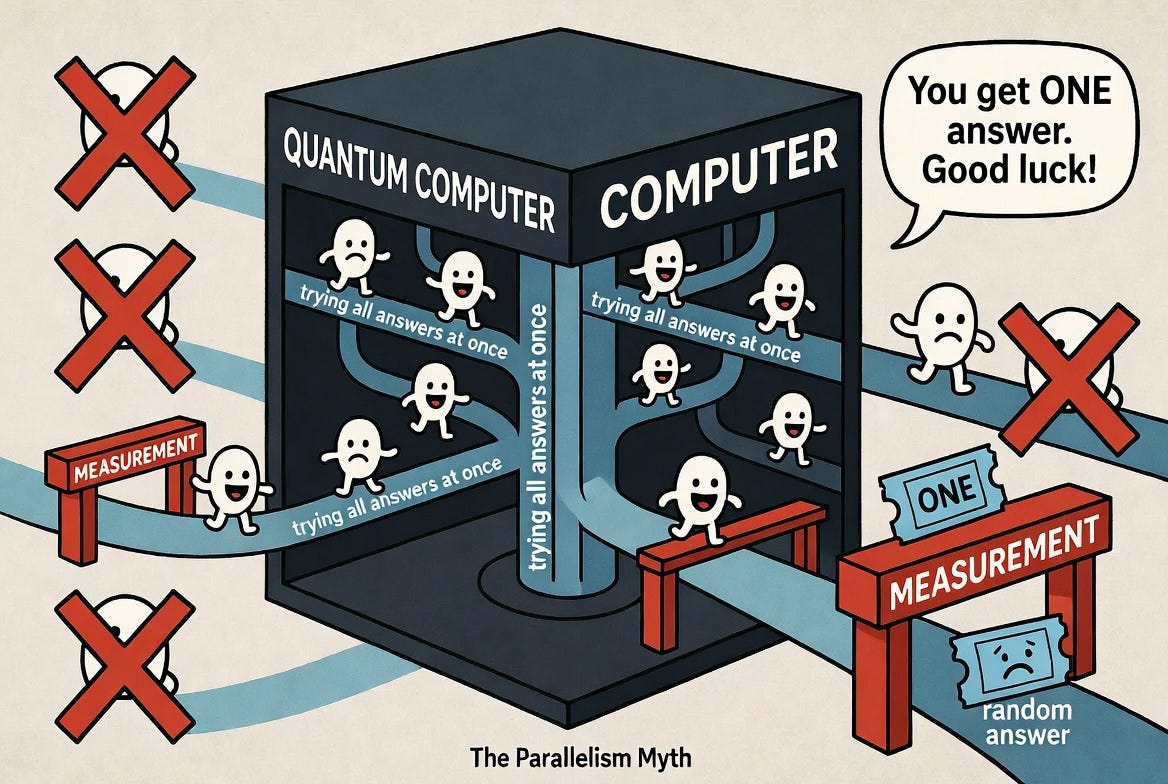
Ask anyone to explain why quantum computers are fast and you will get the same answer. A classical bit is 0 or 1, but a qubit can be both at once, so a quantum computer “tries all the answers in parallel.” Three hundred qubits, 2^300 basis-state amplitudes, more numbers than atoms in the universe, checkmate.
This explanation appears in TED talks, in investor decks, in the mouths of CEOs announcing quantum initiatives, and — I regret to report — in the writing of people with physics PhDs who should know better. It is wrong. Not simplified-but-basically-right wrong. Wrong wrong. And its wrongness is not a pedantic footnote. It is the door to everything actually interesting about quantum computing, including the one application that I think is genuinely, permanently fascinating — which, in a twist nobody in the press releases mentions, is a form of analog computing. The technology we spent seventy years triumphantly abandoning.
One more promise before we start swinging. The mathematics beneath nearly everything in this post — the light that steers these machines, the noise that kills them, the channels their information survives through — leads back to one man, my thesis advisor, whom you have almost certainly never heard of. Hold that thought. We will get to him.
Getting there takes some demolition first. Bring a hard hat.
Here is the problem with “tries all the answers at once”: at the end of the computation, you don’t get all the answers. You get one. Measurement returns a single classical outcome, drawn according to probabilities you may have done nothing to shape. If your algorithm genuinely just “tried everything in parallel,” measurement would hand you a random wrong answer with overwhelming probability, and your 2^300 amplitudes would be worth exactly one lottery ticket.
The entire art of quantum algorithm design — the actual content of Shor’s algorithm, the reason it took a genius to find it — is choreographing interference. Amplitudes, unlike probabilities, carry phase: they can be negative, they can be complex, and above all they can cancel. In the canonical algorithms, the computation is arranged so that paths leading to wrong answers interfere destructively and annihilate, while the structure you care about survives into the final probability distribution. When it works, the measurement at the end is no longer a lottery; the right answer has been made overwhelmingly likely before you look. The parallelism is real, but it is useless without the choreography, and the choreography only exists for problems with a very particular kind of structure. Hold that thought too; it is the hinge of this entire post.
So even in the completely orthodox account, measurement is not an afterthought. It is the toll booth every quantum computation must pass through, and the toll is steep: of your exponentially many amplitudes, you get to keep one classical outcome per run.
Now the second demolition. You will often hear — I have said loose versions of it myself — that a quantum computer “isn’t a general-purpose computer.” Stated that baldly, it is false, and the way in which it is false is more damning than the falsehood.
A universal quantum computer can simulate ordinary classical computation — the Toffoli gate hands you reversible classical logic, and in complexity language, P sits comfortably inside BQP. Anything your laptop can compute, a quantum computer can compute. A sufficiently large one could, in principle, run Excel.
It would do so at spectacular overhead, at millikelvin temperatures, inside a chandelier of dilution-refrigerator plumbing that costs more than your house, with zero speedup of any kind. That is the real point. The quantum computer is not forbidden from general-purpose computation. It is merely pointless at it. It is not a better computer. It is a coprocessor — an accelerator card for a narrow class of problems — and the honest public case is dominated by three motifs:
One: problems with hidden periodic structure. This is Shor’s algorithm and its relatives — factoring, discrete logarithms, the hidden-subgroup family. Here the speedup is genuinely exponential (over the best known classical algorithms; nobody has proven factoring is classically hard, a caveat the press releases also omit). This is the motif that gets essentially all the funding attention, so let’s look at the economics. A prominent 2025 surface-code estimate put the resources for factoring a 2048-bit RSA key below one million noisy physical qubits running for under a week; newer proposals using different error-correcting codes claim lower counts still. The numbers move quickly. The invariant does not: cryptographically relevant factoring demands sustained fault-tolerant computation far beyond anything yet demonstrated. And — here is the punchline — the world is not waiting. NIST has standardized post-quantum algorithms and the migration is underway right now, precisely because everyone can read the same papers. It will be uneven and slow — legacy systems have the survival instincts of cockroaches — and “store now, decrypt later” is a genuine problem not just for intelligence agencies but for anyone holding data whose confidentiality must outlive the decade: medical records, legal files, industrial secrets. But the headline stands: Shor’s algorithm is a billion-dollar key being cut for a lock the world is in the process of replacing.
Two: unstructured search. Grover’s algorithm searches N possibilities in roughly √N steps. Quadratic, not exponential. And a quadratic advantage is exactly the kind that gets eaten alive by constant factors: once you include fault-tolerance overhead and the cost of actually implementing the thing you’re searching, careful analyses find the quadratic advantage can disappear entirely on plausible early machines. The machine wins the asymptotic race and loses the actual one.
Three: simulating quantum systems. The subject of the rest of this post.
(Specialists will note that other algorithmic families exist — quantum walks, amplitude estimation, linear-system solvers, sampling schemes. Noted. None of them supplies a general-purpose accelerator, which is the claim on trial.)
Before moving on, notice the shape of what we’ve just walked through, because there is a conservation law hiding in it. My readers know the reflex by now: whenever someone offers you a free lunch, ask where the mass goes. The quantum speedup is not conjured from the vacuum. It is relocated. You get it exactly when the problem’s structure already matches the structure of quantum interference — when, in a sense, nature has pre-computed the hard part by being the kind of thing it is, and the algorithm merely arranges for you to read the answer off. Periodic structure matches the Fourier transform that quantum mechanics performs natively; so factoring accelerates. Generic problems have no such match; so generic problems don’t. The “power” of quantum computing was never a general-purpose power. It was always a resonance phenomenon. Which raises the obvious question: what problem resonates perfectly?
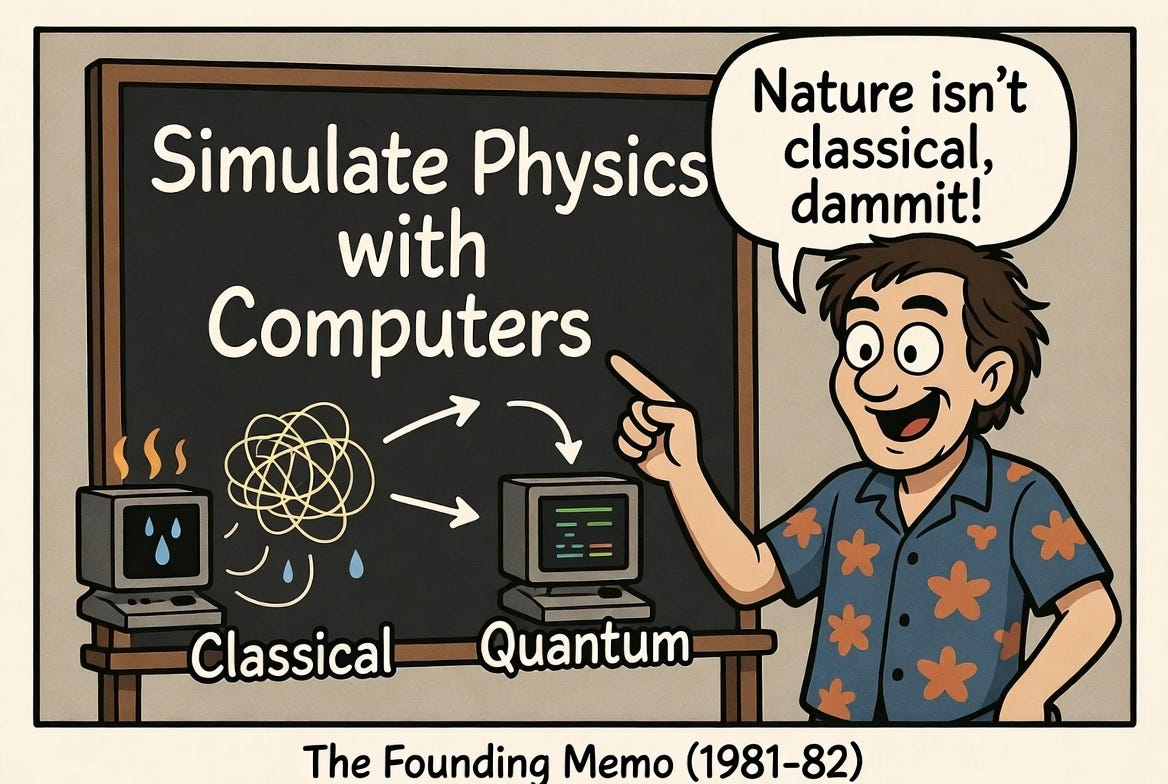
In May 1981, at a conference at MIT, Richard Feynman gave a keynote asking whether a classical computer could efficiently simulate physics. His answer was no — and everyone in the room already half-knew why. Write down a quantum system of n spins — n two-level systems — and the state you must track has 2^n amplitudes. Every additional spin doubles the bill. A dense state vector for 40 spins occupies roughly 16 terabytes; at 50, roughly 16 petabytes — and that is before you do anything to it. Not because engineers are lazy, but because 2^n is 2^n. Nature, Feynman observed, “isn’t classical, dammit” — and if you want to simulate nature, you had better build your simulator out of quantum mechanics itself. The talk was published in 1982 as Simulating Physics with Computers. Feynman was not entirely alone — Yuri Manin and Paul Benioff had already approached quantum computation from adjacent directions — but that lecture became the founding manifesto of quantum simulation, which is precisely the part of the field this post is about.
Read it today and the striking thing is what it does not contain. No factoring. No cryptography. No search, no optimization, no finance, no “quantum machine learning.” The founding memo proposes one central application: use a quantum system to simulate quantum systems. Everything else — four decades of it — has been a detour from the original purpose. A profitable detour, measured in venture funding. But a detour.
The one thing a quantum computer is unambiguously good at is being a quantum system. That sentence sounds like a tautology. It is actually a business plan, and the only honest one in the industry.
Here is where it gets genuinely beautiful, and where the story bends back on itself in a way I find delicious.
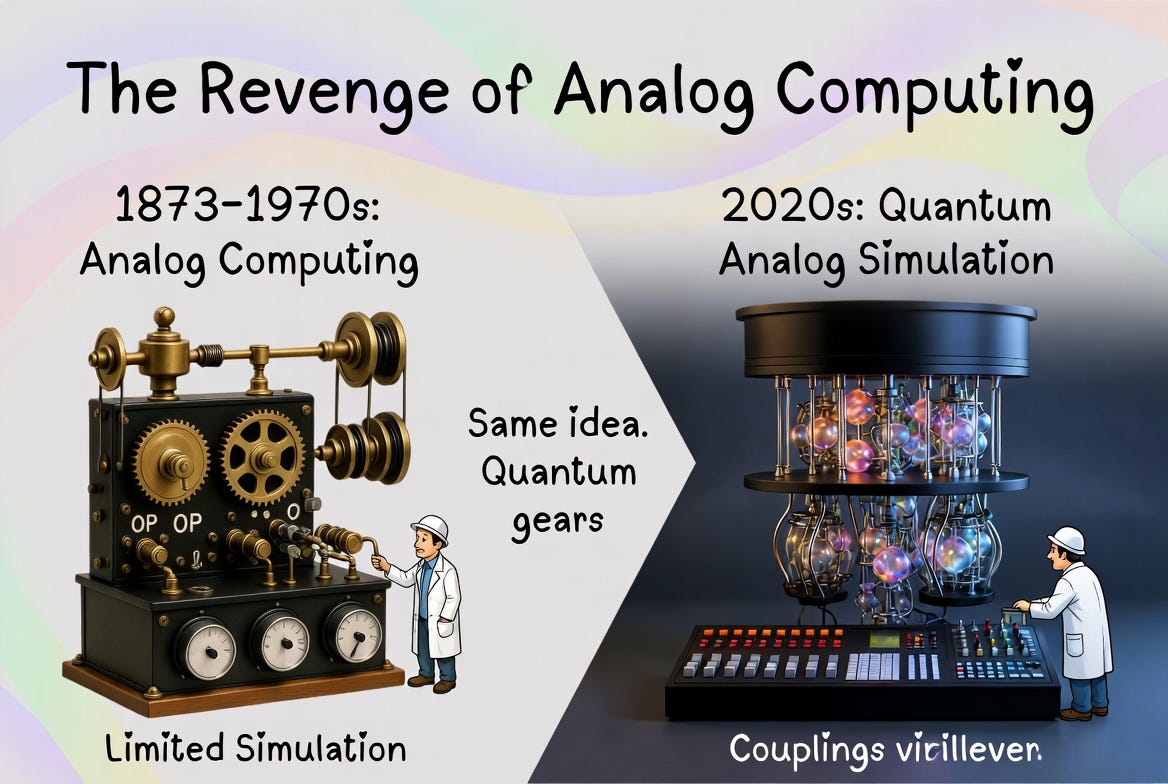
Before digital computers conquered the world, computing was analog. Lord Kelvin’s tide predictor computed tides with brass gears and pulleys because the gears’ motion obeyed the same equations as the tides. The Norden bombsight solved ballistics with cams and gyroscopes. Op-amp machines integrated differential equations as voltages, because a capacitor charging is an integral. The analog principle was always the same: don’t calculate the physics — build the physics, in a medium you can control, and read off the answer.
Digital killed analog for two reasons, and it is worth being precise about them. First, generality: a digital computer is one machine that runs every program, while an analog machine is married to its equations. Second — and this is the deeper one — error correction. Digital signals are discrete, so noise below threshold can be wiped clean at every step. Analog errors accumulate, drift, compound. Digital computing is the technology of keeping errors from breeding. It won so completely that “computer” now simply means “digital computer,” and analog machines sit in museums next to the slide rules.
Now watch what the most interesting corner of quantum computing is actually doing. (I mean analog here in the standard quantum-simulation sense: the computation proceeds through direct Hamiltonian evolution, not through a long sequence of fault-tolerant logical gates.)
Take an array of qubits — real physical systems: atoms, ions, superconducting circuits. Do not compile a program. Do not run gates. Instead, tune the couplings between them — the interaction strengths, the fields, the geometry — until the Hamiltonian of your array matches, term by term, the Hamiltonian of a system you care about. Then let it evolve. The array is not computing a description of the target system. Within its couplings, it is the target system — or, said with the lawyers present, it instantiates the same effective Hamiltonian, the same governing pattern of interactions, in a medium you can actually see and steer. Nature runs the program, at nature’s clock speed, in nature’s native instruction set. You have built Kelvin’s tide predictor out of atoms — with the one upgrade that matters: the gears are quantum mechanical. In the generic, highly entangled regimes where every known exact classical description pays the exponential state-space bill, the quantum device pays nothing extra merely to remain quantum. It was going to be quantum anyway.
This is not a thought experiment. It is a working research program with results:
At Harvard, arrays of hundreds of rubidium atoms held in optical tweezers, with couplings set by Rydberg interactions, have been programmed — in the analog sense, by arranging 219 atoms on the links of a kagome lattice — into a state showing the signatures of a quantum spin liquid, an exotic topological phase of matter that Philip Anderson conjectured in 1973 and that decades of classical numerics could characterize only partially. Cold atoms in optical lattices have realized the Fermi-Hubbard model — the model many condensed-matter physicists suspect holds the secret of cuprate superconductivity — as a literal physical object: an artificial crystal whose “electrons” are atoms you can photograph one by one, whose hopping and interaction parameters you can turn with a dial. Trapped-ion crystals have simulated quantum magnets with more than fifty spins, watching dynamical phase transitions no classical computer could track exactly.
Notice how these machines are being used. Not as universal computers running fault-tolerant gate sequences — even where the underlying platform could in principle support that — but as special-purpose simulators, each one married to a family of Hamiltonians, exactly as the tide predictor was married to tides. They have given up generality — the first thing digital computing won on — to get fidelity to a specific piece of physics. In this mode of operation they are analog computers in the full, honest, brass-gears sense of the term. The frontier of computing in 2026 is a technology from 1873 with the classical gears swapped out for entangled atoms, and almost nobody in the industry will say this sentence out loud, because “we have reinvented the analog computer” raises less capital than “we will break all encryption.”
I will say it out loud. It is the best thing in the entire field.
And now I get to do something I have wanted to do in these pages for a long time, which is talk about my thesis advisor.
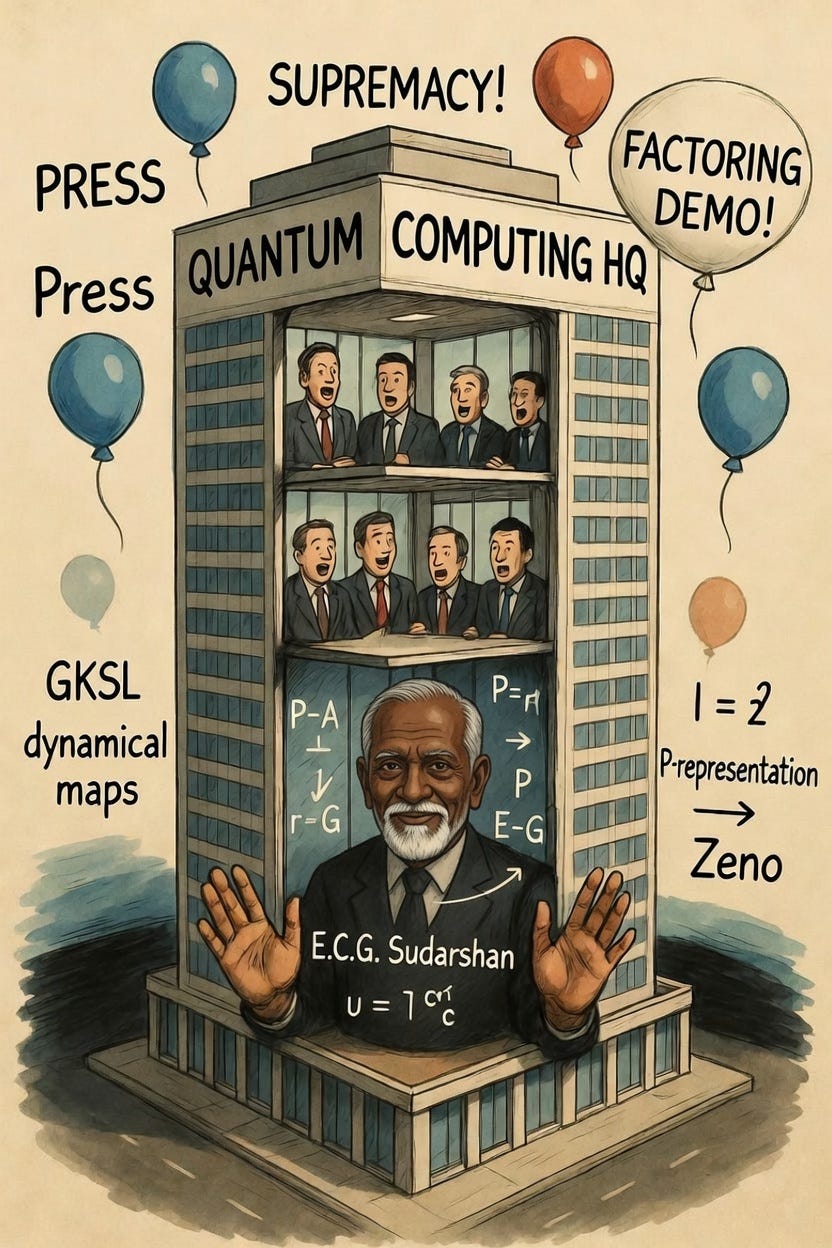
Nearly every load-bearing formalism in this post — the description of the light that steers these machines, the noise that kills them, the channels their information survives through, even some of the tricks for keeping qubits alive — runs on mathematics written by a man most readers have never heard of: E. C. G. Sudarshan, of the University of Texas at Austin, where I did my PhD under him. George, to those who knew him. He died in 2018, and it is as if the field agreed to use his work forever while never mentioning his name. Consider the ledger:
In 1961, with Mathews and Rau, Sudarshan introduced the theory of dynamical maps — the mathematics of how quantum states transform when you don’t track everything they’re entangled with. Today these are called quantum channels, they are foundational objects of quantum information theory, and modern analyses of noise and information flow in quantum processors are routinely conducted in this language.
In 1963, he proved the optical equivalence theorem and introduced the diagonal coherent-state representation of light — the representation in which laser light, squeezed light, and the rest of the quantum states of the electromagnetic field are analyzed to this day. The 2005 Nobel Prize for the quantum theory of optical coherence went to Roy Glauber. The representation is called, when people are being careful, the Glauber-Sudarshan P-representation. People are not usually careful.
In 1976, with Gorini and Kossakowski, he derived the general equation of motion for open quantum systems — the master equation governing decoherence, which is to say: the equation that describes why qubits die. Lindblad published the infinite-dimensional version the same year, and the result is almost universally shortened to “the Lindblad equation”; the careful minority writes GKSL. Every quantum computing company on Earth is fighting, daily, at enormous expense, against a differential equation with Sudarshan’s name correctly on it and colloquially sanded off it.
In 1977, with Misra, he predicted the quantum Zeno effect — a watched quantum pot never boils — since demonstrated experimentally and turned into a working technique for suppressing errors in quantum processors.
Add the part physicists half-know: in 1957, Sudarshan — then a graduate student — and Marshak worked out the V-A structure of the weak interaction. The preprints appeared the same day, September 16, 1957: Feynman and Gell-Mann’s went to Physical Review and ran on New Year’s Day 1958; Sudarshan and Marshak’s was read at a conference in Padua and buried alive in the proceedings. And here is the part that makes the story genuinely strange rather than merely unjust. Feynman — a man constitutionally incapable of claiming credit that wasn’t his — said it explicitly, on the record, in 1963: the theory was “invented by Marshak and Sudarshan, published by Feynman and Gell-Mann” and completed by Cabibbo. Read that again. The most famous physicist alive stood up and said the other guys got there first. The field’s response? Crickets. Not a correction, not a reappraisal, not a prize. The textbooks kept the attribution they had, and the man Feynman pointed at went on being a footnote in the story of a force of nature he got to first — by Feynman’s account, not mine. (And we haven’t even discussed tachyons: the relativistically covariant framework for hypothetical faster-than-light particles is Bilaniuk, Deshpande, and Sudarshan, 1962 — worked out five years before the word “tachyon” existed. Response from the field: also crickets.)
One man. The weak force, the quantum theory of light, quantum channels, the equation of decoherence, the Zeno effect, and, for good measure, tachyons. The persistent rumor is that he holds the dubious distinction of having been nominated for the Nobel Prize more times than anyone who never won it. The nomination archives are sealed for fifty years, so I cannot prove the count. What I can tell you is firsthand. Steven Weinberg — my other advisor, whose office sat perhaps fifty feet down the hall from George’s, and who by universal agreement did not get along with him — confirmed the essence of it to me in person, in not so many words, when he told me that he backed George every single time. Fifty feet of hallway, decades of frost, and a vote cast for the man at the other end of it, every time. That is what it looks like when the work is undeniable and only the crediting mechanism is broken.
I am not telling you this only because he was my advisor and I loved the man, though he was and I did. I am telling you because Sudarshan’s ledger is this field in miniature: the durable substance is unglamorous, sits in the foundations, and the credit flows elsewhere. The press releases go to factoring demos and “supremacy” announcements. The load-bearing structure — the master equations, the channel formalism, the coherent states, the tuned Hamiltonians quietly impersonating unsolvable materials — is where the actual future is, and it is precisely the part nobody’s PR department mentions.
Fair is fair; I’ve audited everyone else’s claims, so here is the hostile audit of mine.
Today’s analog simulators are not fault-tolerant. The thing that killed classical analog computing has not been repealed. Analog quantum simulators have no fault tolerance; their errors drift and accumulate exactly as op-amp errors did. Their defenders argue, plausibly, that for many-body physics you don’t need every amplitude exact — you need phases, transitions, qualitative structure, which are robust to modest noise. Plausible. Not proven. And here is the real epistemic problem: in the classically hard regime — the only regime that justifies building the machine — no general, efficient classical procedure exists to certify every detail of the answer. There are partial courts of appeal: limiting cases that classical methods can check, conserved quantities, agreement between independent platforms. None is universal. It is entirely possible that noise quietly corrupts the fine structure of exactly the phase diagrams we most want, precisely where no referee can look. That should bother you. It bothers me.
The classical frontier keeps moving. Many headline claims of quantum advantage have acquired a shorter shelf life than their publicity suggested. The canonical recent example: in June 2023, IBM reported a 127-qubit experiment in Nature as evidence that noisy quantum processors might already be useful in regimes where leading classical methods struggled — a circumspect claim, whatever the coverage implied. Even so, classical physicists using tensor-network methods rapidly reproduced or surpassed the results — some of them on a laptop. This keeps happening because classical simulation is not a fixed target: tensor networks exploit the fact that low-entanglement states compress beautifully, and clever people keep extending how much entanglement “low” can mean. Nor is the analog side exempt: even the Harvard spin-liquid result drew classical follow-ups — tensor-network calculations accurately tracked the state-preparation dynamics, and theorists continue to debate how much genuine long-range topological order the experiment established versus local patches of it. The result stands as a landmark. It does not stand as untouchable. The honest form of the quantum claim is asymptotic: classical cost grows exponentially in entanglement, so quantum simulators must win eventually, somewhere. Every finite, dated, specific claim of victory should be written in pencil.
In one representative episode, a team at the Technical University of Denmark, using a printer-sized photonic processor from the startup Orca Computing, reported that a quantum-enhanced generative model designed better protein-binding peptides than its classical counterpart — with the biggest gains exactly where training data was thin. The Orca device is a boson sampler: single photons threaded through nested fiber loops, interfering in time rather than across a wall of beam splitters, with room-temperature detectors reading off which time-bins the photons exit — a sample from a distribution that is genuinely hard to compute classically. (No dilution-refrigerator chandelier, which is precisely why it fits on a benchtop.) Drop that hard-to-mimic distribution into a data-starved generative model and you get a richer spread of candidate peptides. Interesting, and worth watching. And to their considerable credit, the researchers said the quiet part aloud: the machines are still so small that a larger classical model could likely do better today. Which means the contest was run against a size-matched classical control, not against the classical state of the art — a promissory note, not an advantage. A sampler injecting exotic diversity into a small model is precisely the kind of edge a cleverer classical prior may erase within a year, and boson-sampling advantage claims have been spoofed classically before. Write it in pencil. And note what it is not: it is not quantum simulation of a physical system. It is the sampling motif — Orca’s own literature calls these devices co-processors — pressed into service accelerating an AI model. A detour from the detour.
And there is a wildcard under the whole table. Stephen Wolfram — cited by name, as usual; the man is right about too many things for the establishment’s comfort — has proposed that quantum mechanics is itself the emergent description of a deeper multiway computation, and in that picture a definite observation is not a free primitive. The observer must do computational work to knit branches into an outcome — in effect, to outcompute the system itself. When his group “compiled” quantum factoring into their models, the measurement stage demanded a pile of additional multiway events — an explicit cost of measurement — and how that cost scales is a question they have not answered. Precision here is friendlier to Wolfram than hype: this is not a hidden defect in Shor’s theorem, which includes measurement and stands firmly within standard quantum mechanics. It is a test that Wolfram’s deeper framework must pass — can it recover the standard speedup without smuggling an exponential bill into the observer? — and the test is unresolved. (It is also a different objection from Gil Kalai’s better-known noise skepticism: Kalai says the machine can’t be built; Wolfram asks whether, even built, the accounting closes.) But note who would be left standing if the answer ever came back negative. Not the grand interference machines, which lean their entire weight on the contested step — but the analog impersonators, which ask their measurements only for ordinary, robust physical quantities: correlations, densities, order parameters, sampled over many runs rather than decoded from one choreographed global answer. Make of that alignment what you will.
What would change my mind? A fault-tolerant digital quantum computer solving a classically-verified-intractable problem end to end, measurement included, with the full error-correction overhead on the books. I will cheerfully eat this post. I am not planning the menu.
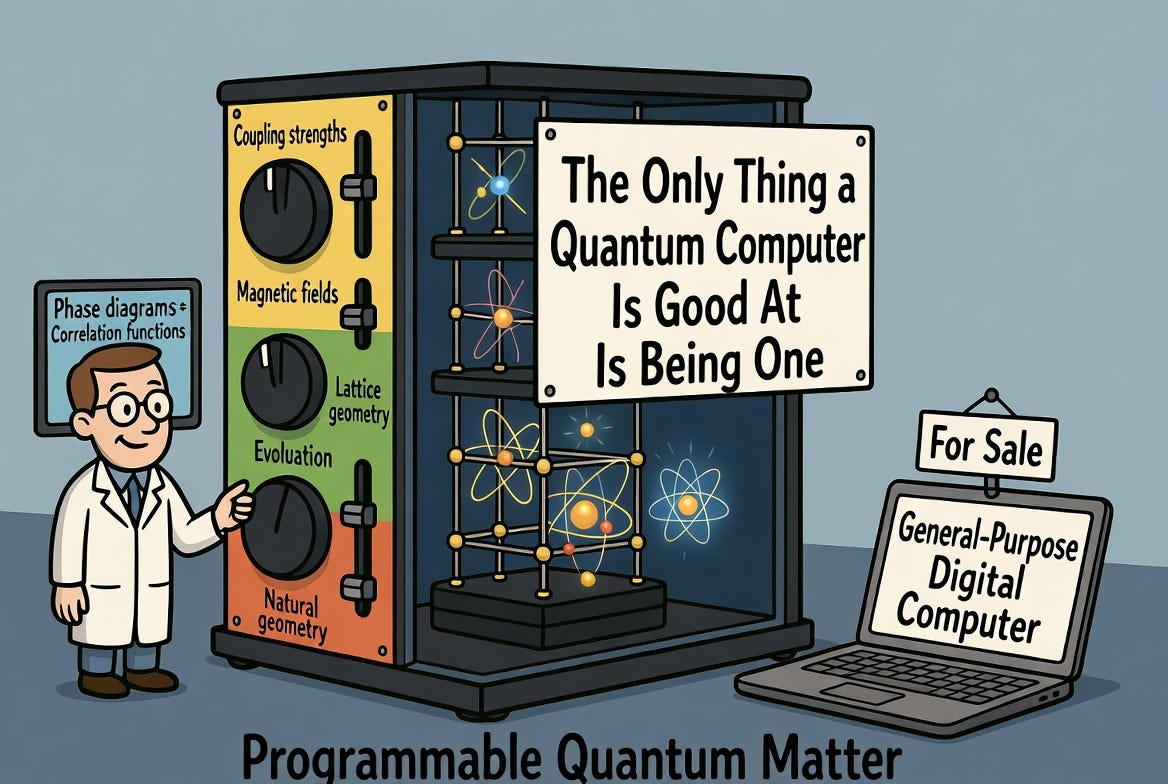
So: ignore the factoring countdowns. Ignore “quantum advantage” announcements that get reproduced on a laptop by August. Watch, instead, for three things. Watch for an analog simulator mapping the phase diagram of the two-dimensional Fermi-Hubbard model in the regime classical numerics cannot reach — because somewhere in that phase diagram, many condensed-matter physicists suspect, lies the mechanism of cuprate high-temperature superconductivity, and a civilization that finally understands the mechanism gets to go shopping for better ones. Watch for spin-liquid and topological-matter results that hold up when the classical spoilers come hunting. And watch for whether the field’s money and language quietly rotate from “quantum computer” to “programmable quantum matter” — because that rotation, when it comes, will be the industry admitting what Feynman told everyone in 1981, what the brass gears knew in 1873, and what this post has been arguing all along.
The quantum computer was never a better computer. It is a piece of nature you can tune — the universe’s own instruction set, exposed through a control panel. That is not a lesser thing than a computer. It is arguably a greater one. It just isn’t the thing on the pitch deck.
If you enjoy watching cherished stories audited down to the studs, my book, The Science of Free Will, asks an equally uncomfortable question about an equally cherished story.
More physics? This post’s cousins live in the Physics series. For markets, see Trading. New here? Start with The Paradox of India and the full India series — and for related country-specific work, there’s Albion, Britain’s institutional decline, first spotted in 1979.
No posts
Comments
Nothing yet. Say the first thing.
Sign in to join the conversation.