
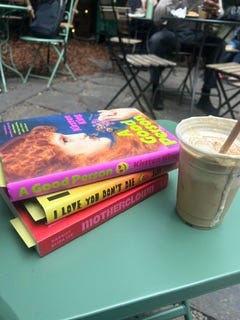
I was forcing myself to write when I really didn’t feel like I wanted to. That was in May-ish. I had so many brightly colored book covers and blurbs starred on Goodreads and saved in a low-effort Note on my phone called “summer tbr.” I felt like these titles were calling out to me with a siren song far more appealing than my empty word document, and so I followed them into their three-hundred-or-so dense pages full of words that were not my own. Later, I will get into why I didn’t feel much like writing.
*
I am picky about which books I will read next. I know myself very well and so when someone suggests a book to me and I say that I don’t think I’d like it, 99.99% of the time I am correct. I don’t pretend to be someone I am not, and so I don’t pretend to enjoy things I hate. Thus, my “summer tbr” was perfectly curated for my own tastes, selected from a long list of novels that were either critically or commercially acclaimed and are all fictional with the exception of two memoirs and a non-fiction book on the commodification of girlhood that I found in the bookstore but have yet to read. Some of them were neither. From a shelf at Type or Flying Books their blurbs just spoke to me, the way authors had always intended their works to speak to others, I suppose, and so I grabbed them.
I started my summer of reading with Caro Claire Burke’s Yesteryear and Belle Burden’s Strangers. I wanted to see what all the fuss was about, but I have also been following Caro on TikTok for years, and knew she was an exceptional writer. Neither of them really spoke to me emotionally, but from a writing perspective, I admired the cinematic and fast-paced nature of Yesteryear, and thought it was fitting that it was going to be adapted into a movie. I think these two novels served as the perfect launchpad for my descent into summer reading. They are escapist, and at times overly-indulgent, predecessors of what would come next: I wanted to be far removed from reality. I wanted to feel otherworldly, the way one does in New York City or on an isolated farm.
*
One sub-genre I particularly enjoyed centered around girlhood, and more specifically, female friendships. Strange Girls and I Love You Don’t Die both dealt with estranged friends who ebb and flow in and out of one another’s lives but ultimately leave a profound impact on the other person, maybe more so than any other person on the planet. In their complexity, they manage to be so many things at once: loving, vengeful, cruel, jealous, warm, eccentric, confusing. I am at an age where the very nature of friendship changes at lightning speed and there is no way to cement someone’s presence in your life. Friendship break-ups can be jarring, messy, and occasionally necessary. I saw myself in both characters, deeply embedded within these dynamics. I was the friend who disappointed people and the friend who wished others would do better. I was the friend who retreated into myself and the one who overextended myself when it wasn’t always mutual. These dichotomies put my brain to work. With every cringeworthy, tense exchange on the page, I thought of all the tenseness that followed me around in real life. When the friends held one another or cried, I thought of all the times I cried to people. I felt hot and embarrassed but then plain and human. Like my experiences were not all that special, or maybe they were, but that they would ultimately be most special to me. You can’t control the things other people value and remember. So, not everything has to be wholly reciprocal in order for it to have meant something. Not everything has to stay the same in order for us to feel like we’ve done our part in contributing to someone else’s life.
*
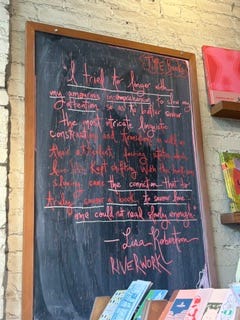
On the front cover of I Love You Don’t Die, Stacey Yu promises that it will “make you want to call your best friend.” I didn’t call mine, but I texted her maybe five or so pages from the novel that resonated so deeply with our friendship. Just that morning, we had been talking about how the actions of others make little sense to us. We deduced that it was partially because of the full moon and partially because you don’t need to understand everyone, and it is very likely that you won’t. But at least we understand one another, we both agreed. It was very productive for my literary analysis.
*
Another sub-genre I enjoyed was the long and winding - and sometimes multigenerational - family saga. This began with The Correspondent, a novel that I think I’ll never forget, even when I’m old and gray; in fact, I may recall it even more strongly, then, fully grasp its relevance to my life. The Correspondent had me trying to recall the last time I had hand-written a letter to someone that was not a birthday card (a few months ago? A year ago?) It had me smiling at strangers. Befriending them. Holding the door open for people and asking them about their days. What the novel did was open my eyes to the mundane. We pass so many people on a daily basis and never think about their interiority or loneliness. If we do, it’s a passing thought that we don’t sit with for a long time, lest it discomfort us. But when you actually take notice of these people, their humanity, you have no idea what kind of impact you can have on one another’s lives. Whistler, a book I will discuss in more detail, put this sentiment perfectly:
“There is so much randomness to youth. The person assigned to share your room becomes your friend, the girl you pass on your way out the door becomes your wife, and from these random encounters our entire lives are built.”
I had more encounters of my own with more families that touched me deeply. Maggie O’Farrell’s Land told a gripping, multi-generational story of an Irish family surviving right after The Great Famine. While each family member went on their individual journey of travel, growth, suffering, and maturity, the most formidable character in the novel was the land itself. In this novel, land is paramount. There is no way to live or die without paying tribute to the land or having the land shape you in some way. I attended a book club meeting in Toronto where we were asked about our own family’s journeys throughout history. The personal reflection was surprising; I wasn’t expecting to leave this meeting having thought about myself. But I thought about myself more than perhaps any singular character in the novel. How exactly had my landscape influenced my personhood? I could think of some obvious answers and some not-so-obvious ones. But to confront land meant confronting all of its historical and political ties: colonialism and climate change, to name a few. Thus, what we see as fictional becomes concrete, and what we see as past has persisted in the present. There is no way to divorce a person from the land they reside on, and the land is shaped by each of our existences. I was more mindful about everything related to my location that week, even with how I used Google Maps.
Like The Correspondent, Whistler is a meditation on both blood and chosen family. This was my long-awaited introduction to Ann Patchett, and she did not disappoint. My favorite thing about reading is being confronted by stories so wildly different from my own. My perception of family as a child and maybe well into adulthood revolved around a nuclear one. Upon growing up, I learned that life’s events and complexities often challenge this structure, and that it’s less integral to culture and society than I had thought. Friends became my family. Women became like sisters to me. My own family grew and added members whose presence re-shaped my entire comprehension of childhood.
Eddie, in many ways, is like a father to Daphne; in other ways, he is her best friend. But his absence from her life for forty years is resolved with the kind of seamlessness that you could only owe a soulmate. The novel is aptly named for a horse whose connection with its owner is a metaphor for the power of love and the impermanence of life. So there is an additional layer to this story; animals can take the place of humans in our brushes with human instincts. Eddie and Daphne reconnecting at the Met symbolizes the persistence of human moments even when our physical forms have melted away. A painting captures life in its immortal form, frozen by time. Their relationship was frozen in time, too, but it never died. I found similar themes to be prominent in Catherine Dang’s horror novel, What Hunger. Through the metaphor of cannibalism, there is an interconnection between the past generations of her family and her present, and their shared grief and trauma regarding the loss of both individuals and their collective identity.
*
As much as I found parallels between myself and these characters, I was also intrigued by our many differences. I admire how characters in books live fluidly, without expectations. The reader has no predisposition as to how their lives will turn out. It lessens the load of their existence. You can walk in the park all day, eat a bag of fruit and then two croissants, make a friend at a stop light, see someone from your long-lost past, catapult them into your present. No one is truly waiting for anything from you. You expect little from yourself. What are the stakes? It’s hard to say when you’re resting at the Met in front of a painting of horses. And as you do all these things, the reader often nods along, yes, yes, because the reader often does not know the character better than the character knows themselves.
*
So, why did I want to take a break from writing?
Like most writers, much of my work is rooted in my own rumination, reflection, and experiences. The woman on the bus becomes the protagonist of my story; a long-lost person becomes the antagonist. While I knew I could physically write about them, I knew that my perspective on the human condition needed to be refreshed. My writing voice is one that I can’t change, even if I would persistently try to; it is as much of a part of myself as my fingernails or calves. And the thing is, I don’t want it to change. I love how singular I am. I love that only I could write the things I write, because only I could have seen that thing that way.
But the thing about voices is that at times, you need to listen to ones that are not your own. I needed the diversity of these stories to remind me of why I am a writer. I am not just a writer because I have something to say. I am a writer because I want to comment on so much at once. I want to reshape the world. And the only way to do so is to consistently challenge yourself to step outside of the boxes of comfort we create, even unknowingly. When I was enveloped by the silence of the pages in front of me, what did I hear? When I was brought to distress by a written thought that put to paper something I never wanted to admit about myself, how did that make me feel? I wanted to be challenged as both a writer and a thinker. Art is uncomfortable. Art makes you look at yourself through new eyes. It introduces you to perspectives that are different from your own and may even be contrarian. But I believe that these experiences are key to understanding humanity. I feel the same about the real world. Talk to a stranger. Talk to someone you can’t stand. What can you learn from someone whose perception is so opposite?
I think to an extent that people today are uncomfortable with discomfort. It is so much easier to rely on our previous notions and to operate within our own limited worldview. The world is already difficult enough, so why make things even worse? It can be quite comforting to lean into our biases, especially as we grow older and our minds can sometimes grow more resistant to change and more passionate about self-preservation. But good writing is not concerned with preserving the self; it is interested in taking a microscope to it and understanding its existence, even on a molecular level.
*
I learned a lot about what good writing is and what it is not. Good writing can be pretentious in language but never in personality. Good writing always seeks to learn and understand and be understood. Good writing reorders words and replaces them and crosses them out because it has no allegiance to any specific method. There is no emotional bond between the author and their words. Good writing cares about the integrity of the story more than the integrity of the author, and no specific word is personal to them, because they know better than to think a single word could make or break their bigger vision. Good writing can create an ocean out of a dam or out of the smallest trickle of water. It can be about something as large as the land or, in the case of The Passion According to GH, as miniscule as a cockroach. It is not so much about what is told as much as it is about how it’s told, and something meaningful to you can begin to look meaningful to others.
*
I have some books left on my “summer tbr.” Stacey Yu’s Kitten, Kirsten King’s A Good Person, Hafsa Lodi’s Turbulence, to name a few. I treat my books like a person on the subway I am curious about and would love to get the chance to understand. A good book is a random encounter on which our lives are built, if only we are courageous enough to turn its pages.
No posts
Comments
Nothing yet. Say the first thing.
Sign in to join the conversation.