
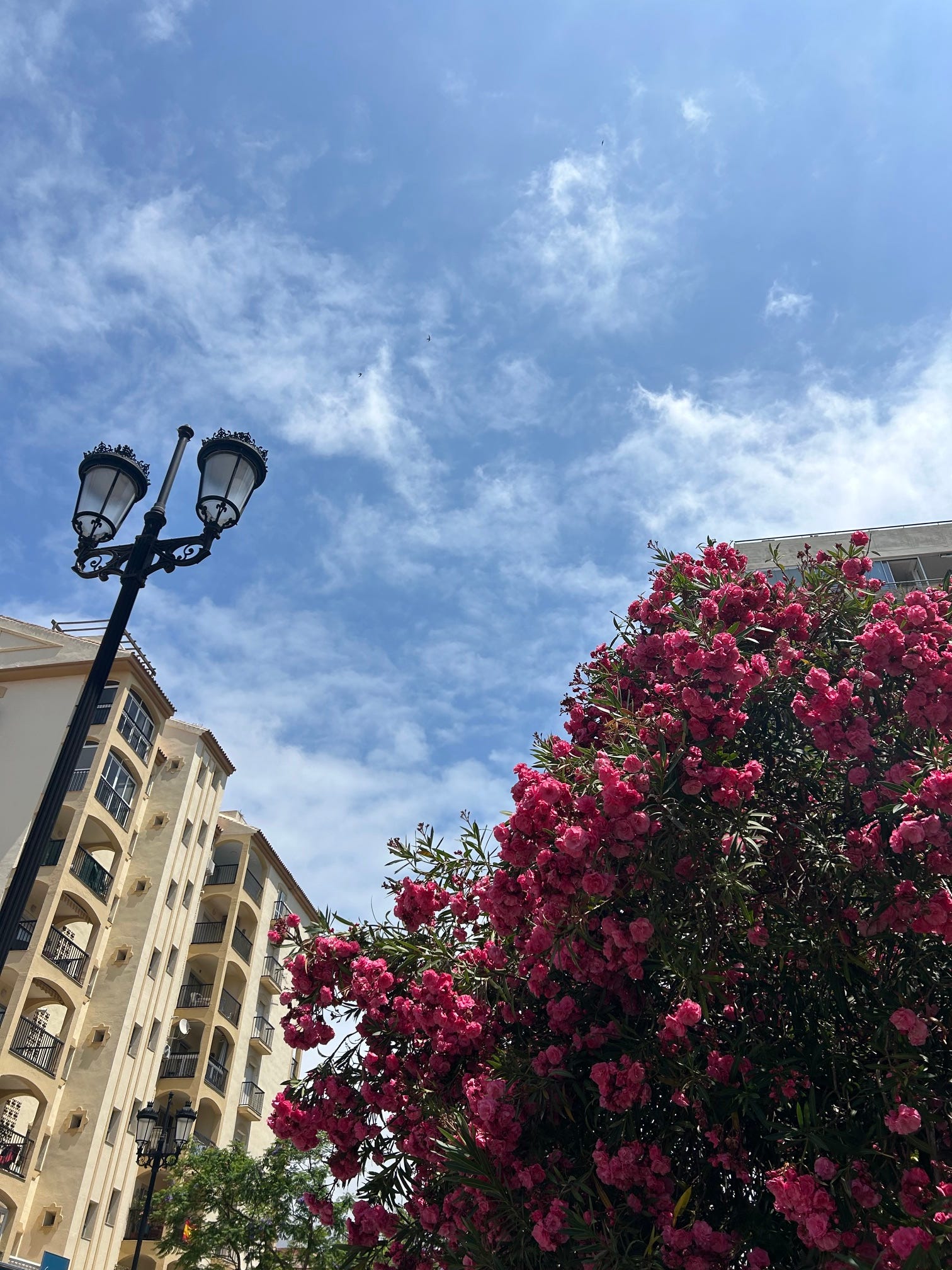
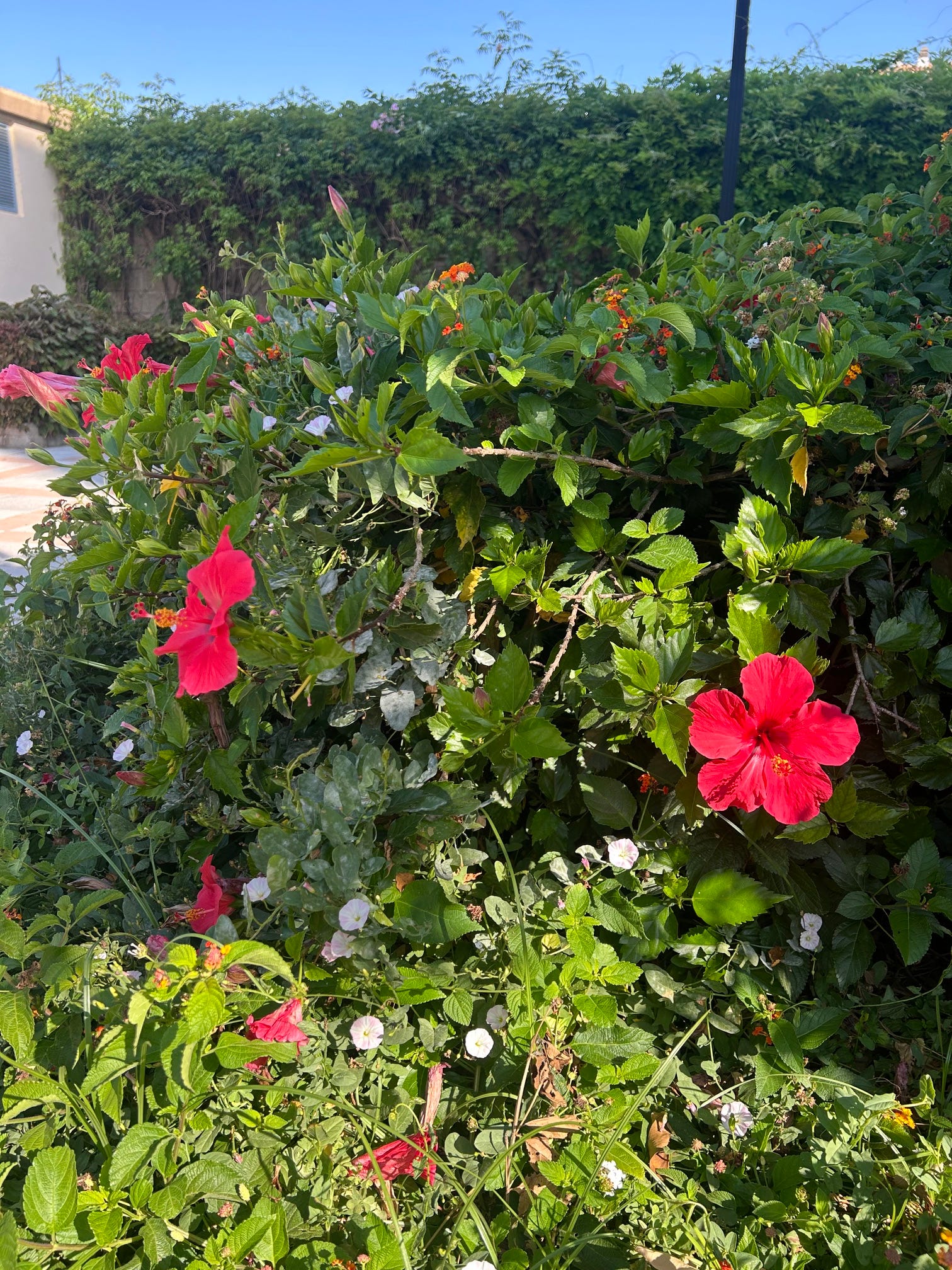
I am in Spain as I type this. It’s much sunnier than I anticipated June to be - the kind of heat mostly reserved for July. Still, I am able to be outside for most of the day, and while I am out in the world, I notice all the things I didn’t have time for: the flowers and the bees and butterflies that surround them, street signs with interesting slogans I often have to translate, and people going about their lives in the same state of limbo I’m in (possibly. Imagining their thoughts is what makes people-watching fun).
It’s the perfect place to reflect on the past and submerge myself in stories - either the ones I write or the ones I read. Sometimes, these two things intertwine in the most interesting of ways. I read something that reminds me of something I experienced, or I go through something in the future that calls me back to something I read. Writing, just like songs or movies, can be the emotional anchors we use to cement ourselves in a storm. You can be going through hell and remember Esther Greenwood and how she went through hell, too, and the ending of The Bell Jar is bittersweet although Sylvia Plath’s life was not, and then you can feel okay-ish again.
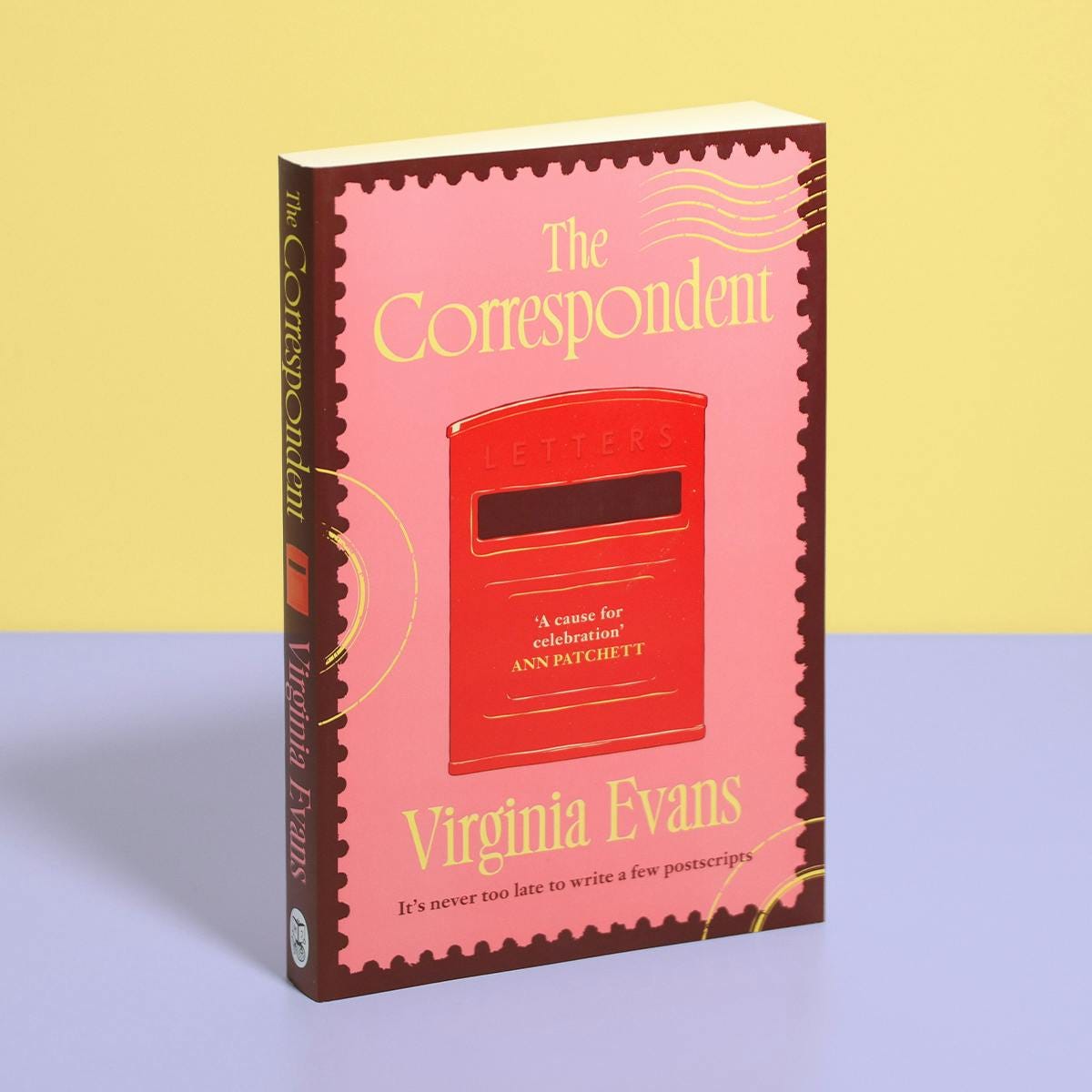
One of the most recent novels I read was The Correspondent. I purchased the e-book on a whim when I was looking for something to read and remembered it was a NYT Bestseller. Needless to say, I can see why; I highlighted about half the book, the lines were so moving and memorable. Anyway, it’s about an older woman named Sybil Van Antwerp who lives alone and communicates primarily through sending letters, with the exception of a rare email. There are so many people she writes to, and the story is told through these letters alone: her daughter, her brother, the Syrian customer service agent at the DNA testing company, her neighbor, the young son of a friend of hers. These people weave in and out of her life for a myriad of reasons, but when they come back, it is evident that Sybil often wrote to them even when they didn’t respond.
This is one of those novels that truly made me think about everything. About myself, my past, my future, my writing, the people I love, the things that bring me joy. Sybil loves to write but is slowly losing her eyesight. It is something I never even thought of, always took for granted. I didn’t even realize what people went through when they lost their capacity for their passions. The very concept was unfathomable and uncomfortable and disturbing. Like being without my skin or heart.
Furthermore, even when connections end or leave her life, Sybil seems to extract a great amount of value from them. I’m going to try my best to avoid spoilers, but you can especially see this in her relationship with her ex-husband. He wrote in a letter to her:
“You still occupy a large space in me. I felt honored those years we were together that you entrusted me with your stones, and I still keep them. I want you to know that, even though that’s not what I’m writing for. I want you to know I keep your stones as safe as ever.”
I wouldn’t say it was unfounded to me, the closeness that can still linger long after you’ve said goodbye to a person. I was more shocked by the acceptance behind it. The sense of this is what it was. It won’t ever be anything else, it won’t ever work, and that’s okay. It was still beautiful.
This sense of maturity has been hard to come by, at least for me. Because of my people pleasing tendencies (which I am working on, don’t worry), I always want to fix things, even pre-emptively, before they’re broken. If things didn’t work out, my brain tells me that it must have been my fault. I have to clutch it to my chest so that it doesn’t try to go anywhere. Eventually, when it does, something inside of me can’t stand it. I long to mend the relationship, but for the wrong reasons. Because I think it would make me better or more whole. I would later learn that there is a right reason to keep someone in your life after your connection or friendship ends, but only with time and experience and plenty of mistakes.
I think we worry too much about the future, and that’s what puts this strain on things. We attach a lot of worth to people and our experiences with them, and it makes sense to do so; you’re investing in them in every way, and so when things end, you can feel like you wasted something. Time, energy, love. But what if we saw things differently? What if that love was given to a person, regardless of their outcome, who needed it, and who needed you? Even if you end up going your separate ways or never speaking again, it doesn’t make their time with you any less meaningful.
Something else I loved about Sybil was how much she valued connections even when they were still in her life, and the amount of care and attention she gave to people. She remembered everyone’s birthdays, what they were reading, and what was going on in their lives. She really made them feel seen. There is something to learn here, too. While we are connected to someone, it’s not so important whether or not it will work out in the future or not. Instead, we can spend that energy showing up as the version of ourselves that would make a positive impact on them. At the same time, you can make yourself proud by being considerate and kind. I tried to implement that this week. I asked my friends how they were, checked up on things they had in the works and mentioned before. I sometimes forget that you get what you give. If you pour your heart into someone else, they will pour theirs back into you.
I also believe that not every connection needs to end. Something I really admire about Sybil is when she admits she is wrong and apologizes and sometimes even begs for forgiveness. I’ve been guilty of living too deeply in my ego. I’ve allowed friendships to disappear from my life simply because I was too afraid to speak to the other person or apologize. Coincidentally, that was my goal for the month of May, and it led to me having very much-needed conversations with two people. It’s difficult to admit when you are wrong, but is it worth the price of someone leaving your life for good? Furthermore, even when people cause us hurt, it helps to remember that they are still a person. It’s their first time living, too. Even if they’re the ones who owe you the apology, there’s no need to walk around with hatred in your heart. You can forgive, gradually, and mend, or forgive and let go. In the end, holding onto darkness and negativity hurts you more than it hurts them.
Another reason we shouldn’t worry about the future? We have so much of it left (inshallah). Sybil wrote this to her sister-in-law/best friend:
“You are right about what you said - we are thirty in our hearts, before all the disappointment, all the ways it turned out to be so much more painful than we thought it would be, but then again, it has also been magic.”
I’m turning twenty-eight, and I had a panic attack the other day thinking about “how old” I’m getting. I imagined myself as a child, still in my pink polka dot dress and pink stockings and bowl haircut. That girl would not be able to believe it, and I still feel like that girl inside. As Sybil said to her daughter: “I know you think of me as your mother, but please remember, inside I am also just a girl.” But hearing Sybil write about how she feels thirty, that young age, made me remember that we have been conditioned by society to feel like we are constantly running out of time, and like we need to run and sprint to the finish line of a race we never remembered signing up for. But why? Sybil is seventy-eight, and she still does all the things she loves (and things I love, too - writing and reading). So why, then, do we feel like there must always be a perfect time for something? Why can’t we just appreciate things in the moment and trust that we will be led wherever we need to go?
I think back to her letter: “it has also been magic.” Yes, it all has been. Every disappointment, every moment of pain, every ounce of regret is the shadow of something we loved and hoped for, and how could that ever be ugly? It can’t be. It is too beautiful. Life holds a beauty that is beyond our comprehension, and if we took it for what it is instead of trying to turn it into something it’s not, we would learn to love it a bit more.
Lastly, meditating on all of this inspired me to write a poem:
and if three months pass
Text within this block will maintain its original spacing when published
without answer, then that will be as much of any as I could ever get.
and that they did. the cold bones of february were buried in a shallow grave and the rains of march
bore april flowers from their dirt.
I plucked one. I held it in my shaking hands.
and look! there it was, alive, as was I,
quivering in the wind, the childish bud
of a fresh stem.
I made it, too. I look around and I am alive, knee-deep in dirt.
was that so bad? a little dirt in my shoes,
a scrape on the knee?
did I ever doubt I’d hold my own against you?
but I have no reason for it. like the birds
that rest for a while on the headstone
that is you, I can take you as you are.
A brief respite. A memory that is so beautiful
or else I would have long forced myself to forget it.
and like that bird, I am not tied to here or there.
slowly, we lift ourselves, legs first.
slowly, we take off.
No posts
Comments
Nothing yet. Say the first thing.
Sign in to join the conversation.