
When I tried to make sense of the series of events in my life, what stuck was fate. It was easy for me, hopping from one worldview of Catholicism and God’s will to the one of a predestinarian universe where everything serves a purpose. Same thing, different looks, still a wolf in sheep’s clothes.
Fate is the predetermined unravelling of time and our lives, implying through its very definition that there is a plan to all of this, like God had a Notion page, a corporate flow chart of how things ought to turn out. It is often used interchangeably with destiny, though destiny has a personal quality, where our agency plays a role in how it comes about. Destiny is where we end up, more focused on choices, whereas fate is a complex design, an organization of things.
When confronted with the reality of life, which is that we only have so much control, and our animal brain, which is incredibly attracted to mastery, we wind up with the human proclivity to invent comfort. We say the unfolding of time and events is the result of a natural order chosen by someone with more (all??) information, one fixed to the fabric of existence. It helps us loosen up, regret less and frankly, become way more tolerable to our circumstances. There’s no point hitting a wall over and over again; the least we can do is find meaning for why we should let go.
We’ve gone so far as the invention of myth, where we built the Parcae in Roman mythology, Moirai in Greek, and Norns in Norse. Each of which uses thread spinning to represent fate; we think of time as linear and well-attached.
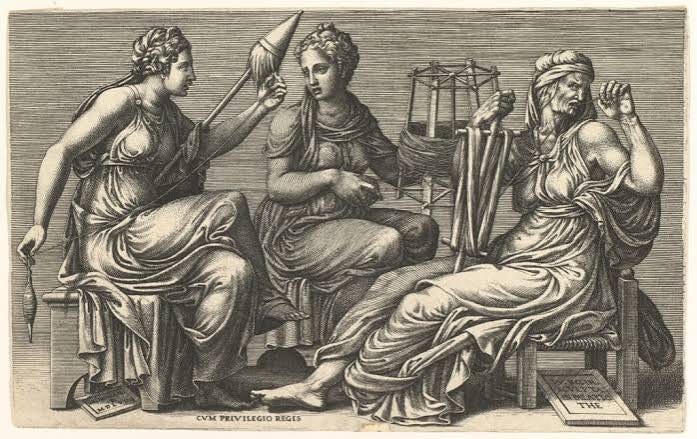
Fate is that out-of-control bit, the part where we wave the proverbial white flag and surrender. It’s the whole shebang, the beginning, middle and end that tell us we are here based on the will of the universe or aliveness or whatever force we decide. Destiny is that our choices brought us here, and somewhere on the depressing side is fate and the idea of fatalism: the ability to express human agency, but it means absolutely nothing. We can’t alter our fates. Bummer.
In the middle but more experientially neutral, we have Ming yun, the concept of destiny in Chinese folk religion. Ming means life or right. Yun means circumstance. There’s room for decision-making here, for influence.
Some thinkers say fate is bogus, but they say it politely enough and suggest that we see patterns and mistake them for predetermined outcomes. Carl Jung offers that what is fate to us is really just unconscious patterns becoming conductors to our lives. We wrongfully attribute a pattern of coincidences to luck or misfortune. Imagine getting stuck talking to this guy at a party.
But really, it is important to question fate as it has implications beyond its mirage. When we speak of fate, we give personhood to the universe, or at least we grant enough intelligence for it to plan. Whether it is your god or the cosmos, we have awarded what I call universal intent. There’s reasoning; decisions have been made. It is no longer random.
This might sound insignificant, but the concept of a foreordained universe is made important by the role of a prescribed happening; there is something fundamental about how our lives unfold that begins to hold purpose, and it is not ours to decide. It is the will of another, a conceptually thoughtful thing.
Comments
Nothing yet. Say the first thing.
Sign in to join the conversation.