
Stroll the leafy grounds of Washington International School, and you might think you’re on the campus of an idyllic New England college.
Housed on six wooded acres that were formerly a residential estate, it’s surrounded by walking paths, meadows, streams and a pond, all carefully maintained by the Tregaron Conservancy. A 58,000 square-foot science and design center looks like it belongs in Architectural Digest. There’s even a bucolic Dacha the site’s previous owner, Marjorie Merriweather Post, brought from Russia in 1945 to remind her of the time she and her ambassador husband were stationed there.
It is, in other words, about as far from a typical school setting as you can get.

So it was notable that when nearly two hundred educators converged on these grounds for a weeklong summer institute in early August, the majority of them came from the area’s public schools.
“This conference has been a slow build,” explained Liz Whisnant, a longtime principal in DCPS. “But there’s nothing like it in the city -- or any city. This week is a vision of what adult learning should look like everywhere.”
The institute is organized by an organization called WISIT -- the Washington International School Institute for Teachers -- and the slow build Whisnant referenced has been happening over the past thirteen years. It began when a group of DC-area educators attended a 2012 summer workshop at Project Zero, the Harvard-based research center, and felt that its insights into the nexus between the art of teaching and the science of learning required an ongoing exploration closer to home.
Whisnant was one of many people in the room who has aspired to make every meeting since. “I’m an O.G.,” said Dr. Elizabeth Dean, who heads up Learning Design at The Village School in nearby Arlington. “I wouldn’t miss this week for anything. It always feels like coming home.”
Hey educators out there -- how often has a weeklong professional development conference felt like “coming home” to you?
Yeah. Me neither.
And yet the spirit of the gathering was apparent from the outset, as teachers and school leaders traversed WIS’s myriad winding paths to find freshly brewed coffee, healthy breakfasts, and the unmistakable spirit of belonging.
“We are doing this work in a setting like this to try and reduce the gaps in privilege that exist, “explained WISIT’s director, Elise Stephenson, in her Monday morning remarks. “And we are doing this to make WISIT a place you can come back to year after year.”
After spending all week there, I can affirm that veterans like Whisnant and Dean have not merely drunk some conservancy-laced Kool Aid.
WISIT is special.
It is different.
And it does offer a recipe the rest of us can follow in our own efforts to create meaningful learning environments in every imaginable setting.
What is that recipe exactly? I’d suggest it boils down to five design principles -- and one creative tension.
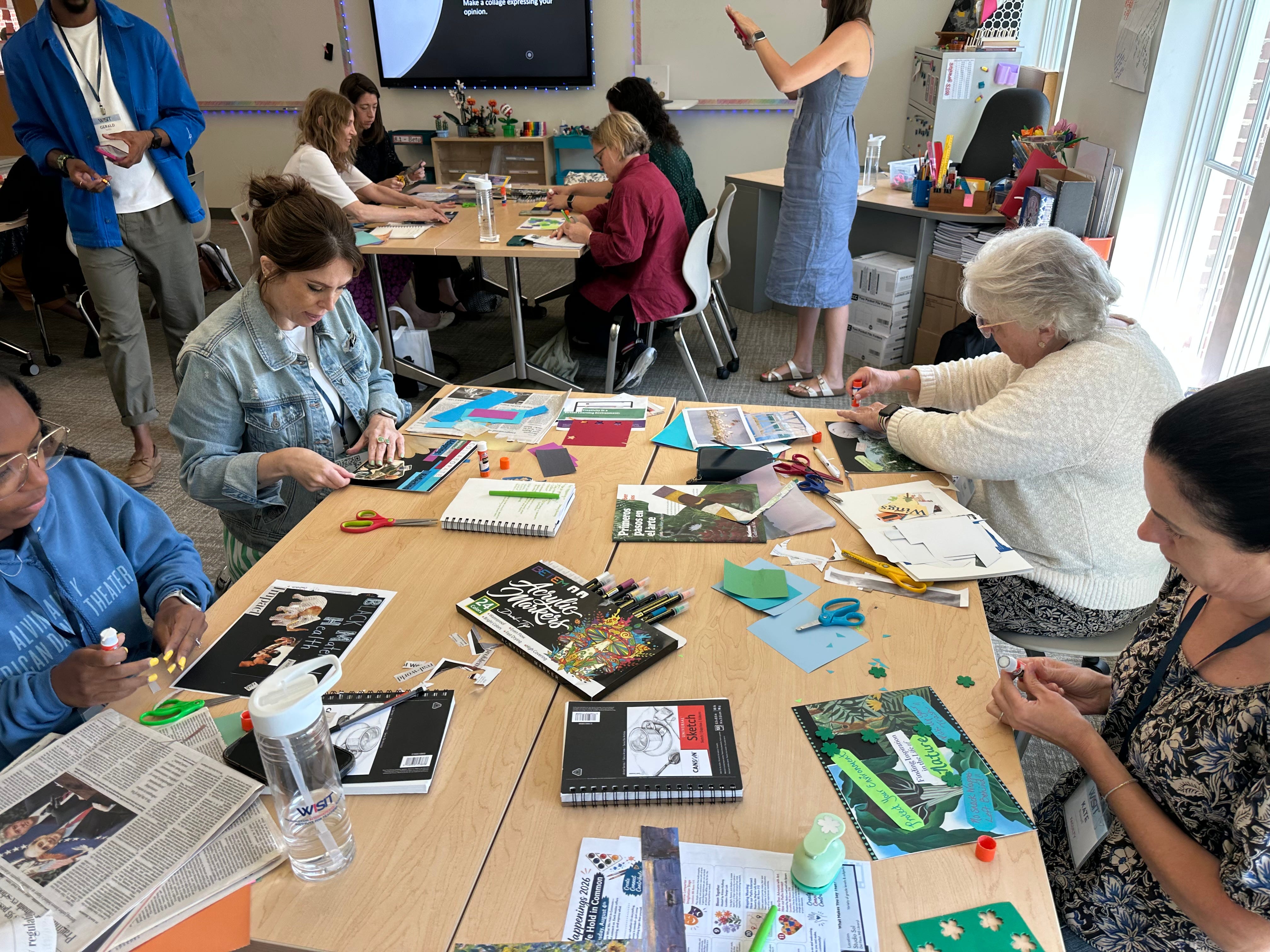
1. Integrating the Arts: WISIT’s ultimate purpose is to help educators better understand and apply the science of learning into their classrooms. So it’s notable that a vital part of that purpose is achieved via a strand of programming that invites them to make art in a variety of mediums: from water-color to drama to print-making.
That work reaches its pinnacle mid-week, when the entire institute shifts to the National Mall, and participants choose from a menu of Museum Day offerings. “Art is the visual history of the world,” explained Dr. Gerald Smith, the Smithsonian’s Lead Education Specialist for Youth Development Programs, and the coordinator for all arts-related programming for WISIT. “Each session is designed to offer a different creative pathway to reflect, make meaning, and express what binds us together.”
Consequently, these courses were not just playful respites from ‘the real work.’ They were ways of ensuring that each person’s creative spirit could arrive and find space to roam.
Every school, and every adult learning experience, should do the same.
2. Rinsing (& Repeating) The Right Components -- For the most part, every day at WISIT followed a similar structure. We’d begin with a morning plenary, introducing everyone to a different aspect of learning science and its application in a classroom setting. From there, we’d shift into Learning Groups -- small, homeroom-like configurations of 10-15 attendees that were led by a faculty of area educators (WISIT is almost entirely teacher-led), and where people could process, on a more human scale, what they were thinking and wondering about. Then we’d receive a catered lunch, followed by a suite of interactive courses, from building agency with AI tools to reimagining thinking in math class.
The simple, repeatable rhythm of this format -- complemented by just enough break time between sessions -- ensured that I was always toggling between receiving and processing, getting and giving. As DC teacher Jacquelyn Lonon put it, “Regulated teachers support regulated students. Thinking comes in waves. Pauses mark the rhythm. So the things we structure for learning to occur must do that, too.”
3. Designing for Praxis -- A frequent tagline attached to most professional development for educators goes something like this: “That was great -- but what do I do on Monday?”
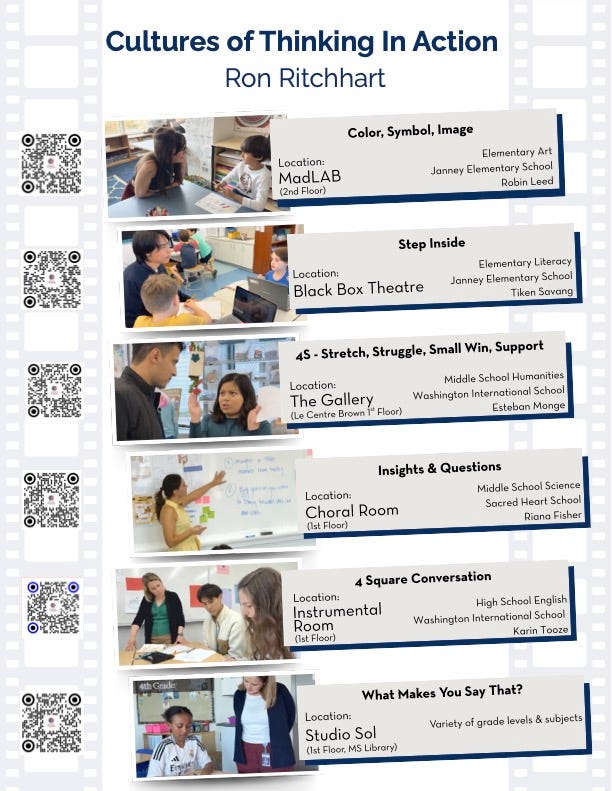
Suffice it to say that no one is asking that question at WISIT, where every day is stuffed with acronymic rituals and routines that teachers can deploy to help make their students’ thinking more visible.
A lot of that is due to the work of Ron Ritchhart, a longtime researcher at Project Zero whose many books on teaching and learning are ubiquitous on campus, and whose plenaries on subjects like “meta-strategic awareness” and “cognitive task analysis” felt like Must See TV for the WISIT faithful. “Who are our students becoming as thinkers and learners as a result of their time with us?” Ritchhart asked us during his opening remarks.
By Friday, every attendee was stuffed with strategies to answer that question with their students more effectively.
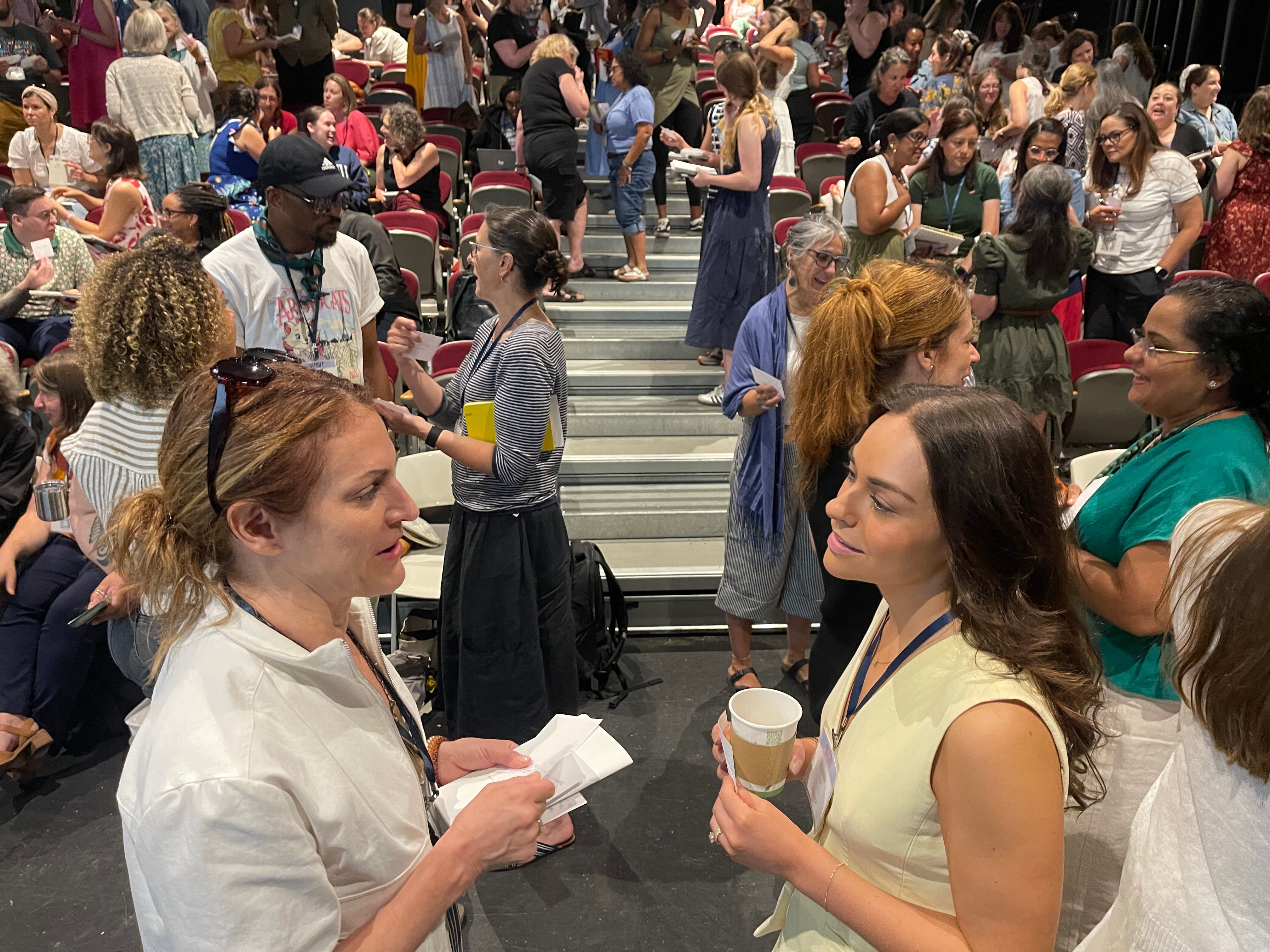
4. Ensuring a Diverse Mix of Perspectives -- WISIT would be a very different experience if it was just teachers from private schools, or elementary schools, or if it purely appealed to folks that only taught history or math. But part of what makes WISIT magical is its ability to attract educators from all of those categories: elementary, middle and high; public, charter, and private; teachers and school leaders, hailing not just from DC, Maryland and Virginia, but also Pennsylvania and New Jersey, Berlin and Shanghai.
“One of the things we believe deeply is that educators learn best when we get outside of our usual spaces,” Stephenson told me. “A public school teacher, an independent school leader, a museum educator, and a teacher from another country may approach the same question very differently. That difference makes everyone’s thinking richer. So we’re intentional about creating a community across schools, roles, grade levels, subjects, and geographies because no one group has all the answers. The more perspectives we bring to the table, the more possibilities we can imagine for our students.”
5. Nourishing the Participants -- Finally, what makes so many people return to WISIT for a full week every summer is the amount of care that is taken to tend to them, from the grounds (peaceful) to the meals (delicious) to the programming (relevant) to the coffee (hot!).
Beyond these physiological needs, WISIT made other choices that extend higher up Maszlow’s pyramid. Each day began with a slide show of the day before, reminding people what they experienced (and how they felt about it), and, literally, letting everyone feel seen and heard. Affinity groups were organized to foster meaningful connections at mealtime. And as an aggregate effect of all the aforementioned design principles, the people I spoke to left on Friday feeling reenergized rather than drained, and hopeful instead of overwhelmed. “I think I’ve used a lot of closed language before in my practice,” confessed Beatriz Huerta, a first-time attendee. “Now I feel like I know how to be more open moving forward, and why that matters so much.”
It was, in short, the best week of professional development I’ve ever experienced - albeit with a sticky creative tension, not yet resolved, at its root.
Fifteen years ago, when The Huffington Post was still a thing, I wrote a review of two celebrated books about teaching: Doug Lemov’s How to Teach Like a Champion and Parker Palmer’s The Courage to Teach.
“Can great teachers be reduced to, and developed by, a discrete set of tools and techniques?” I asked. “Or is teaching ultimately an art form so individualized, so magical and elusive, that it can never be codified?”
Ultimately, of course, this is a false choice. Good techniques are essential, and yet, as Palmer writes, “good teaching can never be reduced to routines, because it springs primarily from the identity and integrity of the teacher.”
I was reminded of this during my week at WISIT, which was awash with conversations about thinking routines, strategic activities, and classroom techniques -- an alluring focus to which Palmer would say, Beware.
“In every class I teach,” he explained, “my ability to connect with my students and connect them to the subject depends less on the methods I use than the degree to which I know and trust my selfhood -- and am willing to make it available and vulnerable in the service of teaching. Different teachers deploy different techniques, but for every great one, they infuse a strong sense of personal identity throughout their work.”
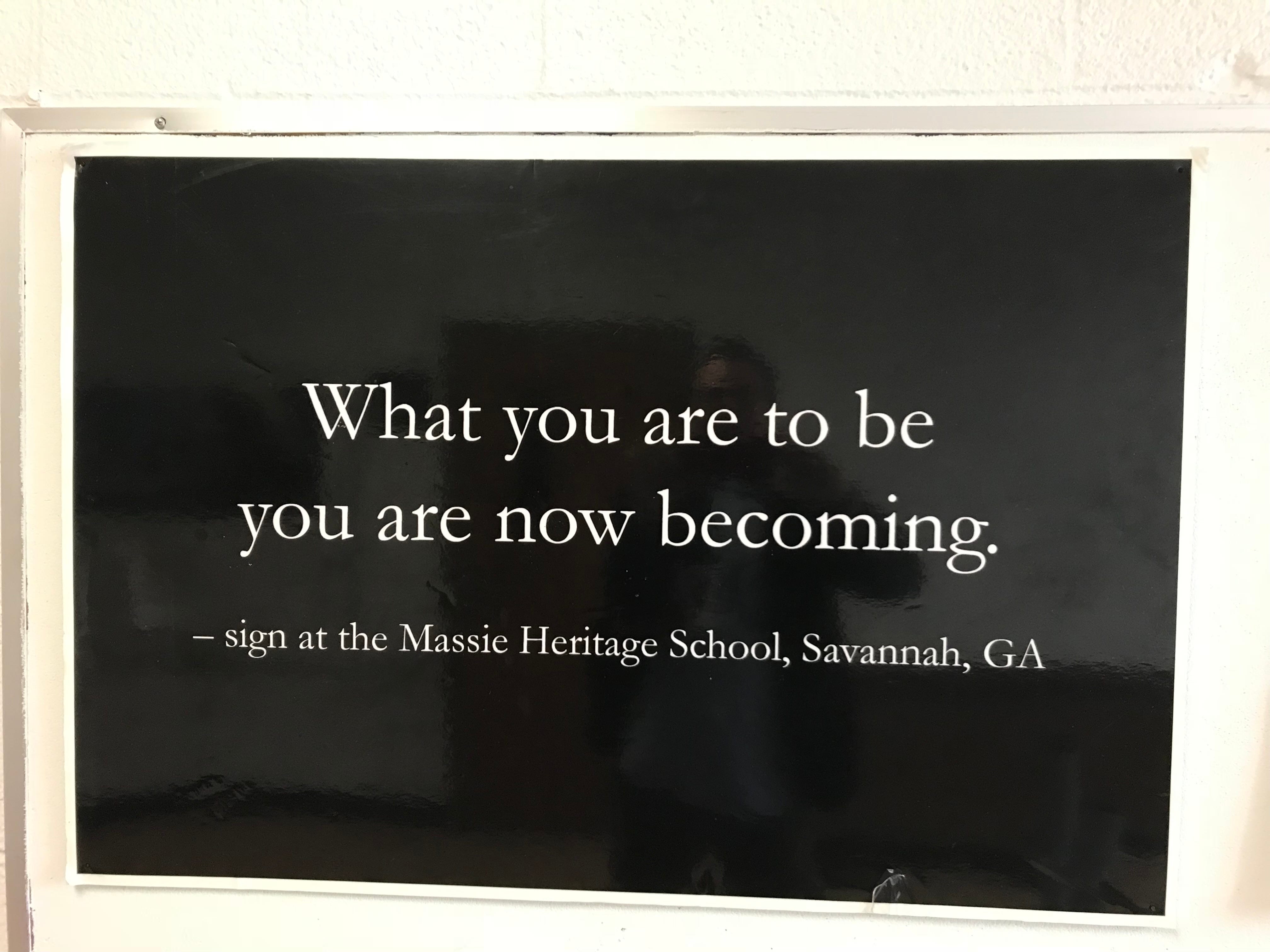
This is the understanding that was absent in Lemov’s book. It is missing in too many of the conversations I have with well-intentioned philanthropies or educational change organizations, whose love of linear logic has lured them into believing there is a discrete technical solution out there that will predictably transform a field whose primary inputs are adults, young people and the eternal messiness of human becoming.
That math will never add up, no matter how many Mckinsey studies or seven-figure grants suggest otherwise. And while the lessons of that inconvenient truth weren’t exactly missing at WISIT, they deserve a more central spot on next year’s stage.
Because, yes, as Lemov says, “great art relies on the mastery and application of functional skills, learned individually, through diligent study.”
And yes, as Palmer points out, “technique is what teachers use until the real teacher arrives.”
Comments
Nothing yet. Say the first thing.
Sign in to join the conversation.